Chadrack
In the last few months, I’ve heard some of my affiliate marketing friends and bloggers question if SEO plugins like Rank Math SEO are truly worth it in the face of what is happening in search.
You know, the way people search has changed. Google AI Overviews, ChatGPT, Gemini, and Perplexity can answer questions directly instead of simply presenting a page of blue links. And, these AI search engines prioritize entities, semantic depth, and citation-worthy content over exact-match keywords, which tools like Rank Math SEO are built around.
So, this shift has understandably left many bloggers, affiliate marketers, and WordPress site owners wondering whether their SEO plugin, such as Rank Math, still matters.
Of course, they do.
AI search engines do not create their answers from nowhere. They retrieve, interpret, and synthesize information from existing web content. That makes crawlability, clean technical SEO, structured data, semantic coverage, internal linking, and clear content structure more important – not less.
What has changed is how you use Rank Math.
Instead of treating Rank Math as a tool for chasing a perfect SEO score or inserting a focus keyword a certain number of times, you can use its AI-era features to strengthen the underlying information architecture of your website. Rank Math Content AI, schema tools, AI Link Genius, and AI Visibility move the plugin beyond basic on-page optimization.
In this article, you’ll learn why Rank Math remains relevant in 2026, how its features support AEO and GEO, where it falls short, and whether Rank Math Pro is worth paying for in the AI search era.
Key Takeaways
- Rank Math SEO remains relevant in 2026. AI search does not eliminate the need for technical SEO; it changes how that foundation is used.
- Traditional SEO and AI search optimization work together. Crawlability, indexation, structured data, internal linking, and accessible content give search and AI systems the information they need to discover and interpret your site.
- Rank Math has moved beyond keyword optimization. Content AI supports semantic optimization, while schema and internal linking help organize the relationships between your content and entities.
- AI Visibility adds a new layer of measurement. Instead of measuring only rankings and clicks, Rank Math can help you monitor how your brand appears in AI-powered search results.
- Rank Math is infrastructure, not a content strategy. A plugin cannot make thin or generic content genuinely useful or citation-worthy. Your expertise, originality, and ability to answer real questions still determine the quality of the information you publish.
- The goal is no longer a green SEO score. The goal is to build a technically sound, semantically connected website that can be discovered, understood, and cited by both traditional search engines and AI answer engines.
DISCLOSURE: WebIncomeJournal is supported by readers like yourself. We may earn an affiliate commission when you purchase through our links, which helps us offer our content for free. Learn more here.
Why Is Rank Math SEO Still Relevant in the AI Search Era?
Rank Math SEO remains relevant because AI search engines still depend on discoverable, crawlable, and technically accessible web content. Google AI Overviews and AI platforms such as ChatGPT, Gemini, and Perplexity may change how users consume search results, but they still need reliable web sources to retrieve information from.
The connection between traditional search and AI visibility is stronger than many site owners realize. Recent statistics indicate that more than 80% of sources appearing in Google AI Overviews already rank in top organic search positions. That means conventional SERP performance remains an important pathway to visibility in generative search.
This changes the question you should be asking.
Instead of asking whether traditional SEO is dead, ask whether your website is technically accessible enough for both search engines and AI systems to discover and interpret.
Traditional SEO Still Creates the Entry Point
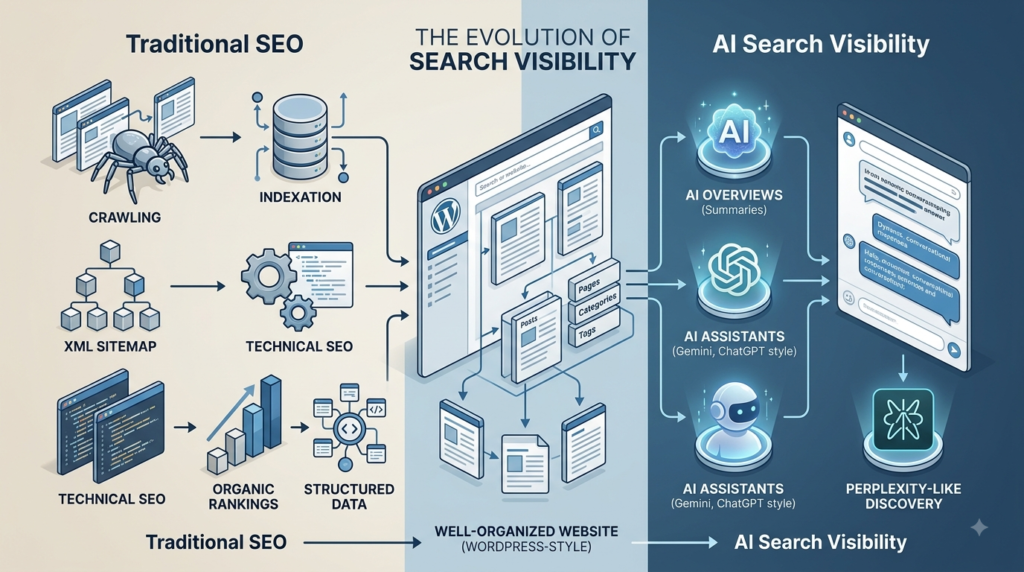
AI search engines cannot summarize content they cannot access. Before an LLM can interpret your article, the underlying web page must be discoverable, crawlable, indexable, and available to the systems retrieving web information.
That is where the technical side of WordPress SEO with AI assistance still matters. Rank Math handles core functions such as XML sitemaps, indexation controls, redirects, breadcrumbs, and other on-page SEO settings that help search engines understand and access your website.
Think of this as the first layer of AI search optimization:
- Crawlability allows search engines to reach your content.
- Indexation makes eligible pages available for retrieval.
- Structured data helps describe important entities and page types.
- Internal linking connects related information across your website.
- Clear content structure makes individual answers easier to identify and extract.
If that foundation is weak, adding AI writing tools will not fix the problem.
Rank Math’s Role Has Changed
The strongest case for Rank Math SEO with AI SEO tools is therefore not that the plugin somehow makes a page rank in ChatGPT. Its value is that it helps build the technical and semantic foundation from which search visibility can develop.
Rank Math now combines traditional SEO functions with features such as Content AI, AI Link Genius, schema generation, and AI Visibility (core tools among modern AI SEO tools for affiliate marketers). Together, these capabilities address several requirements of modern search, including semantic SEO, topical authority, structured content, and monitoring brand mentions in AI search.
So, the green SEO score is no longer the main objective.
The real objective is to create a website that search engines can crawl, understand, connect, and retrieve. That makes Rank Math less of a keyword checklist and more of an AI-driven on-page SEO infrastructure layer for WordPress.
How Does Rank Math SEO Stay Relevant Against AI Search Engines?
Rank Math SEO stays relevant against AI search engines because it shifted its focus from exact-match keywords to entity optimization. The modern search landscape doesn't reward you for repeating a focus keyword five times anymore. AI platforms like ChatGPT, Gemini, and Google AI Overviews evaluate content by mapping connections between real-world concepts, brands, and products, a process closer to building a knowledge graph than scanning for keyword density.
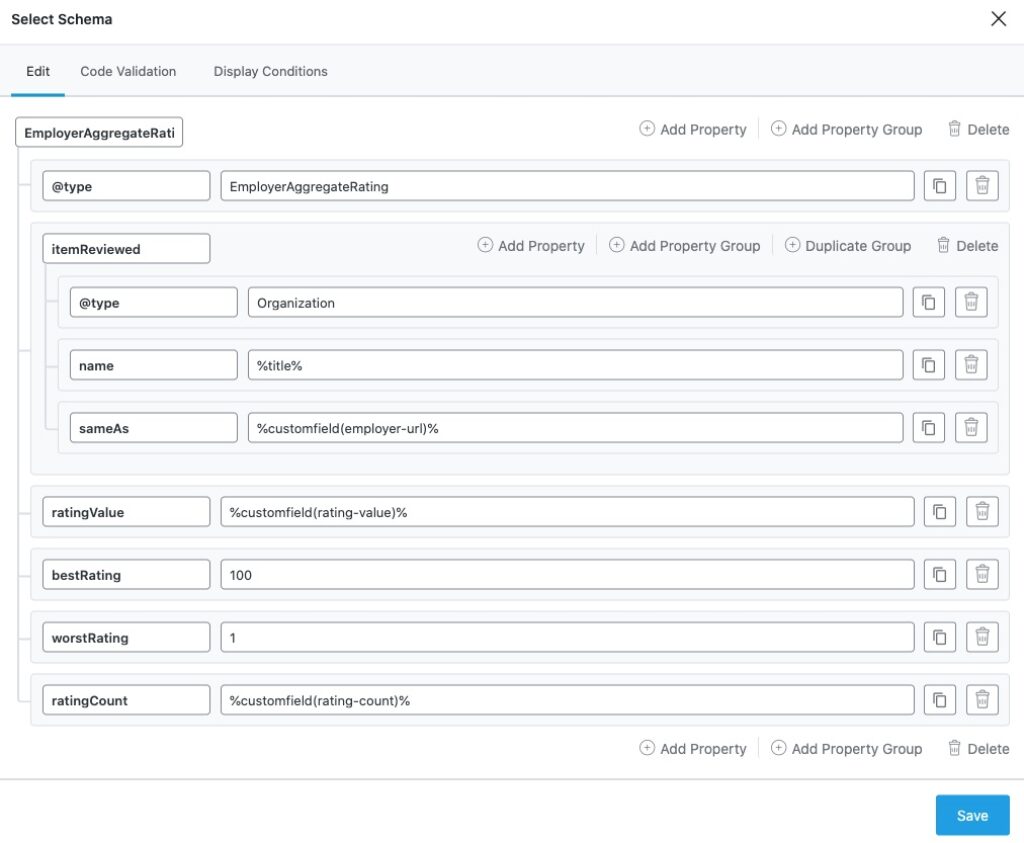
This is entity SEO, and it's the layer most legacy SEO advice still ignores. Instead of asking “did I use my focus keyword enough,” the better question is “does this page clearly define what it's about, who wrote it, and how it connects to related concepts?” Rank Math answers that question through schema markup, using Schema.org structured data to make those connections explicit for machines.
You don't need to write a single line of code to do this. Rank Math's Schema Generator translates your written paragraphs into machine-readable formats that LLMs can parse directly, defining your content entities instead of leaving a bot to guess at them.
How to Map Entities with Rank Math Schema
- Open the Rank Math Schema Generator directly inside your WordPress post editor.
- Replace generic configurations with specific schema types like Product, FAQ, or Course schema instead of a default Article type.
- Manually fill out every metadata field, including specific author profiles and publisher data, to validate your E-E-A-T trust signals.
- Run the custom code validator to confirm the raw HTML executes cleanly for external scrapers, including AI crawlers.
Skipping step three is the most common mistake I see. A generic “Admin” author byline tells Google and AI Overviews nothing about who's behind the content, and thin trust signals are exactly what keeps otherwise solid pages out of AI citations.
What Is the Role of Rank Math Content AI in Generative Optimization?
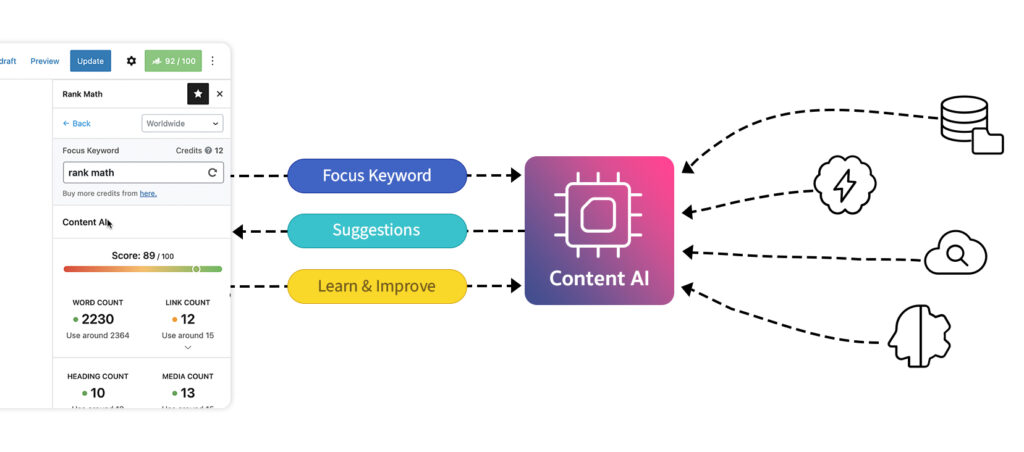
Rank Math Content AI's role in generative optimization is building complete topical clusters instead of encouraging keyword stuffing. The module uses natural language processing to analyze the broad semantic landscape around your topic, then outputs related terms, secondary questions, and context words you'd otherwise miss.
This matters because conversational engines don't quote pages that half-answer a topic. They pull from content that reads as comprehensive. Content AI gets you there by scanning the top 20 ranking pages for your target keyword and surfacing the semantic keywords, recommended word count, and heading structure those pages share.
Under the hood, Content AI packs in more than 40 AI writing and optimization tools plus over 125 curated prompt templates for specific SEO tasks, from meta descriptions to full outlines [Rank Math]. Free users get 750 Content AI credits a month, roughly one credit per word of AI output, which is enough to test the workflow before committing to a paid tier.
A Practical Semantic Writing Workflow Using Content AI
- Enter your main concept into the Content AI research panel.
- Extract the recommended list of question phrases and secondary terms it generates.
- Structure your headings as direct questions using those exact phrases.
- Write immediate, single-sentence answers directly below those headings to optimize for featured snippets and AI summaries.
That fourth step is the one bloggers skip. Most writers still bury the answer three paragraphs into a section because that's how old-school SEO writing trained us. Conversational AI engines don't wait that long. They pull the first clear sentence they find, so if your answer isn't sitting right below the heading, you're handing that citation to a competitor who formatted theirs correctly.
How Do You Use the Rank Math AI Visibility Tool to Track Citations?
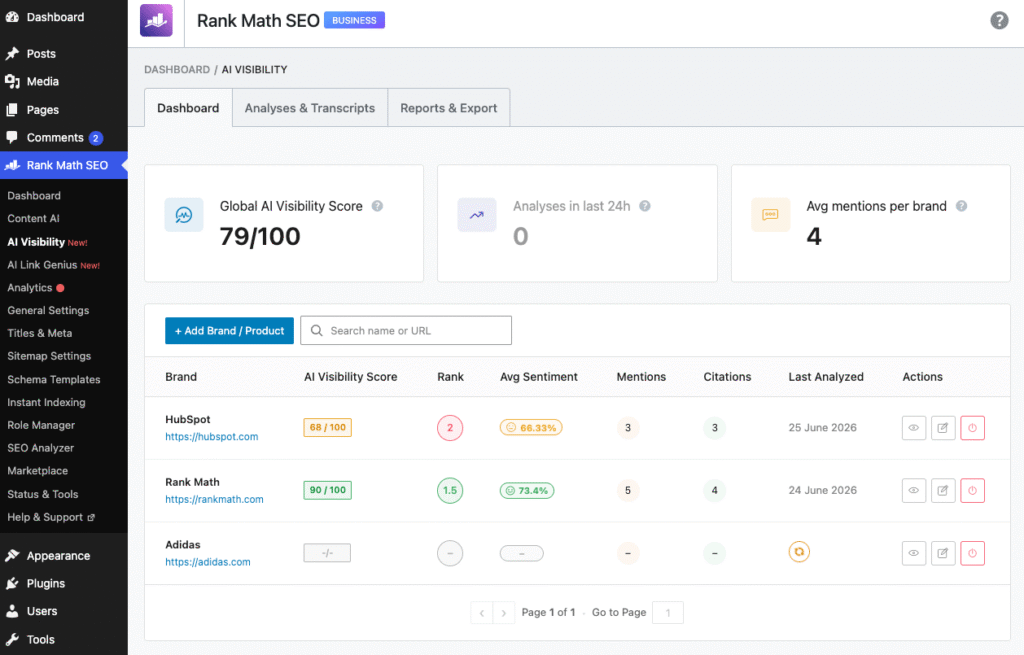
You use the Rank Math AI Visibility tool to track citations by enabling the module and monitoring which conversational queries trigger your brand's mention across AI platforms. The major challenge of modern optimization isn't ranking anymore. It's knowing whether AI systems actually recommend your business when someone asks.
Traditional click tracking can't answer that question. Someone might read a full AI-generated answer that cites your site, get their question resolved, and never click through. You'd see nothing in Google Analytics, yet the citation still built brand trust. Rank Math's AI Visibility module closes that blind spot by tracking how often your site appears in responses from ChatGPT, Gemini, Perplexity, and Google AI Overviews.
Actionable Implementation Guide
- Turn on the AI Visibility module in your main Rank Math dashboard settings.
- Monitor the prompt tracking report to see the specific conversational queries triggering your brand mentions.
- Review the sentiment analysis score to verify that AI models describe your products favorably, not just accurately.
- Analyze the citation share metrics to find out which third-party pages are feeding data to the LLMs, so you know who to target for brand mentions.
That fourth step is where the real strategic value sits. If a competitor's roundup post is the one feeding ChatGPT its answers about your niche, you now know exactly where to pitch a guest mention or build a relationship. AI Visibility turns citation tracking from a guessing game into a targeted outreach list.
Why Are Internal Link Tools Critical for Language Model Crawlers?
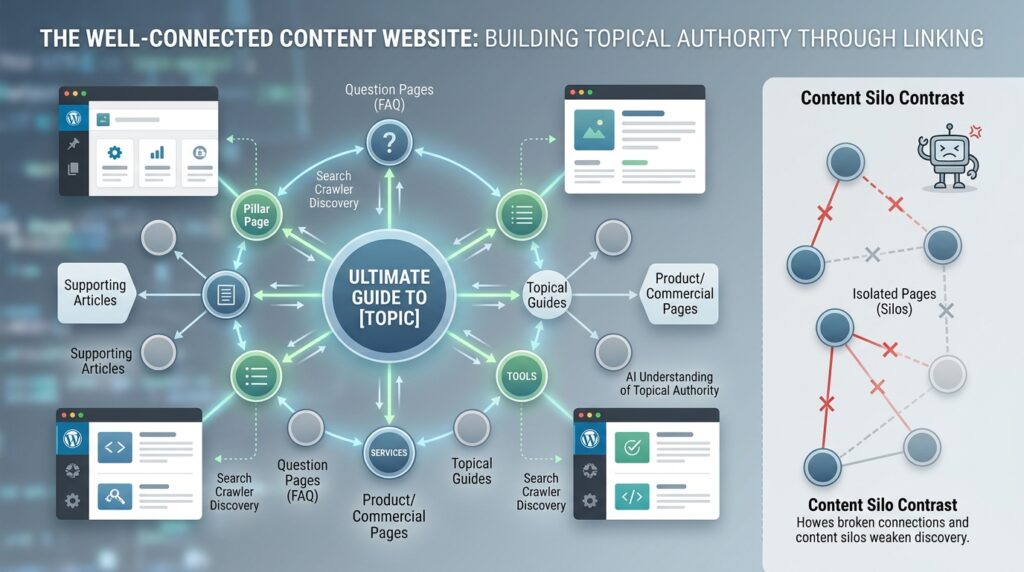
Internal link tools are critical for language model crawlers because AI search engines run query fan-out protocols, crawling related pages simultaneously to build broad context around a single question. If your site is a collection of isolated pages with no connective structure, these bots can't map your expertise. They see fragments, not authority.
This is how internal link silos quietly destroy AI visibility. A single strong article on its own rarely earns a citation. What earns a citation is a cluster of pages that all point to each other, signaling depth on a topic rather than a one-off post.
Rank Math's real-time internal linking suggestions solve this at the editorial level. As you write, the plugin's link suggestions block prompts you to connect relevant articles automatically, without requiring you to remember every related post you've published. This creates a clean data web that lets AI scrapers verify your entire topical footprint in a single crawl.
The practical move is keeping data flowing between your informational and commercial pages. Link your “how-to” content toward your product or service pages, and link those pages back to supporting guides. That two-way structure is what tells an AI crawler you're not just publishing content. You're building topical authority.
What Are the Content Gaps Rank Math Doesn't Solve — and What Should You Do Instead?

Rank Math doesn't solve the content gap that matters most: it can't write genuinely citation-worthy, insightful content for you. Schema markup, internal linking, and a real-time SEO score are infrastructure. They get your content in front of crawlers and organized for entities. None of that decides whether the content is actually worth citing.
AI engines increasingly favor pages with a clear point of view, original data, or firsthand experience over generic summaries that repeat what's already ranking. A perfectly configured schema on a shallow, recycled article won't out-cite a plainly formatted post backed by real expertise. Insightful content is the norm AI search now rewards, not the exception.
So what should you do instead? Treat Rank Math as necessary infrastructure, not a sufficient strategy on its own. Use its technical tools to remove every barrier between your writing and the crawler. Then spend your actual creative energy on the parts no plugin can automate: original testing, specific numbers from your own results, and opinions you're willing to defend. The plugin gets you discovered. Your judgment gets you quoted.
What Are the Biggest Mistakes Bloggers Make with Rank Math Today?
The biggest mistake bloggers make with Rank Math today is optimizing for the plugin's own scoring system instead of for AI search engines. Here are the seven patterns I see most often.
- Chasing green scores. A 100/100 SEO score confirms you hit checklist items. It says nothing about whether ChatGPT would quote your paragraph.
- Over-optimizing keywords. Repeating a focus keyword to satisfy an old-school density rule now reads as noise to entity-based AI models.
- Ignoring entities. Skipping schema and structured data leaves your content's real-world connections undefined for LLMs to interpret on their own.
- Weak internal linking. Publishing isolated posts with no connective structure prevents AI crawlers from mapping your topical authority in one pass.
- Thin AI-generated content. Running Content AI's suggestions with zero personal edit or original insight produces exactly the generic content AI engines now deprioritize.
- Neglecting schema. Leaving the Schema Generator on default Article settings wastes one of Rank Math's strongest AI-era features.
- Measuring only rankings. Tracking SERP position while ignoring the AI Visibility dashboard means missing half your actual performance picture.
Every one of these mistakes shares the same root cause: treating Rank Math as a scorecard to please instead of a toolkit built to feed AI systems accurate, well-structured data.
Is It Worth Paying for Rank Math PRO in 2026?
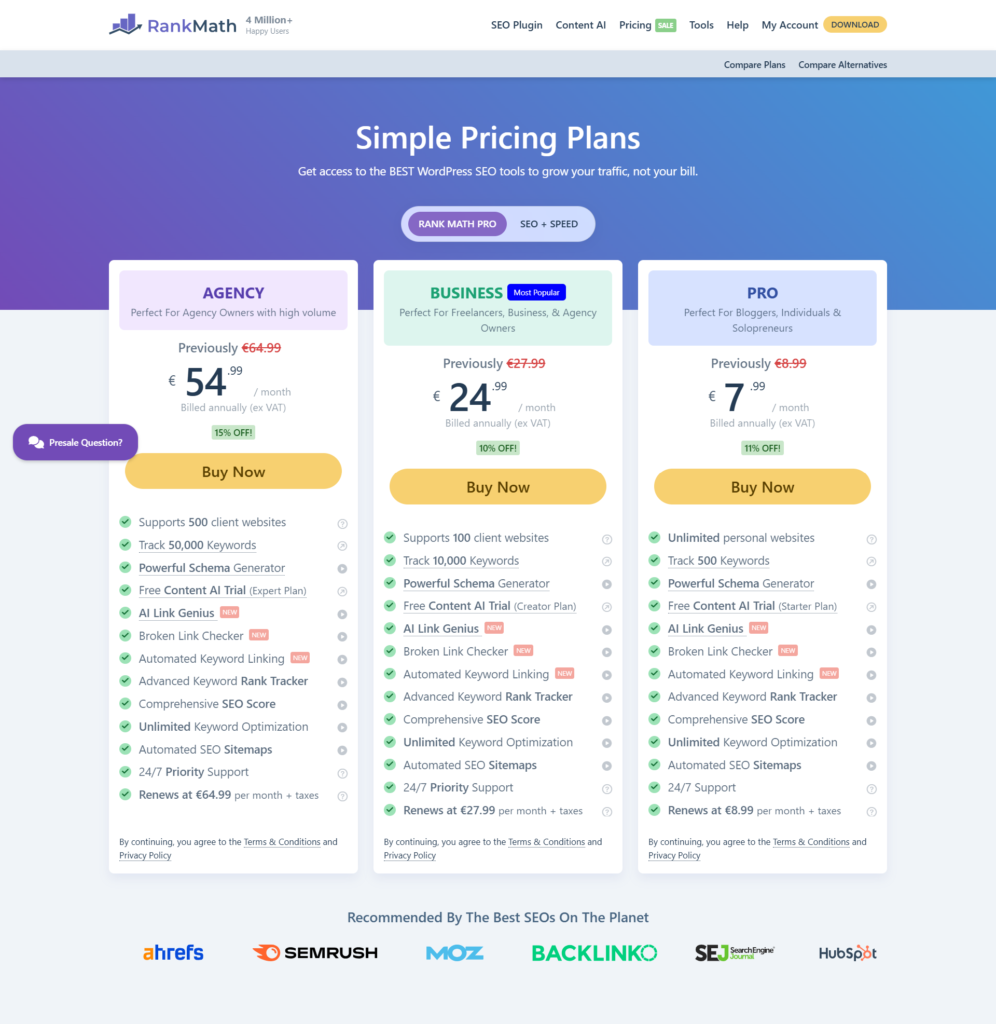
Rank Math PRO is worth paying for in 2026 if you're publishing content regularly and need AI Visibility, advanced schema, or Content AI at scale. The free version already covers up to 5 focus keywords per post, 16+ schema types, and basic Content AI credits, which is generous compared to Yoast's free tier. Pro unlocks 840+ advanced schema types, deeper Content AI limits, and full access to AI Visibility and AI Link Genius.
Who benefits most depends on how you use the site. Bloggers publishing a few posts a month can often run on the free tier plus a small Content AI add-on. Affiliate marketers and small businesses juggling product schema, comparison content, and commercial-intent pages get real ROI from Pro's advanced schema library alone. Agencies managing multiple client sites benefit most from AI Visibility, since tracking citation share across ChatGPT, Gemini, and Perplexity for several brands at once is difficult to do manually.
Rank Math Pro runs around $83.88 a year, roughly $6.99 a month, positioning it as a low-cost AI SEO stack compared to buying separate AI writing and SEO tools. For anyone monetizing a site, that's a reasonable line item, not a luxury.
Conclusion: How Should You Adapt Your WordPress SEO Strategy?
AI search does not mean you should uninstall your WordPress SEO plugin and abandon traditional optimization. It means you need to change what you expect that software to accomplish.
Stop treating a perfect 100/100 content score as the definition of optimized content. That score can tell you whether you've addressed certain technical and on-page recommendations, but it cannot tell you whether your article contains original insights, useful experience, or information worth citing.
Instead, use Rank Math as infrastructure.
Use it to keep your HTML clean, organize relevant schema, strengthen your internal linking structure, manage redirects and technical SEO, and monitor the signals that matter as search evolves.
Then build the layer that software cannot provide: genuinely insightful content that answers questions better than competing pages.
Your WordPress SEO strategy in 2026 should therefore combine technical infrastructure + topical authority + original insight + measurement across traditional and generative search.
Indeed, Rank Math SEO is still relevant in the AI search era because it never stopped being the plumbing underneath your content. What changed is what that plumbing needs to deliver.
Frequently Asked Questions
u003cstrongu003eIs Rank Math good for AI SEO?u003c/strongu003e
Yes, Rank Math is good for AI SEO. The plugin provides schema markup, semantic keyword suggestions, and technical SEO tools that AI search engines use to identify and cite content. Content AI adds NLP-driven optimization for topical depth. The new AI Visibility module tracks citations directly across ChatGPT, Gemini, and Perplexity.
u003cstrongu003eDoes Rank Math support AEO and GEO?u003c/strongu003e
Yes, Rank Math supports both Answer Engine Optimization (AEO) and Generative Engine Optimization (GEO). Schema markup helps AI models parse content entities correctly. Content AI structures answers for direct extraction by conversational engines. The AI Visibility module measures how often AI platforms cite or mention your content, which is a core GEO metric.
u003cstrongu003eWhat is the difference between Rank Math AI Visibility and traditional rank tracking?u003c/strongu003e
Traditional rank tracking measures your position on a Google search results page. AI Visibility measures how often AI platforms like ChatGPT and Gemini cite or mention your brand in their generated answers. Traditional tracking uses click and impression data. AI Visibility uses citation frequency, sentiment analysis, and prompt-level tracking instead.
u003cstrongu003eDo I still need to do keyword research in 2026?u003c/strongu003e
Yes, keyword research is still necessary in 2026. AI search engines still rely on entity recognition and topical relevance, both of which depend on identifying the right terms and questions to target. The method has shifted from exact-match keyword density toward semantic keyword clusters and question-based phrases. Tools like Rank Math's Content AI now handle this research automatically.
u003cstrongu003eIs Rank Math better than Yoast or AIOSEO for AI search?u003c/strongu003e
Rank Math offers deeper AI-specific tooling than Yoast for AI search, including 40+ Content AI tools and a dedicated AI Visibility dashboard that Yoast lacks as of 2026. Compared to AIOSEO, Rank Math and AIOSEO both offer AI citation tracking, but Rank Math provides broader schema coverage and more prompt templates. The better plugin depends on your specific workflow and budget.



![The Rank Math AI Visibility Review You Need to Read [Worth It In 2026?]](https://webincomejournal.com/wp-content/uploads/2026/07/Rank-Math-AI-Visibility-Review-Hero-Image-336x220.png)