
 Chadrack
[EDITOR’S NOTE: This post was first published in 2024 but since then most of the tools reviewed had undergone a lot of changes, hence this update. We have completely rewritten the post, removed some of the tools and added others. Instead of the 8 tools that were reviewed in the 2024 version, we have only included 7 in this version.]
SEO AI copywriting tools combine artificial intelligence with features designed to help create, optimize, and manage search-focused content. Unlike a general AI writing tool, a dedicated SEO platform may also provide keyword research, search-intent analysis, content optimization, SERP insights, internal-linking support, content refresh workflows, or visibility tracking across AI search platforms.
In the last few years, the category has changed significantly. Today's tools are increasingly moving beyond “write me a blog post” toward complete content workflows that cover research, briefing, creation, optimization, publishing, and monitoring.
In this guide, we'll compare seven leading options: Writesonic, Jasper, Copy.ai, Rank Math Content AI, RankIQ, ChatGPT, and Rank.ai. You'll see what each tool does well, where it falls short, who it is best suited for, and how its capabilities fit the needs of bloggers, affiliate marketers, WordPress publishers, and content teams.
The goal isn't to identify one tool that is best for everyone. It's to help you choose the SEO AI copywriting tool that fits the way you actually create and manage content.
Key Takeaways
- Writesonic stands out for combining SEO content creation with AI-search visibility.
- Jasper is better suited to marketing teams and advanced content workflows.
- Copy.ai focuses heavily on AI-powered workflows and automation.
- Rank Math Content AI is a strong choice for WordPress users who want SEO and AI in one workflow.
- RankIQ remains focused on bloggers and organic-search content optimization.
- ChatGPT offers the most flexible general-purpose research and writing workflow.
- Rank.ai targets publishers looking for automated SEO content and AI-search visibility.
- The best choice depends on your SEO requirements, publishing workflow, budget, and desired level of automation.
DISCLOSURE: WebIncomeJournal is supported by readers like yourself. We may earn an affiliate commission when you purchase through our links, which helps us offer our content for free. Learn more here.
The 7 Best SEO AI Copywriting Tools at a Glance
The best SEO AI copywriting tools in 2026 are not interchangeable. Some are complete SEO content platforms, some are AI writing and workflow platforms, some are built directly into WordPress, and others focus heavily on bloggers and organic search.
| Tool | Best for | SEO capabilities | AI-search capabilities | WordPress | Free option/trial | Starting price* |
| Writesonic | SEO content + AI-search visibility | Keyword/content research, optimization, site audits, AI articles | ChatGPT, Gemini, Google AI Overviews tracking | Yes | Free trial | $79/mo annually |
| Jasper | Marketing teams and advanced AI workflows | SEO agents, content workflows, optimization, research | GEO-focused agents and workflows | Via integrations | 7-day trial | $59/mo annually |
| Copy.ai | AI-powered content workflows | SEO article workflows, research, content generation | Indirect/workflow-based | Via integrations | Trial/options vary | $24/mo annually |
| Rank Math Content AI | WordPress SEO + AI | Keyword suggestions, optimization, SEO analysis, internal links | AI Visibility features | Native | Free trial/limited access | Included with Rank Math plans; plan pricing varies |
| RankIQ | Bloggers focused on organic search | Keyword research, content briefs, content optimization | AEO/GEO and AI Overview features through Aided | Not WordPress-native | Current offer available | $99/mo RankIQ standard; current bundle offers may differ |
| ChatGPT | Flexible SEO research and writing | Requires external SEO data and workflow | Search and research capabilities | No native SEO plugin workflow | Free plan | $20/mo Plus |
| Rank.ai | Automated SEO + AI-search workflows | Research, content generation, publishing, rank tracking | ChatGPT, Claude, Gemini tracking | Yes | Free plan | $0; paid plans from $50/mo |
*Pricing and plan features can change. Verify the vendor's current pricing before subscribing. Current published pricing shows Writesonic's Starter plan at $79/month when billed annually, Jasper Pro at $59/month annually, Copy.ai Chat at $24/month annually, ChatGPT Plus at $20/month, and Rank.ai's Basic plan at $0/month. RankIQ currently displays promotional bundle pricing alongside its standard product pricing, so promotional rates should not be treated as permanent pricing.
These tools solve different problems. Writesonic and Rank.ai lean toward broader SEO and AI-search workflows, while Jasper and Copy.ai are stronger examples of AI writing platforms that can support larger marketing processes. Rank Math Content AI takes a different approach by putting AI-assisted SEO directly inside the WordPress workflow.
RankIQ is particularly focused on bloggers and organic search, while ChatGPT is a general AI platform rather than dedicated SEO software. That distinction matters because a flexible AI writing assistant can produce excellent research, outlines, drafts, and edits, but it does not automatically provide the keyword research, SERP analysis, content scoring, or SEO workflow found in specialized platforms.
The goal, therefore, is not to find the tool with the longest feature list. It is to identify which platform best solves the specific stage of your SEO content workflow.
Worth Reading: How I Monetize My Affiliate Blogs with AI Products (2026 Guide)
How We Evaluated the Best SEO AI Copywriting Tools
We evaluated these SEO AI tools according to how well they support the complete content workflow, rather than simply how quickly they generate text. The framework covers research, creation, optimization, AI-search readiness, updating, publishing, and overall value.
We also considered the needs of bloggers, affiliate marketers, WordPress publishers, content teams, and marketers who need to manage content at scale.
SEO Research
A useful SEO copywriting tool should help you understand what people are searching for and what successful pages already cover. We looked at keyword research, search-intent analysis, SERP analysis, competitor content analysis, related keywords, topic coverage, and content-gap opportunities.
Research matters because an AI content generator can produce a polished article from a poor brief. Better tools help establish the strategy before the writing begins.
Content Creation
We assessed how effectively each platform handles AI-assisted content creation, from outlines and individual sections to complete articles and marketing copy.
The important question is not simply whether a tool has an AI writer. We considered whether it can turn research and search intent into a useful content structure while giving the writer enough control to add original expertise, examples, sources, and opinions.
Content Optimization
SEO content optimization involves more than inserting a primary keyword. We looked for features such as semantic keywords, topical coverage, heading optimization, metadata suggestions, internal linking, readability analysis, and content or SEO scores.
A content score can be useful as a quality-control signal, but it is not a ranking guarantee. The strongest workflow uses optimization recommendations to identify gaps without allowing a score to dictate every sentence.
AI-Search Readiness
Search visibility increasingly extends beyond traditional Google results. We therefore considered how each tool addresses AEO, GEO, AI Overviews, and visibility in AI-generated answers.
This includes capabilities such as AI-search tracking, question monitoring, entity coverage, content recommendations, and visibility analysis. The category is still developing, so these capabilities vary considerably between platforms.
Content Refreshing
A strong SEO content workflow does not end when an article is published. Existing pages can lose relevance as search intent changes, competitors publish better information, products change, and new search features appear.
We therefore considered whether each tool can help identify outdated content, find optimization opportunities, update existing pages, and strengthen content using current search data.
Workflow and Automation
We looked at how much repetitive work each platform can remove from the content process. Relevant capabilities include AI content briefs, automated research, content workflows, agents, integrations, bulk operations, publishing, and monitoring.
The best automation should reduce manual work without removing editorial control. Human review remains necessary for factual accuracy, original insight, product claims, and content quality.
WordPress Compatibility
For bloggers and affiliate publishers, WordPress integration can significantly change the usefulness of an SEO AI tool. We considered whether each platform works directly inside WordPress, connects to WordPress, or requires content to move between separate systems.
Native integration can make a difference when the workflow includes writing, SEO analysis, internal linking, updating, and publishing.
Price and Overall Value
Finally, we considered what users actually receive for the subscription cost. This includes feature depth, usage limits, workflow savings, SEO capabilities, AI-search features, integrations, and suitability for the user's publishing volume.
Price alone does not determine value. A $20 general AI subscription may be enough for an individual blogger, while a content team publishing at scale may benefit from paying considerably more for automation, collaboration, SEO research, and monitoring.
At this point let me quickly say that none of these tools scored perfectly across all eight. Picking the right SEO copywriting software therefore depends on which of these eight jobs is your current bottleneck.
That being said, let’s jump into the individual tools.
1. Writesonic – Best for SEO Content + AI Search Visibility
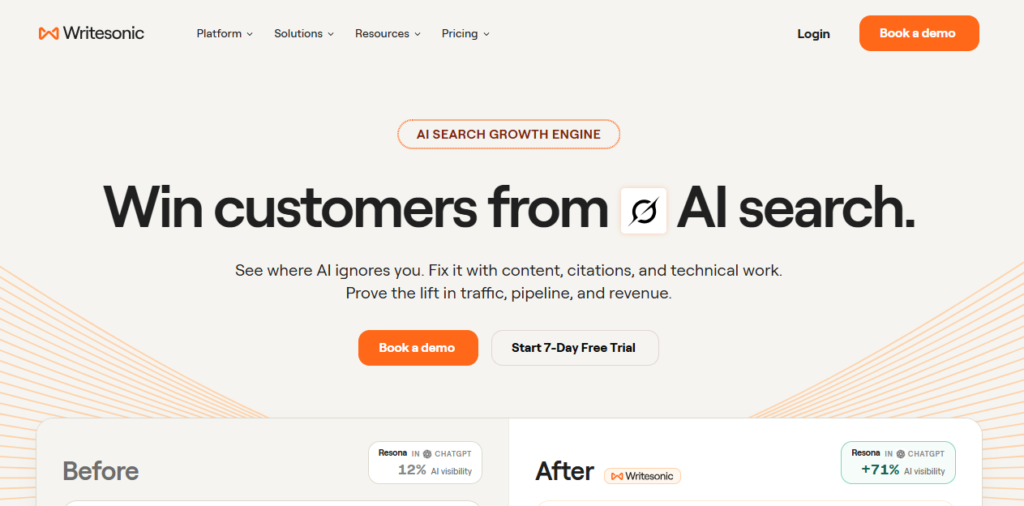
Writesonic is an AI content and SEO platform that combines content creation, SEO workflows, site auditing, and AI-search visibility in one platform. It earns its position here because it addresses both sides of modern search: creating and optimizing content for Google while monitoring how a brand appears in AI-generated answers. Its current platform tracks visibility across ChatGPT, Gemini, and Google AI Overviews.
Key SEO Features
- AI Article Writer with keyword and competitor research pulled from Google Keyword Planner and Ahrefs
- SEO Checker and Optimizer for live content scoring, keyword density, and heading structure
- Site audits that flag technical issues (broken schema, crawl errors) blocking both search engines and AI crawlers
- GEO tracking across ChatGPT, Gemini, and Google AI Overviews, with an Action Center that turns visibility gaps into specific fix tasks
What Writesonic does well
Writesonic's strongest advantage is the connection between SEO content production and AI visibility tracking. Instead of treating AI search as a separate reporting exercise, the platform puts traditional SEO content and emerging AI-search workflows within the same product.
This makes it particularly useful for publishers who want to create content, identify visibility gaps, audit their site, and monitor how their brand is represented in AI answers.
Where Writesonic falls short
Writesonic's breadth can make it more than an individual blogger needs. The Starter plan also limits users to 15 AI articles and 10 site audits per month, while more advanced AI-search and workflow capabilities require higher plans.
That makes the platform harder to justify if you mainly need an AI writing assistant and already have separate SEO tools.
Pricing
As of September 2026, Writesonic's published annual pricing starts at $79/month for Starter, with Basic at $199/month and Growth at $399/month. Starter includes a free trial, 15 AI articles per month, 10 site audits, and AI visibility tracking across ChatGPT, Gemini, and Google AI Overviews.
Best for
Writesonic is best for content marketers, SEO-focused publishers, agencies, and businesses that want SEO content creation and AI-search visibility in one platform.
Our verdict
Writesonic is one of the strongest choices when your definition of SEO now includes both traditional search and AI search. Its combination of content, site auditing, GEO-oriented capabilities, and AI visibility tracking gives it a broader workflow than a conventional AI writer.
If AI-search visibility is becoming part of your SEO strategy, explore Writesonic's current plans and AI visibility features before choosing an SEO AI copywriting platform.
Recommended: 10 Best Email Marketing Tools for Affiliate Marketers: AI-Powered Options Ranked (2026)
2. Jasper – Best for Marketing Teams and Advanced AI Workflows
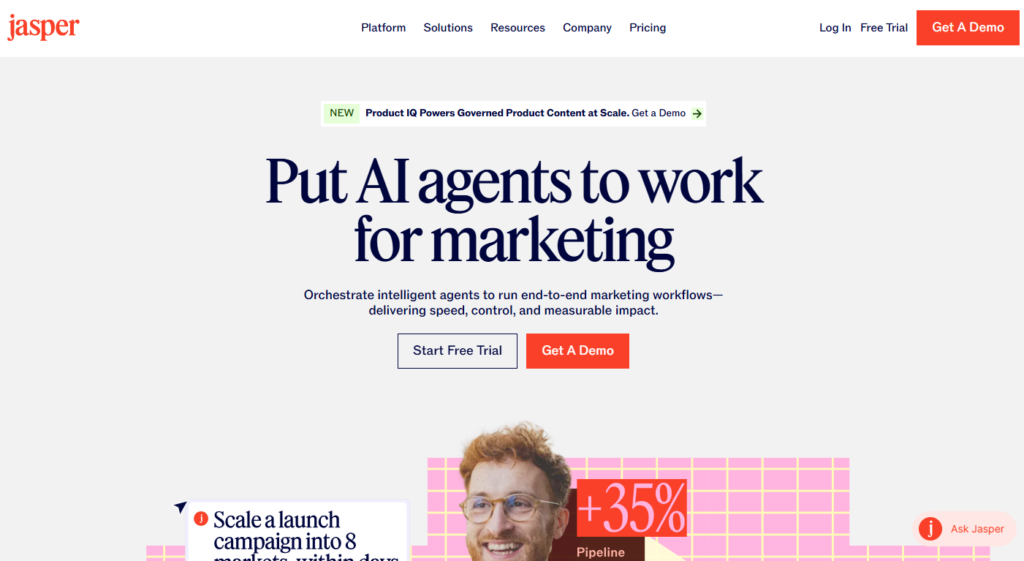
Jasper is an AI marketing platform designed around marketing workflows, brand consistency, and AI agents, rather than simply generating individual pieces of copy. Its current platform includes agents for SEO and GEO content, research, campaign execution, and other marketing tasks. That makes Jasper particularly relevant to teams managing content across multiple channels and campaigns.
Key SEO and AI-Search Features
- SEO Mode, integrated with Surfer SEO, for real-time keyword scoring while drafting
- Marketing Agents that can research a topic, plan a content calendar, or optimize an existing article for SEO
- Instant Campaigns that generate a full asset set (blog post, social captions, ad copy) from one brief
- Jasper also includes Brand Voice, Knowledge, Audiences, and Style Guide capabilities. Brand Voice can be created from examples of existing content and applied across Chat, the document editor, and Agents.
What Jasper does well
Jasper's biggest strength is context. A marketing team can give the platform brand information, audiences, knowledge, and brand voice, then use that context across multiple marketing workflows.
Its combination of AI agents, brand controls, research, SEO, GEO, and content templates makes it better suited to repeatable team processes than a basic AI copywriting tool.
Limitations
Jasper is primarily a marketing platform, so its breadth can be excessive for a solo blogger who only needs help researching and drafting articles. Advanced capabilities also sit within a more complex pricing structure, particularly as Jasper uses credits for certain premium features such as research and optimization agents and GEO tools.
Pricing
As of September 2026, Jasper Pro costs $69 per month when billed monthly or $59 per month when billed annually, with a 7-day free trial. Business pricing is custom, and advanced usage can involve credits depending on the feature.
Best for
Jasper is best for marketing teams, agencies, and businesses that need consistent brand voice, repeatable marketing workflows, and advanced AI-assisted content operations.
Our verdict
Jasper is more than an AI article writer. Its real value comes from combining brand voice, marketing workflows, AI agents, SEO, and GEO into a controlled content-production environment. For a solo affiliate blogger, it may be more platform than necessary, but for a marketing team, that depth can be the point.
If brand consistency and repeatable marketing workflows matter as much as content generation, try Jasper's 7-day free trial and evaluate its current SEO, GEO, and AI-agent capabilities.
3. Copy.ai – Best for AI-Powered Content Workflows
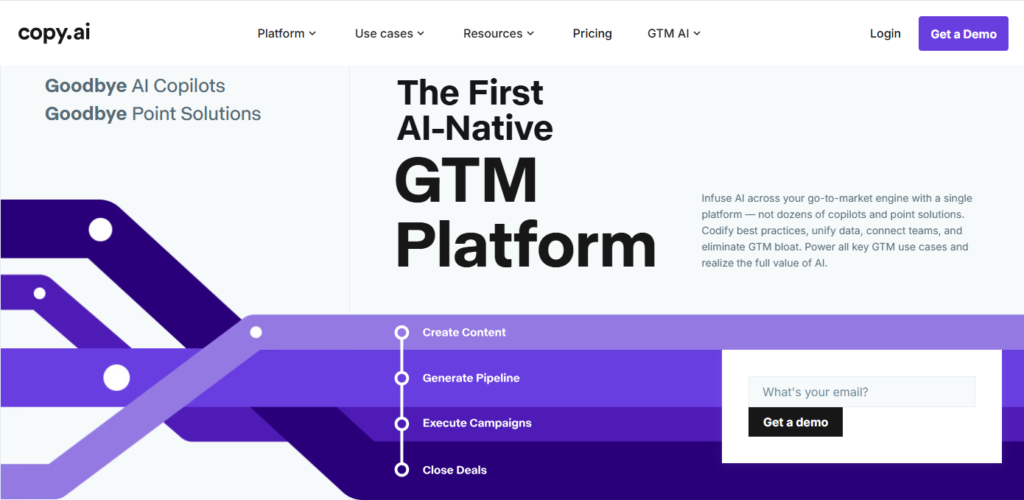
When I reviewed Copy.ai back in 2024, it was mainly a typical AI copywriting tool. But today, it has evolved greatly beyond that. Its current platform is built around customizable AI workflows that can combine research, content generation, optimization, and other actions into repeatable processes. For SEO teams, that makes Copy.ai particularly useful when the problem is not simply writing one article but scaling a consistent content workflow.
Key SEO/content capabilities
Copy.ai supports SEO content briefs, keyword research, content generation, and on-page SEO workflows. Its current SEO workflows can research a target keyword, analyze competing content, build a content brief, and turn that brief into a long-form draft. Copy.ai also documents workflows for internal linking, external sourcing, and content repurposing.
Workflow and automation
Workflows are the platform's biggest differentiator. You can turn a repeatable SEO process into a sequence of AI-powered actions rather than recreating the same prompt every time. Copy.ai describes workflows as processes that can combine research, content generation, and tool integrations, making them useful for scaling SEO production across a team.
What Copy.ai does well
Throughout our test, we discovered that Copy.ai is strongest when you have a defined process that needs to be repeated. It can help automate research and drafting while also supporting content refreshes and repurposing. Its workflow approach also makes it possible to connect SEO content production with broader marketing operations rather than treating every article as an isolated task.
Limitations
The biggest limitation for a solo blogger is complexity and cost at higher workflow volumes. Copy.ai's most substantial workflow capabilities are aimed at businesses and teams, while the lower-priced Chat plan is primarily positioned around AI chat rather than unlimited workflow automation. You also need to design and maintain workflows carefully; automation does not remove the need for editorial judgment.
Pricing
As of September 2026, the Chat plan costs $29/month when billed monthly or $24/month when billed annually. Workflow-focused Growth starts at $1,000/month with 20,000 workflow credits, while Expansion and Scale cost $2,000 and $3,000/month respectively. Workflow runs consume credits based on the complexity of the tasks performed.
Best for
Copy.ai is best suited to content teams, agencies, and businesses that want to turn SEO and marketing processes into repeatable AI workflows.
Our verdict
Copy.ai is compelling when workflow automation matters more than having another standalone AI writer. For a solo affiliate blogger, however, its higher-tier workflow pricing may be difficult to justify unless you're producing content at substantial volume.
If you manage a content team or want to automate a repeatable SEO production process, check Copy.ai's current workflow plans before deciding whether its automation capabilities justify the cost.
4. Rank Math Content AI – Best for WordPress SEO
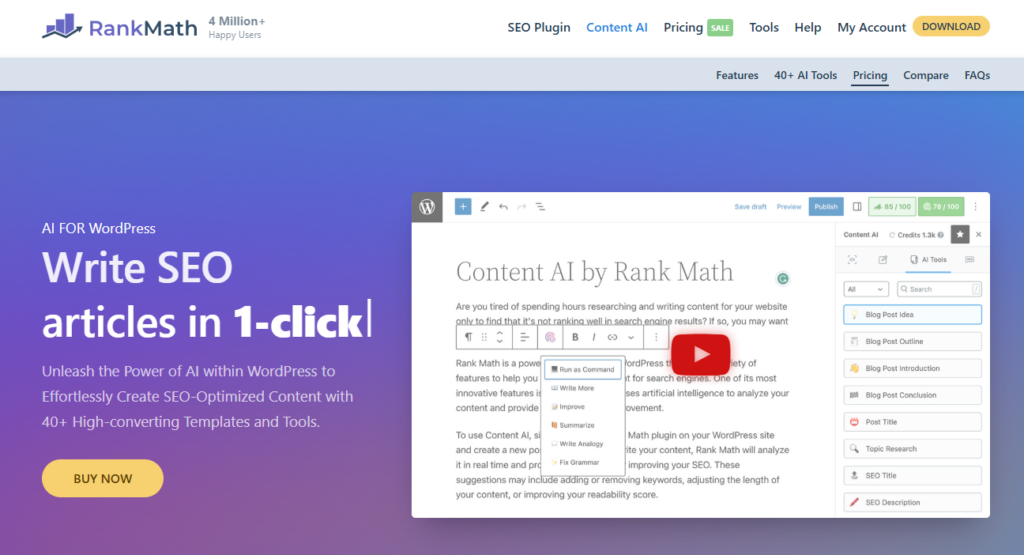
Rank Math Content AI takes a different approach from standalone AI writing platforms. Instead of making you move between an AI writer, SEO tool, and WordPress editor, it puts AI-assisted research, writing, and optimization directly inside the WordPress workflow.
It generates NLP-related terms, FAQ suggestions, meta descriptions, and headline options directly inside the post editor, next to the SEO score you're already optimizing against. There's no export-import step between drafting and optimizing. That makes it particularly relevant for bloggers and affiliate marketers who already use WordPress for publishing.
SEO and Content Features
- Real-time SEO score with a checklist covering title, meta, keyword placement, and readability
- Schema markup across article, product, FAQ, HowTo, and local business types
- Keyword rank tracking (500 keywords on Pro, up to 50,000 on Agency)
- Content AI credits for drafting sections, meta descriptions, and headlines
AI visibility and internal linking
Rank Math has also expanded beyond traditional SEO. Its AI Visibility feature uses a feature-based usage model, while AI Link Genius can identify internal linking opportunities, suggest relevant pages, and automatically add links based on configured keyword maps. AI Link Genius is available with Rank Math PRO.
What it does well
The biggest advantage is workflow integration. You can research search intent and keyword coverage, write or revise content, check SEO recommendations, and work on internal linking without constantly switching between separate applications. For a WordPress publisher with a growing content library, that integration can save considerable time.
Limitations
Content AI is not a replacement for a dedicated SEO research suite or a general-purpose AI assistant. Its recommendations are most useful when you already understand the topic and can judge which keywords, headings, and links genuinely improve the article. Some advanced capabilities also depend on the Rank Math plan and feature limits.
Pricing and usage model
Rank Math changed Content AI from its previous credit system to feature-based monthly usage. That means features such as content generation, keyword research, link suggestions, and AI-powered tools are now measured by feature usage rather than a simple word-credit system. Rank Math also provides free Content AI usage, while paid plans provide higher feature allowances; exact limits vary by plan.
Best for
Rank Math Content AI is best for WordPress bloggers, affiliate marketers, and site owners who want SEO research, content optimization, and AI assistance inside the same publishing workflow.
Our verdict
For a WordPress-focused publisher, Content AI's biggest strength is not that it generates text. It is the way it connects AI-assisted content creation with SEO analysis, keyword coverage, search intent, and internal linking inside WordPress. That makes it one of the most practical options in this list for publishers who want AI to become part of their existing SEO workflow rather than another separate application.
If your site runs on WordPress, explore Rank Math's current plans and Content AI features to see whether bringing SEO and AI content assistance into the same workflow can simplify your publishing process.
5. RankIQ – Best for Bloggers Focused on Organic Search
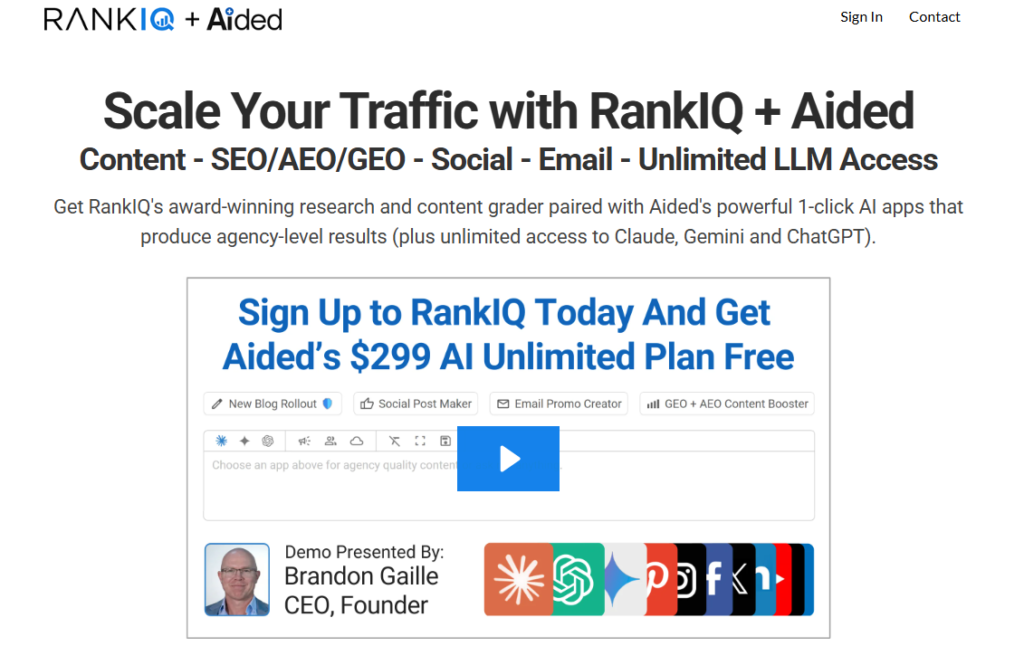
RankIQ is built specifically around the needs of bloggers who want to find realistic organic-search opportunities and optimize content for them. Its core workflow combines keyword research, SERP analysis, and a content optimizer, while its newer Aided platform adds AI-assisted content creation and AEO/GEO capabilities.
Keyword research
RankIQ's keyword research is deliberately focused on finding lower-competition phrases with meaningful traffic potential. Its curated keyword libraries cover major blog niches, while its SERP analysis examines the keywords appearing in top-ranking pages and helps identify terms that can inform titles and content.
Content optimization
The Content Optimizer is the platform's core SEO feature. It identifies terms and topics that can strengthen a post's coverage and helps bloggers optimize existing articles rather than relying only on new-content creation. That makes RankIQ particularly useful for improving an established blog's content library.
AI content capabilities
RankIQ has now evolved into a broader platform through Aided. Aided adds AI content creation designed around SEO, AEO, and GEO, along with AI-assisted social and email content. Existing RankIQ subscribers receive access to both platforms, making the current product considerably broader than the RankIQ content optimizer alone.
What RankIQ does well
RankIQ's biggest strength is focus. Instead of trying to be an all-purpose marketing platform, it is designed around the specific problems bloggers face: finding attainable keywords, understanding ranking-page coverage, optimizing posts, and improving older content. That focused workflow is particularly useful for affiliate bloggers who need organic traffic without building an enterprise SEO stack.
Limitations
RankIQ is less compelling if you need a full technical SEO suite, broad marketing automation, or a WordPress-native publishing environment. Its newer Aided capabilities also mean you should evaluate the combined offering rather than assuming the older RankIQ product description tells the whole story.
Pricing
RankIQ's standard pricing is currently listed at $99/month. As at the time of writing this, the vendor is also advertising a promotional $49 offer combining RankIQ with Aided's AI Unlimited plan, compared with a stated $398 combined rate. Because that is a promotion rather than the standard price, verify the current offer before subscribing.
Best for
RankIQ is best for bloggers, niche-site publishers, and affiliate marketers whose primary goal is growing organic Google traffic through better keyword selection and content optimization.
Our verdict
RankIQ remains one of the more focused options in this roundup for bloggers who care primarily about organic search. Its evolution into RankIQ + Aided also makes it more relevant to today's SEO, AEO, and GEO environment, although the value depends on whether you will actually use those additional capabilities.
If organic traffic is the main growth channel for your blog, check RankIQ's current keyword research and content optimization workflow before investing in a broader SEO platform.
6. ChatGPT – Best for Flexible SEO Content Workflows
ChatGPT is not a dedicated SEO platform, but it can be extremely useful for SEO copywriting when you treat it as a flexible workflow assistant rather than an automatic optimization tool. Its current capabilities include web search, deep research, file analysis, drafting, editing, and structured analysis, giving SEO writers considerable flexibility.
What ChatGPT can do for SEO
- Research: ChatGPT can search the web for current information, while Deep Research can conduct multi-step research across multiple sources and produce a cited report. You can use those capabilities to investigate topics, competitors, products, and supporting sources.
- Outlining: Give ChatGPT a target query, audience, search intent, and research findings, and it can turn them into structured content briefs and outlines.
- Drafting: It can create first drafts, sections, FAQs, titles, introductions, comparisons, and other SEO copy. The quality still depends heavily on the research and instructions you provide.
- Editing: ChatGPT can improve clarity, structure, tone, readability, and consistency without requiring you to rewrite an entire article from scratch.
- Content refreshing: Give it an existing article plus current search data, product information, or source material, and it can identify outdated sections and suggest updates.
- Analysis: ChatGPT can analyze uploaded documents and structured datasets, making it useful for examining Search Console exports, content inventories, spreadsheets, and performance data.
What ChatGPT does not replace
ChatGPT does not automatically provide the same structured SEO environment as a dedicated SEO platform. It does not inherently give you a specialized content score, comprehensive keyword coverage model, proprietary SERP dataset, or a WordPress SEO workflow simply because you are using it to write an article.
What it does well
Its biggest advantage is flexibility. You can adapt the workflow to almost any SEO task instead of being restricted to the features built into one platform.
Limitations
That flexibility also creates more work. You are responsible for supplying SEO data, validating research, designing the workflow, and deciding which recommendations are actually useful. ChatGPT can also make mistakes, so important claims and sources require verification.
Pricing
ChatGPT has a free plan. ChatGPT Plus currently costs $20/month and includes expanded access to tools such as file analysis and Deep Research, subject to usage limits.
Best for
ChatGPT is best for SEO writers, bloggers, affiliate marketers, and content strategists who want one flexible tool that can support research, writing, analysis, and content refreshes.
Our verdict
I must that we are biased towards ChatGPT here on the Web Income Journal. It is our go-to tool for everything SEO copywriting though it is not an SEO platform by itself. Its real value comes from combining its research and writing capabilities with reliable SEO data from tools such as Search Console or a dedicated SEO platform.
If you want a flexible AI assistant for SEO research, writing, editing, and content refreshes, try ChatGPT and build it into your existing SEO workflow rather than expecting it to replace your SEO toolkit.
7. Rank.ai – Best for AI-Search and Automated SEO Content
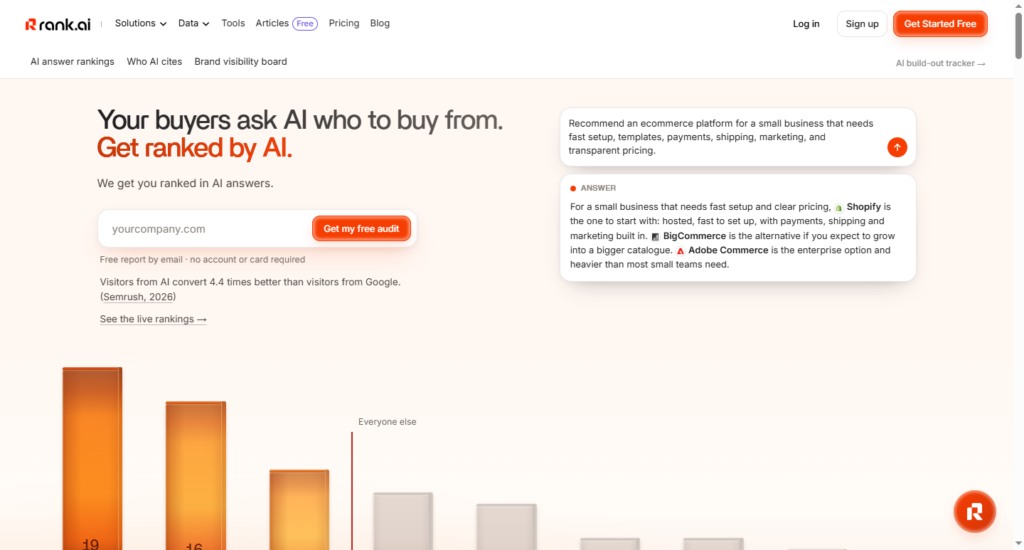
Rank.ai is a newer SEO platform built around a different premise: combine traditional search optimization with visibility in AI-generated answers, then connect that research directly to content production and publishing. Its current platform tracks Google rankings alongside AI-answer visibility and can research, write, illustrate, and publish content to connected CMS platforms.
How Rank.ai approaches SEO and AI search
Rank.ai treats Google search and AI search as connected visibility problems. Its platform can identify pages and sources appearing in AI answers while also tracking traditional Google rankings. The Starter plan currently tracks questions across ChatGPT, Claude, and Gemini, while the platform's AI Rank feature measures whether a domain is mentioned or cited and where it appears in the answer.
Content creation and publishing
The platform can research topics against live search results, generate articles and images, and publish them directly to connected WordPress, Webflow, or Shopify sites. Basic includes 10 AEO-optimized articles per month, while Starter includes 30 and Pro includes 100. The free plan therefore provides a relatively unusual way to test an automated SEO publishing workflow without paying upfront.
AI-search capabilities
AI-search tracking is one of Rank.ai's clearest differentiators. Starter tracks three questions daily across ChatGPT, Claude, and Gemini, while Pro expands that to 15 questions and adds share-of-answer and competitor tracking. Rank.ai also reports AI-bot crawling and referral activity, plus the appearance of Google AI Overviews for tracked keywords.
What it does well
Rank.ai's strength is the connection between measurement and execution. Instead of simply reporting that your visibility is weak, the platform is designed to identify content gaps and then create and publish pages intended to address them. Its WordPress integration also makes the workflow particularly relevant to publishers seeking automation.
Limitations
Rank.ai is less established than the other products in this roundup, so its feature set, positioning, and pricing deserve more scrutiny before committing to a long-term workflow. Its automation also makes editorial review important: publishing more content does not automatically make that content useful, accurate, or valuable to readers.
Pricing
As of September 2026, Rank.ai has a $0 Basic plan, a $50/month Starter plan, and a $250/month Pro plan. Basic includes 10 articles per month and three daily Google keyword checks; Starter adds 30 articles and AI-answer tracking; Pro includes 100 articles, 100 daily Google keywords, and 15 tracked AI questions. Credits are included with each plan, with additional credits currently priced at $0.005 each.
Best for
Rank.ai is best for publishers, agencies, and businesses interested in combining automated SEO content production with Google and AI-search visibility tracking.
Our verdict
Rank.ai is one of the most interesting emerging options in this category because it connects AI-search measurement with automated content creation and publishing. However, its newer position means we would treat it as a platform worth testing rather than automatically making it the foundation of a mature content operation.
If AI-search visibility and automated publishing are priorities, explore Rank.ai's free plan first and test the workflow on a controlled part of your content operation before scaling it.
Worth Reading: How to Use AI to Write Affiliate Product Reviews that Sell [2025 Guide]
How to Use AI Copywriting Tools Without Creating Low-Quality SEO Content
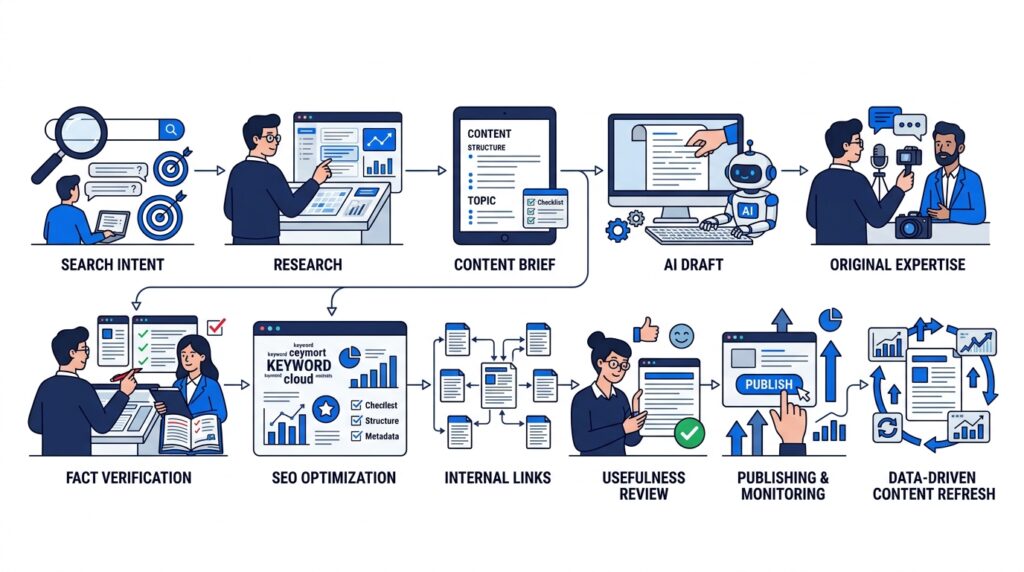
The biggest mistake is treating an AI copywriting tool as an automatic publishing machine. A better approach is to use AI at the stages where it saves time while keeping research, judgment, fact-checking, and final editorial decisions under human control.
- Identify the search intent. Determine what the searcher actually wants before asking AI to write anything. Is the query informational, commercial, navigational, or transactional?
- Research the topic. Gather reliable information from current sources, search results, product documentation, and your own research. Do not assume the AI already knows the latest facts.
- Build the content brief. Define the primary topic, audience, search intent, important subtopics, questions, competing content, and unique angle. A good brief gives the AI something useful to work from.
- Generate or improve the first draft. Use AI for outlining, drafting, restructuring, editing, or expanding sections. Treat the output as working material rather than finished content.
- Add original expertise and examples. Include your experience, observations, screenshots, examples, original analysis, opinions, and lessons learned. These elements give the page value that a generic AI draft cannot provide.
- Verify factual claims. Check statistics, product specifications, prices, features, dates, citations, and other claims against reliable sources. This is especially important for affiliate content.
- Optimize the content. Review headings, keyword coverage, entities, metadata, internal links, readability, and topical completeness. Use SEO recommendations as guidance rather than trying to achieve an arbitrary optimization score.
- Add internal links. Connect the new article to relevant pages elsewhere on your site. Use descriptive, natural anchor text that helps readers discover related information.
- Review the page for usefulness. Read the finished article as the searcher would. Remove repetition, unsupported claims, filler, keyword stuffing, and anything that does not help the reader accomplish their goal.
- Publish and monitor performance. After publication, watch impressions, clicks, rankings, conversions, and other meaningful signals. Search performance gives you information that an AI writing tool cannot predict perfectly before publication.
- Refresh based on actual search data. Update the article when search queries, rankings, product information, or reader needs change. Use real performance data to decide what deserves improvement instead of refreshing content simply because it has reached a certain age.
The principle behind this workflow is simple: use AI to accelerate good SEO work, not to manufacture pages at scale. Human oversight remains essential because search intent, factual accuracy, usefulness, and originality cannot be reduced to a keyword count or an AI-generated optimization score.
Which SEO Copywriting Tool Is Best for Affiliate Marketers?
The best tool depends on what you are trying to accomplish with your affiliate content. Instead of choosing the platform with the most features, match the tool to the bottleneck in your workflow.
| Affiliate goal | Best fit | Why |
| Create SEO content and track AI-search visibility | Writesonic | Combines AI content creation with SEO workflows, site auditing, and AI visibility tracking. |
| Build detailed product reviews and comparison content | ChatGPT | Flexible for research, outlining, drafting, editing, and analyzing product information when you provide reliable source material. |
| Scale repeatable affiliate-content workflows | Copy.ai | Its workflow automation is useful when research, drafting, repurposing, and other steps need to be repeated at scale. |
| Maintain brand consistency across affiliate content | Jasper | Brand Voice, Knowledge, Audiences, and marketing workflows make it a strong fit for teams managing consistent content. |
| Write and optimize affiliate articles directly in WordPress | Rank Math Content AI | Brings AI assistance, keyword research, content optimization, SEO analysis, and internal-linking capabilities into the WordPress workflow. |
| Find lower-competition topics for a niche blog | RankIQ | Its keyword research, SERP analysis, and content optimization workflow is specifically geared toward bloggers. |
| Automate content production and monitor AI-search visibility | Rank.ai | Connects SEO research, automated article creation, publishing, and AI-answer tracking, although its newer platform warrants careful testing. |
| Refresh an existing affiliate content library | RankIQ + ChatGPT | RankIQ can identify optimization opportunities while ChatGPT can help research, restructure, and rewrite outdated sections. |
| Improve internal linking across a WordPress affiliate site | Rank Math Content AI | Its SEO workflow and internal-linking capabilities make it particularly practical for WordPress publishers. |
For most solo affiliate bloggers, I would start with the tool that fits the existing publishing setup rather than adding another standalone subscription. A WordPress publisher may get more practical value from Rank Math Content AI, while a blogger primarily focused on keyword selection and organic-search optimization may prefer RankIQ.
For affiliate teams and agencies, the decision changes. Jasper and Copy.ai become more attractive when brand consistency, repeatable processes, collaboration, and workflow automation are important. Writesonic becomes particularly interesting when traditional SEO needs to be combined with tracking visibility across AI-search platforms.
For research-heavy affiliate content, ChatGPT can be extremely useful because you can adapt the workflow to different products, niches, and content formats. But it works best alongside reliable SEO and product research rather than as a replacement for either.
The important point is that no AI tool should determine your affiliate recommendations for you. Use the software to reduce repetitive work, then apply your own product knowledge, research, judgment, and fact-checking before the content goes live.
Are SEO AI Copywriting Tools Worth It?
Yes, SEO AI copywriting tools can be worth paying for, but not simply because they can generate articles. The real question is whether a specialized tool removes a bottleneck that costs you significant time, money, or publishing capacity. If it does not, a general AI tool may provide enough capability without another monthly subscription.
When they are worth paying for
A dedicated SEO AI platform becomes easier to justify when you publish frequently and need a repeatable process for researching, creating, optimizing, and maintaining content. The value increases further when you manage multiple websites or have a large content library that requires ongoing updates.
These tools can also pay for themselves when you perform repetitive SEO tasks. Keyword research, SERP analysis, content briefs, optimization checks, internal-link discovery, content audits, and refresh workflows can consume substantial time when performed manually across dozens or hundreds of articles.
They can also make sense when you need to scale research. A platform that combines search data with content analysis can reduce the amount of manual work required before an article reaches the drafting stage.
For content teams, the value can extend beyond individual productivity. Shared workflows, brand guidance, automation, collaboration, and centralized content processes can make a dedicated platform more useful than asking every writer to build their own AI workflow.
When a general AI tool may be enough
You may not need dedicated SEO software if you publish only occasionally, operate a single small site, already have reliable keyword and SEO tools, or primarily need help with research, outlining, drafting, and editing.
For example, ChatGPT can handle many writing and research tasks while you use Search Console or another SEO platform for performance and keyword data. In that situation, paying for another AI platform may create more overlap than value.
The same applies if you are still developing your publishing process. Automating an inefficient workflow does not necessarily make it a good workflow.
The real test
The right question is not “Is this SEO AI tool worth the price?” It is “What expensive or repetitive problem does this tool solve for me?”
If a platform saves hours of work every week, helps maintain a large content library, supports a team, or connects SEO research with AI-search visibility and publishing, the subscription may be justified.
If it simply produces drafts you could create with a general AI tool, the additional cost may be difficult to justify.
SEO AI Copywriting Tools vs. General AI Tools
One reason this category is confusing is that “AI writing tool” can describe very different products. A general AI tool is designed to handle many types of research, reasoning, writing, analysis, and other tasks. A dedicated SEO AI platform is usually built around a more structured content workflow and may connect AI generation with keyword data, search results, optimization, or publishing.
| Capability | General AI tool | Dedicated SEO AI tool |
| Drafting | Strong | Strong |
| Editing | Strong | Strong |
| Keyword research | Requires workflow/tooling | Often built in |
| SERP analysis | Usually requires additional research | Often built in |
| Content scoring | Usually limited | Common |
| Competitor analysis | Variable | Common |
| AI-search visibility | Variable | Increasingly common |
| WordPress workflow | Variable | Depends on platform |
| Automation | Increasing | Often central |
The difference is therefore less about whether the tool can write. Both categories can produce drafts, rewrite passages, generate outlines, and help with editing. The difference is what happens around the writing.
A general AI tool gives you a flexible workspace. You can tell it to research a topic, analyze a document, create a content brief, draft an article, or review your existing content. But you may need to supply the SEO data and create the process that connects those tasks.
A dedicated SEO AI platform typically brings more of that workflow together. Depending on the product, it may provide keyword research, ranking-page analysis, competitor research, content optimization recommendations, topical or keyword coverage, content scores, internal-link suggestions, or content-refresh workflows.
With the entrance of AI search engines and Google AI Overviews in the recent time, AI-search visibility is becoming increasingly important. Some dedicated platforms now track whether content or brands appear in AI-generated answers, while general AI tools can help you research or reason about AI search without necessarily providing a dedicated visibility dashboard.
WordPress integration also varies considerably. Rank Math Content AI, for example, works inside the WordPress publishing workflow, while other platforms may connect through integrations or require you to move content manually.
Automation is becoming another dividing line. General AI tools increasingly support sophisticated workflows and agents, but dedicated SEO platforms often make automation central to their product design.
That does not make dedicated SEO platforms automatically better. The best choice depends on the workflow you need. If you already have strong SEO data and mainly need flexible research and writing assistance, a general AI tool may be enough. If you want SEO research, optimization, monitoring, and content production connected in one environment, a dedicated platform may provide considerably more value.
Final Verdict – Which SEO AI Copywriting Tool Should You Choose?
There is no universal winner among the seven SEO AI copywriting tools we evaluated. Each solves a different part of the modern content workflow, so the right choice depends on where you need the most help.
- Best overall: Writesonic — the strongest all-around fit when SEO content production and AI-search visibility need to work together.
- Best SEO + AI search: Writesonic — particularly useful for publishers tracking visibility across traditional and AI search.
- Best marketing workflow: Jasper — a strong choice for teams that need brand voice, AI agents, and structured marketing workflows.
- Best automation: Copy.ai — particularly suited to businesses that want to turn repeatable content processes into automated workflows.
- Best WordPress: Rank Math Content AI — the practical choice for WordPress publishers who want AI and SEO inside the same workflow.
- Best for bloggers: RankIQ — focused on keyword research, organic-search opportunities, and content optimization.
- Best flexible AI: ChatGPT — the most adaptable option for research, outlining, drafting, editing, analysis, and content refreshes.
- Best emerging AI-search and automation option: Rank.ai — worth watching for publishers who want AI-search tracking connected to automated content production.
For most affiliate bloggers, the decision should start with your existing workflow. If you publish in WordPress, Rank Math Content AI may offer more practical value than adding another standalone writer. If organic search research is your biggest bottleneck, RankIQ may be the better fit.
The important thing is not to buy AI software simply because it can generate content. Choose the tool that solves a workflow problem that actually matters to your business.
Frequently Asked Questions
Which AI is best for copywriting?
The best AI for copywriting depends on the type of content you produce. ChatGPT offers broad flexibility for research, drafting, editing, and analysis, while Jasper is stronger for brand-focused marketing workflows. Writesonic and Copy.ai add more structured content and SEO workflows. The best choice is the one that fits your publishing process and editorial requirements.
Which AI is best for SEO writing?
There is no single best AI for every SEO writing workflow. Writesonic is a strong choice when SEO content creation and AI-search visibility are priorities, while RankIQ is particularly useful for bloggers focused on keyword research and content optimization. Rank Math Content AI is especially practical for WordPress publishers who want SEO and AI assistance in one workflow.
Can I use AI for copywriting?
Yes. AI can assist with research, outlining, drafting, editing, content refreshing, and repurposing. However, good copywriting still requires a clear understanding of the audience, accurate information, persuasive judgment, and appropriate editing. For affiliate content in particular, AI should accelerate the writing process rather than replace product research, firsthand experience, or fact verification.
Can I use AI to do my SEO?
AI can support many SEO tasks, including keyword research, content planning, optimization, internal linking, competitor analysis, and content refreshes. However, an AI tool does not automatically replace a complete SEO workflow. You still need reliable search data, technical SEO checks where appropriate, human judgment, and ongoing performance monitoring to make sound SEO decisions.
Can I use ChatGPT for copywriting?
Yes. ChatGPT can support copywriting from research and outlining through drafting, editing, analysis, and content refreshes. Its flexibility makes it useful for many types of copy, including blog posts, product comparisons, emails, and landing-page content. Its main limitation is that it is not inherently a dedicated SEO optimization platform, so additional SEO data and tools may still be necessary.
Which AI is better than ChatGPT for writing?
Some AI writing platforms may be better than ChatGPT for specific workflows, but that does not make them universally better for writing. Jasper can provide stronger brand and marketing workflow controls, while Writesonic offers a more specialized SEO and AI-search environment. Copy.ai can be more useful for workflow automation. The quality of the final content depends more on research, instructions, editing, expertise, and factchecking than on the AI tool alone.






“Fantastic roundup! It’s exciting to see so many innovative AI tools for SEO and copywriting emerging this year. I’m particularly interested in how these tools can streamline the writing process while still optimizing for search engines. Thanks for sharing your insights and recommendations—this will definitely help in choosing the right tool for my projects!”
“Thank you for sharing such insightful content! This post really adds value and provides a fresh perspective on the topic. I truly appreciate the effort and detail that went into creating it. Looking forward to more of your great work!”