Chadrack
The best email marketing tools for affiliate marketers in 2026 are GetResponse, ActiveCampaign, AWeber, Brevo, and Kit (ConvertKit). These platforms explicitly allow affiliate links, offer AI-powered automation and send-time optimization, and provide the deliverability infrastructure — SPF, DKIM, and DMARC authentication to satisfy Google and Yahoo email sender requirements — essential for inbox placement. The top pick for most affiliates is GetResponse, thanks to its built-in sales funnels, AI content tools, and affiliate-friendly terms of service.
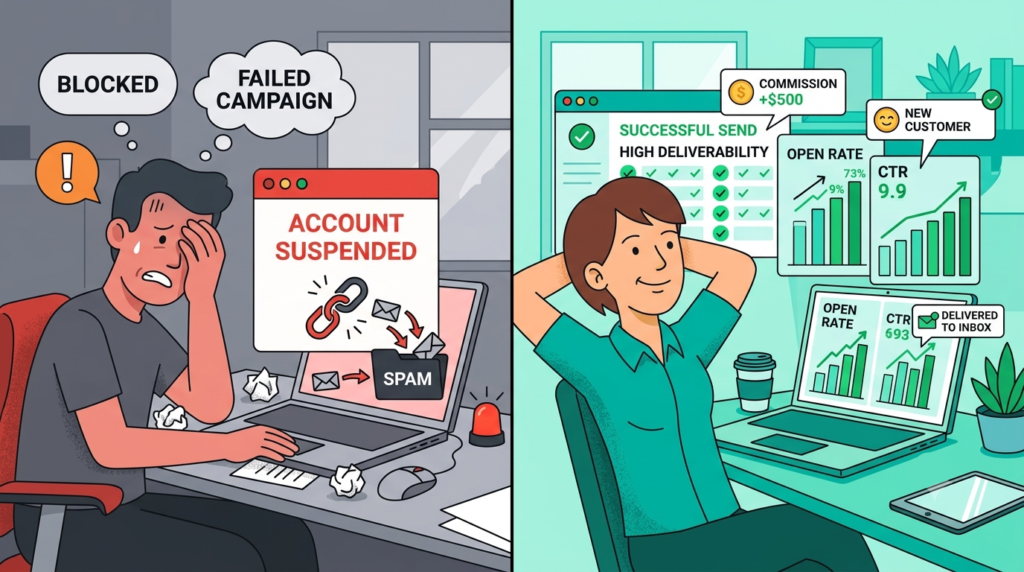
Your affiliate link is only as good as the inbox it lands in. Yet most email platforms were never built with affiliate marketers in mind.
The reality is that email marketing delivers an average ROI of $36 for every $1 spent — higher than social media, paid ads, or any other digital channel. But that ROI only materializes if your emails actually reach the inbox, and if your platform doesn't suspend your account for including affiliate links in the first place.
That's a trap many affiliates fall into. They pick a popular platform like Mailchimp, build their list, start sending promotional emails — and get banned. Not for doing anything illegal. Simply because the platform was never designed for affiliate-first businesses.
The good news is that a new generation of AI-powered email marketing platforms has changed this. Today, a solo affiliate marketer can automate segmentation, optimize send times using machine learning, generate high-converting subject lines with AI, and run sophisticated drip campaigns — without a full marketing team behind them.
In this guide, I've ranked the 10 best email marketing tools for affiliate marketers in 2026, evaluated on six criteria: affiliate link policy, AI features, deliverability infrastructure, automation depth, ease of use, and pricing. Whether you're just building your first list or scaling a full affiliate operation, there's a clear right answer for your stage and niche.
Key Takeaways:
- Affiliate link policy comes first. The best email marketing platforms for affiliates explicitly allow third-party promotional links in their terms of service — this is non-negotiable before evaluating any other feature.
- GetResponse is the #1 overall pick for affiliate marketers in 2026, combining affiliate-friendly ToS, built-in sales funnels, AI tools, and send-time optimization in one platform.
- Mailchimp actively restricts affiliate-first accounts and should be avoided.
- AI features now directly impact commissions. Send-time optimization, AI-generated copy, and behavioral segmentation are not marketing buzzwords.
- Deliverability is as important as features. If your promotional email lands in spam, no one clicks your affiliate link.
- Brevo and AWeber offer the strongest free entry points for affiliates building their first list on a tight budget.
DISCLOSURE: WebIncomeJournal is supported by readers like yourself. We may earn an affiliate commission when you purchase through our links, which helps us offer our content for free. Learn more here.
What Is Email Marketing Software for Affiliate Marketers — and Why Does It Matter?
Email marketing software for affiliate marketers is a platform that lets you build a subscriber list, send promotional emails containing affiliate links, automate follow-up sequences, and track performance metrics (opens, clicks, and conversions) from a single dashboard.
While that definition sounds simple, the reality is more complicated.
Most mainstream email service providers (ESPs) were built for e-commerce brands, SaaS companies, and newsletters — not for affiliate marketers promoting third-party products on commission. And because affiliate-style emails (high click volume, redirect links, promotional copy) share surface-level similarities with spam, many ESPs treat them as a liability. The result: account suspensions, email blocks, and lost lists.
An affiliate-friendly ESP is one that explicitly permits third-party promotional links in its terms of service, provides the deliverability infrastructure to ensure those emails reach the inbox, and offers the automation depth to run time-sequenced campaigns without manual intervention.
That distinction matters more in 2026 than it ever has. U.S. affiliate marketing investment reached $13.62 billion in 2024 — up 49.8% since 2021 — and is projected to surpass $15 billion by 2028. The channel is growing fast, and the platforms supporting it need to keep pace.
What Features Should You Look for in an Affiliate-Friendly Email Marketing Tool?

Before comparing platforms let’s consider the features you must look for before deciding. Here are the seven features I always look out for:
1. Affiliate Link Policy (Non-Negotiable)
The first question to ask about any ESP is not about features or pricing. It's this: does the platform explicitly allow affiliate or third-party promotional links in its terms of service and acceptable use policy?
This is non-negotiable. Some platforms, like Mailchimp, prohibit affiliate marketing as a primary business model. Others allow affiliate links technically but enforce the policy inconsistently, putting your account at risk without warning.
Before signing up for any platform, read both the terms of service and the acceptable use policy. Look for explicit language around “affiliate links,” “third-party links,” and “promotional emails.” If the language is vague or absent, contact support and get a written confirmation. GetResponse, AWeber, and SendX are the clearest examples of platforms that state their affiliate-friendly position openly and publicly.
2. Email Deliverability Infrastructure
Deliverability is the percentage of emails that land in the subscriber's inbox — not the spam folder, not promotions tab, not a black hole.
For affiliate marketers, deliverability is uniquely challenging. Affiliate redirect domains, link cloakers, and high-click-volume campaigns all trigger spam filters on poorly configured systems. The technical foundations that protect your sender reputation are SPF (Sender Policy Framework), DKIM (DomainKeys Identified Mail), and DMARC (Domain-based Message Authentication). These authentication protocols verify if you are who you say you are.
Look for platforms that offer dedicated IP options for high-volume senders, domain reputation dashboards, spam score testing before sending, and email warm-up tools for new domains. Without these, your affiliate email campaigns reach fewer inboxes — and earn fewer commissions.
3. Marketing Automation and Autoresponder Sequences
Affiliate marketing runs on timing. A welcome sequence for a new subscriber, a behavioral drip triggered by a link click, a launch-calendar campaign aligned to a product release — these are the automated sequences that generate commissions while you sleep.
The best platforms offer visual workflow builders that map these sequences visually, alongside rule-based automation that triggers actions based on subscriber behavior: link clicks, page visits, purchase history, or email engagement. The more granular the triggers, the more precisely you can move subscribers through a buying journey.
4. AI-Powered Features
AI features in email marketing are no longer optional extras. They are direct revenue tools.
Send-time optimization (STO) uses machine learning to analyze each subscriber's historical open behavior and deliver your email at their individual peak engagement window. Platforms like GetResponse (“Perfect Timing”) and ActiveCampaign (“Predictive Sending”) report open rate lifts of 5–15% from STO alone. AI subject line generation and AI email copy tools — available in GetResponse, AWeber, Kit, and Mailmodo — accelerate content production without sacrificing quality. AI audience segmentation dynamically groups subscribers by behavioral signals, so your highest-intent buyers receive your best offers first.
5. List Segmentation and Subscriber Management
Segmentation directly increases affiliate conversion rates. Sending the same email to your entire list is the fastest way to generate unsubscribes and damage your sender reputation.
The platforms worth using support subscriber tagging, custom fields, and behavioral segmentation — grouping subscribers by what they clicked, what they bought, how often they engage, and which product categories interest them most. Klaviyo's benchmark data shows email automation flows generate nearly 41% of total email revenue from just 5.3% of total sends. That's what precision segmentation delivers.
6. Compliance Tools (CAN-SPAM, GDPR)
Gmail and Yahoo now require one-click unsubscribe functionality for all bulk senders — it's no longer a best practice, it's a technical requirement. Platforms that don't support this will hurt your deliverability.
Look for built-in suppression list management, double opt-in support to confirm subscriber intent, and GDPR-compliant data handling if you have any EU audience. ActiveCampaign and Brevo are the strongest on compliance tooling out of the box.
7. Pricing and Scalability
Start with what you can afford but think about where you'll be in 12 months. Most platforms charge by subscriber count — so the platform that costs $15/month at 1,000 subscribers may cost $150/month at 10,000. Calculate cost-per-subscriber at your projected list size, not just at the entry tier.
Free plans from AWeber (up to 500 subscribers) and Brevo (unlimited contacts, up to 300 emails/day) are legitimate starting points. Upgrade when automation depth and deliverability tools become the limiting factor on your growth — not before.
Which Email Platforms Explicitly Allow Affiliate Links? (And Which Ones Don't)
From the above, you have seen the importance of choosing email platforms that allow affiliate links. If you are like most people, you might already be asking, but which platforms actually allow affiliate links.
Here’s a few ones to help with that answer:
| Platform | Affiliate Links Allowed? | Notes |
| GetResponse | ✅ Yes | Explicitly affiliate-friendly |
| AWeber | ✅ Yes | Actively courts affiliates |
| ActiveCampaign | ✅ Yes | Allowed with quality list |
| Brevo | ✅ Yes | Not explicitly banned |
| Kit (ConvertKit) | ✅ Yes | Designed for creators |
| SendX | ✅ Yes | Explicit affiliate-friendly policy |
| Mailchimp | ⚠️ Restricted | Bans most affiliate-style emails |
| Klaviyo | ⚠️ E-commerce focus | Not built for affiliate links |
| MailerLite | ⚠️ Conditional | Case-by-case review |
| HubSpot | ⚠️ Restricted | Enterprise-focused; restrictive ToS |
Why Do Platforms Restrict Affiliate Marketers at All?
The reason comes down to shared infrastructure risk. Most ESPs operate on shared IP pools — meaning your emails and thousands of other users' emails go out from the same IP addresses. When affiliate campaigns generate spam complaints (even at normal industry rates), the shared IP's sender reputation takes a hit, which damages deliverability for every other user on that IP.
Platforms like Mailchimp built their business on small business and e-commerce clients who run low-complaint, high-trust campaigns. Affiliate-style emails (higher click volumes, redirect URLs, promotional copy) introduce deliverability risk they are not willing to absorb. So, they restrict or ban the category outright.
Here’s how to verify any platform's affiliate policy before committing:
- Search the platform's terms of service and acceptable use policy for the phrases “affiliate,” “third-party links,” and “promotional.”
- If the language is unclear, open a support chat and ask directly: “Does your platform allow emails that contain affiliate links promoting third-party products for commission?”
- Screenshot or save the response. If you're ever banned, a written confirmation from support is your strongest appeal.
- Check affiliate marketing forums and communities (Reddit's r/affiliatemarketing is useful) for real account-holder experiences with the platform.
The policy matters as much as the features. A platform with outstanding AI tools means nothing if your account gets suspended the week before a major product launch.
The 10 Best Email Marketing Tools for Affiliate Marketers, Ranked by AI Power
Now, let’s get the meat of this article. Each of the tools below was evaluated based on the features we discussed above. However, we prioritized AI capability because, in 2026, AI is the feature that most directly separates high-earning affiliates from the ones still doing everything manually.
#1. GetResponse: Best All-in-One AI Tool for Affiliate Marketers
Score: 9.2/10
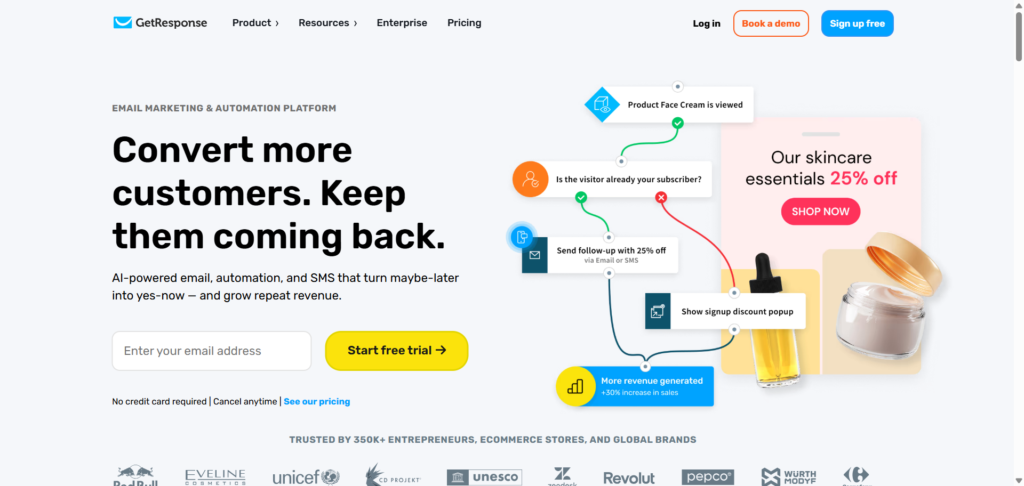
GetResponse is the top overall pick for affiliate marketers in 2026. No other platform on this list combines affiliate-friendly terms of service, mature AI tools, built-in sales funnels, and advanced automation in a single dashboard at this price point.
GetResponse explicitly permits affiliate marketing in its terms of service — there is no gray area, no case-by-case review, no risk of surprise account suspension. That alone puts it ahead of half the platforms on the market.
On the AI side, GetResponse's standout feature is “Perfect Timing” — one of the oldest and most reliable per-contact send-time optimization tools available. Perfect Timing analyzes each subscriber's historical email behavior and delivers your message at their individual peak engagement window. The result is a measurable lift in open rates without changing a single word of your copy. On top of STO, GetResponse includes an AI email generator, an AI landing page builder, and an AI autoresponder sequence builder.
What makes GetResponse uniquely valuable for affiliates, though, is its built-in sales funnel system. You can build a complete promotional funnel — opt-in page, thank-you page, email sequence, webinar (up to 100 attendees), and follow-up automation — all inside the platform, without connecting additional tools. For affiliates running product launches or high-ticket promotions, this is a genuine differentiator.
The visual workflow editor supports sophisticated automation: tag-based triggers, behavioral branching, purchase event tracking, and time-delayed sequences that align with affiliate launch calendars.
- Pricing: Starts at approximately $19/month. Annual billing saves 18%, and non-profit organizations qualify for a 50% discount.
- Best for: Intermediate to advanced affiliate marketers who want a complete funnel system without stitching together multiple tools.
- Limitation: GetResponse's AI content tools are broad-output generators — excellent for producing copy quickly, but they don't learn from your specific audience's behavioral data over time the way a more advanced AI system might.
#2. ActiveCampaign: Best for Advanced Behavioral Automation
Score: 8.9/10
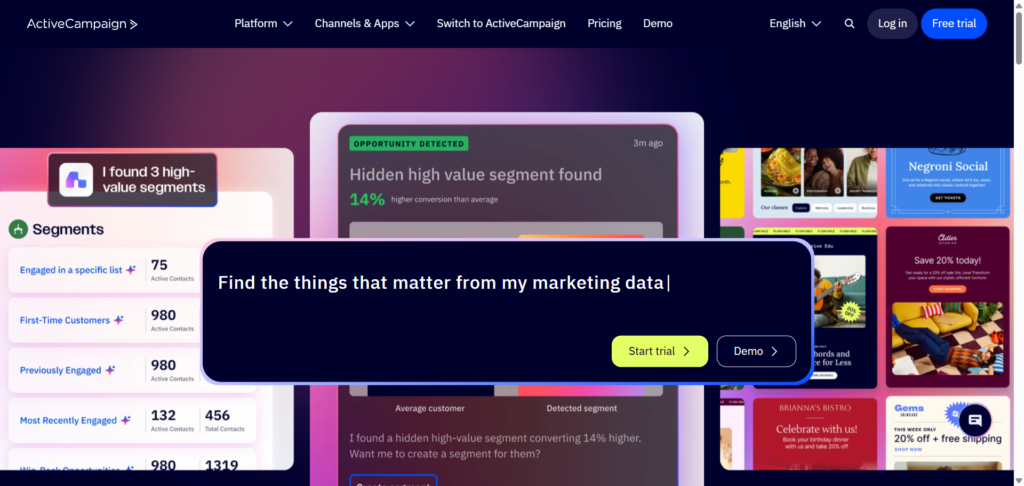
ActiveCampaign is the power tool for affiliates who need to segment and automate with surgical precision. If GetResponse is the best all-rounder, ActiveCampaign is the best specialist — built for marketers who understand that the right message sent to the right segment at the right moment is the actual mechanism of affiliate commission.
The AI features are strong. ActiveCampaign's Predictive Sending (its send-time optimization engine) uses machine learning to determine optimal delivery timing per contact. Its AI content generation tools assist with email copy and subject lines, and its machine learning segmentation dynamically groups subscribers based on engagement patterns and behavioral signals.
What sets ActiveCampaign apart from every other platform on this list is the depth of its behavioral triggers. You can automate email sequences based on specific link clicks, website page visits, purchase history, form submissions, lead scores, and contact lifecycle stage. For affiliate journey mapping — where the sequence of touches before a conversion matters enormously — this level of trigger granularity is invaluable.
The CRM integration is also genuinely useful. ActiveCampaign's built-in CRM lets you manage subscriber lifecycle stages, log interactions, and automate follow-ups based on where a contact sits in the buyer journey — not just where they are in an email sequence. With over 900 integrations, it connects cleanly to virtually every tool in an affiliate marketer's stack.
ActiveCampaign's benchmark data shows an average open rate of 39.26% and an average click rate of 6.21% across 2025 campaigns — a useful baseline for measuring your own affiliate campaigns against industry performance.
- Pricing: Starts at approximately $15/month (Lite plan). Cost scales steeply with list size and feature tier.
- Best for: Experienced affiliate marketers with established lists who need precision behavioral targeting and CRM-level subscriber management.
- Limitation: ActiveCampaign has a steeper learning curve than most platforms on this list, and the cost at scale can become significant. It rewards the affiliate marketer who already knows what they're doing — it is not the right starting point for beginners.
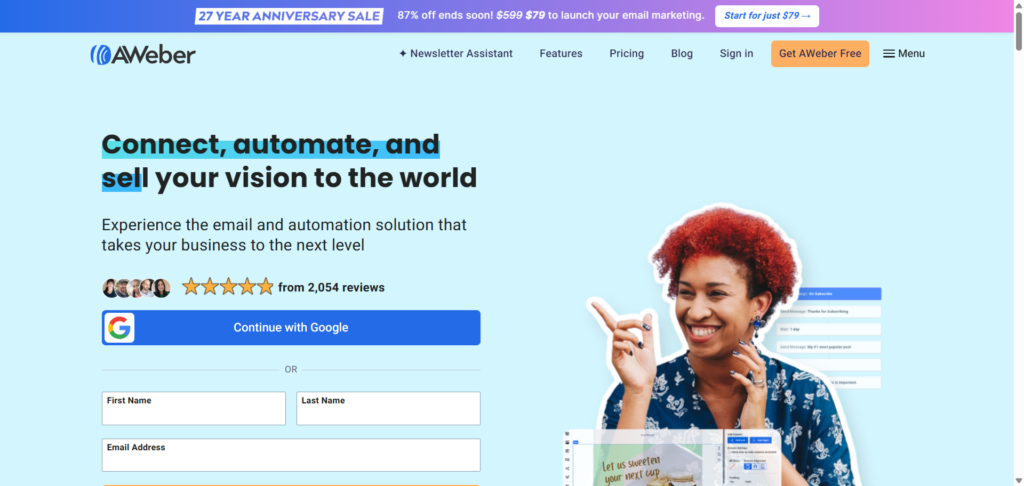
#3. AWeber: Best for Affiliate Marketing Beginners
Score: 8.4/10
AWeber is the most beginner-friendly affiliate email marketing platform available, and it has been publicly and explicitly welcoming affiliate marketers for over two decades. If you're just starting out and want a platform you can trust not to shut down your account, AWeber is the right first choice.
The affiliate-friendly positioning isn't marketing language — AWeber actively promotes its compatibility with affiliate marketers and provides pre-built affiliate marketing email templates to help new users get campaigns live quickly. That combination of policy clarity and practical support is rare.
The AI tools are solid for an entry-level platform. AWeber's AI writing assistant generates subject lines and email body copy. The Smart Designer automatically creates on-brand email templates from your website or social profile. Neither feature is as sophisticated as GetResponse or ActiveCampaign, but both remove friction for marketers who are still developing their email marketing skills.
AWeber's deliverability reputation is one of the strongest in the industry — built over decades of infrastructure investment and sender reputation management. For new affiliates who are still learning list hygiene and engagement management, having a platform with strong baseline deliverability provides a meaningful safety net.
The free plan supports up to 500 subscribers with access to core features — a legitimate starting point for building and learning.
- Pricing: Free up to 500 subscribers. Paid plans start at approximately $15/month.
- Best for: New affiliate marketers building their first list who want a beginner-friendly interface, affiliate-safe policy, and solid deliverability without complexity.
- Limitation: AWeber's automation is functional but less sophisticated than GetResponse or ActiveCampaign. As your list grows and your campaigns become more complex, you may outgrow the platform's workflow capabilities.
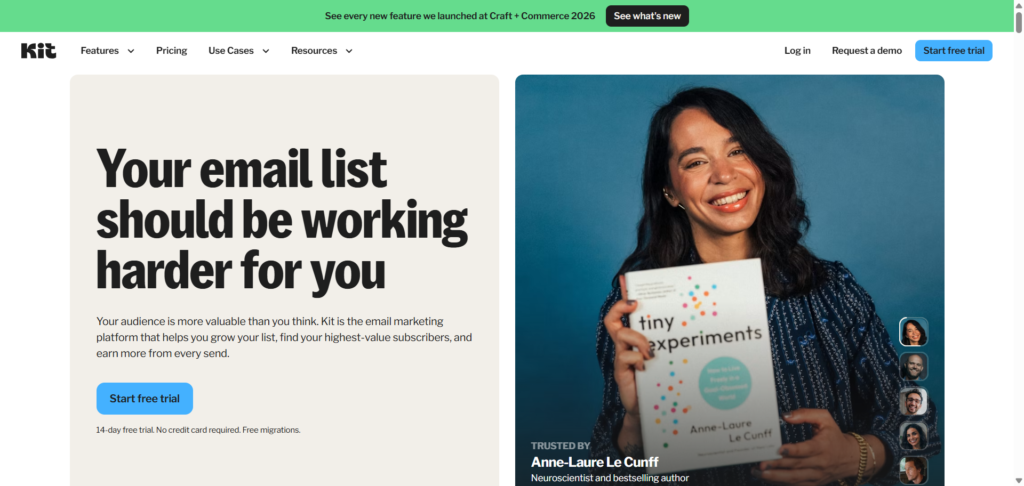
#4. Kit (ConvertKit): Best for Content Creators and Bloggers Promoting Affiliate Products
Score: 8.2/10
Kit — formerly ConvertKit — is built for creators, and that design philosophy makes it a natural fit for bloggers, newsletter writers, and content marketers who monetize through affiliate links. If your affiliate strategy is built around content and audience trust rather than high-volume promotional blasts, Kit is the right platform.
Kit's subscriber tagging and segmentation system is optimized for content-driven businesses. You can tag subscribers by content topic, purchase behavior, link clicks, and engagement level — then trigger personalized affiliate offer sequences based on exactly what each subscriber has shown interest in.
The AI tools include an AI email writer, subject line suggestions, and an automated sequence builder that helps you map out a complete promotional series without starting from a blank page. The visual automation workflow is clean and intuitive — significantly easier to use than ActiveCampaign's for creators who prioritize writing and audience-building over technical automation.
A feature that's often underrated: Kit includes commerce functionality that lets you sell digital products and affiliate offers from the same account. For bloggers and newsletter writers who run a mix of their own products and affiliate promotions, this eliminates the need for a separate checkout tool.
The free plan supports up to 1,000 subscribers — the most generous free tier among the beginner-friendly options on this list.
- Pricing: Free up to 1,000 subscribers. Creator plan starts at approximately $25/month.
- Best for: Bloggers, newsletter writers, and content creators who use affiliate marketing as a primary or secondary monetization channel and want a platform designed around their workflow.
- Limitation: Kit is less suited for affiliates who run high-volume promotional campaigns or need advanced design customization. The platform is built for text-focused, relationship-driven email — not heavy HTML promotional templates.
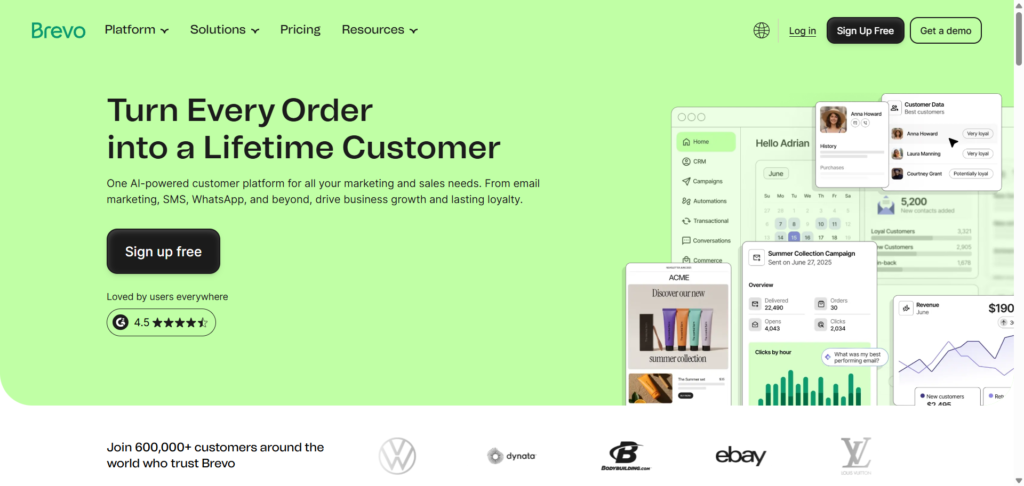
#5. Brevo (formerly Sendinblue): Best Free Option for Affiliate Email Marketing
Score: 8.0/10
Brevo offers the strongest free plan in the affiliate email marketing category — unlimited contacts and up to 300 emails per day, with no monthly subscriber cost. For affiliates starting from zero or testing a new niche before scaling, Brevo removes the financial barrier entirely.
The affiliate link policy is not explicitly restrictive — Brevo does not ban affiliate links the way Mailchimp does, and the platform has been reliably used by affiliate marketers across multiple niches. That said, the policy language is less explicit than GetResponse or AWeber, so verifying your specific use case with Brevo support before building your entire operation there is worth doing.
The AI features are solid for a platform at this price point. Brevo includes AI subject line optimization, send-time optimization, and basic AI segmentation. The built-in CRM is included at no extra charge — a real advantage over platforms that charge separately for CRM functionality. The multichannel capability — email, SMS, and WhatsApp from one platform — is a genuine differentiator for affiliates who want to run follow-up sequences across multiple touchpoints.
Brevo's compliance tools are among the strongest on this list, with built-in GDPR support, double opt-in, and suppression list management — important for affiliates with any EU audience.
- Pricing: Free plan with unlimited contacts and 300 emails/day. Paid plans start at approximately $9/month and remove the daily send cap.
- Best for: Budget-conscious affiliates, beginners building their first list, and marketers who want multichannel follow-up (email + SMS + WhatsApp) at the lowest possible cost.
- Limitation: The 300 emails/day cap on the free plan is a real constraint once your list grows. Advanced automation features require a paid tier upgrade.
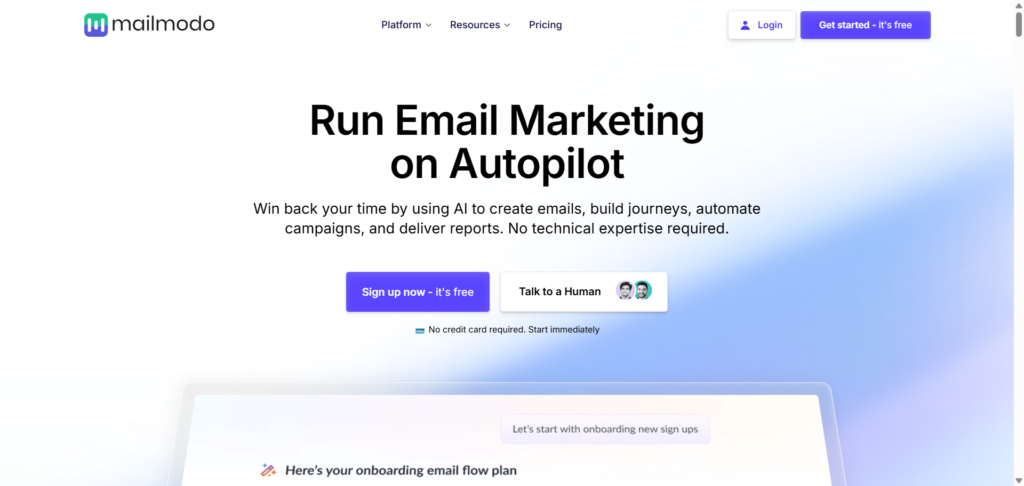
#6. Mailmodo: Best AI-Native Platform for Interactive Affiliate Emails
Score: 7.9/10
Mailmodo is the most AI-forward platform on this list. Where other tools use AI for copy generation and send-time optimization, Mailmodo applies AI at the campaign strategy level — and introduces AMP-powered interactive emails that no other platform on this list supports.
The AI Campaign Planner is Mailmodo's signature differentiator. It doesn't just help you write an email — it suggests how many emails to send, when to send them, which audience segment to target, and what the campaign objective should be. For affiliate marketers who understand their product but don't have a background in email strategy, this is genuinely useful guidance.
The AMP email capability is unique. AMP-powered emails allow subscribers to complete quizzes, fill out forms, and respond to polls directly inside the email — without clicking through to a landing page. Mailmodo reports that AMP emails drive engagement rates approximately 3x higher than standard HTML emails. For affiliates promoting products where interactivity or qualification can increase conversion intent, this is a meaningful advantage.
AI copywriting, sequence planning, and A/B testing tools are all included, with the most advanced features available on higher-tier plans.
- Pricing: Starts at approximately $39/month. Most advanced AI features require higher-tier plans.
- Best for: Tech-savvy affiliate marketers who want to experiment with interactive email formats and AI-driven campaign strategy, and who are willing to invest more to access the most cutting-edge email tools.
- Limitation: Higher entry price than most alternatives on this list. Advanced AI features are gated behind more expensive plans. Mailmodo has a smaller user community than established players, which means fewer third-party tutorials and integrations.
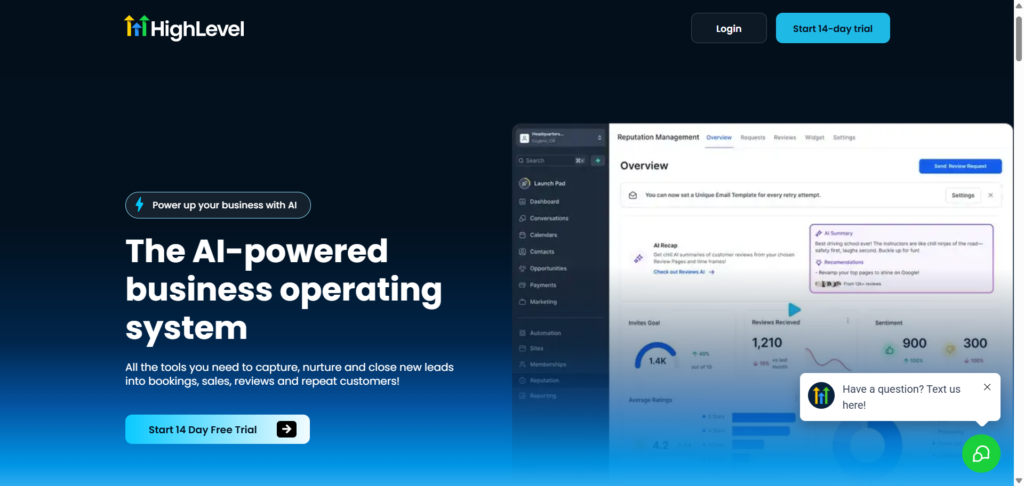
#7. GoHighLevel: Best for Agency-Level Affiliates and White-Label Use
Score: 7.8/10
GoHighLevel is not a traditional email service provider. It is a full marketing suite — CRM, email, SMS, funnel builder, website builder, and AI tools in one platform — and it occupies a unique position in the affiliate marketing space.
For most solo affiliates, GoHighLevel is overkill. For advanced affiliates running agencies, managing multiple client campaigns, or promoting high-ticket offers that require complex multi-step funnels, it is one of the most powerful platforms available.
The AI features include an AI content writer, an AI conversation bot for automated follow-up, and automated email and SMS sequences that can run in parallel across multiple contacts simultaneously. The funnel builder supports sophisticated affiliate promotion sequences with conditional logic, upsell and downsell paths, and behavioral branching.
GoHighLevel's most distinctive opportunity for affiliates is the white-label model. You can rebrand GoHighLevel as your own SaaS product and sell access to it — turning the tool itself into an affiliate offer or a high-value bonus that increases your conversion rate on other promotions. Affiliates running “agency in a box” programs or SaaS-style affiliate offers use this feature to add significant perceived value to their offers.
- Pricing: Starts at approximately $97/month.
- Best for: Advanced affiliates running agencies, high-ticket affiliate programs, or SaaS-model promotions. Also suited for affiliates who want to white-label the platform as part of their own offer stack.
- Limitation: Overkill and cost-prohibitive for solo or beginner affiliates. The learning curve is steep, and at $97/month, the investment requires a list and an offer that can generate a clear return.
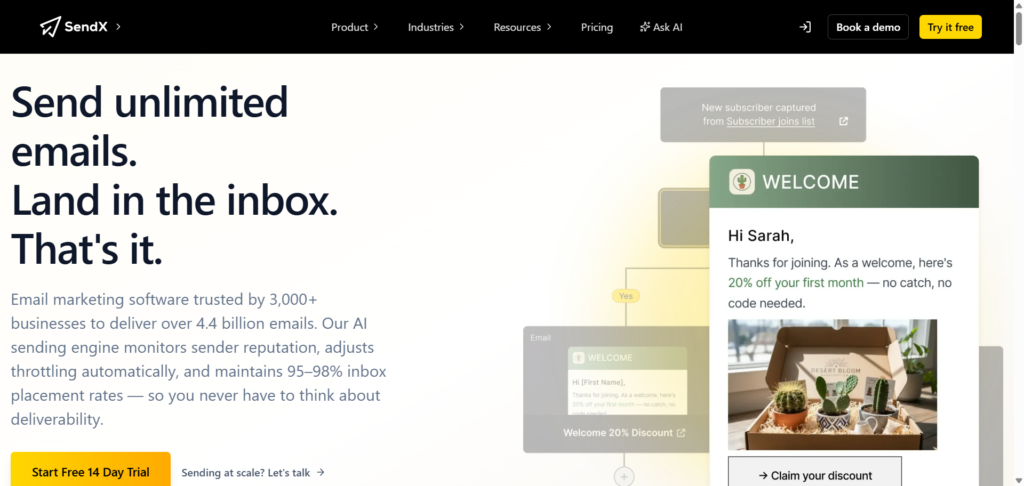
#8. SendX: Best for Affiliates Who've Been Burned by Restrictive Platforms
Score: 7.5/10
SendX leads with the clearest affiliate policy statement of any platform on this list. Their position: if your business is legal and your behavior is good, they will work with you. No ambiguity, no case-by-case review, no risk of waking up to a suspended account.
For affiliates who've previously had accounts terminated at Mailchimp or MailerLite, that clarity is worth a lot.
SendX's proprietary Opti-Send Technology automatically optimizes email delivery timing and routing to maximize inbox placement rates — a deliverability-first feature that directly addresses one of the main risks in affiliate email marketing. The 1-Click Resend feature automatically resends your campaign to non-openers with a different subject line — a simple but highly effective tactic for recovering open rate on promotional emails.
List building tools — pop-up forms, inline forms, and landing pages — are built into the platform at no extra cost, eliminating the need for a third-party form or landing page builder at the early stages of your list growth.
SendX uses flat-rate pricing that includes unlimited email sends — an unusual and genuinely affiliate-friendly pricing model for high-frequency senders.
- Pricing: Flat-rate pricing from approximately $9.99/month with unlimited email sends.
- Best for: Affiliates who want unambiguous policy support and deliverability protection, particularly those who've experienced account suspension at other platforms.
- Limitation: SendX has a smaller feature set and a less advanced AI toolkit than GetResponse, ActiveCampaign, or Mailmodo. The template library is limited. It's the right platform for policy clarity and deliverability — not for cutting-edge AI capability.
#9. EmailOctopus: Best Budget-Friendly Tool for High-Volume Affiliate Senders
Score: 7.0/10
EmailOctopus is the leanest and most cost-effective platform on this list — and intentionally so. It's built for affiliates who have large lists, simple campaign needs, and a clear objective: send a lot of emails for the lowest possible cost.
The subscriber-to-price ratio is the best in the category. The free plan supports up to 2,500 subscribers — five times more than AWeber's free tier. Paid plans scale affordably as your list grows. For affiliates who've moved past the learning stage and need a reliable, low-cost delivery engine for straightforward promotional campaigns, EmailOctopus delivers.
The drag-and-drop editor is clean and functional. Basic automation — welcome sequences and drip campaigns — covers the core affiliate use cases without adding complexity you don't need. EmailOctopus also integrates with Amazon SES, allowing very high-volume senders to route emails through Amazon's infrastructure at a dramatically reduced per-email cost.
The AI features are minimal — basic subject line suggestions rather than the strategic AI tools you get with GetResponse or Mailmodo. If AI-powered optimization is a priority, this is not your platform.
- Pricing: Free up to 2,500 subscribers. Paid plans start at approximately $8/month.
- Best for: Affiliates with established, large lists who run simple, high-frequency promotional campaigns and want to minimize platform costs without sacrificing deliverability.
- Limitation: EmailOctopus is not built for sophisticated behavioral automation or AI-driven optimization. Affiliates who need advanced segmentation, predictive sending, or complex workflow automation will outgrow it quickly.
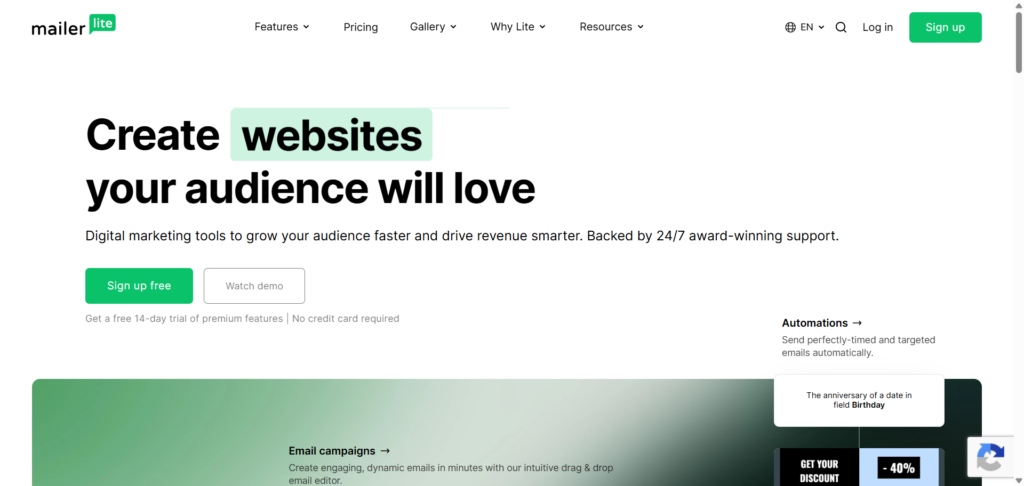
#10. MailerLite: Best for Simplicity with Growing AI Ambitions
Score: 6.8/10
MailerLite is clean, affordable, and increasingly capable on the AI front — making it a solid middle-ground option for affiliates who want a well-designed platform with good deliverability and don't need the advanced automation depth of ActiveCampaign or the full funnel system of GetResponse.
The AI features include an AI email writer, a subject line generator, and Smart Sending (MailerLite's version of send-time optimization). The landing page and pop-up builder are among the best-designed in the category, making MailerLite a strong choice for affiliates who rely on on-site lead capture for list building.
The deliverability record is solid. MailerLite's email infrastructure performs consistently well on inbox placement testing.
The one meaningful caveat: MailerLite's affiliate link policy is conditional. The platform allows affiliate links on a case-by-case basis — which means your account may be subject to manual review before or after you start sending affiliate campaigns. That conditional status creates real uncertainty. Before building your list on MailerLite, contact support, explain your affiliate marketing use case specifically, and confirm eligibility in writing.
- Pricing: Free up to 1,000 subscribers. Paid plans start at approximately $9/month.
- Best for: Affiliates who prioritize simplicity, clean design, and solid deliverability — and who verify their account eligibility for affiliate marketing use before committing.
- Limitation: The conditional affiliate policy is the biggest risk. Without written confirmation that your account is cleared for affiliate campaigns, you're building on uncertain ground. Verify first, build second.
How Do AI Features Actually Help Affiliate Marketers Earn More?
AI in email marketing is not a feature to check off a list. It's a direct revenue mechanism — and understanding exactly how each AI tool translates into affiliate commissions is the difference between using it and using it well.
AI Send-Time Optimization (STO): The Hidden Commission Booster
Send-time optimization uses machine learning to analyze each subscriber's historical open behavior and deliver your email at their individual peak engagement window — not a population average, but a per-contact prediction.
The practical impact: GetResponse's Perfect Timing and ActiveCampaign's Predictive Sending both report open rate lifts of 5–15% from STO alone. On a list of 10,000 subscribers with a 2% click-to-sale conversion rate, a 10% open rate increase means hundreds of additional clicks on your affiliate link — without changing a word of your copy.
To enable STO in GetResponse, activate “Perfect Timing” in the send settings of any email campaign or automation. In ActiveCampaign, enable “Predictive Sending” at the campaign level. One important caveat: STO requires a minimum behavioral data set to function accurately — typically 3 to 6 months of subscriber history. Use it from day one, but don't expect peak performance until your list matures.
AI Copywriting for Affiliate Email Sequences
AI writing tools built into GetResponse, AWeber, Kit, and Mailmodo generate promotional copy, nurture sequences, and subject lines at speed. For affiliate marketers producing high email volume across multiple offers and niches, this matters.
The most effective approach is a targeted prompt strategy: give the AI the product name, the target audience's primary pain point, and your call to action. Then edit the output for your voice and personal experience with the product. AI handles the structure and the first draft — you provide the authenticity that builds subscriber trust.
What AI cannot replace is your direct experience with the product you're promoting. Personal stories, specific results, and genuine recommendations are what convert in affiliate email — and those still come from you.
AI Segmentation and Behavioral Targeting
ActiveCampaign and GetResponse use AI to group subscribers dynamically based on engagement level, purchase intent signals, and content interaction patterns. The practical application is straightforward and high-impact.
Separate your “hot” buyers — subscribers who clicked an affiliate link three or more times — from your “cold” subscribers who haven't engaged in 60 days. Send your strongest, highest-converting offer to the hot segment. Send educational content or a re-engagement sequence to the cold segment. The result is higher click-through rates on your affiliate links, lower unsubscribe rates, and a stronger sender reputation — all of which compound over time.
Predictive Analytics: Knowing Which Subscribers Will Buy
Predictive scoring assigns each subscriber a probability score based on behavioral signals: email open frequency, link click patterns, time since last engagement, and purchase history. The higher the score, the more likely the contact is to convert.
The affiliate application is direct: concentrate your highest-value offers (your best affiliate programs, your limited-time promotions, your bonus-stacked launches) on subscribers with top predictive scores. Send educational content, value emails, and lower-commitment offers to lower-score segments. You stop wasting your best offers on cold audiences, and you stop under-investing in your hottest ones.
Choosing the Right Email Marketing Tool Based on Your Affiliate Niche
While any of these tools is good for affiliate marketing, all of them are not the same for every affiliate. The right platform depends on what you're promoting, how complex your buyer journey is, and where you are in your business. Here's the use-case framework.
Best Tool for Information Product Affiliates (Courses, eBooks, Memberships)
Recommendation: GetResponse or Kit
Information product promotions — courses on ClickBank or JVZoo, eBook launches, membership site offers — require nurture-heavy sequences, webinar-style promotions, and funnel integration. GetResponse is the strongest fit because its built-in sales funnels, webinar hosting, and visual automation workflows are designed specifically for this type of launch-driven affiliate campaign. Kit is the right alternative for bloggers and newsletter writers whose affiliate strategy is built on content trust rather than aggressive promotional sequences — its creator-first tagging and clean email design align with how information product audiences want to be communicated with.
Best Tool for SaaS Affiliate Marketers
Recommendation: ActiveCampaign
SaaS affiliate marketing involves long buyer journeys. A subscriber might research a tool for weeks before converting — clicking multiple emails, visiting pricing pages, watching demos. ActiveCampaign's behavioral triggers, CRM integration, and contact scoring are purpose-built for tracking and responding to that kind of multi-touch journey. The ability to automate follow-ups based on specific link clicks, page visits, and lead score thresholds makes it the strongest platform for SaaS affiliate programs where timing and precision targeting determine conversion.
Best Tool for Physical Products and Amazon Associates
Recommendation: Brevo or MailerLite
Physical product affiliate marketing (Amazon Associates, retail affiliate programs, cashback and coupon offers) requires high-frequency sending at low cost, with product-based segmentation to match the right offer to the right subscriber. Brevo's multichannel capability (email + SMS + WhatsApp), unlimited contacts on the free plan, and built-in CRM make it the right choice for affiliates managing multiple product categories. MailerLite is a solid alternative for affiliates who want simplicity and strong deliverability at a low monthly cost — provided you verify your account eligibility for affiliate campaigns before building your list.
Best Tool for High-Ticket Affiliate Marketers
Recommendation: GoHighLevel or ActiveCampaign
High-ticket affiliate offers — coaching programs, masterminds, premium SaaS, financial products — require the most sophisticated buyer journey management. Longer consideration periods, multiple follow-up channels, and conditional automation logic are non-negotiable at this level. GoHighLevel's full CRM, multi-channel follow-up (email, SMS, voicemail drops), and funnel builder support the complexity that high-ticket conversion requires. ActiveCampaign is the more accessible alternative with equally deep behavioral automation and contact scoring — at a lower entry cost than GHL for affiliates who don't need the full agency infrastructure.
Best Free Tool for Affiliates Just Starting Out
Recommendation: AWeber (free up to 500 subscribers) or Brevo (up to 300 emails/day)
If you're building your first affiliate email list and cost is a constraint, AWeber and Brevo are the two legitimate starting points. AWeber's free plan gives you 500 subscribers, pre-built affiliate marketing templates, and explicit policy permission — plus the confidence that your account won't be suspended for using affiliate links. Brevo's free plan gives you unlimited contacts with a 300-email daily send cap — enough volume to start building momentum. Both platforms allow you to learn affiliate email marketing in a safe environment before committing to a paid tool.
Conclusion: Which Email Marketing Tool Should You Choose?
The best email marketing tools for affiliate marketers in 2026 are the ones that explicitly welcome you, deliver your emails to the inbox, and give you the AI and automation tools to convert subscribers into buyers — repeatedly, at scale.
For most affiliate marketers, the best tool comes down to where you are right now. If you're starting out, begin with AWeber or Brevo — both are free, both are affiliate-safe, and both give you room to learn without financial pressure. If you're intermediate and ready to build a complete funnel system, GetResponse is the right move. If you're advanced, managing an established list, and need behavioral precision, ActiveCampaign is the tool that will unlock the next level of your performance.
Which email marketing tool should you choose? My advice is: pick the tool from the list above that matches your current stage, sign up for a free trial, and build a 5-email welcome sequence using the platform's built-in AI tools. Then monitor three metrics from day one — open rate, click rate, and spam complaint rate. Those three numbers will tell you everything about whether your affiliate email operation is healthy and growing.
The platform is just the infrastructure. The list you build on it is the asset. Start building today.