
 Chadrack
The contest between Rank Math and SEOPress is not about feature-count: whoever has more schema types or a bigger user base wins. The real contest is about which plugin creates the lowest operational risk for your particular WordPress site.
That distinction matters because Rank Math and SEOPress now represent two different approaches to WordPress SEO. Rank Math packs more functionality into one ecosystem. Its feature set covers schema, redirects, 404 monitoring, content analysis, internal-link suggestions, Google Search Console and Google Analytics reporting, rank tracking, Content AI, AI Link Genius, and AI visibility monitoring. For an affiliate publisher or content site owner who wants fewer separate tools, that concentration can save time.
SEOPress, on the other hand, takes a more control-focused approach. It emphasizes a cleaner dashboard, white labeling, page-builder compatibility, privacy controls, unlimited-site licensing on its PRO plan, and the ability to connect AI features to providers such as OpenAI, Claude, Gemini, Mistral, and DeepSeek. That makes it particularly interesting for agencies, developers, and publishers who already have an established AI stack.
These two approaches are very important today in 2026 when Google AI Overviews, ChatGPT, Perplexity, and other AI answer engines have changed how people discover information. Rank Math is leaning into this shift with AI-assisted workflows and AI visibility tracking, while SEOPress taking a more interoperable approach through external AI providers, llms.txt, and WordPress Abilities API/MCP support. I think this two positions are what we should really investigate.
So, in this updated Rank Math vs SEOPress comparison, I’ll focus on the current product direction: AI workflows, generative-search readiness, technical SEO, pricing models, migration, and practical use cases.
Key Takeaways
- Rank Math vs SEOPress in 2026 comes down to a philosophy fight: closed automation versus open interoperability, not just a feature count.
- Rank Math's AI Visibility Tracker monitors brand mentions and sentiment inside ChatGPT responses. SEOPress's MCP support lets external AI agents, including Claude, read and edit your SEO settings directly.
- Rank Math Pro runs $95.88/year for unlimited personal sites. SEOPress PRO starts at $49/year for one site and locks in a lifetime renewal price.
- Rank Math's 2026 AI pricing shifted from per-word credits to a feature-usage model where unused runs don't roll over. SEOPress lets you bring your own OpenAI, Claude, Gemini, Mistral, or DeepSeek API key with no markup.
- Neither plugin replaces content quality, backlinks, or site authority. Pick the plugin that matches how you already work, then execute.
DISCLOSURE: WebIncomeJournal is supported by readers like yourself. We may earn an affiliate commission when you purchase through our links, which helps us offer our content for free. Learn more here.
The Quick Verdict: Rank Math vs SEOPress

If you want the broadest built-in WordPress SEO toolkit, Rank Math is the stronger choice. If you want simpler licensing, white labeling, privacy controls, and the freedom to connect your own AI providers, SEOPress is the stronger choice.
Choose Rank Math for built-in automation
Rank Math makes more sense if you want SEO, analytics, schema, redirects, rank tracking, content analysis, internal linking, and AI tools concentrated inside WordPress. Its AI Link Genius is particularly relevant to publishers managing large content libraries because it identifies internal-link opportunities and supports bulk link updates.
Its Content AI ecosystem also gives writers in-editor assistance rather than forcing them to move between several external tools. That makes Rank Math a practical fit for affiliate marketers and content publishers who value speed and centralized SEO management.
Choose SEOPress for control and multi-site management
SEOPress is the better fit if you manage multiple client websites or want tighter control over your SEO and AI stack. Its PRO Unlimited license costs $149/year, while its white-label capability lets agencies present the SEO system under their own branding.
SEOPress also takes a different approach to AI. Instead of making its own AI ecosystem the center of your workflow, it lets you connect providers such as OpenAI, Claude, Gemini, Mistral, and DeepSeek using your own API keys.
Decision matrix
| Feature | Rank Math | SEOPress | Best for |
| Main plugin pricing | $95.88/year for PRO | $49/year for 1 site; $149/year for unlimited sites | SEOPress for multi-site value |
| AI architecture | Built-in Content AI and proprietary SEO workflows | Bring your own API keys for OpenAI, Claude, Gemini, Mistral, and DeepSeek | Rank Math for integration; SEOPress for provider choice |
| Generative search | AI visibility tracking, schema, and AI-assisted SEO | llms.txt, AI integrations, and agent-ready infrastructure | Depends on your AI strategy |
| Internal linking | AI Link Genius with automated link opportunities | No equivalent native GSC-driven auto-linking system | Rank Math |
| Agency workflow | Business and Agency plans with client-site and keyword-tracking capacity | Unlimited-site PRO license and white labeling | SEOPress |
| Dashboard philosophy | Feature-rich SEO command center | Cleaner, more control-focused workflow | Depends on preference |
The bottom line: Rank Math gives you more built-in levers. SEOPress gives you more control over the system around those levers. Neither is universally the best WordPress SEO plugin, so your site type and operating model should determine the final choice.
If you want built-in automation and a broader SEO toolkit, explore Rank Math. If you prefer a lightweight, control-focused SEO setup, check out SEOPress.
What Are Rank Math and SEOPress?
Rank Math and SEOPress are WordPress SEO plugins that put technical and on-page SEO controls directly inside your WordPress dashboard. They help you manage the signals that search engines need to understand and process your website without requiring a collection of separate SEO plugins.
What Rank Math does

Rank Math positions itself as an all-in-one SEO platform for WordPress. Its WordPress.org listing shows it trusted by more than 4 million websites, with over 16 schema types available in the free version alone.
Rank Math’s feature set covers SEO titles and meta descriptions, XML sitemaps, schema markup, redirects, 404 monitoring, content analysis, internal-link suggestions, image SEO, Google Search Console and Analytics integrations, rank tracking, and AI-assisted workflows.
That broad feature set makes Rank Math particularly useful when you want to consolidate SEO tasks into one dashboard. For an affiliate site, for example, you can manage product-related schema, redirect old URLs, optimize metadata, monitor search performance, and identify internal-link opportunities without adding several specialized plugins.
And, it is important to say at this point that I’ve been using Rank Math on the Web Income Journal for close to four years. So, I’ve experienced firsthand, it’s evolving AI-assisted capabilities.
What SEOPress does
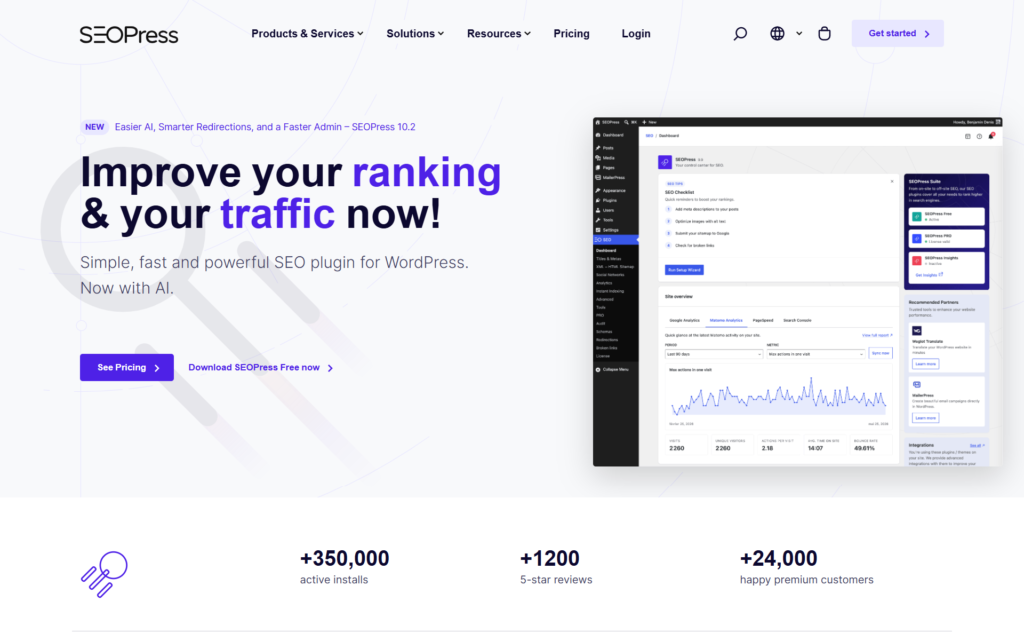
SEOPress covers the same core SEO foundation but takes a more control-oriented approach. It provides metadata controls, social previews, XML and HTML sitemaps, canonicals, schema, image SEO, analytics integrations, page-builder support, redirects, site auditing, WooCommerce SEO, and AI-powered metadata and image optimization.
Its Universal SEO Metabox is also built to work across major WordPress builders, including Gutenberg, Elementor, Divi, Bricks, Oxygen, Breakdance, WPBakery, and others. That makes SEOPress particularly relevant for developers and agencies managing different client environments.
In the last few years, I’ve used SEOPress on some of my niche sites. During this time, I’ve seen how it has evolved with the changing SEO landscape, with its API/MCP support system, though I’ve not tried them specifically.
What an SEO plugin can do?
An SEO plugin can improve how your website communicates its SEO signals. It can control metadata, canonical URLs, robots directives, structured data, XML sitemaps, redirects, social metadata, breadcrumbs, and other technical settings.
It can also make SEO execution faster. Features such as content analysis, internal-link suggestions, bulk metadata tools, schema generators, and Search Console reporting turn repetitive SEO tasks into manageable WordPress workflows.
What an SEO plugin cannot do
An SEO plugin cannot create topical authority or original experience for you. It cannot manufacture useful content, earn authoritative backlinks, build conversion trust, or make weak search-intent alignment disappear.
That distinction is important in this Rank Math vs SEOPress comparison. A plugin is an SEO control layer, not a ranking machine. Your content quality, internal linking, site architecture, technical health, authority, and ability to satisfy visitors still determine whether those SEO settings translate into meaningful organic growth.
Pricing, Licensing, & AI Cost Models: The Real Cost
The biggest pricing difference between Rank Math and SEOPress is not simply the annual license fee. You also need to consider site limits, rank tracking, AI usage, API costs, and whether the features you actually need are included in the core plugin.
Rank Math Pro & Content AI
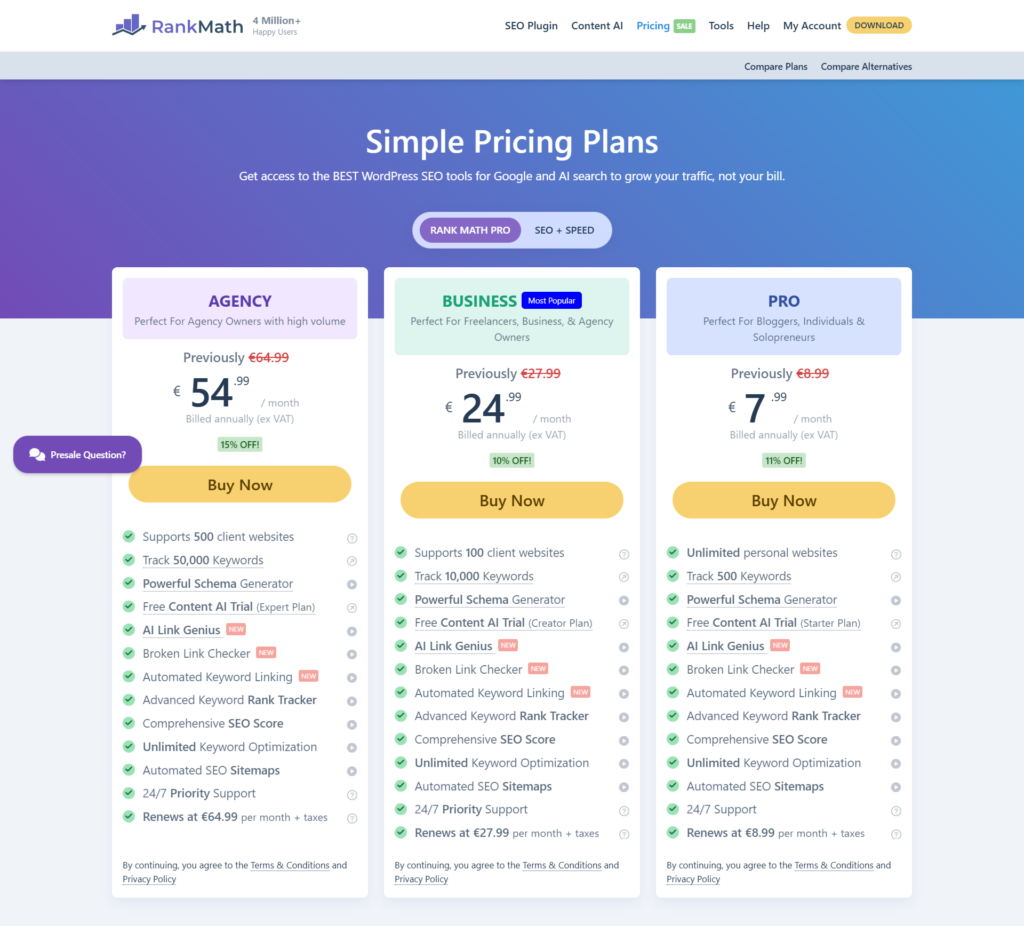
Rank Math Pro costs $95.88 per year for unlimited personal sites, while the Business plan costs $299.88 per year for up to 100 client sites.
The AI pricing model also changed in 2026. Starting from its plugin version 1.0.269 and PRO version 3.0.112., Rank Math moved away from its previous per-word AI credit system toward feature-based usage limits, meaning the cost model is tied to how frequently specific AI capabilities are used. The Creator tier, for example, includes defined allowances for keyword research, semantic variations, long-form articles, and SEO meta-analysis, and unused allocations do not roll over. This means even a quiet month still costs you the allotment you didn't use.
Content AI is an additional subscription rather than simply an extension of the Rank Math Pro license. The documented tiers are Starter at $5.99/month, Creator at $10.99/month, and Expert at $16.99/month, billed annually. Their allowances increase from 1 to 50 AI Visibility brands, 50 to 1,000 AI link opportunities, and 15 to unlimited long-form articles, respectively.
That makes Rank Math's total cost dependent on how deeply you use its AI ecosystem. A publisher who needs AI visibility tracking, internal-link opportunities, metadata generation, and large-scale content assistance needs to evaluate the plugin license and Content AI subscription together.
SEOPress Pro & SEOPress AI
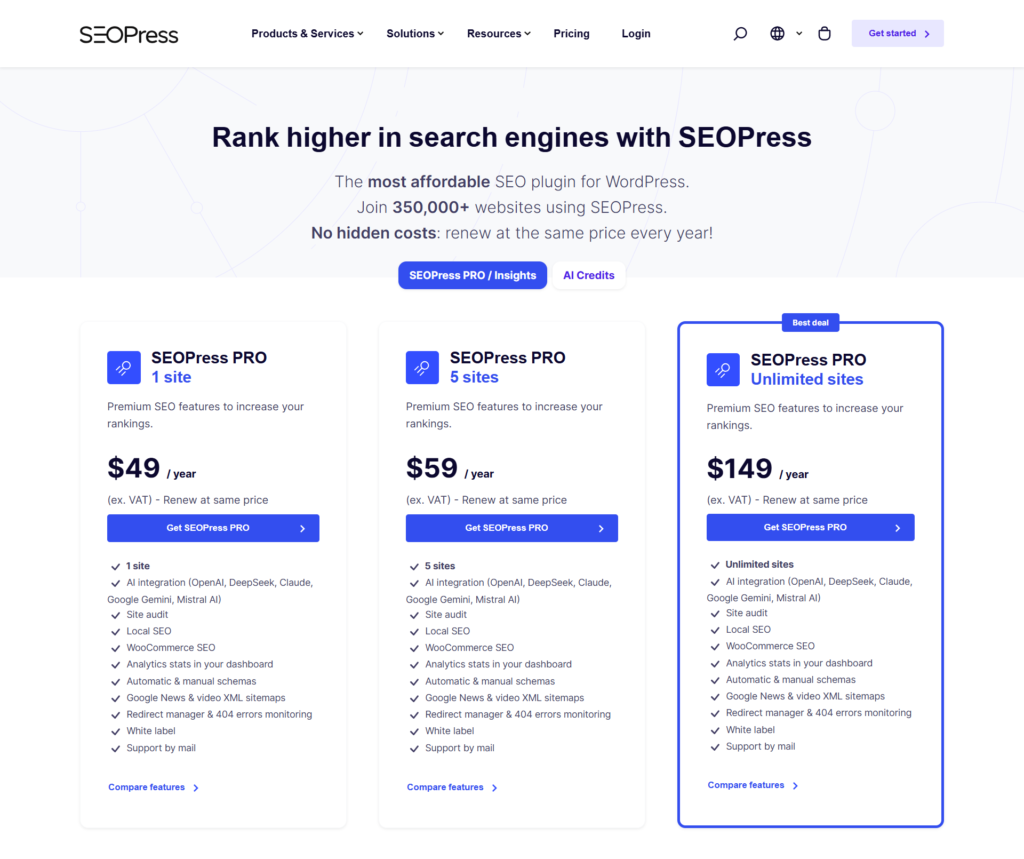
SEOPress uses a simpler licensing structure. PRO costs $49/year for one site, $59/year for five sites, and $149/year for unlimited sites, with a lifetime-locked renewal price.
Its AI model is different as well. The PRO license includes its AI features without arbitrary feature-based limits, but you need an AI provider to power those features. You can either bring your own API key from OpenAI, Claude, Gemini, Mistral, or DeepSeek, or purchase ready-to-use SEOPress AI credits.
The bring-your-own-key model gives experienced users more control over their AI stack and avoids an additional markup from SEOPress for the provider connection. If you purchase SEOPress AI credits instead, the remaining balance is displayed inside the WordPress dashboard so you can monitor usage.
So, which pricing model wins? Rank Math offers a deeper integrated ecosystem, but its total cost can rise as you add AI capacity. SEOPress has the clearer cost structure for multi-site operators, particularly agencies that need unlimited-site licensing and already have preferred AI providers.
IMPORTANT: These plugins are constantly updating their pricing plans. I encourage you to confirm the current pricing before you make you decision to buy.
Rank Math: See Rank Math Plans
SEOPress: See SEOPress Plans
Generative Search (AEO/GEO) Philosophies
Rank Math and SEOPress take fundamentally different approaches to AI search visibility. Rank Math focuses on measuring how brands appear inside AI-generated answers, while SEOPress focuses on making WordPress content and SEO controls accessible to AI agents.
That distinction matters because AEO and GEO are broader than traditional on-page SEO. Google AI Overviews, ChatGPT, and Perplexity can surface information without sending the searcher to a conventional ten-blue-links result page. Your SEO plugin therefore needs to support both the technical foundation of your site and the way your content participates in AI-driven discovery.
Rank Math: AI Visibility and Mention Tracking
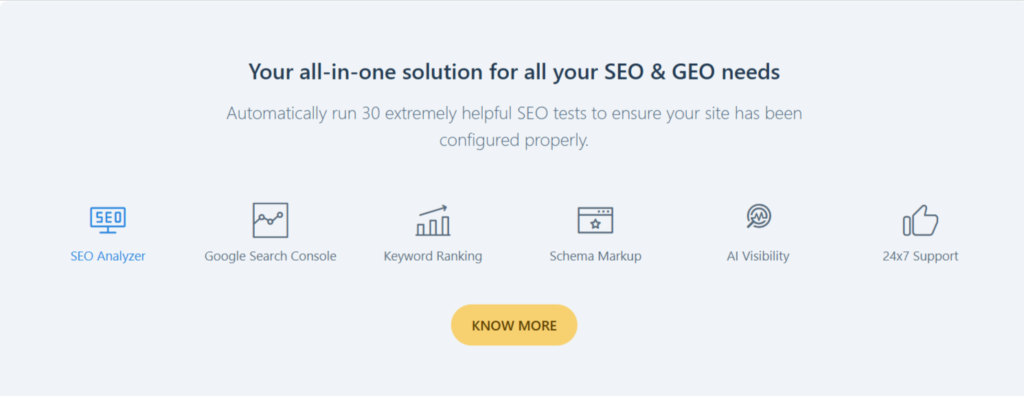
Rank Math's major advantage is that it gives you a measurement layer for AI visibility. Its AI Visibility system provides an AI Visibility Score that combines signals such as brand mentions, sentiment, citations, and visibility trends.
This changes the workflow from simply publishing content and hoping AI platforms notice it. You can monitor how your brand or products appear in ChatGPT responses and identify whether those mentions are positive, neutral, or negative.
The AI Response Transcripts are particularly useful for this purpose. Rank Math provides weekly updated transcripts showing the context in which your brand or product appears, giving you a much clearer view of what an AI system is actually saying about your business.
Rank Math also lets you track competitors alongside your own brand. That creates a practical GEO workflow: identify the queries where competitors receive AI mentions, inspect the context, and look for content gaps that could improve your own visibility.
For publishers focused on AI search visibility, this is a meaningful advantage. Rank Math is treating generative search as something you can monitor and measure rather than simply another reason to add schema markup.
SEOPress: Agent Interoperability and LLM Discovery
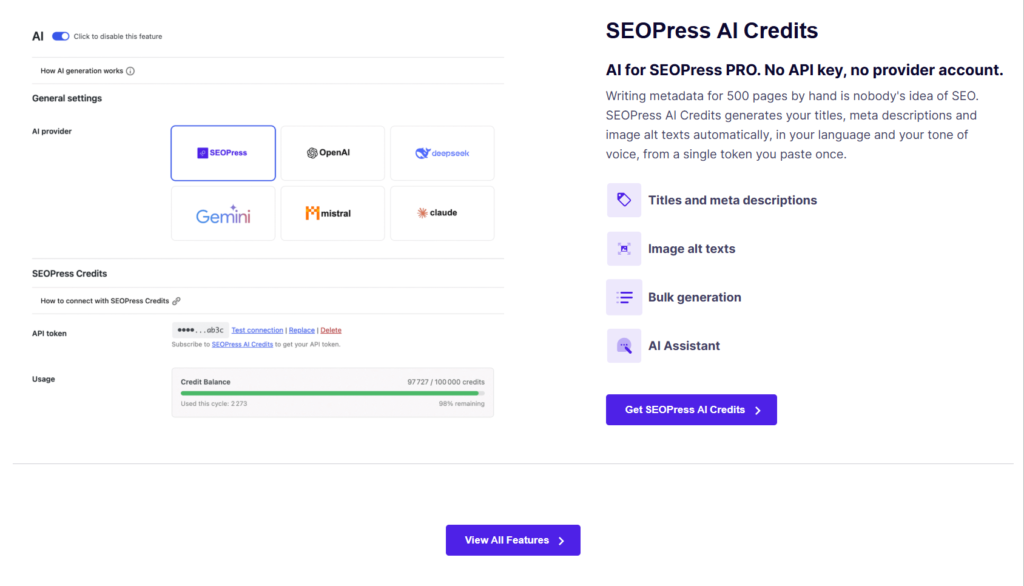
SEOPress approaches AI search from the opposite direction. Instead of concentrating primarily on measuring brand mentions, it focuses on making WordPress SEO data accessible to external AI agents and making site content easier for AI systems to discover.
Its support for the WordPress Abilities API and Model Context Protocol (MCP) allows external AI agents to interact with SEOPress through its REST API. The practical benefit is significant for technical users. With the free version, connected agents can read and update SEO titles, meta descriptions, indexation rules, canonical settings, and social previews. SEOPress PRO expands those capabilities to include redirects, structured data, keywords, and image alt text.
SEOPress also generates a root llms.txt file and additional /.well-known/ endpoints. These provide AI crawlers with structured discovery information about important content on the site.
Which approach is better for AEO and GEO?
There is no universal winner because the plugins solve different problems.
Choose Rank Math if you want to measure AI visibility. Its AI Visibility Score, response transcripts, sentiment data, and competitor tracking give publishers a dedicated system for understanding how brands appear in AI answers.
Choose SEOPress if you want to build an AI-integrated WordPress workflow. Its MCP and Abilities API support, llms.txt generation, and external AI-provider approach give developers and agencies more control over how AI agents interact with their SEO infrastructure.
The key point is easy to miss: neither feature guarantees inclusion in ChatGPT, Google AI Overviews, or Perplexity. AI visibility still depends on the quality, relevance, authority, structure, and accessibility of the underlying content.
Explore Rank Math AITechnical SEO & Automation
Rank Math has the stronger advantage in built-in SEO automation, while SEOPress competes by keeping individual technical workflows controlled and transparent. The difference becomes especially clear in internal linking, AI-assisted publishing, image optimization, and sitemap monitoring.
1. Internal Linking Automation: Rank Math AI Link Genius
Rank Math AI Link Genius is one of the clearest automation advantages in this comparison. It audits site structure and uses Google Search Console data to identify contextually relevant incoming and outgoing internal-link opportunities.
For a large affiliate site, that can solve a real operational problem. Instead of manually reviewing hundreds of articles for missed connections, you can identify opportunities between informational content, comparison pages, and commercial pages.
AI Link Genius can also apply bulk link updates and provides a one-click rollback capability. It can identify orphan pages as well, helping prevent valuable content from becoming isolated within the site's internal architecture.
SEOPress does not offer an equivalent native Google Search Console-driven auto-linking system. Users therefore need to handle internal linking manually or add another tool, like LinkWhisper, when they want automated link discovery and management.
For content-heavy affiliate publishers, Rank Math wins this category.
2. In-Editor Writing Assistants
Rank Math also takes a broader approach to AI-assisted content creation. Content AI provides more than 40 in-editor tools, including rewriting, sentence expansion, copywriting formulas, and the RankBot chat assistant.
SEOPress takes a more conversational approach. Its AI Assistant operates inside the Gutenberg Block Editor, where writers can use commands such as /write to draft sections, translate titles, or perform actions on selected blocks.
The distinction is therefore about workflow rather than simply counting AI features. Rank Math gives you a larger collection of specialized writing utilities, while SEOPress puts AI assistance into a more direct editor-based interaction.
3. Image Metadata Automation
Rank Math uses visual analysis to generate image alt text automatically. Its available allowances depend on the Content AI subscription tier, making this particularly useful for publishers with large image libraries.
SEOPress PRO takes a broader metadata approach. It can generate alt text, captions, and descriptions when images are uploaded, while individual field controls prevent the system from overwriting existing manually written image SEO.
That last point matters for established websites. Automation should reduce repetitive work without destroying metadata that an editor has already reviewed.
4. Technical Sitemap Checks
SEOPress has a useful advantage in sitemap quality control. Its XML Sitemap Health Check can test for 404 errors, caching conflicts, incorrect robots.txt references, and XML formatting problems.
The PRO version can automate these checks twice daily and send Slack or email alerts when a problem is detected. That turns sitemap validation from an occasional manual task into an ongoing technical SEO monitoring process.
So the technical verdict is split. Rank Math is stronger for proactive internal-link automation, while SEOPress is stronger for automated sitemap health monitoring. For a growing content site, both address real operational problems, but they do so at different points in the SEO workflow.
Try Rank MathMigration: What Happens to Your Metadata?

Migrating between Rank Math and SEOPress should be treated as a technical deployment, not a simple plugin replacement. Both ecosystems provide migration or import functionality, but transferring SEO settings successfully is only the first step.
The critical data includes SEO titles, meta descriptions, canonical URLs, robots directives, schema markup, redirects, social metadata, and sitemap configuration. Losing or changing any of these during a migration can create indexing problems even when the new plugin appears to be working normally.
Before switching, export your existing SEO settings and crawl the site. Record important URLs, metadata, canonicals, redirects, schema, indexation rules, and sitemap coverage before deactivating the old plugin.
After importing the data, perform a second crawl and compare the results. Test representative pages manually, validate structured data, check redirects, inspect canonical tags, confirm XML sitemaps, and monitor Google Search Console for unexpected indexing changes.
Do not judge a migration by whether the new plugin activates successfully. The real test is whether the site's existing SEO signals survive the transition intact.
The same principle applies whether you are moving from Yoast SEO to Rank Math, Yoast SEO to SEOPress, Rank Math to SEOPress, or SEOPress to Rank Math. A one-click importer can reduce the mechanical work, but it does not remove the need for migration QA.
White Label, Privacy, and Agency Operations
SEOPress's PRO White Label feature lets agencies and developers change the plugin's name, logo, and appearance for clients, so a client never sees “SEOPress” in their own dashboard. Rank Math offers client-site plans through its Business and Agency tiers, with user-role management to control what client users can access, though it lacks the same full white-label rebrand.
Hiding SEO settings from clients matters for agencies that don't want a client accidentally breaking a redirect or deleting schema. Both plugins support role restrictions, but SEOPress's calmer default dashboard makes accidental changes less likely simply because there's less to click.
Client handover raises a licensing question worth settling before you sign a contract: who owns the license, and who owns the Google, Search Console, and AI provider credentials once the relationship ends? SEOPress's unlimited-site PRO license gives an agency flexibility to manage this internally, while Rank Math's client-site plans tie usage more directly to plan tier.
On privacy, SEOPress explicitly states that its PRO White Label feature lets agencies and developers change the plugin name, logo, and appearance for clients, and that users need their own AI-provider key for AI features, with no extra fee charged for that connection. That data-flow transparency is a real factor for agencies working with clients under GDPR or similar privacy requirements.
So, which is the best choice for agencies? SEOPress is the better agency choice when white labeling, predictable unlimited-site licensing, and control over the AI stack are priorities. Rank Math is stronger when the agency values built-in analytics, extensive rank tracking, automation, and a centralized SEO feature set.
The important point is that agency SEO is an operations problem as much as an optimization problem. The plugin needs to fit your client delivery model, not simply win a feature comparison.
Final Recommendations & Ideal Use Cases
Now, back to our question Rank Math vs SEOPress, which SEO plugin is best for 2026?
I’m sure we have established this already. There’s really no single winner for every WordPress site. Your particular situation will determine the plugin to choose. For most single-site users, the decision comes down to workflow rather than raw feature count.
Rank Math wins for built-in automation and centralized visibility. Its Content AI, broad integrations, internal-linking workflow, and AI Visibility features suit publishers who want more of the process inside one platform.
SEOPress wins for modularity, licensing flexibility, and interoperability. Its cleaner approach, agency-friendly options, BYO-provider model, and WordPress Abilities API support suit developers and advanced users who want control over how SEO and AI tools connect.
And it is worth adding that if you already have one of these plugins working well, switching solely for a feature checklist is rarely worthwhile. Migrate only when the new workflow solves a real problem: excessive cost, missing automation, poor usability, agency licensing, AI-provider control, or the need to connect authorized tools to WordPress.
And remember: neither Rank Math nor SEOPress is a substitute for publishing useful content, maintaining a crawlable site, earning relevant links, and answering the questions your audience actually asks.
Choose Rank Math if you want broader built-in SEO functionality, automation, AI tools, and internal-linking capabilities.
Choose SEOPress if you prioritize simplicity, control, white labeling, and flexible multi-site licensing.
Frequently Asked Questions
Is Rank Math better than SEOPress for a single WordPress blog?
Rank Math is generally the better choice for a single WordPress blog if you want more built-in SEO features and automation. Rank Math combines content analysis, schema, redirects, rank tracking, internal-link assistance, analytics, and AI tools in one WordPress dashboard. SEOPress is a better choice if you prefer a cleaner interface, greater control over your AI providers, and a lower-cost single-site PRO license.
Which plugin has the better free version?
Rank Math and SEOPress both provide strong free SEO functionality, but the better choice depends on the features you need. Rank Math is stronger if you want a broader collection of built-in SEO tools and automation. SEOPress is stronger if you prefer a simpler SEO workflow with core controls and a more focused interface. The source brief does not provide enough evidence to declare one free version the universal winner.
Can Rank Math and SEOPress run together?
No, you should not run Rank Math and SEOPress together as your primary SEO plugins. Both plugins can generate overlapping SEO metadata, canonical settings, sitemaps, schema markup, redirects, and other technical signals. Choose one SEO plugin as the primary system and disable or remove overlapping features from other plugins to prevent duplicate or conflicting output.
Which is better for affiliate marketing?
Rank Math is the stronger choice for affiliate marketing when automation and internal linking are priorities. Its AI Link Genius can identify internal-link opportunities, while its broader SEO toolkit supports schema, redirects, content analysis, analytics, and rank tracking. SEOPress remains a strong option for affiliate publishers who prefer more manual control and a modular SEO stack.
Can I migrate from SEOPress to Rank Math?
Yes, you can migrate from SEOPress to Rank Math, but you should treat the process as a technical SEO migration. Before switching, preserve important SEO data such as titles, meta descriptions, canonical URLs, robots directives, schema, redirects, and sitemap settings. After migration, crawl the site and verify representative pages to confirm that metadata, redirects, structured data, canonicals, and indexation settings remain correct.
Which plugin has better AI features?
Rank Math has the stronger built-in AI feature set for users who want integrated SEO and content workflows. Its Content AI provides more than 40 in-editor tools, while its AI Visibility system tracks brand mentions, sentiment, citations, trends, and competitor visibility. SEOPress has a different AI advantage because it supports external providers such as OpenAI, Claude, Gemini, Mistral, and DeepSeek and supports AI-agent interoperability through MCP and the WordPress Abilities API.







Great SEO plugin comparison! Rank Math vs. SEOPress is a tough choice. Highlighted key differences perfectly. Thanks!
“Fantastic comparison! Both Rank Math and SEOPress offer impressive features, but it’s great to see a detailed breakdown of their strengths and weaknesses. This will definitely help in deciding which plugin provides the best value based on specific needs. Personally, I’m leaning towards Rank Math for its extensive free features, but SEOPress also has some compelling points. Thanks for clarifying the differences!”
“Excellent comparison! Both plugins have great features, but it’s always tough to decide which offers the best value. I’m particularly interested in how each plugin performs in terms of ease of use and long-term benefits. Did you find any standout features in either that made a significant difference? Also, how do they compare in terms of support and updates? Thanks for breaking this down—looking forward to your insights!”
This is a fantastic comparison of Rank Math and SEOPress! Having a clear breakdown of features and pricing is super helpful for choosing the right SEO plugin. Will definitely consider both options for my WordPress site. Thanks for sharing!
“Great comparison! Both Rank Math and SEOPress are popular SEO plugins, and understanding their differences can help users make the best choice for their needs. Your analysis of features, pricing, and performance is really useful. Thanks for providing such a thorough review—this will definitely help users decide which plugin offers the best value for their SEO strategy!”
Great comparison between Rank Math and SEOPress! Choosing the right SEO plugin can significantly impact website performance, so your detailed analysis is incredibly useful. I appreciate the breakdown of features and value—it’s a big help for deciding which plugin offers the best ROI. Thanks for the insightful review
“Great comparison between Rank Math and SEOPress! Both plugins have their strengths. Which one do you find offers the best value for money in terms of features and ease of use, and are there any specific scenarios where one outperforms the other?”
“Excellent comparison! Both Rank Math and SEOPress offer robust features, but it’s great to see a side-by-side analysis of their strengths and value. Your breakdown helps clarify which plugin might be the best fit depending on specific needs and budget. Thanks for providing such a thorough review!”
“Excellent comparison between Rank Math and SEOPress! Choosing the right SEO plugin can make a significant difference, and your detailed analysis helps clarify which might offer the best value for money. Thanks for breaking down the features and benefits—this will definitely aid in making an informed decision!”
The attention to detail and quality of materials make all the difference.