Chadrack
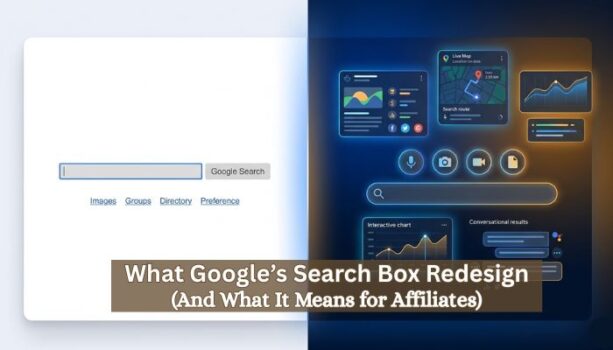
Google's search box redesign — the biggest in 25 years — is a direct admission that AI-mediated search is now the default, not a feature. AI Mode has over 1 billion monthly users, and queries are doubling every quarter. For affiliates, this means one thing: optimizing for AI citations is no longer optional. The affiliates who move now will own the citation landscape before the 2028 crossover.
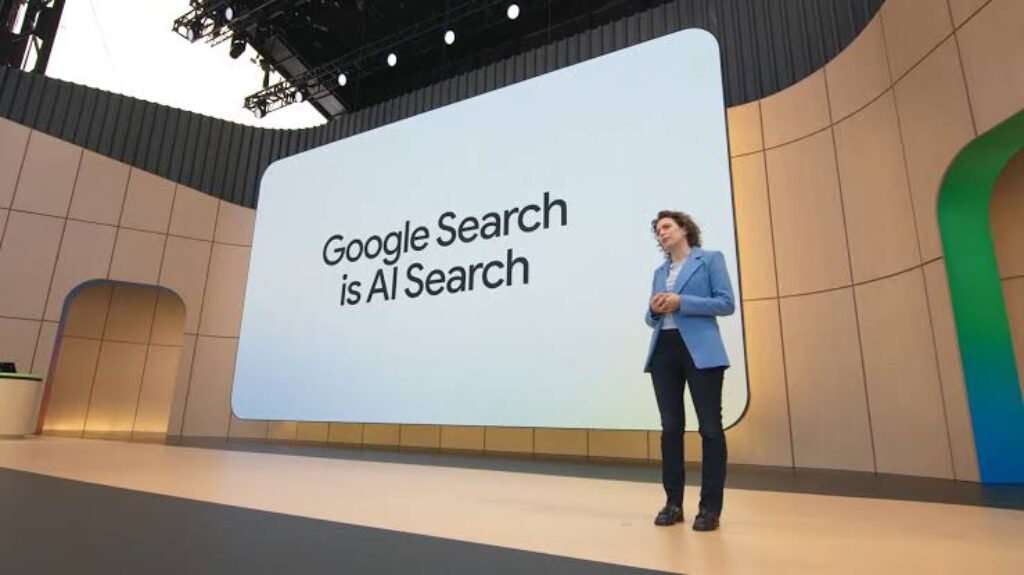
Google just contradicted itself in front of the entire world — and most affiliates missed it.
At Google I/O on May 19, 2026, Google VP of Search Liz Reid unveiled the “intelligent Search box,” the most significant redesign of Google's search interface in over 25 years. The old autocomplete bar is gone. In its place: an AI-powered input that accepts text, images, videos, files, and even Chrome tabs, and returns synthesized answers instead of ten blue links.
Here's the contradiction: for the last few years, Google has been telling SEOs, content creators, and affiliate marketers that GEO (Generative Engine Optimization) and AEO (Answer Engine Optimization) are not new disciplines — that they are just SEO by another name, and that chasing AI-specific optimization is unnecessary. Then Google turned around and rebuilt its 25-year-old search product from the ground up around AI.
Companies don't do that for trends they consider irrelevant.
This article breaks down exactly what Google admitted at I/O 2026, what the data says about where search revenue is actually moving, and what affiliate marketers need to do right now — before the 2028 crossover point makes this conversation moot.
Key Takeaways:
- Google's redesign is a strategic admission. The shift from autocomplete to AI-powered intent suggestions confirms that conversational, AI-mediated search is Google's primary product going forward, not a supplementary feature.
- AI traffic is small in volume but outsized in value. AI platforms currently account for just 0.58% of total site traffic but generate over 5% of sales. AI-referred customers convert at 4.4× to 23× the rate of traditional organic visitors and carry a 25% higher lifetime value ($325 vs. $271).
- The 2028 crossover is approaching. AI search visitors are projected to surpass traditional organic visitors for high-value digital marketing topics by early 2028.
- Affiliates who optimize for AI citation now hold a first-mover advantage.
- Google's I/O keynote is your real playbook. Not their SEO guidance. Not their official statements. What Google built tells you exactly where the commercial value in search is moving.
The Advice vs. The Actions — Google's Contradiction on Record
Let me be direct: Google has been gaslighting the SEO and affiliate marketing community for two years.
While independent SEOs, GEO researchers, and affiliate strategists were advising that the rise of AI search demands a new set of strategies, Google's official position was reassuringly dismissive. Their message, repeated across blog posts, Search Central documentation, and even during the recent Google I/O 2026, was that GEO and AEO are not new disciplines. They have insisted that all of these are just SEO and that we should trust Google's guidance, not outside sources.
That was the advice. Now look at the actions.
What Google Said vs. What Google Did
| Google's Official Stance | Google's Actual Behavior |
| “GEO/AEO is just SEO” | Rebuilt the entire search interface around AI |
| “Follow our existing SEO guidance” | Launched AI Mode, AI Overviews, and agentic search |
| “No need for AI-specific optimization” | Merged AI Mode and AI Overviews into the default experience |
| “Autocomplete still serves users well” | Replaced autocomplete entirely with AI-powered intent suggestions |
A careful analysis of these actions gives me only one conclusion: companies don't redesign 25-year-old business models for trends they consider irrelevant.
Google's capital allocation is its honest opinion. When a company that generates the majority of its revenue from search advertising commits its most significant product redesign in a quarter century to AI-mediated answers, that is not a feature update. That is a strategic repositioning.
I wrote previously about what I called The Great Gaslighting — the period where Google's public messaging and its internal engineering priorities pointed in opposite directions. This article is the next chapter. Because at Google I/O 2026, Google's own behavior finally broke the narrative wide open.
The intelligent Search box announcement didn't just introduce a new interface. It made the contradiction impossible to explain away. Google is no longer building toward AI search. Google is building from it.
So, now, the only question that matters for affiliates is this: what exactly did Google admit — and what does it mean for your business?
Decoding Google I/O 2026 Announcements — What Google Actually Admitted
Stop reading Google's I/O 2026 announcements as product features. Read them as admissions.
Every major announcement Google made on May 19, 2026 answers a question Google has been avoiding for two years. Not “what cool new thing did Google build?” but “what does Google now believe is true about the future of search — and what does it reveal about where affiliate revenue is going?”
Here are the four admissions buried inside the headlines.
Admission #1: AI Mode Is No Longer a Feature — It's the Product
When Google merged AI Mode and AI Overviews into a single default search experience, it wasn't a UX simplification. It was a declaration.
AI Mode already has over 1 billion monthly users, with queries doubling every quarter since launch. You don't merge a feature into the default product unless you've concluded the feature is the product.
Conversational, AI-mediated search is no longer the direction Google is building toward. It is the primary experience Google is building from. That reframes everything: your SEO strategy, your content architecture, and your affiliate revenue assumptions.
Admission #2: Zero-Click Is the Intended End State
AI Overviews have seen a 102% increase in appearance over a two-month window. That is not organic growth. That is an accelerated rollout.
When an AI Overview is present, the position-one organic result loses 59% of its click-through rate (SISTRIX). According to Adweek and Similarweb data from March 2025, 77% of searches that triggered an AI Overview ended with zero publisher clicks.
Google has been framing AI Overviews as a user convenience. The I/O 2026 acceleration tells a different story. Zero-click answers are not a side effect of the AI search transition — they are the intended design outcome. Google is building a search experience where the answer lives inside Google, and the click to your site becomes optional.
For affiliates running traditional SEO strategies built around blue-link rankings and organic CTR, this is not a headwind. It is a structural shift in the economics of content.
Admission #3: The New Search Box Is Built for AI Supremacy, Not User Convenience
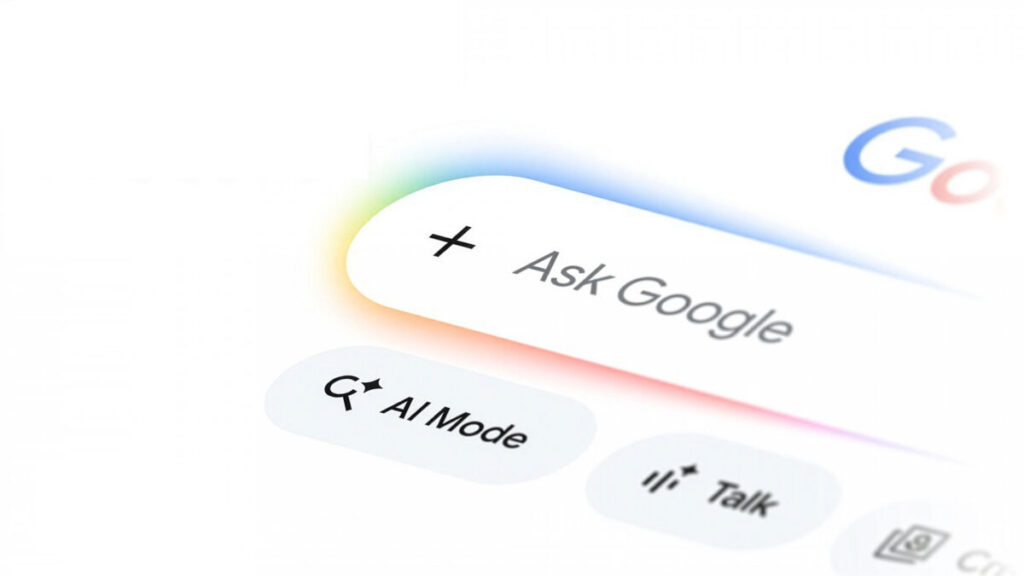
The intelligent Search box — powered by Gemini 3.5 Flash — isn't just a prettier input bar. It accepts text, images, videos, PDFs, and Chrome tabs. It expands to accommodate long, conversational queries. And it replaces autocomplete with AI-powered intent suggestions that go, in Google's own words, “beyond auto-complete.”
This is the infrastructure of agentic search: background information agents that monitor the web, synthesize answers, and return results as dynamic, interactive widgets — without ever sending the user to a publisher's site.
The search box redesign is the physical interface of a fundamental philosophical shift. Google is moving from a directory that points users to information, to a system that delivers information directly. The implications for content creators and affiliate marketers are severe and immediate.
Admission #4: Universal Cart — The Most Damning Announcement of All
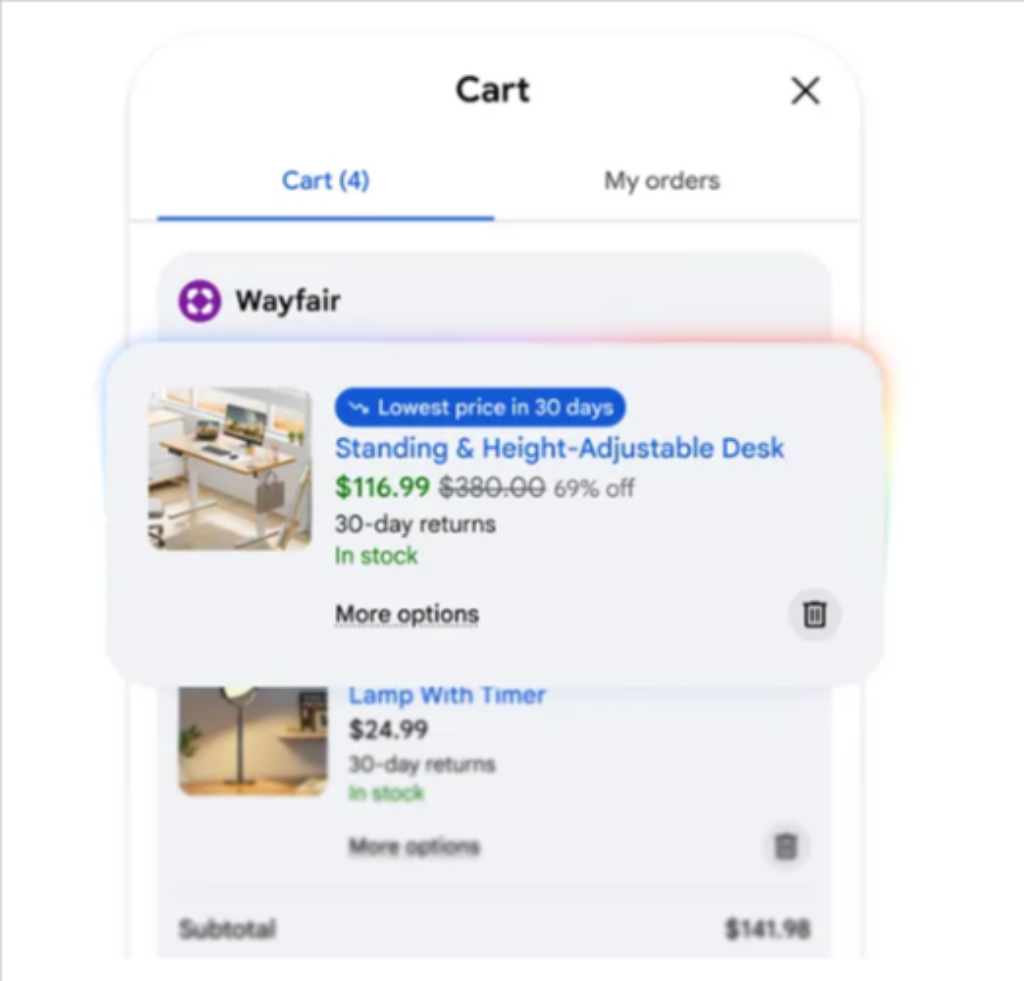
If AI Mode and AI Overviews represent Google's play for the informational end of the search funnel, Universal Cart represents its play for the commercial end — the end where affiliate revenue lives.
Universal Cart is an AI-powered shopping layer embedded directly inside Google Search. It lets users browse products, compare options, and complete purchases inside Google — bypassing affiliate sites, merchant landing pages, and the click-through that affiliate commissions depend on.
This is not Google competing with affiliates. This is Google eliminating the structural need for the affiliate click on high-intent commercial queries. “Best X” roundups, product comparisons, buying guides — the exact content formats that affiliate marketing is built on — are the precise queries Universal Cart is designed to resolve without ever sending the user to your site.
Google is not innovating for users here. Google is repositioning to capture the high-conversion, high-LTV revenue premium that AI-referred traffic commands — revenue that affiliates have been quietly building toward by diversifying into AI visibility.
The I/O 2026 announcements, taken together, form a coherent picture: Google knows exactly where the value in search is moving. And it is moving fast to own it while telling you to focus on traditional SEO.
The Revenue Math Google Doesn't Want You to Run
Here is the number that changes everything: Statistics from different sources show that AI platforms currently account for just 0.58% of total site traffic — but they generate over 5% of total sales.
Run that ratio. A traffic source representing less than 1% of volume is producing nearly 9× its proportional share of revenue. That is not a rounding error. That is a structural signal about where buyer intent has migrated.
Now compare it to traditional Google search: 21.37% of traffic, generating 16.94% of sales. Google sends dramatically more traffic — and produces a proportionally smaller commercial return. The volume-to-value ratio is inverting, and Google's own I/O 2026 redesign is the clearest evidence that they see it too.
The Conversion Multiplier
AI search visitors don't just convert better — they convert at a categorically different rate:
- AI search visitors convert at 4.4× the rate of traditional organic visitors (cross-source 2026 data)
- Ahrefs case data shows conversion rates as high as 23× higher for AI-referred traffic
- Traditional Google organic converts at 2.8%; ChatGPT converts at 15.9%; Claude at 16.8%; Perplexity at 10.5% (Opollo, 2026)
- Clicks that survive AI Overview presence convert 23% better than the pre-Overview baseline
The reason is straightforward. AI search pre-qualifies users during the consideration phase. By the time an AI-referred visitor lands on your page, they have already compared options, understood value propositions, and narrowed their decision. They arrive ready to act — not ready to browse.
The Lifetime Value Gap
The advantage extends beyond the first transaction. AI-referred customers carry a 25% higher lifetime value: $325 compared to $271 for Google-referred customers. For affiliate marketers operating in subscription software, financial products, or high-ticket niches, that LTV gap compounds significantly over time.
The Universal Cart in Search
This is the math Google does not want affiliates to run clearly: the highest-converting, highest-LTV segment of the search funnel is exactly what Universal Cart is designed to absorb.
By inserting a native checkout experience directly into Google Search, Google is not just competing for the commercial query — it is engineering the affiliate click out of the transaction entirely. The “best X for Y” comparison page that earns your commission depends on a user clicking through. Universal Cart removes that dependency for Google's preferred merchant partners.
The affiliates who survive this shift are the ones building content that adds a layer Google's AI cannot replicate: first-hand testing data, transparent commission disclosures, and affiliate-specific use cases that no generative widget can authentically reproduce.
Google's redesign tells you exactly what it values. The question is whether your content strategy reflects that reality yet.
Google's Pivot and the Expected 2028 Crossover
The numbers are already telling the story. The question is whether you're reading them.
ChatGPT's weekly active users grew 8× between late 2023 and early 2025, reaching 800 million. Meta AI crossed 1 billion active users without requiring anyone to download a new app — it embedded itself directly into WhatsApp and Instagram, platforms people already live inside. Google AI Overviews saw a 102% increase in appearance over a two-month window. These are not gradual adoption curves. These are inflection points.
Industry projections place the crossover in early 2028: the point where AI search visitors surpass traditional organic search visitors for high-value digital marketing and SEO topics. That is less than two years away. And the affiliates building for that crossover now — while AI traffic is still 0.58% of volume but 5.09% of sales — will own the citation landscape before the majority of the market even recognizes the shift has happened.
This is the early mover case, stated plainly. Companies investing in AI search optimization in 2025–2026 are projected to see a 144% positive ROI as the market matures toward the crossover point. One agency case documented AI referral traffic growing 43% and conversions from those sources up 83% in just two months of GEO implementation.
Google knows the crossover is coming. That is precisely why they moved at I/O 2026.
They are not redesigning their search box for the search landscape of 2024. They are repositioning for 2028 — and they are doing it now, while they still control the infrastructure. The affiliates who understand this have a narrow but significant strategic window. That window is open today.
The Affiliate Response — What to Do Now That Google Has Shown Its Hand
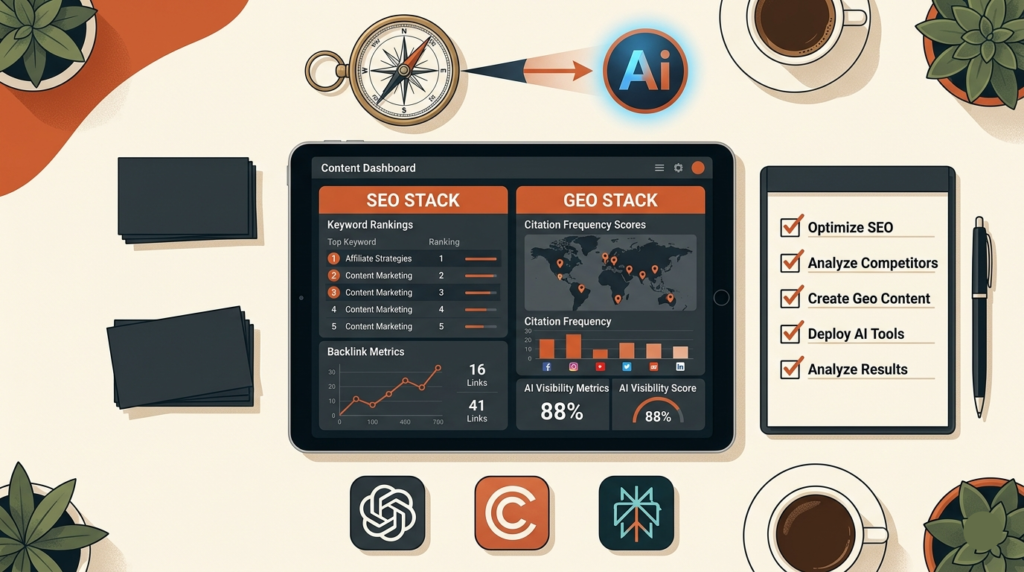
Google has shown you exactly where search is going. The only remaining question is whether your content strategy is built for the destination — or the departure point.
Here is what to do now.
1. Stop Waiting for Google's Permission
Google I/O 2026 is the validation. The intelligent Search box, the AI Mode default, the Universal Cart — these are not beta experiments. They are production decisions made by a company with 1 billion monthly AI Mode users and queries doubling every quarter.
If you have been waiting for an official green light to invest in generative engine optimization and answer engine optimization, the keynote was it. Act accordingly.
2. Optimize for the AI Citation Layer — Separately from Blue Links
This is the insight most affiliates are missing: 28% of AI-cited sources have zero Google organic visibility. The AI citation layer and the traditional search layer are separate discovery systems with different ranking signals.
Winning blue-link position one does not guarantee AI citation. And being cited by ChatGPT, Claude, or Perplexity does not require ranking in Google's top ten. You need a strategy for both — and right now, most affiliate sites only have one.
To build AI citation authority:
- Lead every comparison page and buying guide with a direct answer in the first 150 words
- Publish original data — tests, benchmarks, surveys — that AI models can cite with attribution
- Use FAQ schema and Article schema to make content structurally retrievable
- Build topical clusters — not isolated posts — so AI systems read your site as a depth signal, not a single data point
- Earn authentic brand mentions on Reddit, LinkedIn, and industry publications to strengthen your entity footprint
3. Protect Your Commercial Content from Universal Cart Displacement
The queries most at risk from Universal Cart are your highest-value ones: “best X for Y,” product comparisons, and high-intent buying guides. These are the exact formats Universal Cart is engineered to resolve without a click-through.
The defense is content that no AI shopping widget can authentically replicate:
- First-hand testing data — actual use, actual results, actual screenshots
- Affiliate-specific use cases — who this product is genuinely right for, and who it isn't
- Commission structure transparency — disclosing how you earn builds the E-E-A-T signal that distinguishes editorial content from aggregated product feeds
- Clear comparison tables with “best for” designations — so users who do arrive from AI referral convert faster
Users who click through an AI Overview or AI Mode response are already pre-qualified. Design your pages for that buyer — not the casual browser.
4. Build Your GEO Stack Alongside Your SEO Stack
Traditional SEO still drives 53% of all website traffic across industries (BrightEdge). It is not dead. But it is no longer sufficient on its own.
Your GEO stack needs to run in parallel:
- Freshness discipline: 79% of AI-cited pages were updated within the current year. Set a refresh schedule for every cornerstone content piece, at a minimum every six months
- Structured content for RAG retrieval: Write in self-contained answer blocks that can be extracted independently of surrounding context. Each section should be able to stand alone as a cited source
- Crawlability: Ensure your pages are indexable without JavaScript dependencies. If Google's AI can't cleanly parse your content, it won't cite it
- YouTube as an authority signal: Video transcripts are increasingly processed as content by AI systems. A YouTube presence tied to your written content strengthens entity authority across surfaces
- Outbound linking as a trust signal: According to the Princeton GEO Study, adding citations boosts GEO visibility by 40%. Link to verifiable sources. It signals factual precision, which AI systems reward.
5. Diversify Your Discovery Surfaces Now
Perplexity, ChatGPT Search, and Claude are not Google alternatives you can afford to deprioritize. They are the platforms currently capturing the highest-LTV, highest-conversion segment of the search market — the same segment Google is spending its biggest product redesign in 25 years trying to reclaim.
AI-driven sessions increased 240% from Q4 2025 to Q1 2026 across 42 tracked B2B websites. Claude converts referred visitors at 16.8%. ChatGPT converts at 15.9%. Perplexity at 10.5%. These platforms are not experimental traffic sources. They are active revenue channels with conversion rates that dwarf traditional organic search.
Optimize your content to be cited across all of them. The affiliates who treat GEO as a Google-only discipline are leaving their highest-converting traffic channel unaddressed.
Conclusion: Google's Redesign Is Your Roadmap
Here is the reframe I want to leave you with.
The best strategic document Google has ever produced for affiliate marketers is not their SEO starter guide. It is not their Search Central documentation. It is not the blog post where they told you GEO and AEO are just SEO.
It is the Google I/O 2026 keynote.
Every announcement Liz Reid made on May 19, 2026, tells you precisely where the commercial value in search is moving. The intelligent Search box tells you that conversational, multimodal queries are the new default. The AI Mode and AI Overviews merger tells you that zero-click answers are the intended destination. The Universal Cart tells you that Google intends to own the commercial transaction — the click, the comparison, and the conversion — inside its own interface.
Google is not confused about where search is going. They have made a 25-year bet in a single keynote. Follow what they built, not what they said.
Now is the time to start building your GEO stack. Do not be confused with what Google is doing. Build your commercial content today to survive the zero-click displacement. To own the citation landscape when the crossover arrives you must position yourself now.
Google blinked at I/O 2026.
They showed you exactly where search is going, what they are willing to rebuild to get there, and which revenue streams they intend to capture along the way.
The only question is, will you move now — while the early mover advantage still exists, while AI traffic is still 0.58% of volume and 5.09% of sales, and while your competitors are still waiting for Google's permission to take AI search seriously.
That permission came on May 19, 2026. You just have to act on it.
Frequently Asked Questions
Is Google's “just do SEO” advice still valid for affiliate marketers in 2026?
Google's “just do SEO” advice is partially valid but no longer sufficient for affiliate marketers in 2026. Traditional SEO still drives 53% of all website traffic (BrightEdge), so blue-link rankings remain worth pursuing. However, 28% of AI-cited sources carry zero Google organic visibility, which means the AI citation layer operates as a separate discovery system with different ranking signals. Affiliate marketers need both an SEO strategy and a GEO strategy to capture the full search funnel.
What is Google Universal Cart and how does it affect affiliate marketing?
Google Universal Cart is an AI-powered shopping layer embedded directly inside Google Search that allows users to browse products and complete purchases without leaving Google. It was announced at Google I/O 2026 as part of Google's broader AI Mode integration. Universal Cart directly threatens affiliate marketing by removing the click-through that affiliate commissions depend on — particularly for high-intent queries like product comparisons and “best X” roundups. Affiliates must respond by producing first-hand testing content and editorial analysis that no AI shopping widget can authentically replicate.
Does optimizing for AI search (GEO) actually produce better results than traditional SEO?
Generative Engine Optimization (GEO) produces significantly better conversion results than traditional SEO, even at lower traffic volumes. AI platforms currently account for 0.58% of total site traffic but generate over 5% of total sales. Claude-referred visitors convert at 16.8%, ChatGPT-referred at 15.9%, and Perplexity-referred at 10.5% — compared to 2.8% for traditional Google organic search (Opollo, 2026). Companies that implemented GEO strategies in 2025–2026 are projected to see a 144% positive ROI as AI search volume scales toward the 2028 crossover point.
How is Google AI Overviews changing click-through rates for affiliate sites?
Google AI Overviews are significantly reducing click-through rates for affiliate sites across informational and commercial queries. When an AI Overview appears, the position-one organic result loses 59% of its click-through rate (SISTRIX). Adweek and Similarweb data from March 2025 found that 77% of searches that triggered an AI Overview ended with zero publisher clicks. Affiliate sites must optimize for AI citation inclusion — appearing as a named source inside the AI Overview — rather than relying solely on blue-link click-throughs for traffic.
What should affiliate marketers do differently now that Google has introduced AI search features?
Affiliate marketers must build a dual strategy that targets both traditional blue-link rankings and AI citation inclusion across Google AI Overviews, ChatGPT Search, Claude, and Perplexity. Every comparison page and buying guide should open with a direct answer in the first 150 words, include original first-hand testing data, and use FAQ schema and Article schema for structured retrieval. Commercial content must be refreshed regularly — 79% of AI-cited pages were updated within the current year. Affiliates who diversify across AI discovery surfaces now will hold a measurable first-mover advantage before the projected 2028 AI search crossover.