Chadrack
The global affiliate marketing industry hit $15.7 billion in 2026 — and AI is now the single biggest reason why beginners are breaking in faster than ever.
Not because AI is magic. But because it has collapsed the timeline. What used to take six months of grinding — niche research, content creation, SEO, traffic — now takes days. Some marketers are hitting their first affiliate sale within 30 days. Others are building $1,000/month income streams with a blog, a few AI tools, and a strategy that actually fits 2026.
You can do the same. But only if you know what's changed.
This guide is your complete, beginner-safe roadmap to starting AI affiliate marketing in 2026. Not theory. Not recycled advice from 2021. A step-by-step system built around how AI search, AI content, and AI-powered workflows actually work right now.
What You'll Learn in This Guide:
- What AI affiliate marketing actually is in 2026 (and how it's different from what you've read before)
- Whether affiliate marketing is still profitable — with real numbers
- How to choose a niche you won't regret in six months
- The exact tools, content formats, and traffic channels that work right now
- The mistakes that kill most beginners before they earn a single dollar
Let's get into it.
DISCLOSURE: WebIncomeJournal is supported by readers like yourself. We may earn an affiliate commission when you purchase through our links, which helps us offer our content for free. Learn more here.
What is AI Affiliate Marketing in 2026?

AI affiliate marketing is the use of generative AI and agentic workflows to automate niche research, content production, and affiliate link distribution — while optimizing content to appear in zero-click AI search results on platforms like Google, ChatGPT, and Perplexity.
Well, that's the definition. Now let me break it down so you understand what it actually means in practice.
Traditional affiliate marketing was manual and slow. You'd spend weeks researching a niche, months writing content, and even longer waiting for Google to rank you. The tools helped at the margins — but you were still doing most of the heavy lifting yourself.
In 2026, that model is gone.
AI now handles roughly 80% of the workflow. We're talking niche validation, keyword research, content drafts, SEO optimization, even video scripts and email sequences. Tools like ChatGPT and Claude write your first drafts. SurferSEO and Frase optimize them. Pictory and Opus Clip turn them into video. Agentic workflows — where AI tools chain together to complete multi-step tasks automatically — mean you can run a content system that would have required a full team just two years ago.
Traditional vs. AI-Powered Affiliate Marketing
To succeed today, you must understand the clear contrast between the “old way” and the 2026 standard:
| Traditional Affiliate Marketing | AI-Powered Affiliate Marketing | |
| Content creation | Days per article | Hours (or less) |
| Keyword research | Manual, tool-dependent | AI-assisted, pattern-driven |
| Traffic | SEO-only, slow | Multi-channel, faster ramp |
| Tracking | Basic dashboards | AI-interpreted analytics |
| Scale | Limited by your time | Limited by your strategy |
Is Affiliate Marketing Still Profitable in 2026?
Short answer: yes. But not in the way it used to be.
The 2026 landscape has undergone a massive shift from high-volume noise to high-trust “authority hubs.” Because AI can now generate generic information instantly, the value of “standard” content has dropped to zero. Today, profitability is driven by a concept called Information Gain.
The Power of Information Gain and E-E-A-T
Information Gain is the act of providing unique data, personal experiments, or “boots-on-the-ground” insights that an AI model cannot hallucinate or find elsewhere. This is how you satisfy Google’s E-E-A-T (Experience, Expertise, Authoritativeness, and Trustworthiness) requirements.
Frankly, the retailers are seeing the value too. Roughly 65% of retailers report that affiliate campaigns drive more than 20% of their total revenue growth, particularly in the AI tool and SaaS niche where commissions often range from 20% to 70% and include recurring monthly payouts.
The truth is simple: You don't need a million visitors anymore. You need to be the “trusted expert” that an AI assistant (like Gemini or ChatGPT) cites when a user asks for a recommendation. By focusing on unique case studies and real-world testing—the stuff AI can't fake—you secure your place in the future of affiliate marketing.
How to Choose an AI-Proof Niche in 2026
Let me be direct: this is the single most important decision you will make. While people would tell you to “follow your passion” the truth is, in 2026, passion doesn't pay the bills – strategic positioning does. You need a niche that is “AI-proof,” meaning it requires the human touch, real-world testing, or complex problem-solving that a chatbot can't replicate.
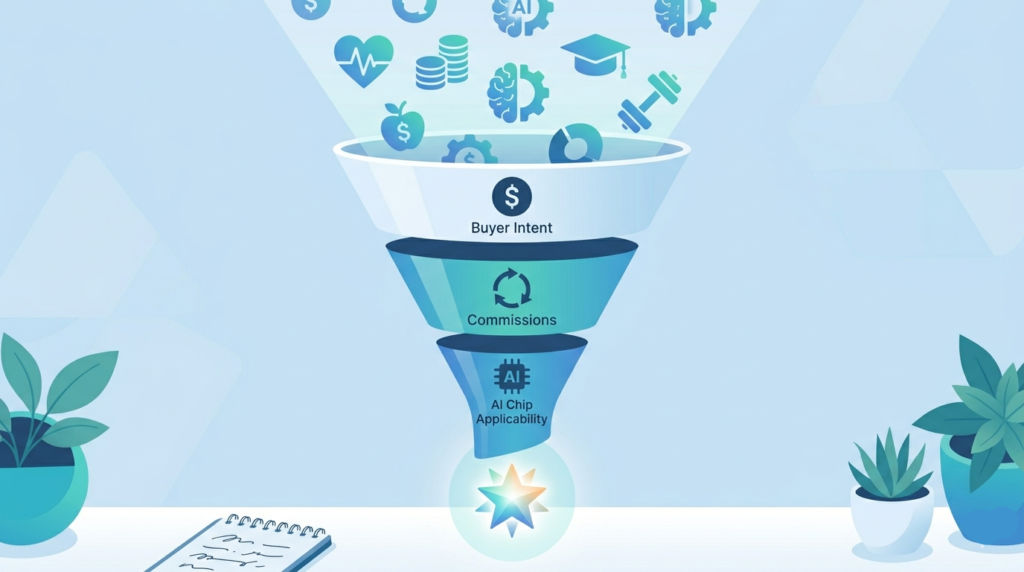
The 3-Factor Niche Filter Framework
Over the last couple of years, I’ve been using this simple scoring tool to qualify any AI affiliate marketing niche in under 10 minutes:
- High Buyer Intent: Are people actively searching for a solution to a painful problem?
- Recurring Commissions: Does the SaaS affiliate niche pay you every month, or just once?
- AI Content Applicability: Can you use AI to produce high-quality content for this niche at scale?
Top AI Affiliate Marketing Niches in 2026
| Niche | Why It Works | Example Sub-Niche | Sample Programs |
| AI Tools & SaaS | Explosive growth, high recurring commissions | AI writing tools for freelancers | Jasper, Copy.ai, Writesonic |
| Personal Finance | Evergreen, high intent, premium payouts | Budgeting apps for self-employed | Monarch Money, YNAB, Wise |
| Online Education | Booming demand, strong platform programs | AI skills courses for marketers | Coursera, Teachable, Kajabi |
| Health & Wellness | Huge audience, strong sub-niche potential | Wearables & sleep optimization | Whoop, Eight Sleep, Hims |
| Productivity Tools | High buyer intent, SaaS-heavy | Project management for remote teams | Notion, ClickUp, Monday.com |
| Marketing Software | B2B buyers, premium commissions | Email marketing for creators | ConvertKit, ActiveCampaign, Beehiiv |
The sweet spot for 2026? AI Tools & SaaS. The category is growing fast, buyers are actively searching, commissions are recurring, and you can build genuine content authority without needing a PhD.
How to Validate Your Niche with AI Right Now
Instead of guessing, here’s the exact prompt I use every time in ChatGPT or Perplexity:
“I'm evaluating [niche idea] as an affiliate marketing niche for 2026. Please give me: (1) an estimated monthly search volume range for the top 5 buyer-intent keywords in this niche, (2) the top 3 sub-niches with the least competition but strong commercial intent, (3) at least 5 affiliate programs in this niche with their commission rates and cookie duration, and (4) a yes/no verdict on whether this niche has strong recurring-commission potential.”
Run this for two or three niche ideas. Compare the outputs. The niche with the strongest recurring-commission programs and the most specific sub-niche gaps wins.
One final rule: “AI tools” is a niche. “AI writing tools for freelance copywriters” is a business. Specificity builds topical authority faster — and attracts buyers, not browsers.
How to Set Up Your “AI-Ready” Affiliate Website
Once you have nailed your AI affiliate marketing niche, your next move is to set up your website. Unfortunately, here's where most beginners stall. They spend two weeks debating platforms and never publish a single word. Let’s overcome that challenge. Here’s how to make a clear decision, and a fast-track your website setup in a weekend.
Blog vs. YouTube vs. Social: Which Platform Is Right for You?
| Platform | Best For | Traffic Speed | Long-Term Value |
| Blog | SEO, AI search citations, compounding traffic | Slow (3–6 months) | Very High |
| YouTube | Product reviews, trust-building, high conversion | Medium (1–3 months) | High |
| Visual niches, lifestyle, finance, fast reach | Fast (weeks) | Medium | |
| TikTok/Reels | Viral reach, brand awareness | Very fast | Low–Medium |
The recommendation: Start with a blog.
Why? Because a well-structured blog post is what Google AI Overviews cite. It's what ChatGPT Search and Perplexity pull from. It compounds over time — meaning a post you write today can still earn commissions two years from now. No algorithm reset. No demonetization risk. And AI makes the content production fast enough that the “slow start” is no longer the blocker it used to be.
Add YouTube as a second channel once your blog has 10–15 posts. Use social to distribute, not to build.
Minimum Viable Blog Setup (The Fast-Track Version)
You don't need a perfect website. You need a live one. Here's the exact setup:
Step 1: Register a domain
Use Namecheap. Pick something short, niche-relevant, and memorable. Use AI: “Suggest 10 brandable domain names for a blog about AI productivity tools for freelancers.”
Step 2: Get hosting
Bluehost is the go-to solution for beginners — affordable, fast, and WordPress-ready out of the box. Their custom cpanel makes setup straightforward even if you've never built a site.
Step 3: Install WordPress and a clean theme
WordPress powers over 40% of the web for a reason. Pair it with a lightweight theme like Kadence or Astra. Fast load times matter for both Google rankings and AI search indexing.
Step 4: Install your core plugins
- RankMath — SEO optimization, schema markup, and AI Overview readiness
- Thirsty Affiliates — affiliate link management, cloaking, and click tracking
- WP Rocket or Litespeed Cache — site speed
- UpdraftPlus — backups
Step 5: Let AI build your key pages
Use ChatGPT or Claude to write your About page, Privacy Policy, Affiliate Disclosure, and your first three content outlines. What used to take weeks now takes an afternoon.
That's it. Your site doesn't need to be beautiful on day one. It needs to be live, fast, and optimized for the right keywords.
Why You Must Build Your Email List from Day 1
I made the mistake back when I got started and many beginners are still making this same mistake. They focus 100% on traffic — Google, Pinterest, YouTube — and ignore email entirely.
The truth is, every traffic source you don't own can disappear overnight. A Google algorithm update. A Pinterest policy change. A platform ban. It happens.
Your email list? That's yours. Forever.
Start collecting emails from your first published post. Use GetResponse or Kit — both have generous free tiers that are more than enough when you're starting out.
Your lead magnet doesn't need to be complicated. Use AI to create it in an hour. Here’s the prompt I used to create one a few months ago:
“Create a one-page PDF checklist called ‘The AI Affiliate Starter Kit' — a step-by-step list of the 10 tools and actions a beginner needs to launch their first AI affiliate campaign in 2026.”
Once you have created the lead magnet, embed the opt-in form in your blog sidebar, at the end of every post, and as an exit-intent popup. Even a list of 500 engaged subscribers can generate consistent monthly commissions — before your SEO traffic has even kicked in.
How to Create Affiliate Content That Ranks and Converts
Content is the engine. Everything else — tools, traffic, email — feeds into it or flows from it. And in 2026, the standard has risen. Generic AI content ranks nowhere. Thin reviews get ignored. But specific, experience-backed, well-structured content? That's what Google features. That's what AI search engines cite.
Here's how to build it.
The 3 Highest-Converting Affiliate Content Formats
1. Product Reviews — “X Review: Is It Worth It?”
This is the highest-converting format in affiliate marketing. Full stop. Someone searching for “[tool] review” has already done their awareness research. They're evaluating. They're close to buying. Your job is to answer the one question they're really asking: should I trust this enough to click your link?
Structure it like this:
- Hook: Your honest one-line verdict, upfront
- What it is: Brief, clear description
- Who it's for: Specific use cases
- Features breakdown: What it actually does
- Pros and cons: Be honest — especially about the cons
- Pricing: Always include this
- Verdict: Direct recommendation
Place your affiliate link in the intro (after the hook), in the pricing section, and in the verdict. Three placements. No more. Over-linking kills trust.
2. Comparison Articles — “X vs Y: Which is Better?”
These attract buyers who are deciding between two specific options. High intent. High conversion. The format is simple: cover features, pricing, ease of use, and ideal user for each tool side by side — then give a clear winner with a reason.
Use a comparison table near the top. It gets cited by AI Overviews and keeps skimmers engaged. Place affiliate links for both tools — you win either way.
3. Best-Of Listicles — “10 Best AI Tools for [Use Case]”
These attract a slightly broader audience but drive serious volume. The key is specificity. “Best AI tools” is too vague. “Best AI writing tools for freelance copywriters in 2026” has a reader. It has an intent. It converts.
Structure: intro → quick-reference table → individual reviews → verdict. Add affiliate links inside each mini-review and in the comparison table.
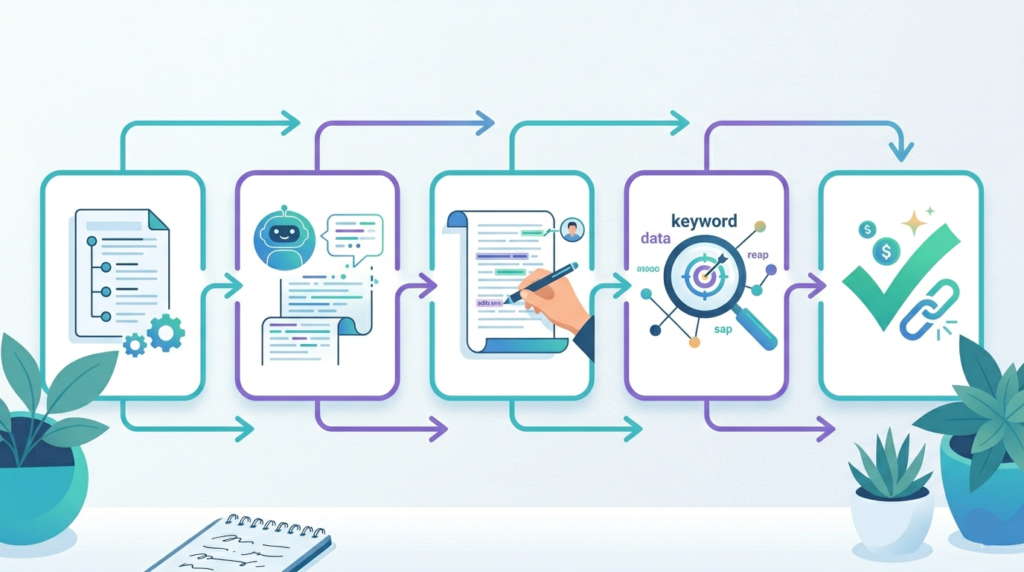
The AI-Assisted Content Workflow (5 Steps)
Step 1: Generate your outline
Prompt ChatGPT or Claude: “Create a detailed H2/H3 outline for a 2,500-word article titled ‘[your title]' targeting the keyword ‘[keyword].' Include a definition section, a features section, pros and cons, and a FAQ.”
Step 2: Draft each section
Feed the outline back to AI section by section. Don't generate the whole article in one go — you get better, more focused output when you work section by section.
Step 3: Human edit for accuracy, experience, and voice
This is the step that determines whether your content ranks or disappears. Add your own experience. Fix any inaccuracies — AI hallucinates pricing, features, and statistics. Add screenshots, real results, or personal commentary. Make it sound like you, not a machine.
Step 4: Optimize with NeuronWriter or Rank Math Content AI
Paste your draft in and let the tool score it against top-ranking pages. Add missing LSI keywords. Adjust length if needed. This step alone can move a post from page 3 to page 1.
Step 5: Review affiliate link placement and CTA
Read the post as a reader, not as an author. Does each affiliate link appear in a natural, helpful context? Is the CTA clear and action-oriented? Does your affiliate disclosure appear before the first link? Fix anything that feels forced.
How to Write Content That Passes E-E-A-T Scrutiny
Google's E-E-A-T framework — Experience, Expertise, Authoritativeness, Trust — is now a direct ranking factor. And it's especially strict for affiliate content, which Google considers a category that historically attracted manipulation.
Here's how to signal all four:
- Experience: Add personal screenshots, real results, or honest accounts of using the tool yourself. “I tested this for 30 days and here's what I found” beats “According to the website” every time.
- Expertise: Cite authoritative sources. Link to original research, official documentation, or credible industry data.
- Authoritativeness: Build an author bio that lists your credentials and links to your social profiles. Make it clear there's a real human behind the content.
- Trust: Include a clear affiliate disclosure above the first link. Use a real name and photo. Don't recommend products you haven't used or wouldn't use yourself.
One practical rule: if you wouldn't say it out loud to a friend asking for advice, don't publish it.
Optimizing for AI-Powered Search Engines (AEO / GEO)
Generative Engine Optimization (GEO) is the practice of structuring your content so it gets extracted and cited by AI-powered search engines — Google AI Overviews, ChatGPT Search, and Perplexity. Zero-click results. Direct citations. Your brand, your link, inside the AI's answer.
Here's how to structure content for extraction:
- Use Q&A-style H2 headings. AI systems are trained to extract direct answers to direct questions. “What is AI affiliate marketing?” performs better than “Introduction to AI Affiliate Marketing.” Match your headings to the exact questions people ask.
- Write a definition paragraph in every key section. Lead each major section with a crisp, self-contained definition or summary — one that answers the section's core question in 2–3 sentences. These get pulled directly into AI Overviews.
- Add a TL;DR or summary box. A clearly labelled summary at the top of long sections gives AI systems a clean extraction point. It also helps human readers who skim before they commit.
- Use FAQ schema markup. Install RankMath and add FAQ schema to your FAQ section. This signals to Google exactly which content is question-and-answer formatted — dramatically increasing your chances of appearing in both People Also Ask boxes and AI Overviews.
- Keep sentences short and subject-verb-object clear. AI search systems parse structured, unambiguous sentences more reliably than complex, clause-heavy prose. Write for clarity first. Every time.
The affiliate marketers who understand GEO right now are building a significant early advantage. This is still a wide-open lane.
How to Drive Traffic to Your Affiliate Content in 2026
The greatest mistake you can make in 2026 is to publish three posts, wait for Google to rank them, get nothing, and quit.
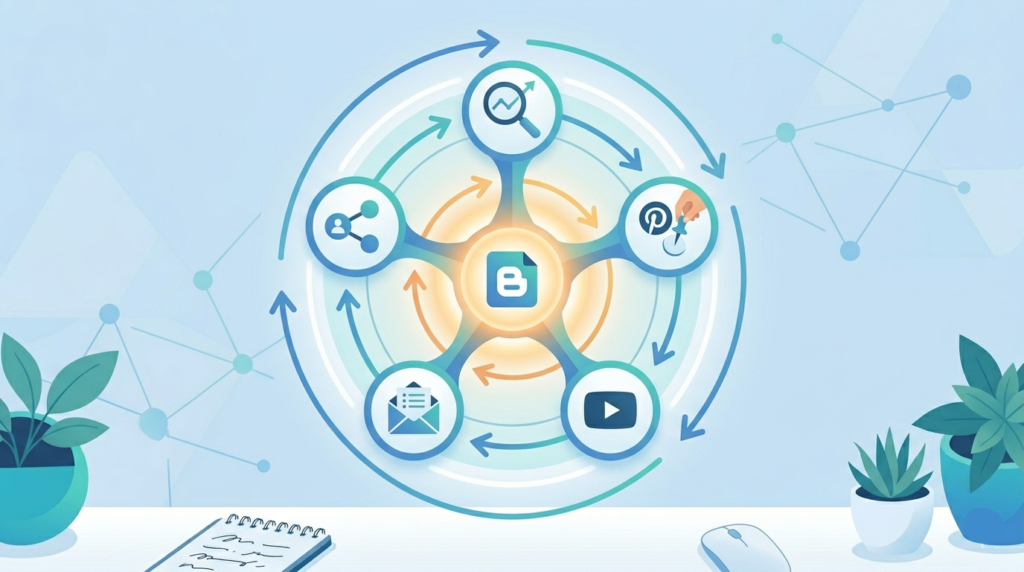
SEO is your primary long-term traffic engine. But it takes 3–6 months to kick in. So, while it compounds in the background, you need early wins from channels that move faster. That's what this section is about — building a multi-channel traffic flywheel that pays you at every stage, not just when you've “made it” on Google.
Channel 1: Organic SEO (The Long Game)
This is your foundation. Every other channel is faster — but none of them compound the way SEO does. A well-ranked post from today can send traffic and commissions two years from now with zero additional effort.
The 2026 SEO strategy for affiliate marketers is built on three things:
- Topical authority over keyword volume. Don't chase high-volume keywords you can't rank for. Instead, dominate a narrow sub-niche. Cover it deeply — 15 to 20 tightly related posts that link to each other. Google rewards sites that demonstrate genuine expertise across a topic, not sites that publish one viral post and disappear.
- Long-tail, buyer-intent keywords. Target phrases like “best AI writing tool for freelancers under $50” over “AI writing tools.” Less competition. Higher purchase intent. Faster rankings.
- AI-accelerated content volume. The reason topical authority used to take years was simple: writing enough content took too long. With ChatGPT or Claude handling first drafts, you can publish 3–4 quality posts per week instead of one. That's the compounding advantage AI gives you on SEO.
Use RankMath ContentAI to optimize every post for schema and internal linking. Connect your site to Google Search Console from day one so you can track which queries you're appearing for — even before you rank. With RankMath this is easy peasy.
Channel 2: Pinterest (Fastest Free Traffic for Beginners)
Don't underestimate Pinterest. It's still one of the highest-converting platforms for affiliate marketers — especially in lifestyle, personal finance, productivity, and health niches. And unlike Google, Pinterest can send traffic to a brand-new blog within days of publishing.
The workflow is simple:
- Write a blog post with affiliate content
- Open Canva AI and batch-create 5–10 branded pins for that post in under an hour
- Schedule them across the week using a tool like Tailwind
- Each pin links directly to your post — and your post contains your affiliate links
Do this consistently — 20 to 30 pins per week — and Pinterest becomes a reliable early-stage traffic source while your SEO builds in the background. One strong pin can drive thousands of clicks over months with no ongoing effort.
Channel 3: YouTube (Highest Trust, Strongest Conversion)
Video reviews and tutorials convert better than written content. That's not an opinion — it's consistent across every affiliate niche. People trust what they can see and hear. A 10-minute honest review on YouTube carries more persuasive weight than a 2,000-word blog post for most buyers.
You don't need to be on camera.
Use ChatGPT to write your video script from your existing blog post. Then use Pictory to convert the script into a fully produced video with stock footage, captions, and voiceover. Or use Synthesia to present with an AI avatar if you want a more personal feel without showing your face.
Place your affiliate link in the video description, in the pinned comment, and mention it verbally with a call-to-action during the video. YouTube videos also rank in Google search — so your video and your blog post can appear on the same results page, doubling your visibility for the same keyword.
Channel 4: Email Marketing (The Traffic Source You Own)
Trust me, this is huge. Every other traffic source can disappear overnight.
Google updates its algorithm. Pinterest changes its distribution rules. YouTube demonetizes your channel. These things happen — and when they do, the only affiliates who survive are the ones with an email list.
Start building yours from your very first published post.
Use GetResponse or Kit — both free to start — and send a weekly digest. Use AI to generate it in under 20 minutes:
“Write a short, conversational weekly email for an audience interested in AI productivity tools. Include one tool recommendation with a brief honest review, one tip they can use this week, and a soft CTA to read this week's blog post.”
A list of 500 engaged subscribers can generate consistent monthly commissions — before your SEO traffic has even meaningfully kicked in.
Channel 5: Social Media (Your Repurposing Engine)
Social media shouldn't be where you build — it's where you distribute. The goal is to take one piece of content and push it everywhere, automatically.
Here's the repurposing prompt to run after every blog post:
“I've written a blog post titled ‘[title]' about [topic]. Please repurpose the key ideas into: 5 tweets/X posts (under 280 characters each), 3 LinkedIn posts (professional tone, 150 words each), 1 LinkedIn article intro (300 words), and 5 Pinterest pin descriptions (keyword-rich, 100 words each).”
One blog post. Seven content assets. Distributed across X/Twitter, LinkedIn, and Pinterest — all pointing back to your blog and your affiliate links. That's what a content flywheel actually looks like.
How to Track, Measure, and Optimize Your Affiliate Marketing Performance
Remember that popular saying, what you can’t measure you can’t grow, right? Well, that is very true here. The affiliates making consistent income in 2026 treat their content like a portfolio. They look at the data, identify what's working, and double down on it.
Here's how to do exactly that — without spending a single dollar on analytics tools.
The 6 KPIs Every Affiliate Marketer Must Track
Set up a simple Google Sheet or Notion table and log these weekly:
- Clicks per post
How many people are clicking your affiliate links from each individual post? This tells you which content is actively driving commercial action — and which posts are getting traffic but not converting.
- Click-through rate (CTR)
What percentage of your posts' readers are clicking your affiliate links? A low CTR on a high-traffic post is a signal: your link placement, CTA, or offer relevance needs work.
- Conversion rate
Of the people who click your link and land on the merchant's page, what percentage actually buy? This is partly out of your control — it depends on the merchant's page quality — but it tells you whether the offer matches your audience's expectations.
- Earnings per click (EPC)
Total commissions earned ÷ total clicks. This is the single most useful number for comparing different affiliate programs. A program paying 50% commission on a $10 product has a lower EPC than one paying 20% on a $200 product. EPC cuts through the noise.
- Average commission value
Are you earning $3 commissions or $30 commissions? This shapes your entire content strategy. Higher-ticket and recurring-commission programs change the math dramatically.
- Content ROI (revenue per hour invested)
Divide total commissions from a post by the hours you spent creating it. This is the number most affiliate marketers never calculate — and the one that tells you most clearly where to focus your time next.
Free Tools to Track Your Performance
You don't need expensive dashboards. This setup costs nothing:
- Google Analytics 4 — tracks all site traffic, traffic sources, time on page, and bounce rate. Set up event tracking for affiliate link clicks.
- Google Search Console — shows which organic keywords are driving impressions and clicks to each post. Essential for identifying content that's close to ranking but needs a push.
- Native affiliate dashboards — every affiliate network (Impact, ShareASale, ClickBank, PartnerStack) has its own dashboard showing clicks, conversions, and commissions per link.
The weekly review system: Every Monday, spend 20 minutes pulling three numbers — top traffic posts from Search Console, top-clicked affiliate links from your network dashboards, and overall commission total. Log them in your tracker. Look for patterns over four to six weeks. That's where the insights live.
How to Use AI to Interpret Your Data and Optimize
This is one genuinely powerful way you can leverage AI for optimizing your affiliate performance.
Export your Google Analytics 4 data as a CSV. Export your affiliate dashboard report. Paste both into ChatGPT and run this prompt:
“Here is my website traffic data and affiliate commission data for the last 30 days. Which posts have the highest traffic but the lowest conversion rate? What could explain the gap? What should I test first to improve conversions on those posts?”
What you'll get back is a prioritized action list — specific posts to optimize, link placement suggestions, CTA improvements, and content gaps to fill. In five minutes, you have a clearer picture than most affiliate marketers get from hours of manual analysis.
Use the same approach to compare affiliate programs:
“Here are my EPC figures across five affiliate programs over the last 60 days. Which program is performing best relative to my traffic? Which should I deprioritize or replace?”
Data without interpretation is just noise. AI turns it into a decision.
The Biggest Mistakes to Avoid in AI Affiliate Marketing
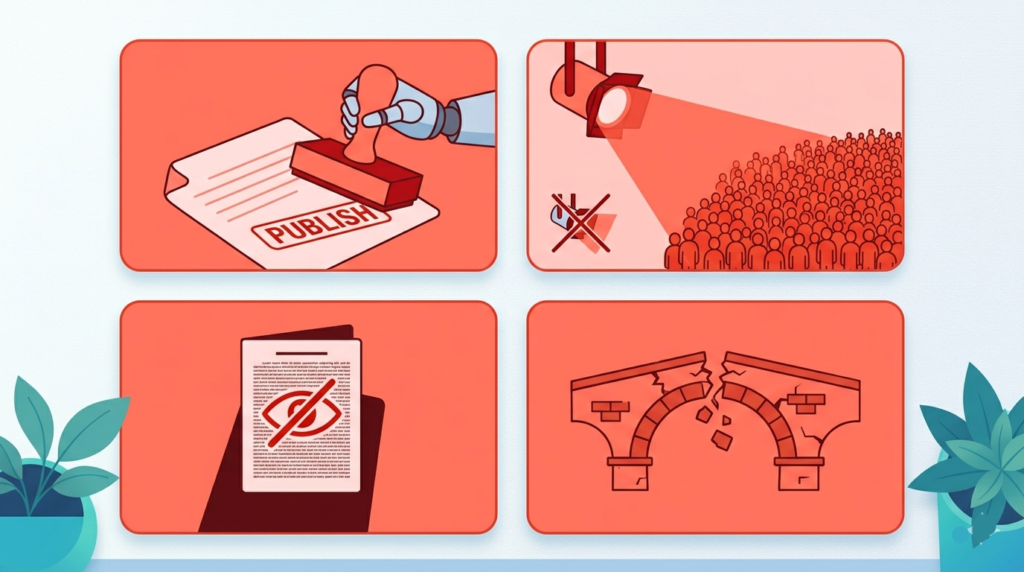
Most affiliates fail because they treat AI like a “set-and-forget” money machine. In 2026, the gap between successful affiliates and those who get penalized comes down to how they handle the machine. Avoid these four specific pitfalls to protect your income.
Mistake 1: Publishing AI Content Without Human Editing
This is the fastest way to get your site penalized — and the most common mistake beginners make.
AI-generated content without original insight, verified facts, or personal experience triggers Google's Helpful Content system. Google isn't just looking for keyword density anymore. It's evaluating whether your content demonstrates genuine first-hand experience. Thin AI output — correct-sounding but hollow — fails that test every time.
Before you hit publish, run this edit checklist:
- ✅ Every statistic and product claim fact-checked against the source
- ✅ At least one section includes your personal experience or perspective
- ✅ Pricing, features, and availability verified directly on the product's website
- ✅ Affiliate disclosure included above the first affiliate link
- ✅ Author bio present with real credentials and a photo
AI writes the draft. You write the article.
Mistake 2: Choosing Too Broad a Niche
“AI tools” is a niche. “AI tools for freelance copywriters” is a business.
The difference isn't just semantic — it's the difference between competing with a thousand generalist sites and owning a specific corner of the internet that buyers actually search in. Broad niches mean broad competition, low topical authority, and audiences with mixed intent.
Narrow niches mean faster rankings, higher-intent traffic, and readers who are already halfway to buying before they land on your page. Pick the sub-niche. Build there first. Expand later once you have authority.
Mistake 3: Ignoring FTC Disclosure Requirements
In 2026, transparency is a ranking factor. The FTC requires that every piece of affiliate content disclose the commercial relationship clearly and conspicuously — before the first affiliate link, not buried in the footer. “Conspicuously” means a reader can't reasonably miss it.
A compliant disclosure looks like this:
“This post contains affiliate links. If you purchase through these links, I may earn a commission at no extra cost to you.”
Place it at the top of every post. Every single one. Not just because it's legally required — but because readers who see it actually trust you more. Transparency isn't a liability. It's a credibility signal.
Failing to disclose isn't just an ethical problem. It's a legal one — the FTC has issued warnings and fines for non-disclosure. Don't risk it.
Mistake 4: Relying on a Single Traffic Source
If all your traffic comes from Google, you're one algorithm update away from losing everything. That's not hypothetical — it's happened to thousands of affiliate sites over the past two years alone.
The fix is simple: diversify from month one. Your stack should always include at minimum:
- SEO — your long-term compounding foundation
- Email — the traffic source no one can take from you
- One social channel — Pinterest, YouTube, or LinkedIn, depending on your niche
You don't need to be everywhere. You need to be in at least three places — so that if one source drops, the others hold you up while you recover and adapt.
Single-source income isn't passive. It's fragile.
Conclusion: Your Next Step Starts in the Next 60 Minutes
In this post, I have given you a detailed guide on how to start AI affiliate marketing in 2026. As you may have seen, this isn't about working harder; it’s about orchestrating smarter systems. By combining Agentic Workflows with genuine human expertise, you can build a scalable business that survives every search engine update.
Bookmark this page today so that you can come back to it again and again as you step out to build your affiliate marketing income in the AI age.
Want to move even faster?
→ Download the Free AI Affiliate Prompt Pack — the exact prompts you can use every time to create affiliate marketing content with ChatGPT and Claude ai — ready to copy, paste, and run.
Frequently Asked Questions
Can beginners start AI affiliate marketing with no experience?
Yes. Beginners can start AI affiliate marketing with no prior experience. AI tools like ChatGPT and Claude handle the most technically demanding tasks — content creation, keyword research, and SEO optimization — so you do not need a background in marketing or writing. You need a niche, a platform, and a willingness to learn by doing. Most beginners who follow a structured system publish their first affiliate content within one to two weeks of starting.
How long does it take to make money with AI affiliate marketing?
Most beginners see their first affiliate commission within 30 to 90 days, depending on their traffic channel. Pinterest and YouTube can drive clicks within weeks. SEO takes longer — typically three to six months before organic traffic compounds into consistent commissions. Case studies from 2026 show that marketers using AI-assisted content systems and multi-channel traffic strategies reach their first $1,000 per month faster than those relying on SEO alone. Consistency is the biggest variable.
Do I need a website to start AI affiliate marketing?
A website is not strictly required, but it is strongly recommended. You can place affiliate links on YouTube, Pinterest, or in an email newsletter without a blog. However, a website gives you a permanent, algorithm-proof content base that compounds in value over time. It also makes you eligible for more affiliate programs, many of which require a content platform as part of their application. A basic WordPress blog on Hostinger can be live within a weekend.
Is AI affiliate marketing legal?
Yes. AI affiliate marketing is completely legal. Using AI tools to research, write, and optimize affiliate content does not violate any laws or platform terms of service, provided you follow two rules. First, you must disclose your affiliate relationships clearly and prominently in every piece of content, as required by the FTC Endorsement Guidelines. Second, your content must be accurate and not misleading. AI-assisted does not mean unethical — the legal and ethical standard is the same as for any affiliate marketer.
What is the best AI affiliate program for beginners?
The best AI affiliate programs for beginners are SaaS-based tools with recurring commissions, low barriers to entry, and strong brand recognition. Top options in 2026 include Jasper, Copy.ai, and Writesonic for AI writing tools; ClickUp and Notion for productivity software; and Beehiiv and MailerLite for email marketing platforms. Look for programs on PartnerStack or Impact that offer at least 20% recurring commission, a 30-day cookie window, and a clear affiliate dashboard. Recurring commissions mean one referral pays you every month — not just once.