Chadrack

Recently, I’ve heard numerous experienced marketers tell new affiliate bloggers to skip Bluehost. I wouldn’t say they are wrong, considering their situation. However, many experienced bloggers dismiss Bluehost because they compare it with premium managed hosting built for established, high-traffic websites.
But, that comparison misses an important point. If you're launching your first affiliate blog, Bluehost solves the problems you actually have today, which is, getting online quickly, learning WordPress, publishing consistently, and keeping costs under control while you build traffic.
Over the last 15+ years, I've built and managed a number of WordPress websites. During these years, I've seen many beginners spend too much money chasing “the fastest host” before earning their first affiliate commission. In most cases, that's the wrong priority. Your first goal, as a beginner, should be to build a website that is reliable, easy to manage, and capable of supporting steady content publishing. Once your blog begins attracting meaningful traffic and your content library grows, upgrading to more powerful hosting becomes a business decision rather than an expensive guess.
In this Bluehost affiliate marketing guide, I evaluate Bluehost’s suitability across the six factors that actually matter to a first-time blogger — performance, ease of use, pricing, scalability, SEO impact, and long-term value. I'll also show you where Bluehost genuinely falls short, when to outgrow it, and how it compares to Hostinger and SiteGround for someone starting from zero.
Whether you're starting your first niche website, building an affiliate marketing side hustle, or creating a long-term online business, this guide will help you decide if Bluehost still deserves a place on your shortlist in 2026.
Key Takeaways
- Bluehost remains one of the best beginner-friendly hosting providers for new affiliate bloggers because it combines affordability, simple WordPress setup, reliable performance, and room to grow.
- Hosting supports SEO rather than directly improving rankings. Reliable uptime, faster loading pages, secure connections, and a better user experience contribute to stronger long-term search performance.
- Bluehost is best suited for new and growing affiliate websites, while larger authority sites with heavy traffic may eventually benefit from VPS, cloud, or managed WordPress hosting.
- The right strategy is to start with hosting that matches your current needs, focus on publishing high-quality content consistently, and upgrade only when your traffic and revenue justify the additional cost.
What Is Bluehost and Why Do So Many Affiliate Bloggers Use It?

Bluehost is a web hosting company that provides shared, WordPress-specific, VPS, and dedicated hosting plans. It is positioned primarily toward beginners, small businesses, and bloggers who need a fast, low-cost path from domain registration to a live WordPress site — which is precisely the profile of a first-time affiliate blogger.
Bluehost was founded in 2003 by Matt Heaton and Danny Ashworth in Provo, Utah. It is now owned by Newfold Digital and hosts millions of websites worldwide. Bluehost has been one of three hosts officially recommended on WordPress.org since 2005 — a partnership that still shapes its market position today.
That WordPress.org recommendation matters more than most beginners realize. It signals direct compatibility testing, one-click WordPress installs, and pre-configured server settings tuned for WordPress specifically. Bluehost markets itself as trusted by more than 5 million WordPress websites, and it leans hard into that scale as social proof for anyone comparing WordPress hosting for beginners.
Affiliate bloggers repeatedly choose Bluehost for three reasons. First, low technical barrier to entry — you don't need cPanel experience or server knowledge to launch. Second, price. Entry-level shared hosting plans start low enough to commit to before a single affiliate commission clears. Third, ecosystem. A five-million-site install base means abundant tutorials, plugin compatibility testing, and community troubleshooting already exists for nearly any problem a new blogger hits.
Why Is Bluehost Still a Good Choice for New Affiliate Bloggers?
Bluehost remains one of the best hosting choices for new affiliate bloggers because it combines affordability, simplicity, and dependable performance in a single platform. If your goal is to launch your first affiliate website rather than manage a complex online business, Bluehost gives you everything you need to get started quickly.
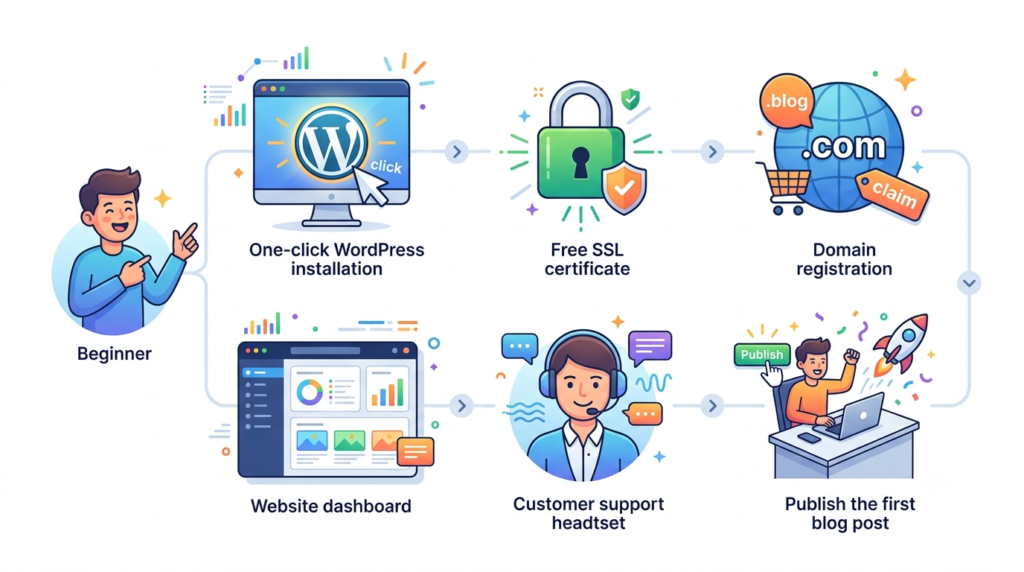
The biggest advantage is its easy WordPress installation. Instead of manually downloading WordPress, creating databases, and configuring files, Bluehost walks you through the setup with guided onboarding and one-click installation. Most beginners can have a working website online within an hour.
Cost is another reason Bluehost continues to attract first-time bloggers. Shared hosting plans provide a relatively low-cost entry point compared with managed WordPress hosting or cloud infrastructure. That leaves more of your budget available for keyword research tools, content creation, email marketing, and other investments that directly grow an affiliate business.
Bluehost also includes several features that many beginners would otherwise purchase separately:
- Free SSL certificate to secure your website with HTTPS.
- Free domain registration for the first year on eligible plans.
- Professional email hosting linked to your domain.
- Built-in website management tools through an intuitive dashboard.
Managing a WordPress website can feel intimidating at first. Bluehost reduces that learning curve with a clean control panel, automated updates, helpful documentation, and access to customer support whenever you encounter problems. Instead of spending hours troubleshooting server settings, you can spend your time publishing blog posts and improving your SEO.
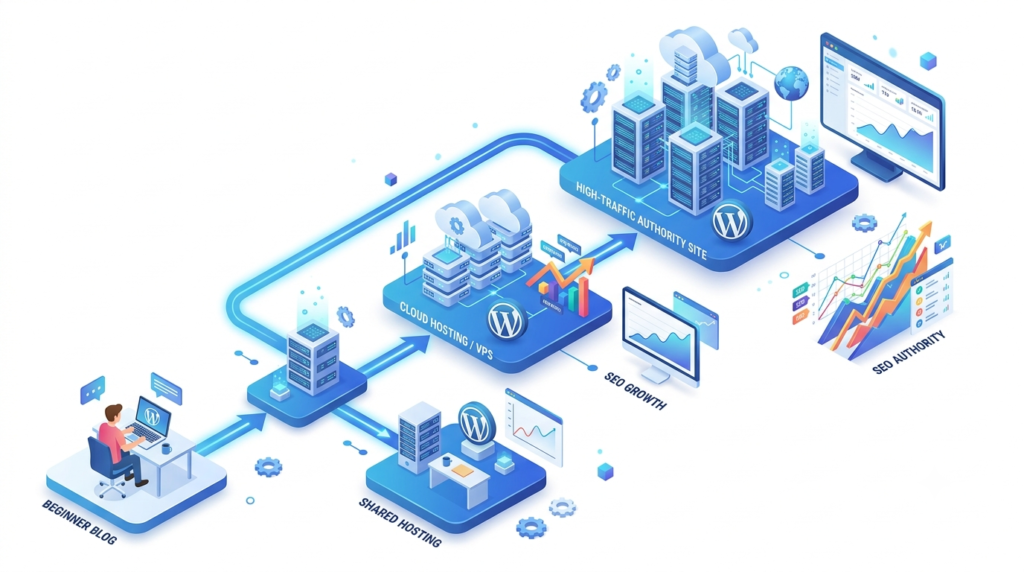
That balance of simplicity and scalability is why Bluehost continues to appeal to beginner bloggers in 2026. It provides enough performance to support growing content libraries while giving you clear upgrade paths when your website eventually outgrows shared hosting.
What Features Matter Most When Choosing Hosting for Affiliate Marketing?

The best hosting for affiliate marketing is not necessarily the fastest or the most expensive. It's the hosting that delivers reliable performance while supporting SEO, user experience, and long-term growth. Before comparing hosting providers, focus on the features that actually influence your website's success.
Seven features determine whether hosting actually supports an affiliate blog's growth: speed, uptime, security, scalability, support, backups, and ease of use. Each one affects either your reader's experience or your ability to keep publishing without technical friction.
- Speed directly affects Core Web Vitals, bounce rate, and conversions on affiliate links. A slow time-to-first-byte (TTFB) costs you clicks before a reader ever sees your call to action — you can verify this yourself with Google PageSpeed Insights.
- Uptime determines whether your affiliate links are even live when traffic arrives. Bluehost advertises 99.9% uptime on standard plans, which is the industry baseline for shared hosting.
- Security protects both your content and your affiliate tracking codes from injection attacks. Free SSL, automated malware scanning, and spam protection are the minimum bar here — Bluehost includes all three by default.
- Scalability is what lets you move from shared hosting to VPS or dedicated resources without migrating platforms. This matters less at launch and far more once you cross a few hundred posts.
- Support shortens the time between “something broke” and “I'm publishing again.” For a solo blogger with no developer on call, 24/7 live chat isn't a luxury — it's the difference between a one-hour fix and a lost week.
- Backups protect months of content work from a single bad plugin update or failed migration. Automated daily backups should be non-negotiable, regardless of host.
- Ease of use determines how much time you spend fighting your hosting dashboard instead of writing content. This is the single biggest reason beginners gravitate toward Bluehost over more technical alternatives.
Feature Importance for New Affiliate Bloggers
| Feature | Why It Matters | Priority |
| Website Speed | Improves user experience and supports Core Web Vitals | ⭐⭐⭐⭐⭐ |
| Uptime | Keeps your site accessible to readers and search engines | ⭐⭐⭐⭐⭐ |
| Security | Protects your website, visitors, and affiliate income | ⭐⭐⭐⭐⭐ |
| Ease of Use | Helps beginners launch and manage WordPress confidently | ⭐⭐⭐⭐⭐ |
| Customer Support | Resolves technical issues quickly | ⭐⭐⭐⭐☆ |
| Backups | Enables fast recovery after errors or attacks | ⭐⭐⭐⭐☆ |
| Scalability | Supports future traffic growth without migration pressure | ⭐⭐⭐⭐☆ |
When I evaluate web hosting for affiliate blogs, I don't start by asking which provider claims to be the fastest. I ask whether the hosting allows a beginner to publish consistently, maintain good website performance, protect visitor trust, and scale when traffic arrives. Those factors produce better long-term results than chasing benchmark numbers that most new affiliate websites will never fully utilize.
How Does Bluehost Compare with Hostinger and SiteGround?

Bluehost, Hostinger, and SiteGround all serve beginner-to-mid-level WordPress users, but they optimize for different priorities. Hostinger generally wins on raw price-to-performance ratio, SiteGround wins on managed WordPress performance and support quality, and Bluehost wins on WordPress.org integration and beginner onboarding simplicity.
Bluehost vs. Hostinger vs. SiteGround
| Factor | Bluehost | Hostinger | SiteGround |
| Pricing | Low entry-tier pricing, higher renewal rates | Typically the most aggressive entry pricing | Mid-to-higher pricing, positioned as premium |
| Speed | Solid for shared hosting, not class-leading | Consistently strong for the price point | Frequently rated among the fastest managed WordPress hosts |
| Ease of use | Very beginner-friendly dashboard | Beginner-friendly, custom hPanel interface | Clean interface, slightly more technical depth |
| Support | 24/7 live chat and phone | 24/7 live chat | 24/7 live chat, widely praised responsiveness |
| WordPress tools | Official WordPress.org partner, one-click install | One-click install, WordPress-optimized plans | Deep WordPress-specific tooling and staging |
| Beginner friendliness | Very high | High | High, with a slightly steeper learning curve |
| Upgrade options | Shared, VPS, Dedicated | Shared, Cloud, VPS | Shared, GrowBig, GoGeek |
Bluehost remains my recommendation for complete beginners because it removes much of the technical complexity involved in launching a WordPress hosting for beginners setup. The onboarding process is polished, the dashboard is intuitive, and nearly every tutorial you'll find online includes Bluehost examples.
Hostinger is an excellent alternative if your priority is maximizing value for money. It delivers impressive performance for its price and has become increasingly popular among affiliate marketers who want affordable hosting without sacrificing speed.
SiteGround is better suited to bloggers who already understand WordPress and expect their websites to grow quickly. Its premium infrastructure, developer tools, and advanced caching make it an excellent long-term option, but many beginners will not immediately benefit from the additional cost.
For most first-time affiliate bloggers, I recommend choosing the provider that lets you start publishing today rather than delaying your launch while comparing benchmark scores. Building quality content will have a much greater impact on your affiliate income than choosing between three reputable hosting companies.
What Are Bluehost's Biggest Strengths?
Bluehost's greatest strength is that it simplifies every stage of launching a WordPress affiliate blog. Rather than overwhelming beginners with technical settings, it guides users from purchasing hosting to publishing their first blog post with minimal friction.
Its close integration with WordPress is a major advantage. Bluehost has worked alongside the WordPress ecosystem for years and is officially recommended by WordPress.org. From the moment you create your account, the platform is designed around getting WordPress installed, configured, and ready for content creation as quickly as possible.
The onboarding experience deserves special mention. Instead of presenting dozens of technical options, Bluehost walks new users through choosing a domain, installing WordPress, selecting a theme, and configuring essential website settings. That guided setup significantly reduces the learning curve for first-time bloggers.
One-click installations also save valuable time. Installing WordPress, enabling SSL, creating email accounts, managing domains, and adding many popular applications can all be completed from a single dashboard without manually configuring servers or databases.
Another strength is Bluehost's extensive documentation and educational resources. Whether you're troubleshooting an issue, learning how to migrate a website, or setting up email hosting, you'll usually find step-by-step tutorials, knowledge base articles, and support documentation covering the process. Combined with 24/7 customer support, beginners rarely feel left on their own.
Bluehost also benefits from a broad ecosystem. It integrates smoothly with popular WordPress plugins such as Rank Math SEO, WooCommerce, Elementor, WPForms, FluentCRM, and many other tools that affiliate marketers commonly use to build, optimize, and monetize their websites.
Finally, Bluehost delivers stable performance where it matters most. A new affiliate blog with dozens—or even a few hundred—well-optimized articles typically requires reliability more than extreme server power. Bluehost provides dependable uptime, adequate resources for growing content libraries, and clear upgrade paths as your traffic increases.
In my experience, that's exactly what beginners need. They don't need enterprise infrastructure on day one. They need hosting that stays out of the way so they can focus on creating content, improving SEO, and earning their first affiliate commissions.
What Are the Downsides of Bluehost?
While I admit that Bluehost is a great host it is definitely not the right host for every affiliate blog. It’s important therefore that you understand its limitations so you can make a more informed decision and avoid unrealistic expectations.
Here are four criticisms that come up consistently which deserves a direct answer:
- Shared hosting limitations: On entry-level plans, your site shares server resources — CPU, RAM, bandwidth — with other websites on the same server. This is standard practice across the industry, not a Bluehost-specific flaw, but it does mean performance can dip under a traffic spike shared with a noisy neighbor site.
- Renewal pricing: Bluehost's introductory pricing is significantly lower than its renewal rate. This is a widely repeated criticism online, and it's accurate — budget for the renewal price when calculating your first-year hosting cost, not just the promotional rate.
- Resource constraints: Entry-tier shared plans cap the resources available to your site. A blog publishing a handful of posts a month won't notice. A site running dozens of plugins, heavy image libraries, and high daily traffic will.
- Not ideal for very large sites: Sites publishing at high volume — think 500+ posts with substantial daily traffic — typically outgrow shared hosting's performance ceiling and need to move to VPS, dedicated, or a specialized managed WordPress host.
- Advanced users may outgrow it: Bloggers who need granular server control, custom configurations, or enterprise-level scalability will eventually find Bluehost's beginner-oriented tooling restrictive rather than helpful.
While these criticisms are valid, none are dealbreakers for a beginner. If you're launching your first affiliate blog, learning SEO, and publishing consistent content, most of these complaints have little impact on your day-to-day experience. If your website eventually reaches hundreds of thousands of monthly visitors, that's a good problem to have—and a clear signal that it's time to upgrade your hosting.
Can Bluehost Support a Growing Affiliate Blog?

Yes. Bluehost can comfortably support a growing affiliate blog through its early and intermediate growth stages. Most new affiliate websites will outgrow their content strategy long before they outgrow Bluehost's hosting resources. The key is knowing when your website has reached the point where upgrading will improve performance and user experience.
Growth stages break down into three distinct phases, each with different hosting needs.
- 0–50 posts: This is the validation stage — you're testing a niche, publishing consistently, and traffic is likely under a few thousand visits a month. Entry-level shared hosting handles this comfortably. Resource constraints are a non-issue at this volume.
- 50–200 posts: This is the growth stage. Traffic climbs, you're adding more images, more plugins, and possibly your first affiliate income. Shared hosting still works here, but it's worth monitoring page speed via Google PageSpeed Insights to catch early strain before it affects conversions.
- 200–500 posts: This is the scaling stage, where shared hosting starts to show its ceiling. Daily traffic is meaningful, plugin count is higher, and Core Web Vitals become harder to maintain on shared resources. This is the range where most serious affiliate bloggers move to VPS or a managed WordPress host.
When to upgrade: Don't upgrade simply because another blogger says you should. Upgrade because your data shows you've outgrown your current hosting. A successful affiliate blog isn't built by starting with enterprise hosting. It's built by publishing consistently, attracting qualified traffic, and upgrading your infrastructure only when your business genuinely requires it.
How Do You Start an Affiliate Blog with Bluehost?

Starting an affiliate blog with Bluehost is straightforward because the platform simplifies the technical setup and lets you focus on publishing content. If you're building your first WordPress website, these nine steps will help you launch with confidence.
- Choose a hosting plan: Select an entry-level shared hosting plan built for WordPress. Don't oversize this decision — a beginner plan handles your first 50+ posts without issue.
- Register a domain: New Bluehost signups typically include a free domain for the first year. Pick something short, brandable, and relevant to your niche — avoid hyphens and hard-to-spell words.
- Install WordPress: Bluehost auto-installs WordPress during signup. You'll land in your WordPress dashboard within minutes, no manual configuration required.
- Pick a lightweight theme: Choose a fast-loading, minimal theme over a feature-heavy one. Speed matters more than visual complexity at this stage, and a bloated theme is one of the fastest ways to sabotage Core Web Vitals before you've published a single post.
- Install essential plugins: Keep this list tight: an SEO plugin like Rank Math, a caching plugin, a security plugin, and an affiliate link management plugin. Resist the urge to install “just in case” plugins — each one adds load time and potential conflicts.
- Create core pages: Build your About page, Contact page, Privacy Policy, Terms of Service, and — critically — your Affiliate Disclosure page before you publish content that includes affiliate links.
- Publish pillar content: Start with 3–5 comprehensive pillar posts that establish topical authority in your niche. These become the foundation your future cluster content links back to.
- Add affiliate disclosures: Every page containing affiliate links needs a clear, visible disclosure. This isn't optional — it's an FTC requirement, and skipping it puts your entire site at legal and platform risk.
- Start building traffic: Focus early traffic efforts on SEO-optimized content and one or two distribution channels — Pinterest, email, or a niche forum — rather than spreading thin across every platform at once.
Follow this sequence in order. Skipping steps — publishing before you've added disclosures, or choosing plugins before a theme — tends to create rework later.
What Mistakes Do New Affiliate Bloggers Make with Their Hosting?

Most hosting mistakes new affiliate bloggers make aren't about choosing the wrong host — they're about mismanaging the right one. Six mistakes show up repeatedly.
- Buying oversized plans: Purchasing VPS or dedicated hosting before you have traffic to justify it wastes budget that should go toward content or tools. Start small and upgrade when resource strain actually appears.
- Installing too many plugins: Every plugin adds load time and a potential point of failure. A bloated plugin stack is one of the most common — and most avoidable — causes of a slow affiliate site.
- Ignoring backups: Skipping automated backups is a bet that nothing will ever break. It will. A failed plugin update or bad migration without a backup means losing months of content work.
- Chasing “fastest hosting” before getting traffic: Obsessing over marginal speed gains on a site with fifty visitors a month is time better spent publishing content. Speed matters — but it matters more once you have traffic to lose.
- Neglecting image optimization: Unoptimized images are one of the single biggest drags on page speed and Core Web Vitals. Compress images before upload rather than relying on hosting resources to compensate.
- Failing to plan for future upgrades: Never checking your host's upgrade path means discovering — under traffic pressure — that migrating is harder than it should have been. Know your upgrade route before you need it.
The pattern across all six: new affiliate bloggers tend to either overspend early or under-plan for later. Matching your hosting decisions to your actual current stage, not your hoped-for one, avoids both.
Is Bluehost Worth the Money for Affiliate Marketing?
Yes, Bluehost is worth the money for affiliate marketing if you're a first-time blogger with no existing traffic or revenue. The value equation shifts once you're running an established, high-traffic site — but for a beginner, the cost-to-benefit ratio favors Bluehost clearly.
- Cost versus benefits: Entry-level shared hosting costs a fraction of managed WordPress alternatives, and in exchange you get a WordPress.org-endorsed setup, free SSL, and a support team built for non-technical users. The tradeoff is a lower performance ceiling — one you won't hit until you're publishing at real volume.
- Who gets the most value: First-time affiliate bloggers, side hustlers testing a niche before committing serious budget, and anyone whose top priority is getting published quickly without a steep technical learning curve. For this group, every dollar saved on hosting is a dollar available for content, tools, or paid promotion — the things that actually drive early affiliate revenue.
- Who should spend more: Bloggers who already have traffic, an existing content library of 200+ posts, or revenue that justifies premium managed WordPress hosting. If your bottleneck is server performance rather than content volume, a higher-tier host pays for itself.
Bluehost Value-for-Money Scorecard
| Category | Rating | Why It Matters |
| Affordability | ⭐⭐⭐⭐⭐ | Low entry cost for beginners |
| Ease of Setup | ⭐⭐⭐⭐⭐ | Guided onboarding and one-click WordPress installation |
| WordPress Integration | ⭐⭐⭐⭐⭐ | Excellent compatibility with WordPress websites |
| Performance for New Blogs | ⭐⭐⭐⭐☆ | More than adequate for most beginner affiliate sites |
| Scalability | ⭐⭐⭐⭐☆ | Multiple upgrade paths as your business grows |
| Overall Value | ⭐⭐⭐⭐⭐ | Outstanding value for first-time affiliate bloggers |
If I were launching a brand-new affiliate blog today with a limited budget, I'd prioritize value over premium specifications. Bluehost provides enough performance to build a successful online business while allowing you to invest more of your budget in content, SEO, and audience growth.
Should You Choose Bluehost or Something Else?

The right hosting choice depends on your current stage, not your long-term ambitions. Bluehost is an excellent starting point for many affiliate bloggers, but there are situations where another provider makes more sense. Instead of asking, “Which hosting company is the best?” ask, “Which hosting company is best for where I am today?”
Use this simple decision framework to guide your choice.
Choose Bluehost if this describes you:
- You're publishing your first affiliate blog and have zero to minimal existing traffic
- You want a WordPress.org-recommended host with a simple setup process
- Budget is a real constraint, and you need the lowest reasonable entry cost
- You're not yet sure your niche will work and don't want to overcommit financially
Choose a higher-tier host like SiteGround if this describes you:
- You're already publishing 200+ posts with consistent daily traffic
- Site speed is measurably affecting conversions or rankings
- Your affiliate revenue can comfortably absorb a higher monthly hosting cost
- You need advanced caching, staging environments, or dedicated resources
Choose a budget alternative like Hostinger if this describes you:
- Price is your single biggest constraint, even below Bluehost's entry tier
- You're comfortable with a more DIY support experience
- You want strong price-to-performance without brand-name backing
There's no universally “best” host — there's only the host that matches where you are right now.
Conclusion
Bluehost isn't the perfect hosting provider for every website, and it doesn't claim to be. Premium managed WordPress hosts, cloud platforms, and enterprise infrastructure can outperform shared hosting in specific situations. However, those solutions are built for businesses that have already reached a level of traffic and revenue most new affiliate bloggers haven't achieved yet.
For someone starting an affiliate blog, Bluehost continues to offer a practical combination of affordability, beginner-friendly WordPress tools, dependable performance, and clear upgrade paths. It removes much of the technical complexity that prevents new bloggers from getting started and lets you focus on the activities that actually grow an online business—publishing helpful content, improving SEO, building topical authority, and earning your audience's trust.
One lesson I've learned over the years is that successful affiliate blogs are rarely built because someone chose the “fastest” hosting provider. They're built because someone consistently created content that solved readers' problems, attracted organic traffic, and recommended products honestly.
If Bluehost matches your current goals, it's a sensible place to begin. Launch your website, build a library of valuable content, and measure your progress with real data. When your traffic, revenue, and resource requirements eventually exceed what shared hosting can comfortably handle, you'll have a much stronger reason to upgrade—and the business to support it.
Frequently Asked Questions
Is Bluehost good for affiliate marketing?
Yes. Bluehost is a good choice for affiliate marketing because it offers beginner-friendly WordPress hosting, affordable pricing, reliable uptime, and simple website management. It gives new affiliate bloggers everything they need to launch a blog, publish content consistently, and grow traffic before upgrading to more powerful hosting. For most first-time affiliate websites, Bluehost provides excellent value.
Is Bluehost good for WordPress?
Yes. Bluehost is one of the best hosting providers for WordPress beginners and has long been officially recommended by WordPress.org. It includes one-click WordPress installation, automatic updates, free SSL certificates, and an intuitive dashboard that simplifies website management. Its close integration with WordPress makes it easy to launch and maintain a professional blog without advanced technical skills.
Can beginners use Bluehost?
Absolutely. Bluehost is designed with beginners in mind and requires very little technical knowledge to get started. Its guided onboarding process, one-click WordPress installation, helpful documentation, and responsive customer support make it easy to build your first website. If you've never created a blog before, Bluehost offers one of the simplest ways to get online quickly.
When should I upgrade my hosting?
Upgrade your hosting when your website consistently outgrows the resources available on your current plan. Common signs include slower page speeds during traffic spikes, increasing resource usage, higher monthly visitor numbers, or growing affiliate revenue that justifies better performance. For most new bloggers, upgrading makes sense only after your website has established consistent traffic and income.
Does hosting affect SEO?
Hosting does not directly improve your search engine rankings, but it supports several factors that influence SEO performance. Reliable uptime, faster page loading, secure HTTPS connections, and a better user experience help search engines crawl your website efficiently and keep visitors engaged. Good hosting provides a strong technical foundation for your overall SEO strategy.
Can I switch hosts later?
Yes. You can migrate your WordPress website to another hosting provider whenever your business needs change. Most hosting companies provide migration tools or assistance to simplify the process, and many offer free website migrations for new customers. This means you can confidently start with Bluehost today and upgrade to VPS, cloud, or managed WordPress hosting when your traffic and resource requirements increase.
![Why Bluehost Is Still a Solid Choice for New Affiliate Bloggers [2026]](https://webincomejournal.com/wp-content/uploads/thumbs_dir/AI-Affiliate-Marketing-Starter-Kit-ru1ouk8y1jo2jyavtia9fc1x85cd2t2nhip7oighto.png)
![Why Bluehost Is Still a Solid Choice for New Affiliate Bloggers [2026]](https://webincomejournal.com/wp-content/uploads/thumbs_dir/Rank-Math-SEO-with-AI-SEO-tools-ru1qq8mm44bah7zwmrf8y98oyvrra9qwshnrlq41to.png)