Chadrack
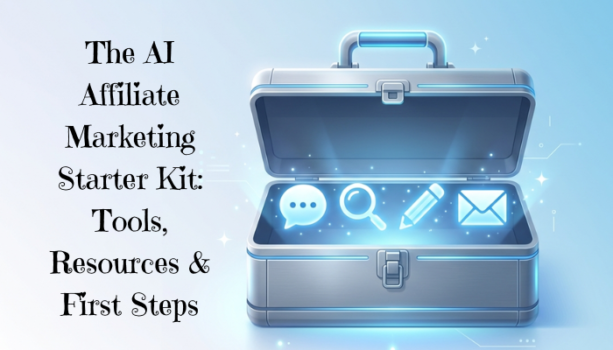
An AI affiliate marketing starter kit gives beginners everything they need to launch an affiliate business using artificial intelligence. It combines essential AI tools, proven workflows, beginner-friendly resources, and a step-by-step roadmap into one practical system. With the right setup, you can research profitable niches, create high-quality content faster, grow organic traffic, and work toward earning your first affiliate commissions without wasting money on unnecessary software.

Most beginners install ChatGPT, watch a handful of YouTube tutorials, and still have no idea what to do on day two. I've seen this happen dozens of times with people I've mentored: they collect tools — a writing assistant here, an SEO plugin there — and end up with a folder of software and zero traffic. That's not a tools problem. It's a system problem.
An AI affiliate marketing starter kit solves this by treating AI as one part of a connected workflow, not a replacement for one. Success in affiliate marketing has never come from having the most AI subscriptions. It comes from following a simple, repeatable process and executing it consistently.
This guide gives you that system. Rather than giving you another list of AI software, I'll show you exactly how each tool fits into the affiliate marketing process, which tools deserve your attention, which free alternatives are worth using, and how to launch your first AI-powered affiliate website without feeling overwhelmed.
By the time you are done reading this guide, you'll know which AI tools to start with, how to build an affordable tech stack, how to connect every tool into a practical workflow, the common mistakes to avoid, and the exact first steps to take during your first 30 days.
Key Takeaways
- An AI affiliate marketing starter kit is a complete system, not just a collection of AI tools. It combines software, workflows, templates, and proven processes into one beginner-friendly roadmap.
- You don't need dozens of subscriptions to succeed. A carefully selected five-tool stack can help you research profitable niches, create content, optimize for search engines, and track results.
- The biggest advantage comes from connecting your tools into one workflow. Research leads to content, content drives traffic, traffic generates subscribers, and subscribers become affiliate customers.
- Human judgment remains essential. AI speeds up research, writing, SEO, and automation, but your experience, editing, fact-checking, and honest recommendations are what build trust and long-term rankings.
- Following a structured 30-day plan is more valuable than buying another AI tool. Consistent execution with a simple system produces better results than constantly chasing the latest software.
DISCLOSURE: WebIncomeJournal is supported by readers like yourself. We may earn an affiliate commission when you purchase through our links, which helps us offer our content for free. Learn more here.
What Is an AI Affiliate Marketing Starter Kit?
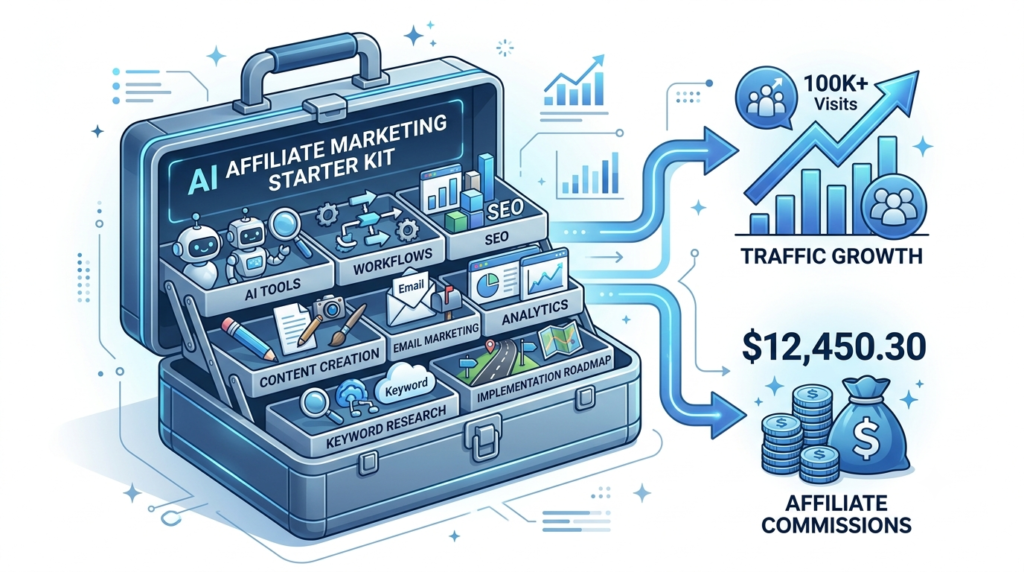
An AI affiliate marketing starter kit is defined as a bundled system that combines AI tools, repeatable workflows, foundational education, and hands-on implementation steps into one beginner path to affiliate income. It is not a single product. It is a structure.
This matters because most beginners confuse “having AI tools” with “having a system.” They are not the same thing.
- It's different from AI tools alone. A tool like ChatGPT or Claude writes a paragraph when you ask it to. It does not tell you which niche to pick, which keyword has buyer intent, or when to publish. Tools without a sequence produce scattered content, not income.
- It's different from an affiliate marketing course. A course teaches theory — how commissions work, what a niche is, how funnels function. Most courses stop at concepts and leave you to figure out execution on your own. A starter kit skips the theory-heavy phase and hands you the exact stack and order of operations.
- It's different from a software bundle. A bundle sells you five subscriptions and calls it a solution. Overbuying overlapping AI tools is one of the most common money-wasters beginners make in this space, according to advanced 2026 guides in the category. A starter kit deliberately limits your stack to what each workflow step actually requires.
A real starter kit combines four elements: tools (a minimum-viable AI stack), workflows (how each tool connects to the next), education (why each step exists), and implementation (a dated action plan you follow). Remove any one piece and the system breaks. Tools without workflow create noise. Workflow without tools slows you down. Education without implementation stays theoretical. This guide gives you all four, connected.
Why Is AI Changing Affiliate Marketing for Beginners?
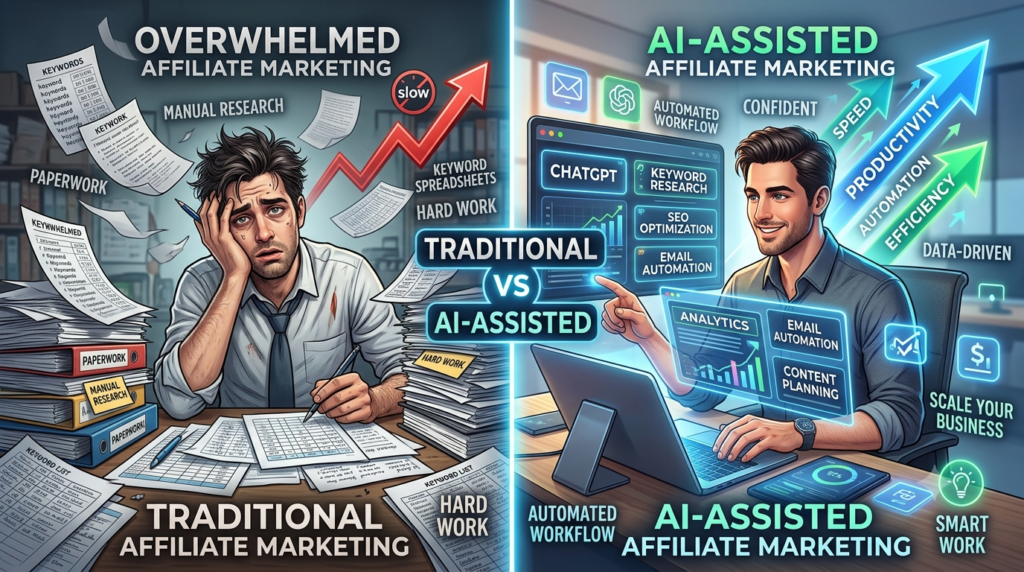
AI is changing affiliate marketing for beginners because it compresses tasks that used to take days into work you can finish in hours — niche research, keyword discovery, first drafts, and on-page SEO all move faster with the right tools. That speed is the entire shift. It doesn't replace strategy; it multiplies whatever system you plug it into.
Only a few years ago, launching an affiliate website required weeks of research before writing the first article. Today, ChatGPT, Claude, and Perplexity can help you brainstorm micro-niches, analyze competitors, identify customer pain points, and organize content ideas in minutes instead of hours.
The same acceleration applies throughout the entire affiliate workflow.
- Research got faster. Instead of manually reading forums and competitor sites for a week, you can prompt ChatGPT or Claude to map a niche, list buyer pain points, and surface affiliate offers in an afternoon. Perplexity's Deep Research workflow extends this further by pulling live sources instead of relying on static training data.
- Writing got faster. AI drafts outlines, full articles, and email sequences in minutes. One 2026 tutorial creator says AI now handles roughly 90 percent of the drafting workload for scripts and articles — you're editing, not starting from a blank page.
- Keyword discovery and content planning improved. Tools built around AI SEO, including essential AI SEO tools for affiliate marketers like Rank Math Content AI and NeuronWriter, score your draft against top-ranking pages and flag missing entities before you publish, not after.
- Automation and productivity compound the gains. Publishing schedules, email follow-ups, and link tracking all run with less manual input, freeing your time for the parts AI can't do.
But AI has clear limits.
AI cannot replace personal experience, honest product testing, or ethical recommendations. It doesn't know whether a tool genuinely solved your problem. It cannot take original screenshots, verify every fact, or build credibility with your audience. Those responsibilities remain yours.
This is why the most successful beginner affiliate marketing with AI approach combines automation with human expertise. I use AI to accelerate research, drafting, optimization, and planning, but every article still goes through careful editing, fact-checking, and refinement before publication. That human review is what aligns your content with modern E-E-A-T principles while helping it earn trust from readers, search engines, and AI-powered search experiences alike.
What Tools Should Every AI Affiliate Marketing Beginner Start With?
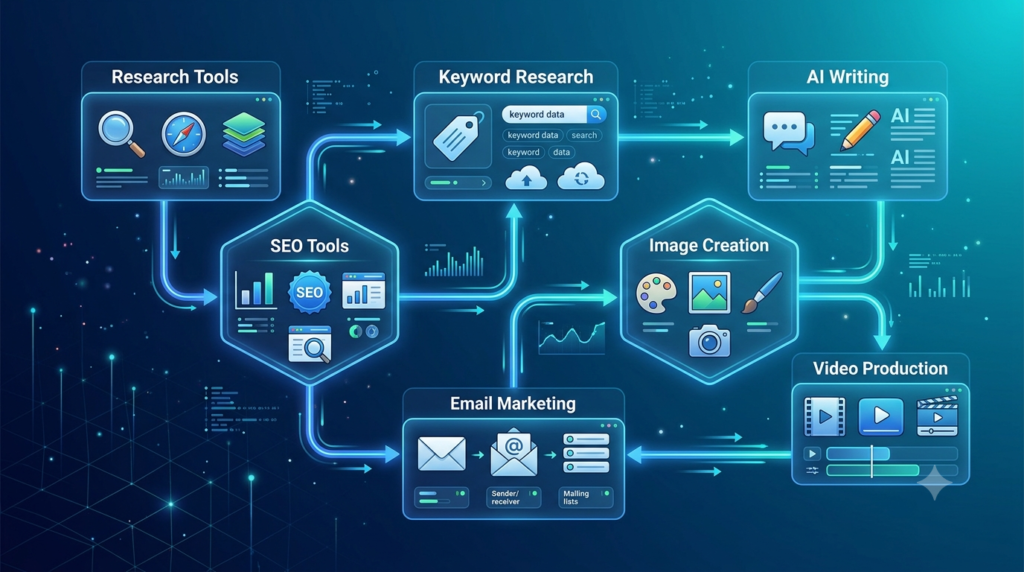
Every AI affiliate marketing beginner should start with seven tool categories: research, SEO, keyword research, writing, image creation, video, and email marketing. Together, they form what serious 2026 guides call a minimum viable stack — one tool per function, not five overlapping subscriptions. Here's what belongs in each category and why.
Research Tools
Research tools are defined as the AI systems you use to validate a niche and surface affiliate offers before you write a single word. Start with ChatGPT, Perplexity, and Google Trends.
ChatGPT is the tool I use most often when starting a new affiliate project. Instead of staring at a blank page, I simply ask it to map “problem – product – price point” for a given audience, and it returns a working list in minutes instead of hours. Perplexity goes further for validation because it pulls live web sources rather than static training data; its Deep Research workflow is specifically built for affiliate niche vetting, citing real pages instead of guessing. Finally, I use Google Trends to confirm whether interest in a niche is rising, flat, or declining. This protects you from building content around a topic that peaked two years ago.
Use all three together: ChatGPT for ideas, Perplexity for verification, Google Trends for momentum. Skipping the verification step is how beginners waste months writing about a niche nobody searches for.
SEO Tools
Great content rarely ranks without proper optimization. SEO tools ensure your articles are discoverable by Google and increasingly visible in AI-powered search experiences. Here is the core three I use on all of my sites: Rank Math, Google Search Console, and Google Analytics.
Rank Math, specifically its AI feature, scores your draft against on-page SEO factors — title tags, headers, keyword placement — before you hit publish. It's the plugin most 2026 WordPress-based affiliate guides recommend as the default SEO layer for beginners. Google Search Console shows you which queries actually bring impressions and clicks to your site, which matters more than any keyword tool's estimate once you're live. Google Analytics tracks what visitors do after they land — bounce rate, session length, which pages lead to affiliate clicks.
None of these tools write content for you. They tell you whether the content you published is working, which is a different job than drafting — and one beginners frequently skip entirely.
Keyword Research Tools
Keyword research prevents you from publishing content nobody searches for. The right keywords connect your content with buyers who are already looking for solutions. Start with Ahrefs, Mangools, or Google's Keyword Planner.
Ahrefs is the most complete option, showing search volume, keyword difficulty, and competitor rankings side by side — useful once you're past the free-tier stage. Mangools offers a lighter, cheaper alternative with a friendlier interface, a solid fit for a beginner's first paid keyword tool. Google Keyword Planner is free and pulls data directly from Google Ads, making it the right starting point if your budget is zero.
I often combine Google Keyword Planner with ChatGPT brainstorming and Mangools validation to create comprehensive content plans.
Writing Tools
AI should accelerate writing, not replace your expertise. The highest-performing affiliate content combines AI speed with human editing and real experience. Start with ChatGPT, Claude, and Grammarly.
ChatGPT and Claude both generate outlines, full drafts, and email sequences from a single prompt — pick one as your primary writer and use the other for a second opinion on structure or tone. Grammarly catches grammatical errors and clarity issues that AI drafts sometimes introduce, particularly awkward phrasing that reads fine to a model but off to a human.
The critical rule here: AI drafts are a starting point, not a finished product. Never publish raw AI text. Unedited drafts read in a flat, generic “robot voice” that hurts both reader trust and E-E-A-T signals. Add your own screenshots, personal results, and specific numbers before anything goes live.
Image Creation Tools
Bottom line: High-quality visuals increase engagement, strengthen branding, and make affiliate content more shareable across search engines and social platforms. Start with Midjourney, ChatGPT Images, and Canva AI.
Midjourney produces the highest-quality custom illustrations, useful for a distinct brand look across your site. ChatGPT Images is a faster, built-in option if you're already paying for ChatGPT and don't want a separate subscription. Canva AI is the fastest path to usable graphics for beginners specifically — templates, brand kits, and AI-assisted design tools all in one place, and it doubles as your lead magnet and thumbnail creator.
Most new AI affiliate marketers use Canva to design their initial site branding — logo, color palette, layout — in under an hour. You don't need custom illustration skill to look professional; you need a template and 20 minutes.
Video Tools
Bottom line: Video expands your reach beyond search engines and allows you to promote affiliate products across YouTube, Instagram, Facebook, and TikTok. Start with InVideo AI and CapCut.
InVideo AI turns a script into a produced video with stock footage, voiceover, and captions automatically. CapCut handles editing, trimming, and caption styling if you're recording short-form content or refining AI-generated footage. Together, they support a faceless affiliate channel strategy without a camera, studio, or editing background.
Email Marketing Tools
Affiliate marketers who build an email list own their audience. Those who depend only on search or social media rent it. Start with FluentCRM or GetResponse.
FluentCRM runs inside WordPress, which keeps your list and your content on the same platform — a natural fit if you're already using Rank Math and a WordPress theme. GetResponse is a hosted alternative with a broader automation builder if you want a standalone email tool outside WordPress.
Either way, the email tool is not optional. Building a site without an email list is one of the most common beginner mistakes, because it means never owning your audience — you're renting attention from Google's algorithm instead. A simple lead magnet, built with AI and delivered through FluentCRM or GetResponse, is what turns one-time traffic into repeat affiliate revenue.
How Do You Build Your AI Affiliate Marketing Tech Stack on a Budget?
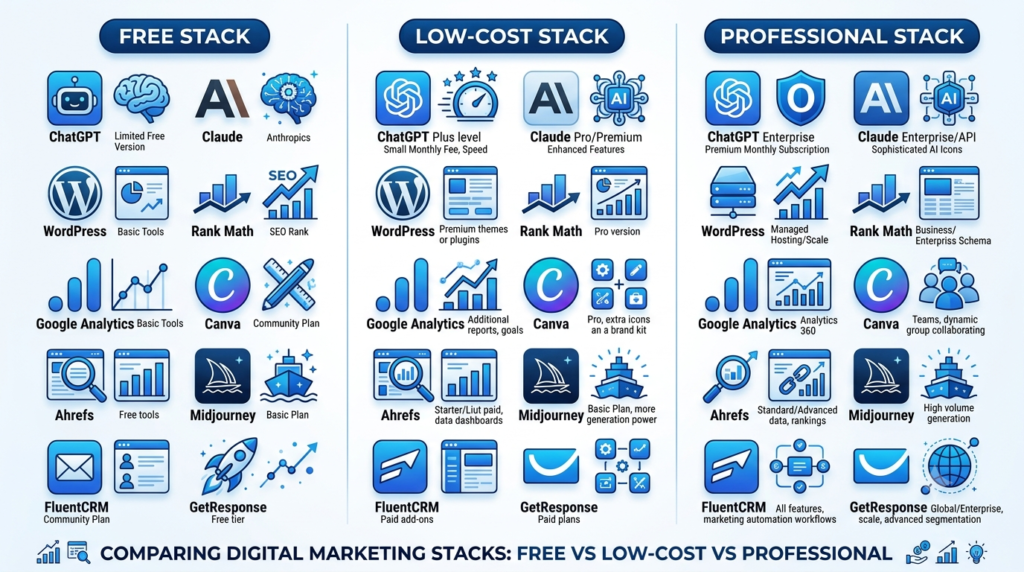
You can build a working AI affiliate marketing tech stack at three budget levels: free, low-cost, and professional. Each tier covers the same five functions — research, writing, SEO, design, and email — just with different depth and automation.
- The free stack uses ChatGPT's free tier, Google Keyword Planner, Google Trends, Canva's free plan, and a free-tier email tool. It's enough to launch a complete affiliate content stack with zero software spend at the start.
- The low-cost stack adds a paid writing tool like Claude Pro, a lightweight keyword tool like Mangools, and Rank Math's free SEO plugin — typically $20–$40 per month total.
- The professional stack layers in Ahrefs for competitive keyword data, NeuronWriter for content scoring, and a paid email automation platform like GetResponse — usually $100+ per month once you're generating consistent commissions and reinvesting.
| Tier | Research | Writing | SEO/Keywords | |
| Free | ChatGPT (free), Google Trends | ChatGPT (free) | Google Keyword Planner, Rank Math (free) | FluentCRM (free tier) |
| Low-Cost ($20–$40/mo) | Perplexity | Claude Pro | Mangools | GetResponse (starter) |
| Professional ($100+/mo) | Perplexity Pro | ChatGPT Plus + Claude | Ahrefs, NeuronWriter | GetResponse (automation tier) |
Start free. Upgrade only when a specific bottleneck — like keyword data depth or email automation — is actually slowing you down, not because a tool looks impressive.
How Do These AI Tools Actually Connect to One Workflow?
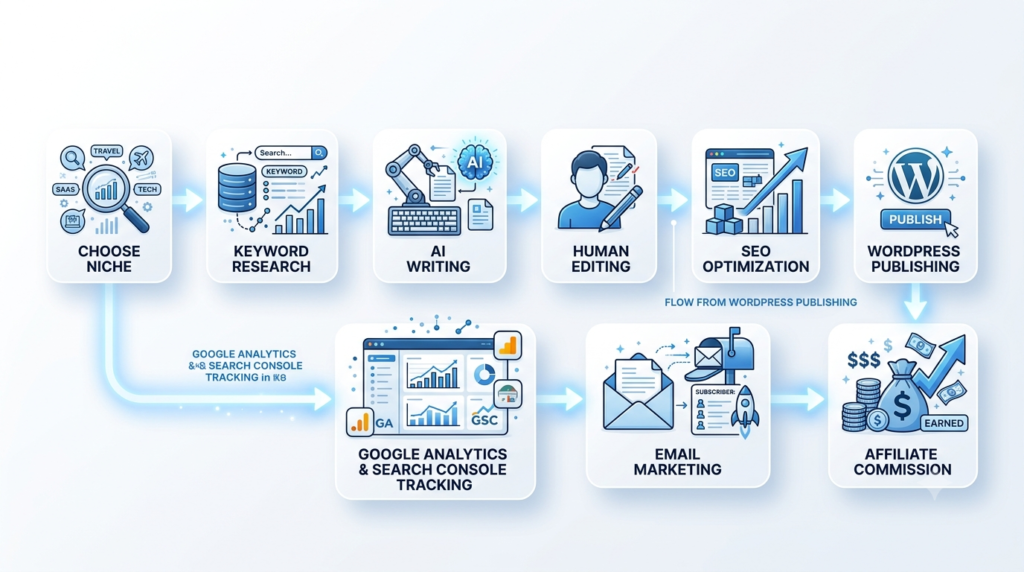
The most successful affiliate marketers don't think in terms of individual tools. They think in terms of systems. Every tool performs one specific job before handing the work to the next tool. That's what transforms an AI affiliate marketing starter kit from a collection of apps into a repeatable business process.
Here's the workflow I recommend for beginners:
- Niche. ChatGPT or Claude generates niche and offer ideas; Perplexity validates them against live search data.
- Keyword tool. Ahrefs, Mangools, or Keyword Planner confirms search volume and buyer intent for the niche you picked.
- AI writer. ChatGPT or Claude drafts the outline and first draft around that keyword.
- Human edit/fact-check. You add personal proof, screenshots, and correct anything the AI got wrong — this step is non-negotiable, not optional polish.
- Publish. The edited piece goes live through WordPress, scored by Rank Math before it publishes.
- Track. Google Analytics 4 measures traffic and behavior; a link tracker like Bitly measures affiliate click-through and EPC.
- Nurture. FluentCRM or GetResponse follows up with subscribers through an automated email sequence, turning one visit into repeat engagement.
Each tool exists to feed the next step. A keyword tool without a writer stalls at research. A writer without human editing produces content that reads as generic AI text. Publishing without tracking means you're flying blind on what actually converts. The pipeline, not any single tool, is what produces commissions.
Is AI-Generated Affiliate Content Against Google's or the FTC's Rules?

No. AI-generated affiliate content is not against Google's policies simply because it was created with artificial intelligence. What matters is the quality, originality, usefulness, and accuracy of the final content. Likewise, the FTC does not prohibit AI-assisted affiliate marketing, but it does require clear disclosure whenever you may earn a commission from recommended products.
- Google's stance: Google does not penalize content for being AI-assisted. It penalizes content produced primarily to manipulate rankings, regardless of whether a human or an AI wrote it. Thin, unedited AI drafts published purely to rank for a keyword fall under this policy and risk deindexing. Content that demonstrates real experience, original insight, and human review — the standard Google groups under E-E-A-T — is treated the same whether AI assisted the draft or not.
- The FTC disclosure requirement: The FTC requires clear, conspicuous disclosure of any affiliate relationship, placed near the recommendation itself, not buried in a footer or a separate disclosure page. This rule has nothing to do with AI specifically — it applies to every affiliate marketer — but beginners using AI to mass-produce content are more likely to skip it because they're optimizing for speed over compliance.
- Affiliate-network approval risk: Individual affiliate networks and programs run their own quality reviews. Sites publishing large volumes of unedited AI content with no personal proof or disclosure are the accounts most likely to fail approval or get banned after acceptance.
The kit-based fix for all three risks: run every AI draft through human editing and fact-checking before publishing and add your affiliate disclosure directly above or beside each recommendation — not in a separate page. That two-step habit, built into your workflow from day one, is what separates compliant AI-assisted content from the content that gets flagged.
How Much Does an AI Affiliate Marketing Starter Kit Cost?
An effective AI affiliate marketing starter kit can cost anywhere from $0 per month to about $50 per month for most beginners. You don't need enterprise software to publish high-quality affiliate content, optimize it for search engines, and build an email list.
In fact, many successful affiliate marketers begin with free tools and only upgrade after generating their first commissions.
Here's a realistic comparison.
| Category | Free Tier | Upgraded Tier (~$50/mo) |
| Writing | ChatGPT free | Claude Pro (~$20/mo) |
| SEO | Rank Math free | Rank Math free |
| Keyword Research | Google Keyword Planner | Mangools (~$15/mo) |
| Design | Canva free | Canva free |
| FluentCRM free tier | GetResponse starter (~$15/mo) | |
| Hosting | — | Bluehost (~$10–$14/mo, required at both tiers) |
The one cost that applies at every tier is hosting — a WordPress site needs somewhere to live, and Bluehost is a common choice in 2026 beginner tutorials for its speed and beginner-friendly setup, typically $10–$14 per month.
Beyond hosting, the free-tier stack costs nothing and is genuinely sufficient to launch — ChatGPT's free plan, Google's free keyword and analytics tools, Canva's free design tier, and a free email plan cover every step of the pipeline. The upgraded stack adds Claude Pro for a second writing tool, Mangools for deeper keyword data, and GetResponse's automation features — landing around $50 per month total, including hosting.
Don't upgrade a category until it's the actual bottleneck. A beginner with zero traffic doesn't need Ahrefs; a beginner with no email automation running does need a paid email tier once their list passes a few hundred subscribers.
What Mistakes Do New AI Affiliate Marketers Make?
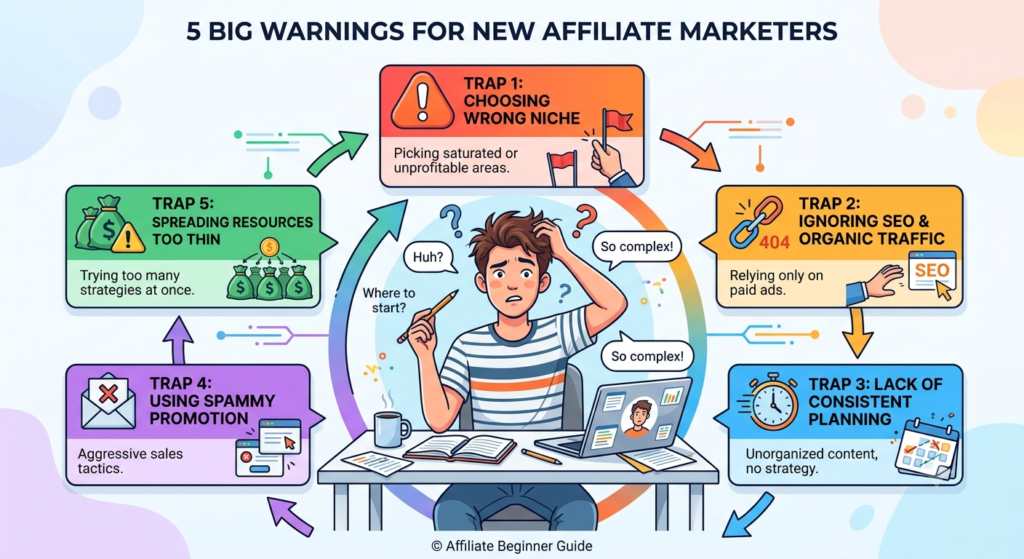
New AI affiliate marketers repeatedly make four mistakes: skipping the trust/funnel step, hoarding tools, skipping disclosure, and publishing unedited AI drafts. Each one is preventable with the workflow already outlined above.
1. Promoting Before Building Trust
Beginners publish content, get some traffic, and never capture a single email address. When that traffic disappears — algorithm update, seasonal dip, whatever — they own nothing. The fix: a lead magnet and an email tool are non-optional parts of the starter kit, not a “someday” upgrade.
2. Forgetting the Email Funnel
One of the biggest mistakes I see is treating every blog visitor as a one-time opportunity.
If someone leaves your website without subscribing, you may never see them again.
Offer a simple lead magnet—such as an AI Affiliate Marketing Starter Kit checklist, prompt library, or SEO template—and use FluentCRM or GetResponse to build a relationship over time. Email subscribers often become your highest-converting audience.
3. Tool-hoarding.
Signing up for five overlapping AI subscriptions before publishing a single article is one of the most common money-wasters in this category. A beginner doesn't need Ahrefs, SEMrush, and Mangools simultaneously. One keyword tool, used consistently, beats three tools used occasionally.
4. Skipping affiliate disclosure.
Some beginners bury their disclosure in a footer link or skip it entirely, either from ignorance or from thinking it hurts conversions. It doesn't just risk an FTC violation — it also erodes the exact trust that makes affiliate content convert in the first place.
5. Publishing unedited AI drafts.
This is the fastest way to end up with flat, generic “robot voice” content that fails both readers and Google's quality signals. AI drafts are a starting point. Beginners who skip the human edit/fact-check step publish content that reads as AI-generated because it is — with no personal proof, no screenshots, no specific numbers.
The common thread across all four mistakes: skipping a step in the workflow to move faster. Every step in the pipeline exists because removing it creates one of these exact problems.
What Are the First Steps to Take During Your First 30 Days?
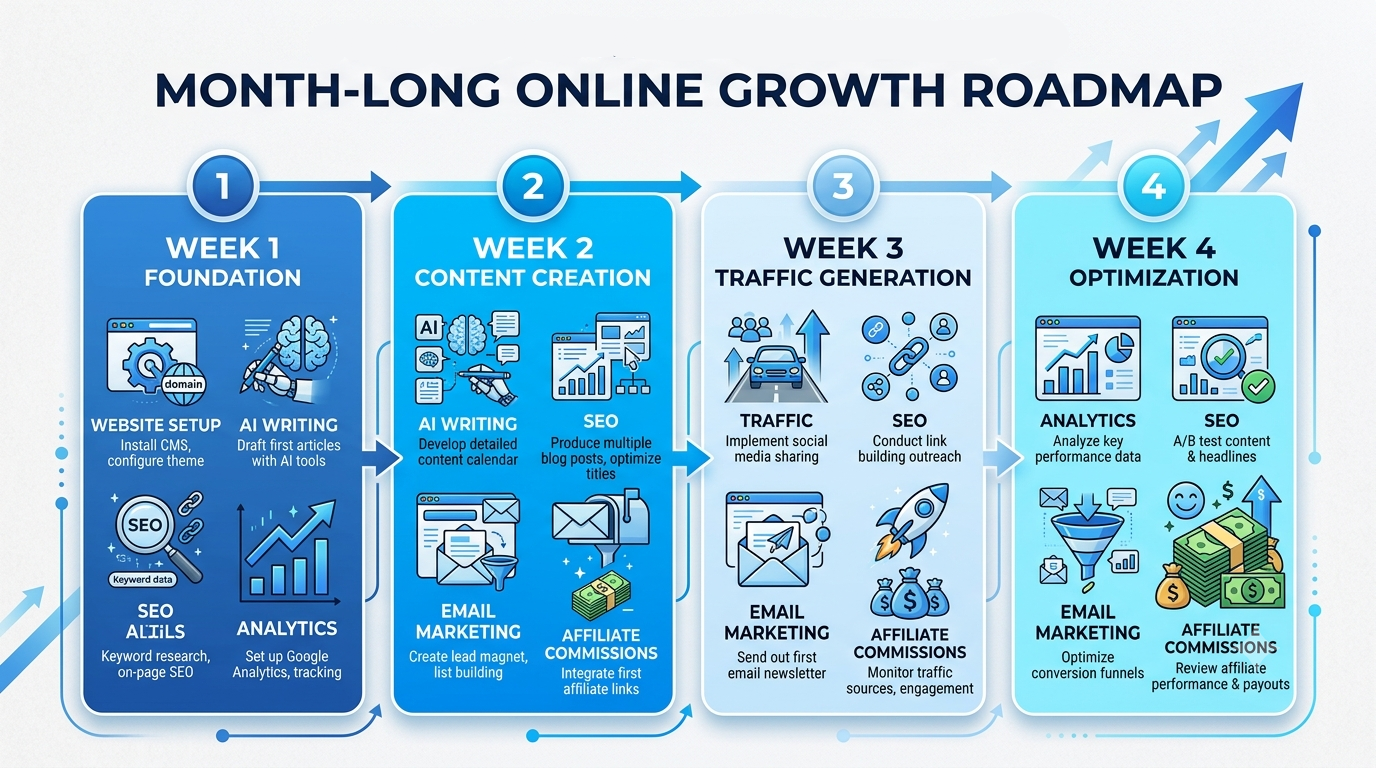
Your first 30 days follow a four-week sequence: foundation, content, traffic, and optimization. Each week builds on the last — skipping ahead usually means redoing work later.
Week 1 — Foundation.
Pick a tight niche and a specific affiliate offer using ChatGPT or Claude for ideation and Perplexity to validate demand. Set up WordPress hosting, install Rank Math, and draft your core pages — About, Privacy, Affiliate Disclosure — using AI for the first pass and editing for accuracy.
Week 2 — Content.
Run keyword research through Ahrefs, Mangools, or Keyword Planner to find 5–10 core buyer-intent keywords. Draft your first batch of content: 3 review posts, 2 comparison posts, and 1 best-of roundup, each written by AI and finished by you with real detail and 2–3 natural affiliate link placements.
Week 3 — Traffic.
Publish your content and submit your sitemap to Google Search Console. Set up your lead magnet — an AI-drafted PDF checklist built in Canva — and connect it to FluentCRM or GetResponse. Start driving initial traffic through search and, if relevant, a faceless video channel using InVideo AI or CapCut.
Week 4 — Optimization.
Review Google Analytics 4 and Search Console data to see which pages are getting impressions and clicks. Check your affiliate link performance and EPC through your link tracker. Double down on whatever format — reviews, comparisons, or best-of posts — is converting, and cut or revise whatever isn't.
Conclusion
An AI affiliate marketing starter kit isn't about finding one perfect tool. It's about building a simple, repeatable system that helps you research smarter, create better content, attract qualified traffic, and convert readers into customers.
Throughout this guide, you've seen that AI works best as a productivity multiplier—not a replacement for experience, integrity, or strategic thinking. The affiliate marketers who achieve sustainable success are the ones who consistently publish helpful content, recommend products they genuinely believe in, follow Google's and the FTC's guidelines, and continuously improve their workflow using real performance data.
So, don't wait until you can afford every premium AI platform.
Start with a focused tool stack, follow the 30-day roadmap, publish consistently, and refine your process as your business grows. One well-executed system will always outperform a collection of unused software subscriptions, and that's the foundation of a profitable AI-powered affiliate marketing business.
Don't wait for the perfect stack. Start with a simple one, and improve it as you go.
Frequently Asked Questions
u003cstrongu003eCan beginners really use AI for affiliate marketing?u003c/strongu003e
Yes, beginners can use AI for affiliate marketing without prior experience. AI tools like ChatGPT and Claude handle niche research, content drafting, and keyword ideation, removing the technical barriers that used to require years of practice. A beginner still needs to edit every AI draft and verify every affiliate offer. AI speeds up the process; it does not replace the beginner's judgment.
u003cstrongu003eWhich AI tool is best for affiliate marketing?u003c/strongu003e
No single AI tool is best for every task. ChatGPT and Claude work best for research and writing. Rank Math and NeuronWriter work best for SEO. Ahrefs and Mangools work best for keyword research. The right starter stack combines one tool per function instead of searching for one tool that does everything.
u003cstrongu003eIs AI-generated content safe for SEO?u003c/strongu003e
AI-generated content is safe for SEO when a human edits it for accuracy and adds original proof. Google penalizes low-quality, unedited content, not AI assistance itself. Content that passes human fact-checking and includes real screenshots or personal results ranks the same as fully human-written content. Unedited AI drafts published purely to rank are the actual risk.
u003cstrongu003eHow long does it take to earn the first affiliate commission?u003c/strongu003e
Most beginners following an AI-assisted workflow earn their first commission within 30 to 90 days. This timeline depends on niche competition, content volume, and how quickly a beginner publishes their first batch of buyer-intent content. A 30-day foundation and content plan, followed by 60 days of traffic and optimization, is a realistic baseline.
u003cstrongu003eCan I use AI for YouTube and social media affiliate marketing?u003c/strongu003e
Yes, AI supports YouTube and social media affiliate marketing directly. Tools like InVideo AI turn written scripts into produced videos, and CapCut handles editing and captions. This setup enables a faceless YouTube channel without filming, camera equipment, or editing experience. The same AI-drafted scripts can also repurpose into short-form social content.