Chadrack

To monetize a blog with AI products, you need three things: a focused niche, content that attracts buyers, and a monetization stack — a layered set of income streams that includes AI affiliate programs, your own digital products, and, eventually, display advertising. This guide walks you through my process for 2026, from choosing your niche to your first commission check.
The AI software market is projected to exceed $1.8 trillion by 2030. That's not a rounding error — that's a generational shift. And right now, bloggers who understand how to position themselves in this space are building real, recurring income from it.
But here's a problem: if you do a simple search on Google for this topic right now, most of the guides you’d find are nothing but vague or outright useless. Articles that say, “Write about AI tools and add affiliate links” are not offering a strategy but a suggestion with no map.
After over 15 years of building affiliate blogs in different niches, I've decided to do something different in this guide. Inside, you'll find my complete, step-by-step system — what I call the AI Blog Revenue Stack — that shows you exactly how to build a monetized AI blog from scratch, even with zero audience and zero technical background.
📌 Key Takeaways:
- What does it mean to monetize a blog with AI products? It means building a content-driven blog that earns income by promoting AI tools as an affiliate, selling AI-related digital products (like prompt packs and templates), and layering in passive revenue streams like display ads and sponsored content.
- The core system: The AI Blog Revenue Stack — a 4-tier monetization approach that starts with affiliate marketing (fastest to activate), adds digital products (highest margin), layers in display advertising (passive but traffic-dependent), and builds toward sponsored content as your authority grows.
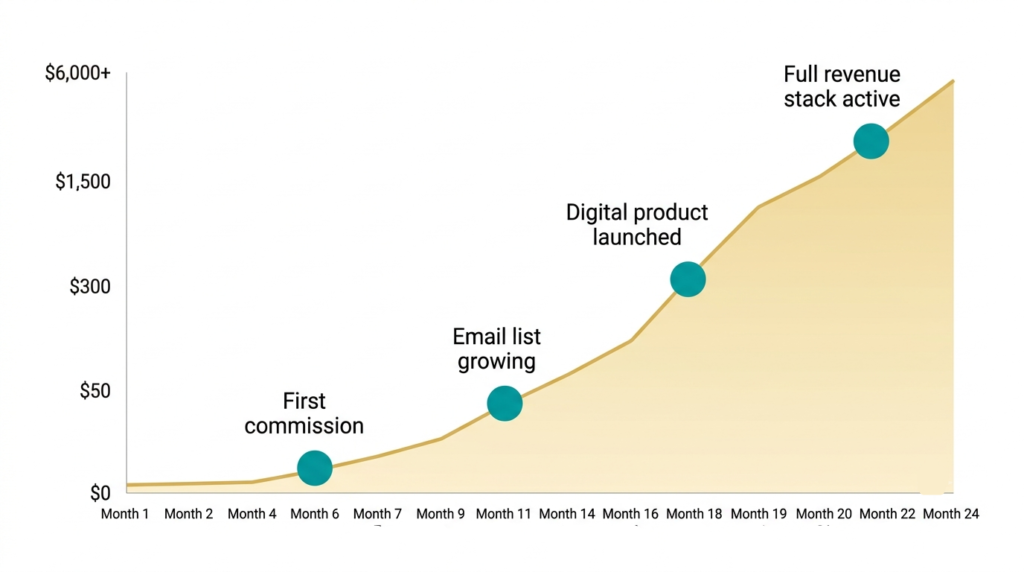
- Realistic timeline: Expect $0–$50/month in months 1–3, growing to $300–$1,500/month by month 6–12 with consistent effort. Full revenue stack activation typically takes 12–18 months.
- Your first move: Choose a sub-niche. Not “AI” broadly — a specific, ownable slice of it. The AI Sub-Niche Matrix in Section 2 will show you exactly where to focus.
Let’s jump in.
DISCLOSURE: WebIncomeJournal is supported by readers like yourself. We may earn an affiliate commission when you purchase through our links, which helps us offer our content for free. Learn more here.
What Does It Actually Mean to Monetize a Blog with AI Products?
Let me be direct: there are two ways people talk about “AI blogging,” and beginners almost always confuse them.
The first is using AI tools — like Jasper, ChatGPT, or Claude — to write faster, produce better content, and run your blog more efficiently. The second is making money from AI products by promoting or creating them. This blueprint covers both. Together, they create a system that's genuinely hard for competitors to replicate.
So, what exactly counts as an “AI product”? Think broadly:
- AI writing tools (Jasper, NeuronWriter, Copy.ai)
- AI image generators (Midjourney, Adobe Firefly, Canva AI)
- AI SEO platforms (Semrush AI, Ahrefs, Rank Math SEO)
- AI video tools (Pictory, InVideo, Synthesia)
- AI productivity apps (Notion AI, Otter.ai, Motion)
- AI automation platforms (Zapier AI, Make, HubSpot AI)
Almost all of them have affiliate programs. Many pay recurring commissions of 20–40% — meaning every month your referral stays subscribed, you earn again.
The good news? You don't need to be a developer, data scientist, or tech expert to profit from this. Your job as a blogger is to be an educator and promoter — not a builder. You test the tools, share your honest experience, and help readers make smarter buying decisions.
That's the entire model.
Who Is the AI Niche Actually For? (And How Do You Choose Your Sub-Niche?)
Here's where most beginner bloggers make their first — and most expensive — mistake.
They decide to blog about “AI.” Full stop. No further definition.
That is not a niche. That is a category. And you cannot compete in a category — you compete in a corner of one.
The AI content space is enormous, growing fast, and already dominated at the top by publishers with million-dollar content budgets. As a beginner, your path to traction is not through them — it's around them, inside a focused sub-niche where you can become the go-to voice.
How to Choose the Right Sub-Niche
I use a simple three-part filter before committing to any niche:
- Demand — Are people actively searching for solutions here? Use Google Search Console, Semrush, or Ahrefs to verify search volume before you invest a single hour in content.
- Monetization density — Do multiple AI products with affiliate programs exist in this space? If there's only one tool to promote, your income ceiling is low.
- Content sustainability — Can you produce 30+ pieces of content without repeating yourself? If the answer is no, the niche is too narrow to build a real blog around.
Run every sub-niche idea through those three questions before you commit.
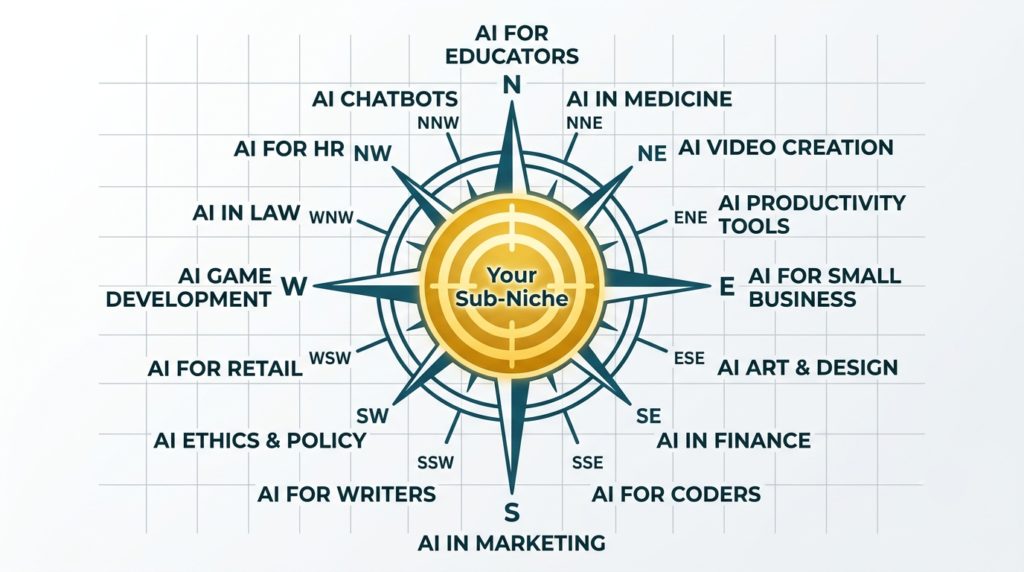
The AI Sub-Niche Matrix
| Sub-Niche | Example Blog Focus | Affiliate Opportunity | Demand Level | Competition |
| AI writing tools | Reviews of Jasper, Writesonic, Copy.ai | High (20–30% recurring) | Very High | High |
| AI for small business | Automating customer service, HR, finance | Medium–High | Growing | Moderate |
| AI video creation | Pictory, InVideo, Synthesia reviews | High (25–35% recurring) | High | Moderate |
| AI for educators | Lesson planning, grading, tutoring tools | Medium | Growing | Low |
| AI art & image tools | Midjourney, Adobe Firefly, Canva AI | Medium | High | Moderate |
| AI productivity tools | Notion AI, Otter.ai, Motion | Medium | Stable | Moderate |
| AI for marketers | Ad copy, email automation, analytics | High | High | High |
Best pick for beginners: AI for small business or AI for educators. Lower competition, buyers with real budgets, and demand that is growing — not already saturated.
Recommended: The Best Blog Niches for Affiliate Marketing Success in 2025
What Is the AI Blog Revenue Stack (and Why Single-Strategy Blogs Fail)?
Most beginner bloggers start with affiliate links and stop there. That works — for a while.
Then traffic dips. Or a program cuts its commission rate overnight. Or a competitor outranks you and your income disappears with your rankings.
Single-strategy blogs are brittle. They look like businesses, but they behave like bets.
The AI Blog Revenue Stack is a different approach. Instead of depending on one income source, you build revenue in layers — each tier activated when you have the traffic and audience to support it.
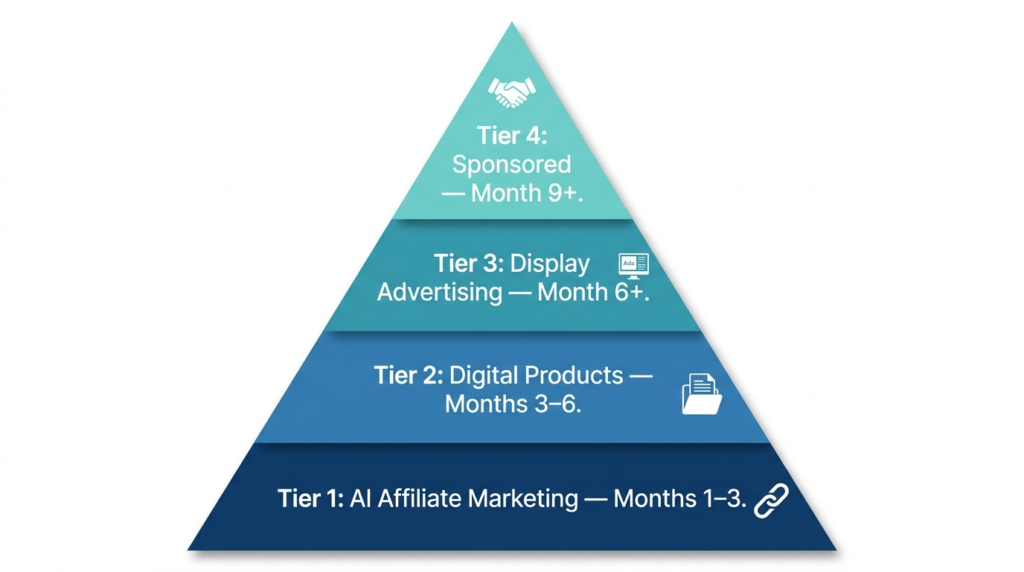
The 4-Tier AI Blog Revenue Stack
Tier 1 — Foundation (Months 1–3): AI Affiliate Marketing
Start here. No product to create, no inventory, no customer support. Just content that sends readers to tools they already want. Affiliate marketing is the fastest path to your first dollar online — and in the AI niche, recurring commissions make it compound over time.
Tier 2 — Amplifier (Months 3–6): Digital Products
Once you have an engaged audience — even a small one — your own digital products (prompt packs, PDF guides, templates) become your highest-margin income stream. No revenue split. Full pricing control. Every sale goes directly to you.
Tier 3 — Passive Layer (Month 6+): Display Advertising
Display ads through networks like Mediavine or Google AdSense require traffic first. Aim for 10,000+ monthly sessions before applying to premium networks. Once active, ads run in the background — your only job is to keep publishing.
Tier 4 — Authority Play (Month 9+): Sponsored Content & Brand Partnerships
This is where an established blog becomes a media property. Brands pay for placement, reviews, and newsletter mentions. But this requires demonstrated authority. You have to earn it before you can sell it.
Why this order matters: Each tier builds on the one before it. Affiliate income validates your niche. A digital product proves your audience trusts you enough to pay you directly. Display ads reward traffic growth. Sponsored content rewards authority. Skip a rung and you skip the foundation it needs.
Recommended: 10 Best Email Marketing Tools for Affiliate Marketers: AI-Powered Options Ranked (2026)
How Do You Build a Blog That Attracts AI Tool Buyers?
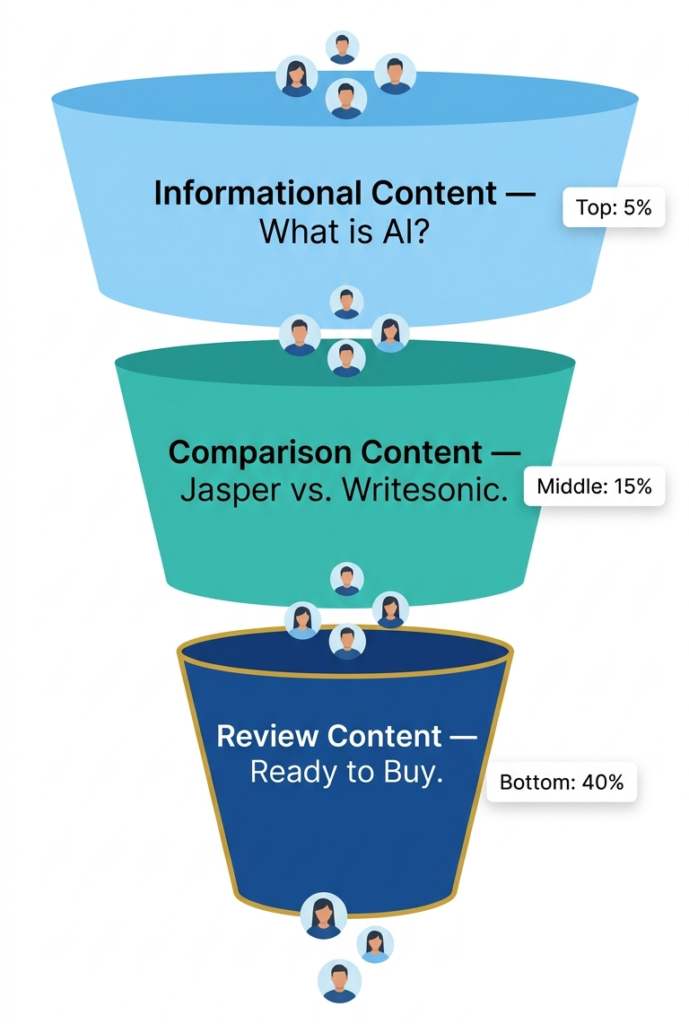
Traffic is not created equal. One thousand visitors actively looking for a tool recommendation are worth more than 100,000 curious visitors who are still in “learning mode.”
According to a 2026 affiliate marketing analysis, high-intent visitors from AI-powered search may convert at nearly 4x the rate of traditional search traffic. Your goal is not just to get traffic. Your goal is to get buyer-intent traffic.
Start with Buyer-Intent Keyword Research
Not all keywords convert equally. A visitor searching for “best AI writing tools for beginners” is a potential buyer. A visitor searching “what is AI” is a curious person. Both have value — but only one will click your affiliate link today.
Focus your early content on three proven formats:
- Review posts: “Rank Math SEO Review: Is It Worth It in 2026?” (2,000+ words, real testing, real screenshots, honest verdict)
- Comparison posts: “SEOWriting vs. Writesonic: Which AI Writer Actually Wins?”
- Best-of lists: “7 Best AI Tools for Small Business Owners in 2026”
These three formats consistently outperform informational posts in affiliate conversion. Use tools like Ahrefs, Semrush, or the “People Also Ask” box on Google to surface high-intent queries in your sub-niche.
Use AI Tools to Accelerate Your Own Content Production
There's a satisfying irony in using AI writing tools to build a blog that reviews AI writing tools — and it's fully worth leaning into.
Use tools like Claude, ChatGPT, or Jasper to generate outlines, draft first passes, repurpose posts into email newsletters, and brainstorm content angles. According to Showit's 2026 guide on AI-assisted blogging, AI can significantly compress your content production time without sacrificing quality — if you use it correctly.
The non-negotiable: always add your own testing experience, real screenshots, and an honest verdict. AI-generated content without a human perspective does not rank and does not convert. It just blends into everything else.
Build Topical Authority Before You Build Links
Google's Helpful Content system rewards blogs that demonstrate genuine depth on a specific topic — not broad coverage of many topics at a surface level.
Here's how topical authority works in practice: write one comprehensive pillar post (e.g., “The Complete Guide to AI Writing Tools in 2026″), then build 8–12 supporting posts that each answer a specific sub-question and link back to the pillar. Together, they signal expertise to Google and dramatically speed up how quickly new posts rank.
Think of it like a wheel. Your pillar post is the hub. Every supporting post is a spoke. The more spokes you add, the stronger the structure.
Recommended: How to Use AI to Write Affiliate Product Reviews that Sell [2025 Guide]
How Do You Choose the Right AI Affiliate Programs for Your Blog?
Not all AI affiliate programs are worth your time. The difference between $50/month and $500/month in affiliate income usually comes down to three things: commission structure, cookie duration, and whether the product actually converts.
Before you join any program, run it through this five-point checklist.
The 5-Point AI Affiliate Program Evaluation Checklist
- Commission type: Recurring commissions beat one-time payouts almost every time for SaaS tools. A 30% recurring commission on a $49/month subscription earns you $14.70 every single month per customer — and that compounds as more readers convert. One-time payouts give you a spike, then nothing.
- Cookie duration: Aim for 60+ days. Many AI tools offer 30 days, which is workable. Anything under 14 days is high-risk. A reader who clicks today and buys in two weeks won't earn you a single cent.
- Product reputation: Only promote tools you have genuinely tested. Readers are smarter than most bloggers assume. Generic praise for a tool you've clearly never opened produces zero trust — and zero commissions. Spend at least one week inside any tool before you write a review.
- Conversion economics: Does the product offer a free trial or freemium tier? Tools with a no-cost entry point convert significantly better because the first step costs the reader nothing. Elementor's blogging monetization guide notes that free-trial offers consistently outperform paid-only funnels in affiliate conversion rates.
- Payout threshold and method: Confirm you can actually get paid. Look for PayPal, Stripe, or wire transfer options. Check the minimum payout threshold — many programs pay at $50 or $100, which means you need to hit that before you see a cent.
Recommended AI Affiliate Programs for Beginners in 2026
According to Workborn's 2026 AI monetization guide, many AI SaaS affiliate offers pay 20% to 50% recurring commissions with 60 to 90-day cookie windows — some of the most generous terms in the affiliate marketing space.
| Program | Commission | Type | Cookie | Best For |
| Jasper AI | 25–30% | Recurring | 60 days | Writing/content niche |
| Writesonic | 30% | Recurring | 30 days | Marketing, copywriting |
| Pictory | 30% | Recurring | 30 days | Video content niche |
| InVideo | ~35% (monthly) | One-time/Recurring | 30 days | Video creators |
| Notion AI | 20% + $50 bonus | Recurring (1 yr) | 30 days | Productivity niche |
| Tailwind | Tiered recurring | Recurring lifetime | 30 days | Social media niche |
| Zebracat | 30% | Recurring lifetime | N/A | Video marketing |
| Scalenut | Variable | Recurring | 30 days | SEO content niche |
FTC disclosure note: You are legally required to disclose affiliate relationships. Include a clear statement at the top of every post containing affiliate links: “This post contains affiliate links. I may earn a commission if you purchase through my link, at no extra cost to you.” This is not optional — and transparency actually improves trust and conversion rates.
How Do You Actually Make Money with AI Affiliate Links? (Step-by-Step)

Knowing which programs to join is the easy part. The harder part — the part most guides skip entirely — is execution: how you actually turn a blog post into consistent affiliate income.
Here's the four-step process that works.
Step 1: Join 2–3 Programs (Not 20)
The most common beginner mistake is joining every affiliate program available, then spreading promotion thin across all of them.
Better approach: pick two to three programs that genuinely fit your sub-niche and build real depth around them. One useful, well-tested review post that converts beats ten shallow mentions that don't. Depth wins every time.
Step 2: Create “Money Pages” That Convert
Your highest-converting content will almost always be one of three formats:
- In-depth review posts (2,000–3,000 words): Real screenshots, a clear pricing breakdown, honest pros and cons, and your verdict stated early — not buried at the end.
- Comparison posts (“Jasper vs. ChatGPT: Which One Is Better for Blog Writing?”): These capture readers at the decision stage of the buying journey — the moment they're closest to purchasing.
- Tutorial posts (“How to Write a Blog Post in 30 Minutes Using Jasper AI”): These work because they show the tool in action rather than just describe it.
For every money page: place your primary affiliate link within the first 300 words, in the conclusion, and in a clearly labeled CTA button. A transparent disclosure doesn't hurt conversions — it helps them.
Step 3: Build an Email List from Day One
Every visitor who leaves without subscribing is a lost opportunity you may never recover.
An email list gives you a direct channel to your audience that no search algorithm can touch. Build it from day one with a simple lead magnet: a tool comparison checklist, or a quick-start guide. One 2026 case study showed a creator with no prior audience earning their first affiliate commission in under a month — largely by pairing content with an email capture strategy from the start.
Email sequences with soft affiliate recommendations consistently outperform cold blog traffic in conversion rate. Your list is a multiplier.
Step 4: Disclose, Track, and Optimize
FTC compliance is not optional. Add a clear disclosure to the top of every post containing affiliate links.
Then track performance using a link management tool — Pretty Links works well for WordPress — or use your affiliate dashboard's built-in analytics. After 60–90 days, look for patterns:
- Posts with traffic but no affiliate clicks? There's a trust or intent mismatch. Revise the CTA and check whether the offer fits the content.
- Posts that convert consistently? Double down. Build supporting content that links to them and add an email sequence around the topic.
The data tells you where to invest next. Follow it.
Recommended: 10 Best Email Marketing Tools for Affiliate Marketers: AI-Powered Options Ranked (2026)
What Other AI Products Can You Sell from Your Blog (Beyond Affiliate Links)?
Affiliate commissions are the fastest way to start earning. But they're not the highest margin revenue stream available to you.
When you promote someone else's product, you earn a percentage. When you sell your own, you keep everything.
In the AI niche, the most valuable digital products are also among the easiest to create — and your blog audience is already primed to buy them.
AI-Specific Digital Products That Actually Sell
- AI Prompt Packs: Curated sets of prompts for specific use cases: “100 ChatGPT Prompts for Freelancers,” “50 AI Prompts for Social Media Managers.” Low creation cost, high perceived value. Price range: $9–$29. Sell via Gumroad or Payhip.
- AI Tool Comparison Guides (PDF): A downloadable PDF like “The Complete Guide to AI Writing Tools 2026” (with comparison tables, pricing breakdowns, and a decision tree) solves a real problem for readers who don't want to do the research themselves. Price range: $17–$47.
- AI Workflow Templates: Notion templates, Airtable bases, or workflow SOPs for people building AI-assisted businesses. These take more time to build but carry higher perceived value. Price range: $19–$79.
- Mini Courses or Workshop Recordings: A 60–90-minute recorded workshop — “How to Use AI to Write Faster” — can sell for $47–$197. Record with Loom and sell via Gumroad or Podia.
One important reality check: Don't launch a digital product until you have at least 500 email subscribers or 5,000 monthly sessions. Without an audience, even a great product won't sell. Build the audience first. Then build the product.
How Much Money Can You Realistically Make Monetizing a Blog with AI Products?
This is the question everyone wants answered — and almost no blog answers honestly.
So here it is, without the hype.
According to Workborn's 2026 AI blog monetization analysis, a blog in the AI tools niche with 10,000 monthly visitors can realistically generate $2,000 to $8,000 per month across affiliate, digital product, email, and ad revenue layers. That's a real ceiling — but it takes time and consistent effort to reach.
Realistic Income Ranges by Stage
| Stage | Monthly Sessions | Primary Strategy | Realistic Monthly Income |
| Early (Month 1–3) | 0–1,000 | 2–3 affiliate programs, building content | $0–$50 |
| Growing (Month 3–6) | 1,000–5,000 | Affiliates + email list building | $50–$300 |
| Established (Month 6–12) | 5,000–15,000 | Affiliates + digital products + display ads | $300–$1,500 |
| Authority (Month 12–24) | 15,000–50,000 | Full revenue stack + sponsored content | $1,500–$6,000+ |
Key Variables That Determine Where You Land
- Niche specificity — Narrow niches convert better. “AI for real estate agents” outperforms “AI tools” every time.
- Content volume and quality — More buyer-intent posts mean more conversions. Two strong money pages beat ten weak ones.
- Email list growth rate — A 1,000-person list that trusts you is worth more than 50,000 cold visitors.
- Affiliate program selection — Recurring commissions compound. One-time payouts plateau.
The honest bottom line: Six months of consistent effort — two to three posts per week — before meaningful income is the norm, not the exception. US affiliate marketing spending is projected to reach $13.81 billion in 2026, up from $12.42 billion in 2025. The market is growing. But growing markets still reward patience over shortcuts.
AI tools can accelerate your content production. They cannot accelerate audience trust — and trust is the actual bottleneck.
Recommended: HubSpot vs Mailchimp: Which Email Platform Is Best for Affiliate Bloggers in 2025?
How Do You Optimize Your AI Blog for AI-Powered Search Engines Like ChatGPT and Google's AI Overviews?
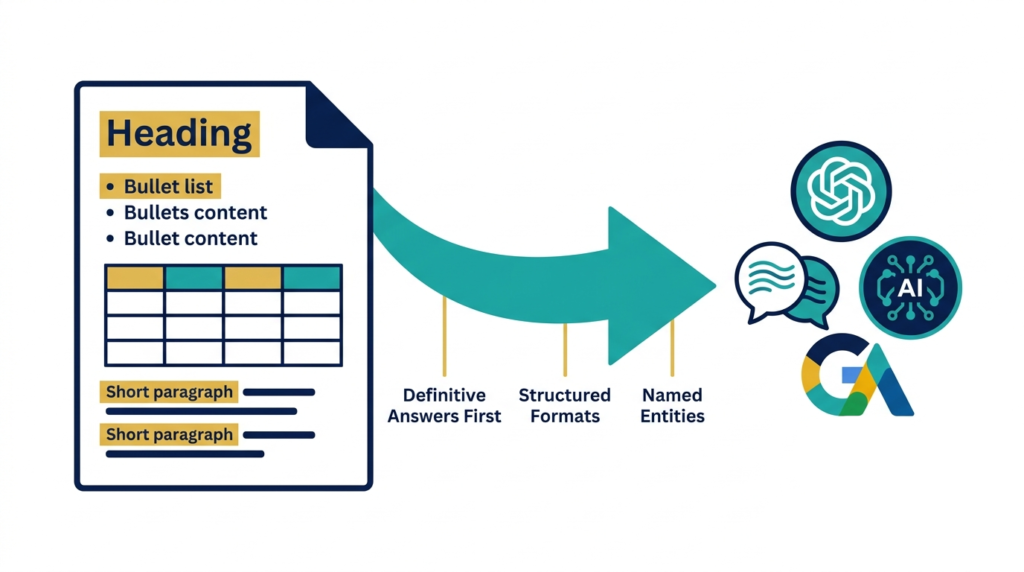
In 2026, a meaningful percentage of informational searches are answered directly inside AI tools — ChatGPT, Perplexity, Google's AI Overviews — before the user ever clicks through to a website.
This is not a future trend. It is the current reality.
For bloggers, this creates both a threat and an opportunity. The threat: if your content isn't structured for AI extraction, you get skipped. The opportunity: if it is, you get cited as a source — inside the AI's answer — to an audience that never had to find you on page one.
The discipline of optimizing for these systems is called Generative Engine Optimization (GEO).
How to Optimize Your Blog Content for AI Extraction
- Write definitive answers early. The first 100 words of every section should contain a complete, quotable answer to the question your H2 poses. AI search systems pull from early, dense, authoritative sentences. Bury your answer in paragraph five and AI systems won't find it.
- Use structured formats generously. Numbered lists, comparison tables, and definition-style paragraphs are easier for AI systems to parse and re-present. Narrative prose alone is harder to extract cleanly and consistently.
- Cite specific data and named tools. Vague claims (“many experts say…”) get ignored. Specific claims (“Jasper's affiliate program pays 30% recurring commissions with a 60-day cookie”) get cited. Google's own 2026 AI marketing guidance confirms that AI systems favor content with verifiable, entity-linked information over generic commentary.
- Use question-style headings. H2 and H3 headings phrased as questions match exactly how AI search engines parse and map user queries to content. Every section heading in this guide is written as a question — that's intentional, not stylistic.
- Build entity associations. Mention the names of tools, platforms, and programs consistently and in context. Reference Jasper, Writesonic, HubSpot, WordPress, and Semrush in relevant, natural sentences. This helps AI systems understand what your blog is about at an entity level — not just a keyword level.
- Keep paragraphs short. Three to four sentences maximum. Long, dense paragraphs are harder for AI to extract clean, quotable passages from. Short paragraphs win in both human readability and AI extraction.
What Are the Most Common Mistakes Beginners Make When Monetizing a Blog with AI Products?
Most monetization failures in the AI blog niche are not caused by bad luck or a bad market. They're caused by a handful of completely avoidable mistakes.
Here are the five that account for the vast majority of early failures.
- Promoting AI tools you've never tested. Readers are savvier than most bloggers assume. Generic praise for a tool you've clearly never used reads exactly like what it is. It produces zero trust and zero commissions. Spend at least a week inside any tool before writing a review — your credibility depends on it.
- Choosing one-time commissions over recurring. Do the math: a 40% one-time commission on a $50 sale earns you $20. Once. A 30% recurring commission on a $49/month subscription earns you $14.70 every month, potentially for years. The recurring option wins — almost always.
- Writing for traffic before writing for buyers. “What is ChatGPT?” gets 100,000 searches a month. “Jasper vs. ChatGPT for blog writing” gets 800. The second query brings people who are ready to decide — and those are the readers who click affiliate links. Conversionminded's 2026 strategy guide makes this point clearly: conversion-first blogs that start with the offer and build content around it consistently outperform traffic-first blogs that chase volume.
- Skipping the email list. Affiliate links in blog posts are entirely dependent on organic traffic. One algorithm update, one ranking drop, and your income disappears. An email list is a direct line to your audience that no search engine controls. Build it from day one — even if you start with 10 subscribers.
- Trying to cover all of AI. The AI space moves faster than any single blogger can track. Trying to be the “everything AI” blog means you're always a step behind the specialists. Choose a sub-niche, own it, and build from there.
What Does Your First 90 Days Look Like? A Week-by-Week Checklist
Knowing the strategy is one thing. Having a clear action plan for the first 90 days is what turns strategy into income.
Here's exactly what to do — week by week.
Weeks 1–2: Foundation
- [ ] Choose your sub-niche using the AI Sub-Niche Matrix above
- [ ] Register a domain and set up hosting (WordPress on BlueHost is a solid, affordable starting point)
- [ ] Install an SEO plugin (Rank Math or Yoast)
- [ ] Identify your first 10 target keywords using Google Search Console, Mangools, Ubersuggest, or Ahrefs
- [ ] Sign up for 2–3 AI affiliate programs from the table above
- [ ] Set up a simple email opt-in with a lead magnet (an AI prompt pack is the easiest and most relevant place to start)
Weeks 3–6: Content Creation
- [ ] Publish your first review post (2,000+ words, real testing, screenshots included)
- [ ] Publish your first comparison post targeting a high-intent keyword
- [ ] Publish 3–4 supporting informational posts that link back to your pillar content
- [ ] Set up your first email welcome sequence (3 emails minimum: introduce yourself, deliver the lead magnet, make a soft tool recommendation)
- [ ] Start promoting content on one social channel — LinkedIn or Pinterest drive the strongest referral traffic for most AI blog niches
Weeks 7–12: Optimization & Growth
- [ ] Set up Google Search Console and Google Analytics if you haven't already
- [ ] Review your data: which posts get traffic but no affiliate clicks? Revise the CTAs and check the offer alignment.
- [ ] Publish 2 additional money pages based on what your keyword research shows converting
- [ ] Create your first simple digital product — a prompt pack or PDF guide works well as a starting point
- [ ] Soft-launch the digital product to your email list to validate the offer and generate your first non-affiliate income
By the end of week 12, you should have 6–8 published posts, a growing email list, 2–3 affiliate programs actively promoted, and your first digital product ready to sell. That's a real business foundation — not just a blog.
Conclusion: Is Monetizing a Blog with AI Products Worth It in 2026?
Yes. With honest caveats.
The AI software market is growing faster than almost any other niche online. Affiliate commissions in the AI SaaS space are among the most generous available — 20–40% recurring is common, and the global affiliate market is projected to grow from $27.8 billion in 2024 to $48 billion by 2027. The content gap between what beginners need and what currently exists is still wide enough for new voices to rank, build audiences, and generate real income.
The barriers are not technical. They are consistency and patience. And if you have loads of that then monetizing your blog with AI tools is your best bet right now.
Start today. Not next week. Today.
Choose your sub-niche. Everything else — the content, the income, the audience — builds from that single decision.
Ready to go deeper? Check out our guide to the best AI tools for content creation and start building your stack right now.
Frequently Asked Questions
Can AI-generated blogs make money?
Yes. AI-generated blogs make money by delivering original value to a target audience. Publishers earn revenue through digital product sales, affiliate marketing programs, and contextual ad networks. Success requires human editors to refine the automated drafts, add unique insights, and maintain quality control. Blogs that publish mass-produced content without human editing fail to generate sustainable income.
Does AI content get monetized?
Yes. Google AdSense and other premium ad networks monetize AI-assisted content that complies with their webmaster guidelines. Monetization approval depends entirely on the depth, utility, and originality of the published information. Platforms explicitly permit automated drafting tools if the final articles serve real user intent. However, networks reject websites that use automation simply to manipulate search engine placements.
Which AI is best for blogging?
Anthropic Claude and OpenAI ChatGPT currently lead the industry for strategic blogging workflows. Claude excels at structural logic, matching complex brand voices, and creating comprehensive information gain. ChatGPT provides strong outlining tools, programmatic data gathering, and rapid conceptual brainstorming. Successful bloggers deploy these models to build initial outlines and text assets before executing manual editorial reviews.
Which AI tool is best for earning money?
The best tools for earning money are no-code automation platforms like Make.com paired with custom OpenAI API instances. These software combinations allow you to build proprietary micro-services, automated prompt kits, and intelligent databases directly for your audience. Creators package these custom setups into paid premium digital assets. This product-driven model produces significantly higher revenue margins than standard display advertising.
Can I monetize my blogging site with AI-generated content?
Yes. You can monetize your blogging site with AI-generated content if you provide unique, expert-reviewed information. Modern search algorithms prioritize first-party data, clear author expertise, and distinct topical depth over simple word counts. Authors must inject personal case studies, verified data points, and clear structural formatting into every automated text file. This manual enrichment prevents automated content penalties and secures long-term ad network approvals.