Chadrack
![The Rank Math AI Visibility Review You Need to Read [Worth It In 2026?]](https://webincomejournal.com/wp-content/uploads/2026/07/Rank-Math-AI-Visibility-Review-Hero-Image-613x350.png)
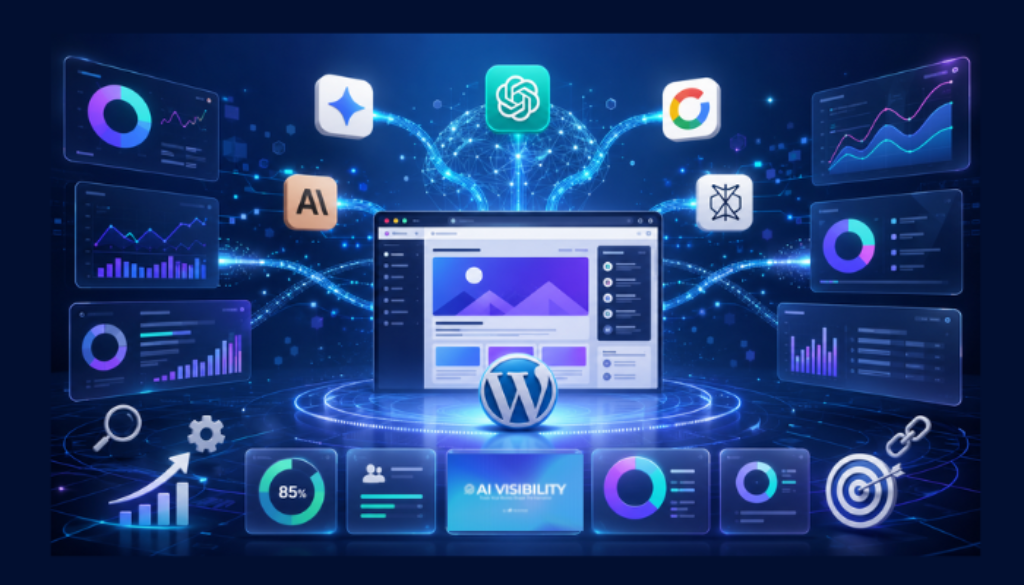
Rank Math AI Visibility is one of the most accessible AI visibility tracking tools available for WordPress users today. It gives you meaningful insights into how AI systems talk about your brand, but it does not directly improve your AI rankings. Its real value lies in helping you identify opportunities to strengthen your content, increase authoritative citations, and build the signals that AI search engines rely on when generating answers. For 2026, it's worth it if you need visibility data on the AI side of search.
Over the past few months, one question has been at the front of my mind: How do I get my brand mentioned by ChatGPT and Google's AI Overviews?
That question led me down a rabbit hole of AI visibility monitoring tools. After all, if Peter Drucker was right when he said, “You can't improve what you can't measure,” then the first step toward improving my AI visibility was finding a reliable way to measure it.
The problem was cost.
Most of the established AI visibility platforms are built for enterprise customers, and their pricing reflects that. Tools from Moz start at around $179 per month, SE Ranking at $129 per month, while Ahrefs' AI features on higher-tier plans can cost hundreds of dollars each month. For bloggers, affiliate marketers, and many small businesses, that's a significant investment for a tool that measures visibility rather than directly generates revenue.
That is why I paid attention when I received an email from Bhanu Ahluwalia, Co-Founder of Rank Math, announcing the launch of Rank Math AI Visibility. As someone who already uses Rank Math SEO across all of my websites, I was curious to see whether this new tool could deliver enterprise-style AI visibility tracking at a price that ordinary WordPress users could actually justify.
I immediately signed up for the free trial and spent time exploring its features, testing its workflow, and comparing its capabilities with other AI visibility platforms on the market.
In this Rank Math AI Visibility Review, I'll show you exactly how the tool works, what it measures, how to set it up, which AI platforms it currently supports, what I genuinely liked, where I think it still falls short, how its pricing compares with competing tools, and whether it's a worthwhile addition to your SEO stack in 2026. If you're trying to understand how your brand appears in AI-generated answers, this review will help you decide whether Rank Math AI Visibility deserves your investment.
Key Takeaways
- Rank Math AI Visibility measures how your brand appears in AI generated answers rather than traditional search rankings.
- It tracks brand mentions, citations, sentiment, competitor visibility, AI response transcripts, and an overall AI Visibility Score.
- The tool helps you understand how ChatGPT, Google AI Overviews, Perplexity, Gemini, Claude, and other AI platforms perceive your brand.
- It integrates directly into the WordPress dashboard, making AI visibility monitoring easier for existing Rank Math users.
- The platform measures AI visibility but does not optimize it automatically. Improving AI visibility still depends on strong entities, structured data, topical authority, original research, expert authorship, and trusted citations.
- For businesses investing in SEO and Generative Engine Optimization (GEO), Rank Math AI Visibility is best viewed as an AI intelligence platform that complements traditional SEO tools, rather than replacing them.
DISCLOSURE: WebIncomeJournal is supported by readers like yourself. We may earn an affiliate commission when you purchase through our links, which helps us offer our content for free. Learn more here.
What Is Rank Math AI Visibility? (The Core Concept)
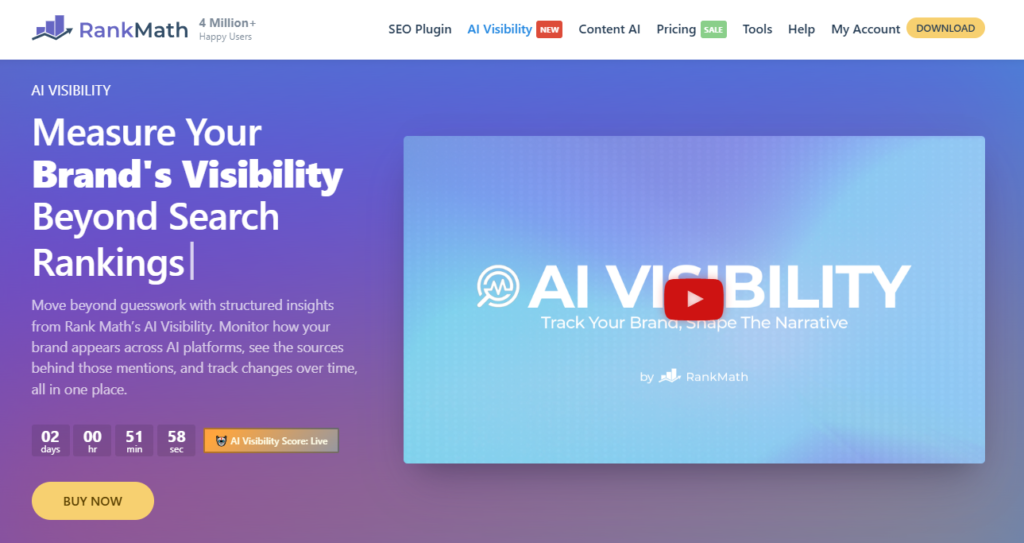
Rank Math AI Visibility is a feature within the Rank Math SEO plugin that tracks how often your brand appears in AI-generated answers. Instead of focusing only on Google keyword rankings, it measures brand mentions, citation sources, sentiment, competitor visibility, and overall presence across AI platforms.
For someone familiar with SEO, the easiest way to understand it is this: traditional rank tracking asks, “Where does my page rank for a keyword?” AI visibility tracking asks, “Does an AI system mention my brand when someone asks a relevant question?”
This shift matters because search behavior has changed over the last few months. Users are increasingly asking ChatGPT, Google AI Overviews, Perplexity, Gemini, and Claude for recommendations and explanations. A website may rank well in Google search but still be absent from AI-generated responses. Rank Math AI Visibility is designed to reveal that gap.
The tool centers on an AI Visibility Score, which combines signals such as mentions, citations, and sentiment into a single view of how visible and trusted your brand appears in AI answers. This makes it useful for SEOs, marketers, and business owners who want to understand brand presence beyond traditional blue-link rankings.
Currently Rank Math’s AI Visibility tracking is focused primarily on ChatGPT, which remains one of the most influential AI models for consumer queries. Rank Math has indicated that support for additional AI platforms is expanding, so the scope of coverage may evolve as the product matures.
How Does Rank Math AI Visibility Work?
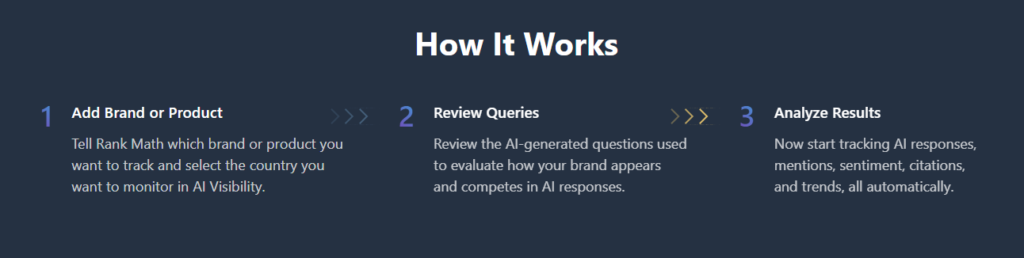
Rank Math AI Visibility follows a straightforward workflow: you define what you want to track, the system generates relevant AI search queries, and the dashboard summarizes how AI platforms respond to those queries.
- Add a brand, domain, or product: You start by entering the brand name, website URL, or product you want to monitor. This tells Rank Math which entity it should look for in AI-generated answers.
- Choose tracking settings: You can configure settings such as target country, tracking interval, and other relevant preferences. These settings help make the AI visibility data more relevant to your market.
- Generate and evaluate queries: The system creates or evaluates relevant questions that users might ask AI platforms. It then checks how those platforms respond and whether your brand appears in the answers.
- Collect visibility signals: Rank Math records brand mentions, citation sources, sentiment, and competitor appearances. These signals provide context for how AI systems are presenting your brand.
- Display the data in a dashboard: The results are organized into reports and visual summaries, allowing you to analyze trends, compare competitors, and identify opportunities for improvement.
Behind the scenes, the tool is essentially performing a structured audit of AI-generated responses. It is not crawling search rankings in the traditional sense. Instead, it is analyzing how AI systems answer questions related to your brand and industry.
This process gives users a clear mental model: Rank Math AI Visibility turns scattered AI responses into measurable data that can be monitored over time.
What Metrics Does Rank Math AI Visibility Show?
Rank Math AI Visibility provides several metrics that help translate AI-generated responses into actionable SEO and brand insights. Each metric answers a different question about how AI systems perceive and present your brand.
- Brand mentions: Brand mentions show how often your brand appears in AI-generated answers. This is useful for measuring awareness: if your brand is rarely mentioned, it may indicate that your content or brand signals are not yet strong enough to be recognized by AI systems.
- Citations: Citations reveal whether AI answers reference your website or other sources associated with your brand. This matters because citations can signal authority and trustworthiness. If AI platforms frequently cite your site, it suggests that your content is being recognized as a relevant source.
- Sentiment: Sentiment analysis classifies mentions as positive, neutral, or negative. This helps you understand not just whether your brand is visible, but also how it is being described. A high level of positive sentiment can support brand reputation, while negative sentiment may highlight areas that need attention.
- Competitor visibility: Competitor visibility shows which competing brands appear in AI answers instead of or alongside your brand. This metric is valuable for benchmarking because it reveals who is winning visibility in your niche and where your content strategy may need improvement.
- Visibility score or average ranking: The AI Visibility Score summarizes how prominently your brand appears in AI-generated responses. While the exact calculation may vary, the score is intended to provide a quick snapshot of overall AI visibility.
Together, these metrics help connect AI visibility data to practical SEO actions. They can guide content creation, authority building, citation acquisition, and reputation management by showing how AI systems currently represent your brand.
How Do You Set Up Rank Math AI Visibility?
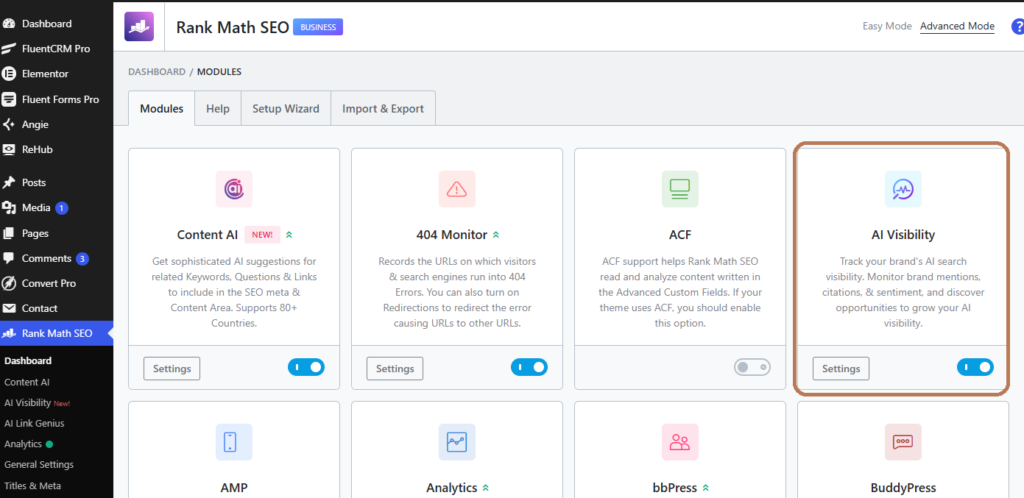
Setting up Rank Math AI Visibility takes only a few minutes. Once configured, the tool begins monitoring how AI platforms mention your brand and organizes the results into reports you can review over time.
Follow these steps to create your first AI Visibility report:
- Enable the AI Visibility module. Log into your WordPress dashboard, open Rank Math, and activate AI Visibility from the module list. It requires an active Content AI subscription, so confirm your plan before you start.
- Add your brand or product. Click to add a new brand entry. This is the anchor for everything the system tracks going forward.
- Enter the domain and description. Add your site's domain and a short, specific description of what your brand does. Vague descriptions produce vague query sets, so be precise here — this single field shapes the quality of every query the system generates.
- Choose location and tracking preferences. Select your target country and relevant category. Rank Math uses this to generate region-appropriate queries, since an AI platform's answer can shift based on the searcher's assumed location.
- Save and generate the first report. Once saved, the system runs its initial query batch and populates your dashboard with mentions, sentiment, and citation data.
That's the whole flow. No coding, no separate login, no API keys to manage on your end. Once everything is configured, there is very little ongoing maintenance. Your primary task becomes reviewing the reports regularly and using the insights to improve your content, authority, and brand presence across AI search platforms.
One thing worth flagging for advanced users: the description field in step three is doing more work than it looks like it's doing. I'd treat it the way you'd treat a meta description — write it for precision, not just completeness. A generic description gets you generic queries, and generic queries produce a visibility score that doesn't reflect how your actual audience talks about your niche. Spend the extra two minutes getting it right before you hit save.
What Are the Key Features? Inside the AI Visibility Dashboard
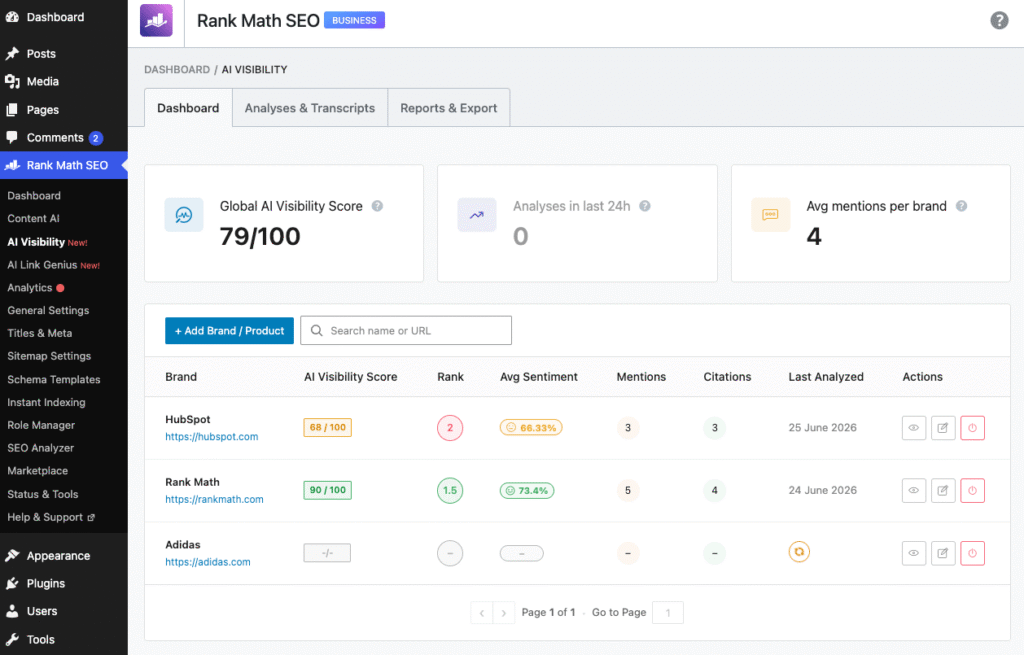
The AI Visibility dashboard is designed to answer one question: How do AI platforms describe your brand today? Instead of overwhelming you with raw data, Rank Math organizes the information into several focused sections that are easy to understand and act on.
- Overview: The Overview tab provides a high-level snapshot of your AI visibility. Here you'll find your AI Visibility Score, brand mentions, citation counts, sentiment trends, and overall performance over time. This is the first place most users will check because it quickly highlights whether visibility is improving or declining.
- Queries: The Queries tab shows the prompts and questions used during analysis. Reviewing these queries helps you understand the kinds of searches AI platforms associate with your brand. It can also uncover content opportunities you may have overlooked.
- Competitors: The Competitors section compares your brand with others appearing in the same AI responses. Rather than guessing who dominates AI recommendations, you can see which competitors receive more mentions, stronger citations, or better overall visibility. This benchmarking is particularly valuable for SEO planning because it reveals where competing brands are outperforming you.
- Raw Data and AI Response Transcripts: One of the most useful sections is the Raw Data or Transcripts view. Instead of showing only scores, Rank Math lets you inspect the complete AI-generated responses. This context helps explain why your brand received a particular sentiment or visibility score.
- Reports: Finally, the reporting system brings everything together into organized summaries that can be reviewed over time or exported for clients, stakeholders, and internal SEO teams. The result is a dashboard that transforms AI conversations into measurable business intelligence.
How Useful Are the Reports and Exports?
Reports become far more valuable when they can be shared, compared, and analyzed outside the dashboard. That is why Rank Math includes export functionality instead of limiting users to on-screen charts.
For agencies, exports simplify client reporting. Rather than taking screenshots every month, you can provide structured reports showing changes in AI Visibility Scores, brand mentions, competitor rankings, citation sources, and sentiment trends. This creates a much more professional presentation and makes long-term progress easier to demonstrate.
SEO consultants can also combine exported AI visibility data with Google Search Console, Google Analytics 4, Ahrefs, Semrush, or internal reporting dashboards. Looking at these metrics together provides a broader picture of how AI visibility relates to organic traffic, branded searches, and content performance.
Content teams benefit as well. Exporting the data into spreadsheets makes it easier to identify recurring themes, frequently cited pages, common AI prompts, and areas where competitors receive stronger recommendations. These insights can directly influence editorial calendars and content updates.
The ability to work with structured data also opens the door to custom reporting. Marketing teams can create executive dashboards, compare quarterly performance, or track improvements after publishing new content.
Most importantly, exported data provides evidence instead of opinions. A dashboard screenshot captures only one moment in time. Exported reports allow you to monitor trends, perform deeper analysis, and document progress over weeks or months.
If you regularly report SEO performance to clients or company leadership, exports quickly become one of the most practical features of the platform.
The Good, The Bad, and the Honest Truth About Rank Math's AI Visibility
What I truly loved:
- Native WordPress workflow. AI brand monitoring lives right next to your SEO settings and Content AI features — no separate platform, no extra login.
- Automated brand monitoring. No more manually prompting ChatGPT dozens of times. The tool runs the queries and organizes findings into readable reports.
- Competitor benchmarking. Most businesses know their Google rivals but have no idea who dominates AI-generated recommendations. This tool names them.
- A broader definition of visibility. It measures whether AI systems actually recommend your brand, not just where you rank in search.
- Early-warning intelligence. For agencies, affiliate marketers, and publishers doing GEO work, it flags AI visibility shifts conventional SEO tools simply can't see.
What I was not pleased with:
- A separate subscription. The tool requires an active Content AI plan to function but then you still need to purchase it separately. Would have preferred it to be bundled into the existing Content AI plan instead of requiring its own purchase.
- Coverage gaps remain. The tool currently does not cover every AI platform and every query type yet.
- Setup Needed: You must input a strong brand description so the AI knows exactly what to track.
- Still needs a human. The dashboard shows patterns; you still have to figure out why competitors are winning and what to fix. I wish the tool could analyze the results and suggest some form of fix.
- No built-in optimization. It could have been integrated into the Content AI tool so the results can be used in some way, to optimize existing content.
How Much Does It Cost?
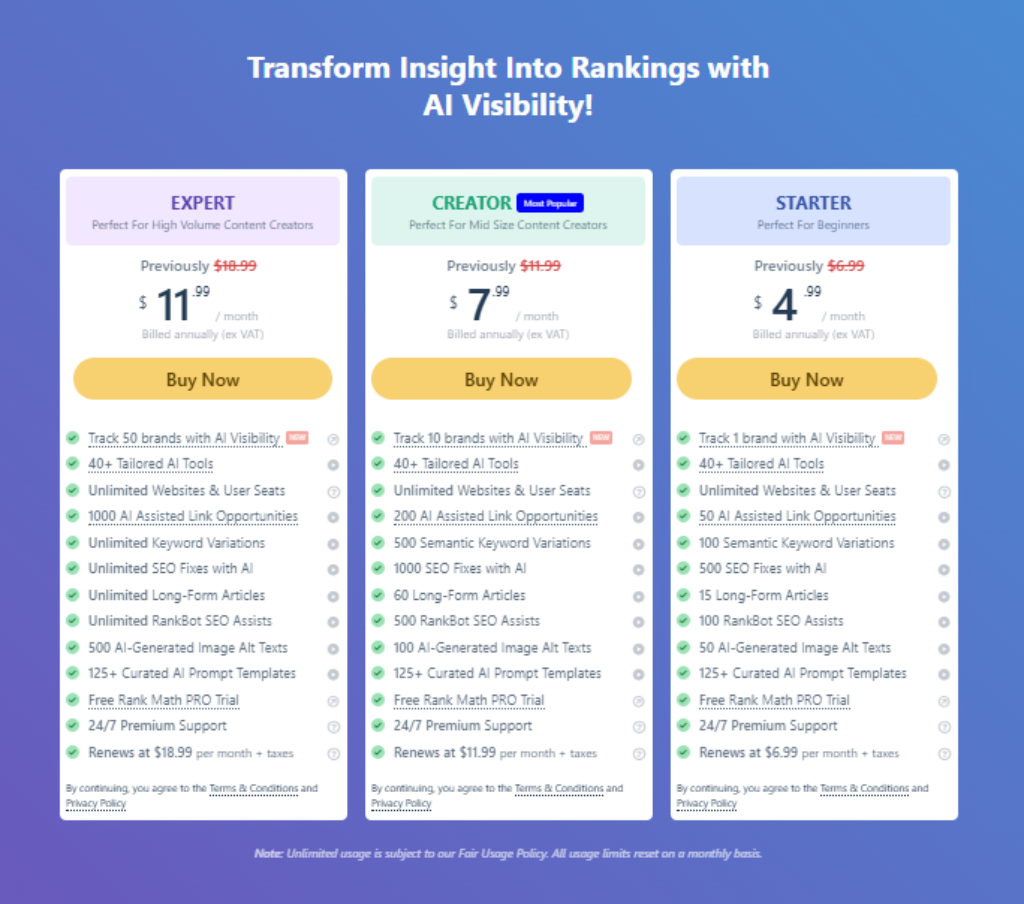
One of Rank Math AI Visibility's biggest advantages is its pricing. Many enterprise AI visibility platforms charge hundreds or even thousands of dollars each month, placing them beyond the reach of freelancers, bloggers, and small businesses. Rank Math takes a different approach by placing AI Visibility behind its Content AI subscription plans.
Starter — $4.99/month (billed annually)
Tracks 1 brand. This fits solo operators, freelancers, or anyone monitoring a single business or personal brand. If you're just trying to answer “does ChatGPT know I exist,” this tier does the job.
Creator — $7.99/month (billed annually)
Tracks 10 brands. This is built for freelancers managing multiple client accounts or small agencies running a handful of properties. It's also labeled the most popular tier, which tracks with where most working SEOs and content strategists actually sit — managing more than one property but not running enterprise-scale operations.
Expert — $11.99/month (billed annually)
Tracks 50 brands. This is for larger agencies managing full client rosters where AI visibility reporting needs to scale across dozens of accounts without dozens of separate subscriptions.
The subscription includes more than AI Visibility. Users also gain access to 40+ tailored AI tools, AI Link Genius, AI-assisted SEO fixes, semantic keyword generation, long-form article creation, image alt text generation, curated prompt libraries, and other Content AI features.
So, if you're already running Rank Math and Content AI, the marginal cost of adding AI Visibility is low relative to bolting on a separate, dedicated platform.
Rank Math AI Visibility vs Other AI Visibility Tools

Rank Math AI Visibility is entering a growing market of AI visibility platforms, but it targets a different audience than many enterprise solutions. While tools like Profound and Peec AI focus primarily on large organizations, Rank Math AI Visibility stands out because it brings AI visibility tracking directly into WordPress at a price that is accessible to bloggers, affiliate marketers, and agencies. Plans range from $4.99 to $11.99 per month, and the platform currently focuses on ChatGPT, with support for Perplexity, Gemini, Claude, and Google AI Overviews expanding over time. It includes competitor tracking, citation tracking, sentiment analysis, and exportable reports, making it an excellent choice for WordPress users who want AI visibility insights without investing in expensive enterprise software.
Profound takes the opposite approach by targeting enterprise organizations with dedicated AEO budgets. Pricing starts at $99 per month for the Starter plan, increases to $399 per month for the Growth plan, and offers custom pricing for Enterprise customers. The Starter plan tracks only ChatGPT, while Growth adds Perplexity and Google AI Overviews, and Enterprise supports up to 10 AI engines, including Claude. Advanced competitor tracking, exports, and deeper analytics are primarily available on the higher-tier plans, making Profound better suited to large organizations than small businesses.
Peec AI is designed for mid-market marketing teams and agencies that need clean, multi-engine AI visibility data. Pricing starts at $95 per month for the Starter plan, $245 per month for Pro, and $495 per month for the Advanced plan. Each self-service plan includes monitoring for three AI engines, with additional engines available as paid add-ons. Peec AI also offers competitor tracking, source-level citation tracking, sentiment analysis, and reporting through CSV exports and Looker Studio integration on higher-tier plans.
Semrush AI Toolkit is a logical choice for businesses already using the Semrush ecosystem. Available as a $99 per month per domain add-on, it tracks brand visibility across ChatGPT, Gemini, Google AI Overviews, and Perplexity. The toolkit supports monitoring of up to nine competitors, includes citation and sentiment tracking, and integrates seamlessly with Semrush's My Reports presentation tools. Existing Semrush customers will likely find it easier to add this capability than adopt a separate AI visibility platform.
Otterly.AI positions itself as a more affordable option for lean SEO teams and budget-conscious agencies. Pricing starts at $29 per month for Lite, $189 per month for Standard, and $489 per month for Premium. The platform tracks ChatGPT, Google AI Overviews, Perplexity, and Microsoft Copilot by default, while Gemini and Google AI Mode are available as optional add-ons. It includes share-of-voice competitor tracking, link-level citation analysis, sentiment monitoring, and Looker Studio reporting on Standard and Premium plans.
Overall, the choice comes down to your needs and budget. Rank Math AI Visibility offers the best value for WordPress users looking to add AI visibility tracking to their existing SEO workflow. Semrush AI Toolkit is the natural fit for businesses already invested in Semrush, while Profound and Peec AI are stronger choices for enterprise organizations that require broader datasets and advanced analytics. Otterly.AI fills the gap for smaller agencies that want multi-engine AI tracking without paying enterprise prices.
Can Rank Math AI Visibility Improve Your AI SEO Rankings?

No.
This is probably the biggest misconception surrounding AI visibility tools.
Rank Math AI Visibility measures how AI platforms talk about your brand. It does not directly improve your rankings or force ChatGPT, Google AI Overviews, Gemini, Claude, or Perplexity to recommend your website.
Think of it like Google Search Console.
Search Console tells you how your pages perform in Google Search, but it does not improve your rankings by itself. The same principle applies here. Rank Math AI Visibility provides the intelligence you need to make better decisions, but your SEO strategy is still responsible for earning better visibility.
So, what actually improves AI visibility?
- Entities. AI models retrieve and cite based on clearly defined entities — your brand name, product names, and the specific concepts tied to them. Vague copy produces vague retrieval.
- Structured data. Schema markup gives AI crawlers explicit signals about what your content is and who it's from. It's not optional in 2026; it's table stakes.
- Topical authority. A single article rarely earns a citation. A cluster of interconnected content covering a topic from multiple angles does, because it signals depth an AI model can trust.
- Citations. Getting cited by other authoritative sites feeds the same trust signals AI models use when deciding who to cite in their own answers.
- Brand mentions. Mentions across the web — not just your own site — build the kind of ambient brand recognition that shows up in AI training data and retrieval indexes.
- Original research. Data and findings nobody else has published are exactly what AI models look for when they need a source to cite. Recycled content doesn't earn citations. New information does.
- Expert authorship. Named, credentialed authors with a real footprint signal trustworthiness to both AI models and the humans fact-checking their outputs.
The real value of Rank Math AI Visibility is that it shows whether these efforts are working.
If your AI Visibility Score improves after publishing original research or strengthening your topical authority, you have measurable evidence that your strategy is moving in the right direction. That feedback loop is far more valuable than guessing why your competitors receive more AI recommendations.
Final Verdict: Is Rank Math AI Visibility Worth It in 2026?
After reviewing its features, pricing, and workflow, I must say that despite its current limitations and my displeasure that the tool is hidden behind Rank Math’s Content AI, Rank Math AI Visibility is one of the most practical AI visibility tracking tools available for WordPress users in 2026.
However, I must point out that AI Visibility is a measurement platform, not an AI optimization platform. It cannot automatically improve your presence in ChatGPT, Google AI Overviews, Gemini, Claude, or Perplexity. Those results still depend on you publishing authoritative content, building trusted entities, earning citations, and establishing long-term topical authority.
The good thing is that its three tiers come with a bundled Content AI access which includes 40+ tailored AI tools, AI Link Genius, AI-assisted SEO fixes, semantic keyword generation, long-form article creation, image alt text generation, curated prompt libraries, and other Content AI features. With this you can definitely turn your AI Visibility report into actionable results. So, whether you are a blogger and affiliate marketer or an SEO consultant or agency, Rank Math AI Visibility is worth your investment.
Frequently Asked Questions
What is a good AI visibility score?
A good AI visibility score sits above 70 out of 100 on most tracking platforms. This range indicates your brand appears consistently across AI-generated answers with mostly positive or neutral sentiment. Scores below 40 signal weak or absent brand presence in AI search results. Context matters, though — a new brand competing against established enterprise names should benchmark against direct competitors, not an absolute number.
How to improve AI visibility score?
You improve your AI visibility score by strengthening entities, structured data, and topical authority on your site. Publish original research that other sites can cite. Build a content cluster that covers your topic from multiple angles instead of one isolated article. Earn brand mentions across other authoritative websites, since AI models weigh external validation heavily when generating answers
Is Rank Math any good?
Rank Math is a good SEO plugin used by more than 4 million WordPress sites. It offers built-in schema markup, content optimization scoring, and now AI Visibility tracking inside one dashboard. Users consistently rate it 4.8 out of 5 based on thousands of reviews. It competes directly with Yoast SEO and All in One SEO, and it matches or exceeds both on feature depth per dollar spent.
Is Rank Math SEO friendly?
Rank Math is SEO friendly by design. It automates schema markup, generates XML sitemaps, and provides real-time content scoring against target keywords. It also includes redirection management, 404 monitoring, and Google Search Console integration inside one plugin. These features directly support technical SEO health and on-page optimization, which are core ranking factors for both traditional search and AI-generated answers.
Is SEO dead or evolving in 2026?
SEO is not dead in 2026. It is evolving into a broader discipline that includes AI search visibility alongside traditional rankings. Google AI Overviews, ChatGPT, and Perplexity now influence how users discover brands, which means optimization now targets citations and AI mentions, not just keyword position. Traditional ranking factors still matter, but they now share priority with entity authority and structured data built for AI retrieval.
![The Rank Math AI Visibility Review You Need to Read [Worth It In 2026?]](https://webincomejournal.com/wp-content/uploads/thumbs_dir/Perplexity-AI-for-Affiliate-Niche-Research-ru1mc3a68ltj33pt3wfyxnxqw19j7kwq1q7rsqlmpo.png)
![The Rank Math AI Visibility Review You Need to Read [Worth It In 2026?]](https://webincomejournal.com/wp-content/uploads/thumbs_dir/Affiliate-Keyword-Research-ru1ou3bumj0wqyzgkayz6gbmj7nr897hf6yh1j5kxo.png)