Chadrack

Perplexity AI is one of the most effective tools for affiliate niche research because it combines live web search with AI-generated answers backed by citations. Instead of relying on outdated assumptions, you can validate profitable niches, uncover buyer intent, analyze competitors, and identify content opportunities using current data. With the right prompts, a research process that once took a week can often be completed in just a few focused hours.

After running affiliate niche sites for over a decade, I can confidently tell you that most affiliate marketers do not fail because they choose a bad niche. They fail because they choose a niche before gathering enough evidence.
The traditional research process is usually painfully slow. You waste 5–7 days on searching Google, browsing Reddit, comparing affiliate programs, checking keyword tools, opening dozens of browser tabs, and still walk away unsure whether your chosen niche will actually make money.
That is not a research problem. It is a workflow problem — and Perplexity AI solves it directly.
Unlike traditional AI chatbots that primarily rely on previously trained knowledge, Perplexity searches the live web, cites its sources, and gives you access to current discussions, affiliate program information, buyer questions, competitor insights, and emerging market trends. Used correctly, it becomes a research assistant that helps you move from scattered information gathering to evidence-based decision making.
In this guide I will show you exactly how I’m using Perplexity AI affiliate niche research prompts to build a repeatable system for discovering, validating, and planning profitable affiliate niches.
By the end of this article, you'll know how to:
- Discover profitable affiliate niche ideas using live market data instead of guesswork.
- Validate whether a niche has strong monetization potential before investing months creating content.
- Research affiliate programs, commission rates, cookie durations, buyer intent, and current demand in minutes.
- Analyze competitors to uncover content gaps and underserved audience segments.
- Build a complete keyword strategy and 90-day content plan using Perplexity's research capabilities.
- Create a reusable four-phase workflow that you can apply to virtually any affiliate niche.
- Use more than 20 copy-and-paste prompt templates that dramatically improve the quality of Perplexity's responses.
DISCLOSURE: WebIncomeJournal is supported by readers like yourself. We may earn an affiliate commission when you purchase through our links, which helps us offer our content for free. Learn more here.
What Is Perplexity AI and Why Does It Beat ChatGPT for Niche Research?
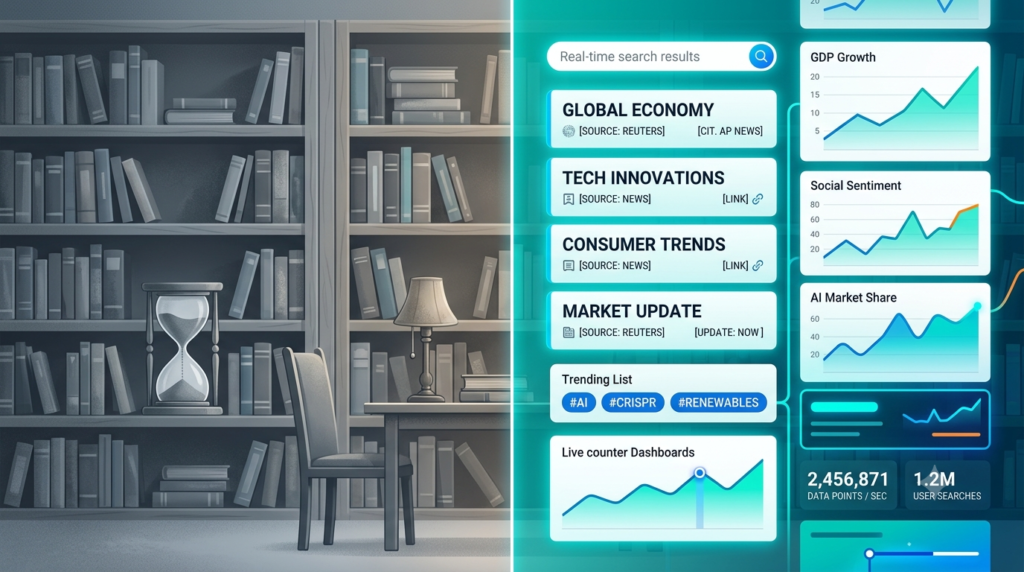
Perplexity AI is an AI-powered answer engine that combines large language models with live web search and inline citations, making it one of the best tools available for affiliate niche research. If your goal is to find profitable affiliate niches using current market evidence instead of assumptions, Perplexity consistently delivers better research than ChatGPT alone.
The biggest advantage is simple. Perplexity searches today's web before answering your question, while ChatGPT primarily relies on its trained knowledge unless connected to search. That distinction matters because affiliate marketing changes constantly. Commission rates change, affiliate programs launch and close, buyer behavior shifts, and new opportunities appear every month.
For affiliate marketers, current information is often more valuable than historical information.
Here is what Perplexity can surface that ChatGPT simply cannot:
- Current affiliate program commission rates and cookie durations — pulled from live network pages, not cached training data
- Trending niche topics with real-time demand signals — including rising Reddit threads and Quora discussions happening right now
- New product launches that have not yet attracted a wave of competitor content
- Live forum sentiment about affiliate programs, including payment reliability complaints and recent policy changes
Why More Affiliate Marketers Are Adopting Perplexity
Perplexity has quickly evolved from an emerging AI search tool into a mainstream research platform. As of mid-2026, the company reportedly processes more than 1.2 billion monthly queries and has reached approximately $200 million in annualized revenue. Those figures reflect growing trust among professionals who need fast, citation-backed answers instead of endless browser tabs.
For affiliate marketers, the takeaway is straightforward.
Use Perplexity to discover opportunities, validate markets, uncover buyer intent, identify monetization opportunities, and gather real-time competitive intelligence. Then use ChatGPT or Claude to transform that research into high-quality content briefs, topical clusters, product comparisons, and long-form affiliate articles.
That combination consistently produces a faster, more reliable affiliate research workflow than either tool can achieve on its own.
How Do You Write Perplexity Prompts That Actually Deliver Useful Affiliate Research?

The quality of your research depends far more on the quality of your prompts than on the AI itself. The best Perplexity AI affiliate niche research prompts tell Perplexity exactly what to research, where to look, how recent the information should be, and how you want the results organized. That is the difference between getting a generic answer and receiving research you can confidently use to make business decisions.
I follow the same prompt structure every time I evaluate a new affiliate niche. Over the years this has consistently produced more accurate insights, better citations, and far less follow-up work for me.
Here’s the basic structure of my highest-performing prompts:
- Query core — State exactly what you want. “Top affiliate programs in [niche]” is a query core. “Tell me about affiliate marketing” is not.
- Time constraint — Add “as of 2026” or “in the last 6–12 months” to every research prompt. Without it, Perplexity may surface data that is two years stale.
- Source type — Specify where Perplexity should look. “Based on affiliate network data and forum discussions” produces different — and more useful — results than an unguided search.
- Output format — Ask for tables, ranked lists, or numbered steps when you need data you can compare or act on immediately. Unstructured paragraphs are harder to evaluate.
- Uncertainty flag — Add “flag anything you cannot confirm with a source.” This one instruction dramatically reduces confident-sounding hallucinations.
Thread research, do not dump everything into one prompt. Start broad, then use Perplexity's thread context to drill down: broad niche → sub-niche → specific program validation. Each follow-up inherits the context of the previous exchange.
Know Which Search Mode to Use:
Not every research task needs the same level of depth.
| Mode | Best Used For |
| Standard Search | Quick fact checking, niche brainstorming, and basic keyword discovery |
| Pro Search | Detailed competitor analysis, affiliate program research, and multi-source comparisons |
| Deep Research | Comprehensive market validation, complex content gap analysis, and building complete affiliate research reports |
My workflow is simple. I begin with Standard Search to identify opportunities, switch to Pro Search when comparing competitors and affiliate programs, and reserve Perplexity Deep Research for niches I'm seriously considering building a business around.
What Is the 4-Phase Perplexity Affiliate Niche Research Workflow?
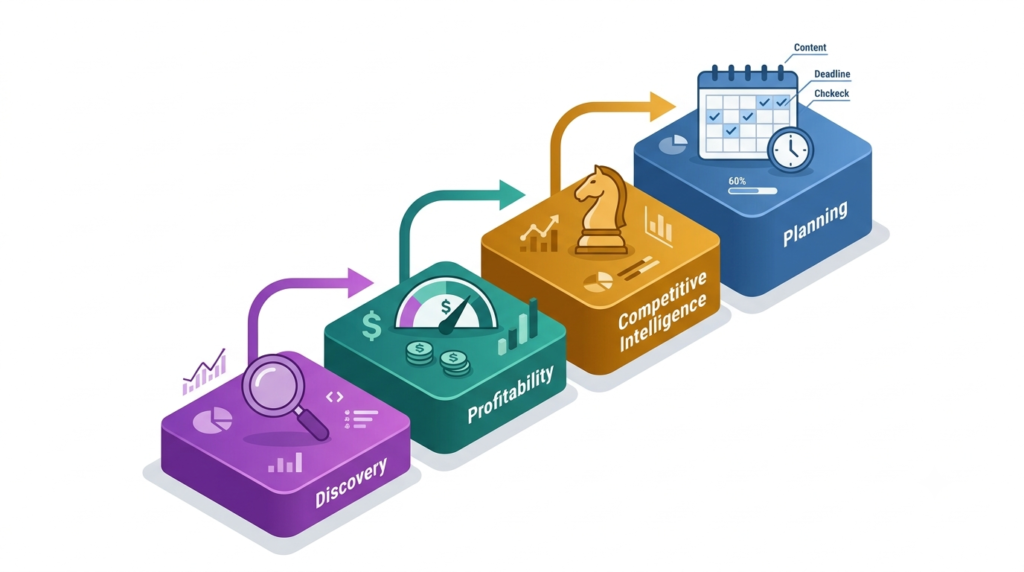
Successful affiliate marketers rarely choose a niche after running one AI prompt. They follow a repeatable research process that moves from opportunity discovery to market validation before a single article is written. That is exactly what this four-phase workflow is designed to do.
Instead of treating these Perplexity AI affiliate niche research prompts as disconnected tricks, my framework organizes them into a logical sequence. Each phase answers one critical business question, and the output from one stage becomes the input for the next. By the end of the process, you'll know whether a niche is worth pursuing, how competitive it is, and what content you should publish first.
Recommended: How I Monetize My Affiliate Blogs with AI Products (2026 Guide)
The 4-Phase Affiliate Niche Research Framework
| Phase | Goal | Perplexity Action | Expected Output |
| Phase 1: Niche Discovery | Find profitable niche opportunities with commercial potential. | Brainstorm niche ideas, uncover profitable sub-niches, identify emerging trends, and evaluate buyer demand. | A shortlist of validated niche ideas with strong monetization opportunities. |
| Phase 2: Profitability Validation | Confirm that the niche can generate affiliate income. | Research affiliate programs, commission rates, cookie duration, buyer intent, search demand, and product ecosystems. | A profitability score backed by real-world demand and affiliate program quality. |
| Phase 3: Competitive Intelligence | Understand the competitive landscape before entering the market. | Analyze top-ranking affiliate blogs, perform content gap analysis, review keyword gap analysis, and identify underserved audience segments. | A clear picture of your competitors and the opportunities they have overlooked. |
| Phase 4: Content & Keyword Planning | Turn research into an actionable publishing strategy. | Build topical clusters, identify low-competition keywords, organize buyer intent keywords, and develop a content calendar. | A prioritized roadmap of articles designed to attract traffic and generate affiliate revenue. |
Why This Workflow Works
Many affiliate marketers jump straight into keyword research or competitor analysis without first validating whether a niche deserves their attention. That often leads to months of publishing content around markets with weak demand, poor affiliate programs, or overwhelming competition.
This framework reverses that process. You first discover opportunities, then validate their commercial potential, study the competitive landscape, and finally build an affiliate content strategy around evidence instead of assumptions. Each stage reduces uncertainty while increasing your confidence in the niche you've selected.
The result is a research workflow that is systematic, repeatable, and scalable. Whether you're evaluating AI software, personal finance, health technology, or another emerging market, you can apply the same four phases to uncover profitable affiliate niches, identify genuine buyer intent, and build content around opportunities supported by current Google Search data and citation-backed research.
In the next four sections (Phase 1 – 4), we'll break down each phase in detail and provide the exact copy-and-paste prompts I use to complete the entire workflow in just a few focused hours.
Recommended: AI Affiliate Marketing Content Strategy That Ranks in AI Search Engines (2025 Tested)
Download the prompt templates used in this post as a PDF file (12 prompts across the 4 phrases + 3 bonus prompts).
Phase 1: How Do You Use Perplexity AI to Discover Profitable Affiliate Niches?
The goal of Phase 1 is simple: generate a list of niche opportunities that have real commercial potential before you spend time validating them. This is where Perplexity AI has a clear advantage over traditional brainstorming methods because it can combine live trend data, current affiliate program information, community discussions, and recent market activity into a single research process.
Many affiliate marketers start with their interests and then try to find a way to monetize them. I prefer the opposite approach. Start with evidence, then narrow the opportunities to niches that align with your interests and expertise.
Start with broad niche discovery, not keyword research
Most people begin by searching for keywords.
That is usually too early.
Before you worry about search volume, keyword difficulty, or topical clusters, you need to identify markets with strong monetization opportunities. Perplexity is excellent at this stage because it can uncover emerging categories, growing software markets, and underserved industries that traditional keyword tools often miss.
This is where Perplexity AI niche research outperforms ChatGPT. ChatGPT can generate niche ideas, but Perplexity can support those ideas with current web evidence, trend signals, and citations from multiple sources.
Prompt Templates — Phase 1: Niche Discovery
PROMPT 1 — Broad Niche Discovery
“I want to build a profitable affiliate site in 2026. Suggest 15 niche ideas that: (1) have active affiliate programs paying at least 20% commission or $50+ per sale, (2) include SaaS tools or subscription products for recurring commissions, (3) are growing in demand but not yet dominated by major media brands, (4) can be covered by a single expert rather than a full editorial team. For each niche, estimate earning potential and difficulty. Cite sources for trend data.”
Run this with Pro Search enabled. The earning potential estimates Perplexity returns will not be perfectly precise — cross-reference anything that looks unusually high. What you are actually looking for in the output is the pattern: which niches come back with cited sources showing community growth, new product launches, and affiliate program activity in 2026.
PROMPT 2 — Sub-Niche Drill-Down
“I am considering building an affiliate site in [NICHE]. Identify 8 specific sub-niches that: (1) are more specific than the parent niche, (2) have dedicated affiliate programs, (3) could support a 50-article content plan, (4) show growing search volume based on current trends as of 2026. For each sub-niche, flag any signs of oversaturation. Cite sources.”
Run this as a follow-up thread immediately after Prompt 1 — do not start a new session. Perplexity carries the context of your previous exchange, so its sub-niche output will be anchored to the specific niche you flagged rather than drifting into generic suggestions.
PROMPT 3 — Regional Opportunity Finder
“Find affiliate marketing niches in [NICHE CATEGORY] with strong buyer demand in [REGION/COUNTRY] that mainstream US-focused affiliate sites are underserving. Include current affiliate programs available in this region and estimated competition level.”
This prompt targets one of the most underused angles in affiliate niche research: geographic white space. Most affiliate content is US-centric. Markets in the UK, Australia, Canada, and emerging economies are often served by the same handful of authority sites — leaving significant room for a focused regional entrant with localized content and region-specific program recommendations.
Phase 2: How Do You Validate That a Niche Is Actually Profitable Using Perplexity?
Finding an interesting niche is only half the job. The real question is whether that niche can consistently generate affiliate income.
Many niches have healthy search traffic but weak monetization. Others have excellent affiliate programs but very little buyer demand. Phase 2 helps you eliminate both problems by validating whether a niche has the commercial foundation to support a profitable affiliate business.
This is also where Perplexity AI becomes a major time saver. Research that once required opening dozens of affiliate program pages, forum threads, and review sites can now be completed in a few well-crafted prompts.
Prompt Templates — Phase 2: Profitability Validation
PROMPT 4 — Affiliate Program Intelligence
“What are the top 10 affiliate programs in the [NICHE] space in 2026? For each program, provide: commission rate, cookie duration, payout threshold, affiliate network (if applicable), and any known issues with payment reliability. Prioritize programs with recurring commissions. Cite sources.”
Flag any commission figures Perplexity returns without a cited source. Cross-verify those specific numbers directly on the affiliate network page before building content around them. Perplexity is faster than manual research — it is not a replacement for final verification on high-stakes data.
PROMPT 5 — Buyer Intent Verification
“What questions are buyers asking about [PRODUCT CATEGORY] in 2026? Pull from current forum discussions, Reddit threads, and review sites — not AI-generated guesses. Organize responses by buyer stage: awareness, consideration, and decision. Flag any recurring objections or purchase barriers. Cite sources.”
The buyer stage breakdown is the most valuable part of this output. Decision-stage questions (“Which [product] is best for [specific use case]?”) are where affiliate conversions happen. If Perplexity returns mostly awareness-stage questions for your niche, that is a signal the audience is not close enough to purchase to convert well.
PROMPT 6 — Demand Signal Check
“What evidence exists that [SUB-NICHE] has growing consumer demand in 2026? Include: search trend signals, social media discussion volume, product launch activity, and any market research reports. Flag anything that suggests demand may be peaking or declining. Cite all sources.”
Pay close attention to the “peaking or declining” flag instruction. A niche that had explosive growth in 2023–2024 and is now flattening out is a different investment than one still in its early growth curve. Perplexity's live search access makes this distinction visible in a way that no training-data-dependent tool can replicate.
Recommended: HubSpot vs Mailchimp: Which Email Platform Is Best for Affiliate Bloggers in 2025?
Phase 3: How Do You Analyze Your Affiliate Niche Competition with Perplexity AI?
Knowing your niche is profitable is not enough. You also need to know whether you can realistically compete — and more importantly, where the gaps are that your competitors have left open.
Perplexity makes competitive research faster, but the strategic thinking is still yours. The prompts below surface raw competitive data. Your job is to read that data and identify the editorial opening: the audience segment, content angle, or topic cluster your competitors are collectively ignoring.
What You Are Actually Looking for In Competitive Research:
Most affiliate marketers use competitor research to confirm what they already suspect. Use it instead to find what everyone else has missed. Three signals matter most:
- Newer sites successfully ranking — a sub-DA40 site ranking in the top 5 means the niche is not locked down by authority sites; new entrants can compete
- Consistent content gaps across multiple competitors — if the top five sites all ignore the same audience question, that is not an oversight; it is an opportunity
- Underserved audience segments — beginners, regional audiences, and advanced users are systematically underserved in most affiliate niches because most sites target the same “average” reader
How Perplexity Surfaces What Manual Research Misses:
Standard competitor research tools like Ahrefs and Semrush show you traffic and keyword data. They do not tell you what real users are frustrated about in forum threads right now, or which competitor just launched a new content push in your target sub-niche. Perplexity's live web access fills that gap.
Prompt Templates — Phase 3: Competitive Intelligence
PROMPT 7 — Competitor Landscape Mapping
“Who are the top affiliate sites and blogs in [NICHE] in 2026? For each site, estimate: traffic level (high/medium/low), domain age, content focus, and monetization model. Identify whether any are newer sites (under 3 years old) successfully ranking — this signals opportunity for new entrants. Cite sources.”
The newer-site signal is the one most affiliate marketers overlook in this output. If Perplexity identifies two or three sites under three years old ranking well in your target niche, that is direct evidence the niche rewards fresh, well-structured content — not just legacy domain authority.
PROMPT 8 — Content Gap Finder
“Compare the top 5 ranking affiliate content sites in [NICHE]. What topics do they consistently cover? What topics, audience questions, or product categories are they missing or underserving? Identify at least 5 specific content gaps a new site could target to differentiate itself. Cite sources.”
Ask Perplexity to run this prompt in Deep Research mode for a more comprehensive cross-site analysis. The output typically surfaces gaps that are invisible when you manually browse competitor sites — because those gaps are defined by absence, and humans are poor at noticing what is not there.
PROMPT 9 — Audience Segment Gap Analysis
“In the [NICHE] affiliate space, what specific audience segments are being underserved by current content? Consider demographics, experience levels, geographic regions, and use cases. For each underserved segment, suggest a content angle that could attract them. Cite sources.”
This prompt frequently returns the most actionable output of the entire competitive research phase. In most affiliate niches, content clusters around one audience profile — typically a mid-level English-speaking user in North America. Beginners, advanced practitioners, non-English-speaking markets, and profession-specific use cases are left almost entirely unaddressed. One of those underserved segments is usually your most direct path to early traction.
Phase 4: How Do You Build an Affiliate Content Plan Using Perplexity Research?
Research only creates value when it turns into content that attracts qualified buyers. After completing the first three phases, you should know which niche to target, which affiliate programs are worth promoting, and where your competitors are vulnerable. Phase 4 transforms that research into a publishing strategy that builds topical authority, captures search traffic, and generates affiliate commissions.
Instead of asking, “What should I write next?”, you'll have a data-driven roadmap based on current search trends, buyer intent, and competitive opportunities.
Prompt Templates — Phase 4: Content Planning
PROMPT 10 — Keyword Cluster Discovery
“Find low-competition keywords related to [PRODUCT CATEGORY/NICHE] with high buyer intent in 2026. Organize by cluster: informational keywords (how-to, what is), commercial keywords (best, vs., alternatives), and transactional keywords (buy, discount, coupon). Flag keywords showing rising search trends. Cite sources.”
Use the three-cluster output directly as your content calendar architecture. Informational clusters build your topical authority base; commercial clusters drive the majority of your affiliate clicks; transactional clusters convert the buyers who are already decided and just need a trusted source to confirm their choice.
PROMPT 11 — Question Cluster Extraction
“What are the most common questions people ask about [PRODUCT/NICHE] at each stage of the buyer journey in 2026? Pull from Reddit, Quora, and industry forums — not AI-generated assumptions. Organize by: Awareness Stage / Consideration Stage / Decision Stage. Include any recurring objections that prevent purchase. Cite sources.”
The recurring objections output is often the most valuable line in this response. A buyer objection that appears across multiple forum threads is an unmet content need — and a direct conversion opportunity for an affiliate review that addresses it head-on.
PROMPT 12 — Content Calendar Seed
“Based on current search trends and buyer behavior in the [NICHE] space, suggest 20 blog post topics for a new affiliate site in 2026. Include: suggested title format, target keyword, content type (informational/commercial/review), and estimated buyer intent level (low/medium/high). Prioritize topics with the best combination of demand and low existing competition. Cite sources.”
This prompt produces your 90-day content calendar skeleton in a single output. Sort the returned topics by buyer intent level — high intent first — and sequence your publishing plan so your commercial and review content goes live while your informational foundation is still being built. Early revenue signals from high-intent content also validate that you chose the right niche before you are 40 posts deep.
Download the prompt templates used in this post as a PDF file (12 prompts across the 4 phrases + 3 bonus prompts).
How Do You Set Up Perplexity Spaces for Ongoing Affiliate Niche Research?

Most affiliate marketers use Perplexity as a search tool — one question, one answer, move on. Perplexity Spaces changes that dynamic entirely. It is the feature that converts Perplexity from a research tool into a research infrastructure.
What Perplexity Spaces Actually Does
A Space is a persistent, context-loaded research environment tied to a specific project. Every query you run inside a Space inherits the context you pre-loaded — your niche, your target audience, your competitor list, your topic constraints. You stop re-explaining your site to the AI on every query. Perplexity already knows who you are building for.
For affiliate marketers running multiple niche sites, the practical implication is significant. You create one Space per niche. Your home automation affiliate site Space knows it is targeting US homeowners aged 35–55 evaluating smart device ecosystems. Your SaaS tools Space knows it is targeting solo founders comparing productivity software. Each Space produces contextually appropriate outputs without a single line of re-prompting.
The Always-On Research Partner Setup
Pre-load each Space with the context block below, customized for your specific niche. Every subsequent research query (new competitor sites, trending buyer questions, fresh affiliate program launches) runs against this standing context automatically.
Space Context Template — Paste into Your Space Setup
“You are a research assistant for an affiliate content site in the [NICHE] space. My target audience is [AUDIENCE DESCRIPTION]. My site covers [TOPIC AREAS]. My main competitors are [COMPETITOR 1], [COMPETITOR 2], [COMPETITOR 3]. When I ask research questions, prioritize: sources published within the last 12 months; data from primary sources (official affiliate networks, industry reports, brand sites); findings relevant to my specific audience rather than the niche generally. Always flag any uncertainty or low-confidence claims. Always include citations.”
Three ongoing uses for your niche Space:
- Competitor monitoring — Run a weekly query asking Perplexity to surface new content published by your competitor list. New content clusters from established competitors signal which topics are gaining commercial traction.
- Affiliate program tracking — Query monthly for new program launches, commission changes, or payout policy updates in your niche. Perplexity's live web access catches these faster than any newsletter.
- Trending buyer question alerts — Run a monthly question cluster prompt to surface emerging buyer questions before they become saturated keyword targets.
Spaces is a Perplexity Pro feature. At $20/month, the ongoing research infrastructure it provides makes the subscription straightforward to justify for any affiliate marketer publishing at volume.
What Are the Limitations of Using Perplexity AI for Affiliate Niche Research?
While Perplexity is one of the best research tools available for affiliate marketers, it is not perfect. Here are six limitations you must understand if you want to avoid costly mistakes while getting the maximum value from its research capabilities.
- Hallucination risk: Perplexity can fabricate citations on narrow or technical topics where web coverage is thin. The citation appears real; the source either does not exist or does not say what Perplexity claims. Open two to three source links for every important claim before you act on it — especially commission rate data and market size figures.
- Citation quality variance: A citation is not the same as a credible source. Perplexity may cite a low-authority blog, an outdated press release, or a vendor's own marketing page as if it carries the same weight as an industry report. Evaluate source authority, not just source presence.
- Information lag on very recent data. Live web search does not mean instantaneous. Events from the last 24–48 hours may not yet be indexed or surfaced consistently. For breaking affiliate program changes or very recent product launches, verify directly on the source site.
- Niche coverage gaps: Highly localized niches — regional markets, non-English-language audiences, extremely narrow verticals — may have limited web coverage. Perplexity's output quality degrades when the underlying web data is sparse. This is precisely where Prompt 3 (Regional Opportunity Finder) needs the most manual verification.
- Perplexity is research-first, not writing-first: It surfaces and synthesizes information. For producing affiliate content drafts — long-form reviews, comparison posts, editorial narrative — Claude and ChatGPT produce significantly better output. Use the right tool for each job.
- The judgment gap: Perplexity cannot tell you whether you have the credibility, genuine interest, or long-term patience to build authority in a niche. A niche can pass every profitability signal and still be wrong for you. That remains a human decision no AI research tool can make.
Mitigation Practices to Apply Consistently:
- Verify every cited statistic directly at the source before publishing or making niche commitments
- Cross-reference Perplexity findings with Google Trends, Ahrefs, or a targeted ChatGPT analysis as a second opinion
- Treat Perplexity outputs as a strong first draft of your research — not a final report
How Does Perplexity AI Compare to Other Niche Research Methods?

No single research tool does everything well.
The most productive affiliate marketers build a research stack where each tool performs the task it does best. Perplexity AI is not a replacement for keyword research platforms such as Ahrefs or SEMrush, nor does it eliminate the need for Google or Reddit. Instead, it replaces the slow, repetitive research process of opening dozens of browser tabs, manually comparing sources, and piecing information together yourself.
Think of Perplexity as the intelligence layer that sits at the beginning of your affiliate research workflow.
Here’s a comparison of the most common research methods:
| Research Method | Speed | Real-Time Data | Source Verification | Cost | Best For |
| Manual Google Research | Slow (5–8 hrs) | Yes | Manual | Free | Deep-dive verification and primary source research |
| ChatGPT | Fast | No (unless connected to search) | None | Free / Plus | Brainstorming, analysis, outlining, and content creation |
| Perplexity AI | Fast (2–3 hrs) | Yes | Inline citations | Free / Pro | Real-time market intelligence and affiliate niche research |
| Ahrefs / SEMrush | Medium | Partial | Yes | $99–$399+/month | Keyword research, backlink analysis, and SEO metrics |
| Reddit & Forum Research | Slow | Yes | None | Free | Discovering audience pain points and buyer language |
Each tool answers a different question.
If you need to understand how people describe their problems, Reddit is invaluable. If you want precise keyword metrics and backlink data, Ahrefs or SEMrush remains the industry standard. If your objective is creating high-quality affiliate content from your research, ChatGPT or Claude are excellent writing partners.
Perplexity excels at connecting all of those sources into one research workflow.
Conclusion
After about three years of running these Perplexity AI for affiliate marketing prompts across different niche sites, I must say, Perplexity AI does not make niche selection easy. Rather, it makes it faster, more defensible, and significantly less dependent on guesswork.
The four-phase workflow in this guide gives you a repeatable system you can run on any niche, any market, and any budget level. Remember that the prompt templates are starting points, not rigid scripts. You'll get the best results by customizing them for your niche, target audience, geographic market, and business goals. The more context you provide, the more relevant Perplexity's research becomes.
You should also keep in mind that Perplexity is a research tool. ChatGPT and Claude are writing tools. Use Perplexity to uncover opportunities, validate your findings, and gather citation-backed research. Then move that research into ChatGPT or Claude to create content briefs, comparison articles, product reviews, and SEO-focused affiliate content.
Ready to put this into practice? Then, download the prompt templates used in this post as a PDF file (12 prompts across the 4 phrases + 3 bonus prompts), all designed to take you from niche selection to content execution.
Click here to download for free.
Frequently Asked Questions
Is Perplexity AI good for market research?
Perplexity AI is highly effective for market research because it searches the live web and cites every source inline. It surfaces current data — trending topics, new product launches, forum sentiment, and real-time consumer demand signals — that static AI tools cannot access. Affiliate marketers specifically benefit from its ability to pull current commission rates, competitor content updates, and emerging niche opportunities in a single research session.
Is Perplexity AI better than ChatGPT?
Perplexity AI is better than ChatGPT for research tasks that require current data. ChatGPT generates answers from training data with a fixed knowledge cutoff, while Perplexity queries the live web on every search and attaches inline citations to its outputs. For tasks like writing, editing, or long-form content drafting, ChatGPT and Claude produce stronger results. The two tools serve different jobs and work best when used together.
What are the disadvantages of Perplexity AI?
Perplexity AI can fabricate citations on narrow or highly technical topics where web coverage is limited. Not all cited sources carry equal authority — users must evaluate source quality, not just source presence. Very recent data from the last 24 to 48 hours may not surface consistently, and output quality drops significantly for highly localized niches with thin web coverage. Perplexity also produces weaker results than dedicated writing tools for long-form content creation.
What is Perplexity AI most useful for?
Perplexity AI is most useful for real-time research tasks that require sourced, current information. It excels at niche discovery, competitor analysis, affiliate program research, buyer intent mapping, and keyword trend identification. Researchers and marketers use it to replace the manual tab-opening and cross-referencing phase of their workflow — compressing what previously took five to eight hours into two to three focused research hours with cited outputs.
Which AI tool is better than Perplexity?
No single AI tool outperforms Perplexity across every research dimension. Ahrefs and Semrush provide more precise keyword volume data and backlink analysis than Perplexity can deliver. Claude and ChatGPT produce better long-form written content. Google Search gives deeper control over manual source verification. The most effective research stack combines Perplexity for real-time market intelligence, a dedicated SEO tool for keyword precision, and a writing-focused AI for content production.