Chadrack
Have you ever wondered why some affiliate marketers earn commissions in their sleep while others barely get clicks?
The truth is, they’re not relying solely on social media algorithms or random blog traffic. They’ve built a direct, predictable sales channel – and it’s sitting right inside their subscribers’ inboxes. That’s the power of affiliate email marketing.
Affiliate email marketing is the practice of promoting products or services from other companies via email, using unique affiliate links to earn a commission on resulting sales. Done right, it’s one of the most profitable strategies available in 2025, with affiliates using email earning 66.4% more conversions than those who don’t.
In this guide, you’ll get a complete beginner-friendly blueprint to build, grow, and monetize your email list – step by step. From choosing your niche to writing high-converting emails and avoiding common pitfalls, you’ll leave with a clear, actionable plan you can start today.
Key Takeaways (TL;DR)
- Definition: Affiliate email marketing means using targeted, permission-based emails to promote affiliate offers and earn commissions.
- Why it matters in 2025: Email still delivers the highest ROI in digital marketing – averaging $36 for every $1 spent – and AI-driven personalization makes it even more powerful.
- Core advantage: You control the audience, the message, and the timing – no dependency on social media reach.
- What you’ll learn here: How to start from zero, grow your list, choose profitable programs, write persuasive emails, and automate sales with the right tools.
What is Affiliate Email Marketing and Why Does it Work So Well?
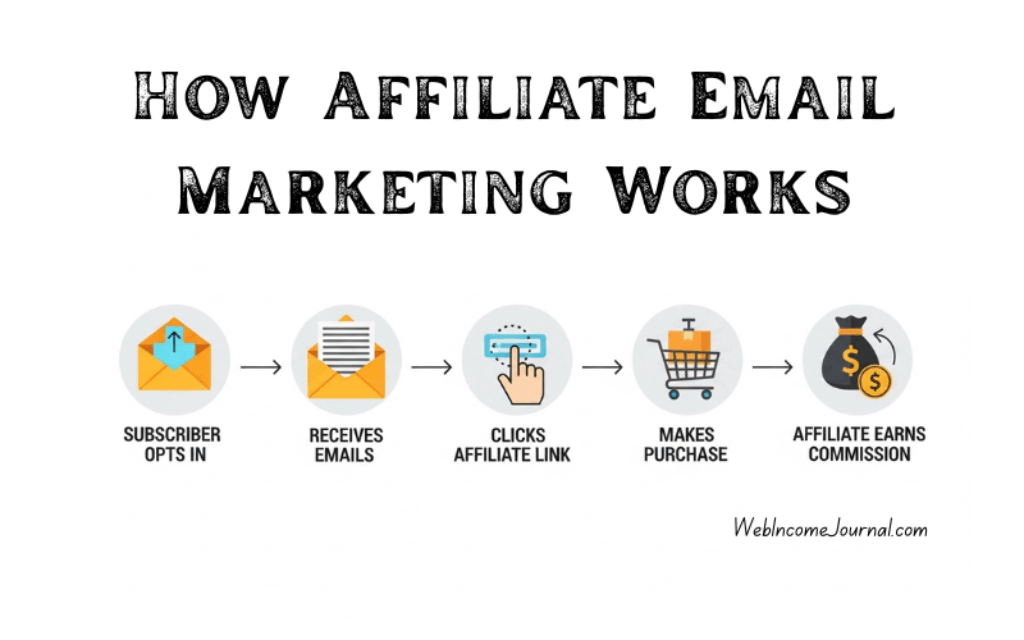
Affiliate email marketing is the process of sending targeted emails to a permission-based list, promoting third-party products or services through unique affiliate links. When a subscriber clicks your link and makes a purchase, you earn a commission – the rate depends on the affiliate program’s structure.
Tracking works through special URLs embedded with your affiliate ID. Most programs use cookies (lasting anywhere from 24 hours to 90+ days) to record sales. If the customer buys within that window, you get credit.
The main advantage? Direct inbox access. You’re not competing with crowded social feeds or unpredictable algorithms. Your message lands where your subscribers already pay attention – their email inbox – giving you full control over delivery and timing.
Why Email Marketing Outperforms Other Affiliate Channels
Email consistently outperforms platforms like Facebook or Instagram for one simple reason: intent. People who’ve subscribed to your list have already signaled interest in your content or niche.
Email campaigns enjoy higher conversion rates than social media because they build trust over time. Each email is another touchpoint – whether you’re sharing tips, answering questions, or offering exclusive deals.
The numbers prove it: email marketing delivers an average ROI of $36 for every $1 spent, and affiliates using email see 66.4% more conversions than those relying on other channels. That’s not just better – it’s game-changing.
Real Examples of Successful Affiliate Email Campaigns
- Case Study – Csillagkönyv: Using personalized campaigns and automation with GetResponse, this publisher grew revenue to over €150,000 in one year.
- Case Study – LesFrenchies: By moving followers from social media to an email list, they achieved a 50% open rate vs. Facebook’s 3–5% reach, dramatically boosting affiliate sales.
When done right, a single email sequence can generate steady commissions for months – even years – without additional effort.
Get my Affiliate Email Marketing Quick-Start Checklist + 5 Proven Email Templates – FREE & Turn Your Email List into Affiliate Sales – FAST
How to Get Started with Affiliate Email Marketing as a Complete Beginner
Starting with affiliate email marketing can feel overwhelming, but a step-by-step approach makes it simple. I’ve seen countless beginners find success by following a clear roadmap. The key is to lay a solid foundation before you even think about sending your first email.
Step 1: Choose Your Niche and Target Audience
Your niche determines who you serve and what products you’ll promote. Pick a niche that combines your expertise or interest with proven demand. Look for evergreen topics (health, personal finance, software, hobbies) where people actively buy solutions.
Research your audience using:
- Keyword tools (Google Keyword Planner, Ubersuggest, Mangools) to see search demand
- Forums and social groups to find common questions
- Competitor analysis to see what’s already working
Validate your market by checking if there are active affiliate programs and paid ads targeting your niche – it’s a sign that money is being made.
Step 2: Select Profitable Affiliate Programs
Not all affiliate programs are worth your time. Evaluate them by:
- Relevance – Does the product solve a real problem for your audience?
- Conversion history – Look for programs with strong landing pages and proven sales.
- Commission rates – SaaS affiliate programs can pay 20–70% recurring commissions, while Amazon Associates pays lower rates but offers massive product variety.
Watch for red flags like delayed payouts, poor tracking, or aggressive upsells that could damage trust with your subscribers.
Step 3: Choose the Right Email Marketing Platform
Many email service providers (ESPs) ban affiliate links directly in emails. Choose affiliate-friendly platforms like GetResponse, Brevo, or Omnisend that allow promotions when done responsibly.
Key features to look for:
- Automation sequences (welcome series, abandoned cart campaigns)
- Segmentation tools for targeting based on behavior or interests
- Analytics to track clicks and conversions
- Mobile optimization and AI-assisted send times
If you’re on a budget, start with beginner-friendly plans and upgrade as your list grows. Some platforms even offer free tiers with enough features to get going, but prioritize scalability – switching providers later can be costly in time and lost data.
How to Build an Email List for Affiliate Marketing from Scratch
Building an email list is the single most important step for long-term success in affiliate email marketing. I’ve learned that a quality list is an asset you own, unlike social media followers who are subject to platform algorithms and policy changes. You need a clear, intentional strategy to attract the right people and encourage them to subscribe.
Creating Irresistible Lead Magnets
A lead magnet is the free incentive you offer in exchange for someone’s email address. It must solve a specific, urgent problem for your audience. Popular formats include:
- Checklists (quick wins)
- Mini-guides or ebooks
- Templates (email scripts, spreadsheets)
- Exclusive video tutorials
Use tools like Canva for designing PDFs, or landing page builders like GetResponse to host your offer. Keep your lead magnet easy to consume – no one wants a 100-page ebook just to get one tip.
Optimize by giving your lead magnet a benefit-driven title, like “5 Quick Email Subject Lines That Double Open Rates”, and ensure it aligns directly with the affiliate products you’ll promote later.
Setting Up High-Converting Opt-in Forms
Where you place your opt-in forms matters. Effective locations include:
- Above the fold on your homepage
- End of blog posts
- Exit-intent popups
- Dedicated landing pages
Design best practices: use minimal fields (name + email), clear calls-to-action, and colors that stand out from the page. Test variations using A/B testing tools to see which headlines, colors, or offers perform best.
Traffic Sources for List Building
To grow your list, you need consistent traffic:
- Content marketing: Publish blog posts or videos optimized for search, then offer your lead magnet in context.
- Social media: Share tips and teasers that link to your opt-in page.
- Paid ads: Use Facebook or Google Ads to drive targeted traffic directly to your lead magnet.
Start with one or two traffic sources you can manage well. The goal is to bring in qualified subscribers who are likely to engage with your affiliate offers.
Best Practices for Writing High-Converting Affiliate Emails

Now that you have your foundation set up, it's time for the execution phase: writing the emails that will actually generate commissions. The goal is to write compelling emails that connect with your audience buyers – without sounding like a pushy salesperson.
Frankly, this is where most beginners fail. They just push links without providing any real value.
1. Crafting an Irresistible Subject Line
Your subject line is the gatekeeper. If it doesn’t get opened, nothing else matters. Aim for curiosity without clickbait. Examples:
- “The 3 tools that tripled my affiliate sales last month”
- “Quick tip: How to boost your email clicks in 5 minutes”
Use personalization (first names, location) and test short vs. long formats. AI tools like ActiveCampaign’s Predictive Sending can help optimize send times for higher open rates.
2. Focus on Value First, Promotion Second
Subscribers stay on your list because they trust you to help them. Share educational tips, quick wins, or personal insights before introducing an offer. When the promotion feels like a logical next step to solving a problem, conversion rates climb.
3. Writing Body Copy that Connects
Use a conversational tone – write like you’re talking to a friend over coffee. Share personal stories or results you’ve experienced with the product. Highlight benefits, not just features, so readers can picture how their life will improve.
4. Using a Clear and Compelling Call-to-Action (CTA)
Your CTA should be unmissable and specific. Instead of “Click here,” try “Get your free trial now” or “See how this tool doubles your leads.” Make buttons a contrasting color and place them strategically within the email.
5. Affiliate Disclosure: An Absolute Must-Have
FTC guidelines require you to disclose affiliate relationships. It’s also the right thing to do. A simple line works:
“This email contains affiliate links, which means I may earn a commission at no extra cost to you if you purchase through them.”
Transparency builds trust – and trust is the foundation of long-term affiliate income.
Tools and Resources to Simplify Your Affiliate Email Marketing
Affiliate email marketing can be highly efficient, but only if you have the right tools in your corner. I've spent years testing different platforms, and I know that having a reliable tech stack is what separates the pros from the amateurs.
Here are the tools I personally recommend to simplify your workflow and boost your affiliate income.
Email Service Providers (ESPs)
- GetResponse – Known for automation workflows, AI-powered send-time optimization, and landing page builders.
- Brevo (formerly Sendinblue) – Great for beginners with its free plan, transactional emails, and SMS integration.
- Omnisend – Ecommerce-focused, perfect for automated product recommendations and abandoned cart campaigns.
- ConvertKit – Popular with creators for simple tagging, visual automation, and clean email templates.
- FluentCRM – A WordPress-based ESP that keeps your list in-house, with full affiliate link flexibility.
Lead Magnet Creation
- Canva – Design PDFs, checklists, and social graphics without graphic design skills.
- Beacon – Turns blog posts into downloadable guides automatically.
- GetResponse Landing Page Builder – Build opt-in pages and thank-you pages in minutes, integrated with your ESP.
Affiliate Link Management
- ThirstyAffiliates – Cloak, track, and categorize affiliate links.
- Pretty Links – Shorten and track links with custom slugs.
- Lasso – Premium tool with attractive product displays and auto-link replacement.
Investing in these tools early reduces technical headaches and keeps your campaigns running smoothly – so you can focus on growing your list and increasing conversions.
Common Mistakes New Affiliate Email Marketers Should Avoid
As an affiliate email marketer, your success depends on building trust and providing real value. I’ve seen many beginners make the same predictable mistakes that tank their efforts before they even get off the ground. Avoiding these common pitfalls is just as important as knowing what to do right.
Content and Strategy Mistakes
- Over-promotion pitfalls – Constant sales emails erode trust. Balance with educational or entertaining content.
- Irrelevant product recommendations – Stick to offers that match your niche and solve your audience’s problems.
- Neglecting list maintenance – Remove inactive subscribers regularly to keep deliverability high.
Technical and Compliance Errors
- Poor email deliverability – Avoid spammy subject lines and too many links. Comply with strict email deliverability requirements, use reputable ESPs, and test emails before sending.
- Missing disclosures – Always inform readers about affiliate links to stay compliant and build trust.
- Inadequate tracking setup – Use analytics to see which campaigns convert best.
List Management Mistakes
- Buying email lists – Ineffective, risky, and illegal in many regions.
- Ignoring unsubscribes – Violates anti-spam laws and damages your sender reputation.
- Poor segmentation – Send targeted content based on behavior, not generic blasts.
Get my Affiliate Email Marketing Quick-Start Checklist + 5 Proven Email Templates – FREE & Turn Your Email List into Affiliate Sales – FAST
Conclusion – Your Path to Affiliate Email Success
Affiliate email marketing isn’t complicated – but it is powerful. You’ve seen how it works: choose a niche, pick affiliate programs that align with your audience, build a targeted email list, and send value-packed emails that naturally lead to sales. With the right tools, clear strategies, and consistent effort, you can create a dependable income stream that grows over time.
The beauty of this approach is control. You own your list. You decide what to send, when to send it, and how to nurture trust with your subscribers. Unlike social media, no algorithm stands between you and your audience.
If you focus on delivering genuine value first, automate smartly, and track your results, you can start seeing commissions faster than you think – even if you’re brand new.
Ready to take the next step?
Download our free email template pack + step-by-step checklist to launch your first affiliate email sequence today.
Your list is your greatest asset – start building and monetizing it now.