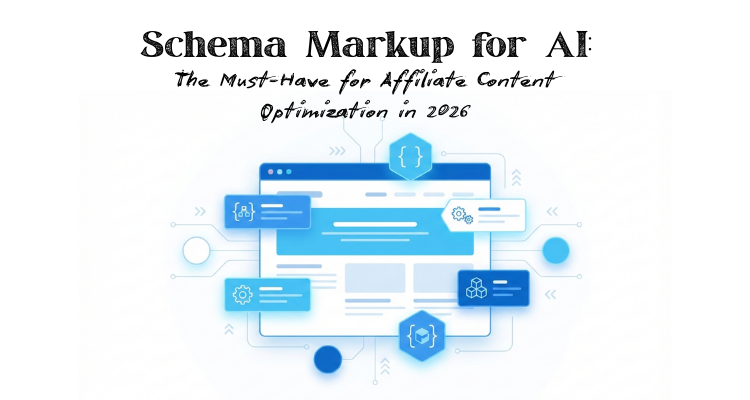
Schema Markup for AI: The Must-Have for Affiliate Content Optimization in 2026

The “Golden Age” of simple keyword targeting is officially over. If you've ever felt the sting of watching your best-performing affiliate reviews get swallowed by a Google AI Overview—where the machine provides the answer but keeps the click—you know the game has changed. In 2026, AI search engines don't just “read” your content; they “ingest” it to feed their generative models.
The truth is, most affiliate sites are currently being used as free training data. Without Schema Markup for AI, your blog is essentially invisible to the machines that now gatekeep search traffic. Schema is the structural layer that tells AI systems your content is authoritative, trustworthy, and worth a citation.
LLMs that use knowledge graphs built from schema have a 300% higher accuracy compared to those reading plain text, according to Almcorp 2026 research. This guide is your practical, affiliate-first roadmap to ensure your links aren't just summarized, but cited as the primary source.
Key Takeaways:
- The Zero-Click Threat: AI Overviews are absorbing affiliate review traffic, making traditional SEO insufficient for revenue protection.
- The Citation Signal: Pages with comprehensive structured data are 2-4x more likely to appear in Google AI Overviews.
- Revenue Impact: Implementing Product and Review schema can boost click-through rates by 20-30% by pulling buyers directly to your offers.
- Main Takeaway: To stay profitable in 2026, you must transition from keyword optimization to generative engine optimization (GEO) by making your content machine-readable through schema.
What Is Schema Markup, and Why Is It Important in the AI Search Era?
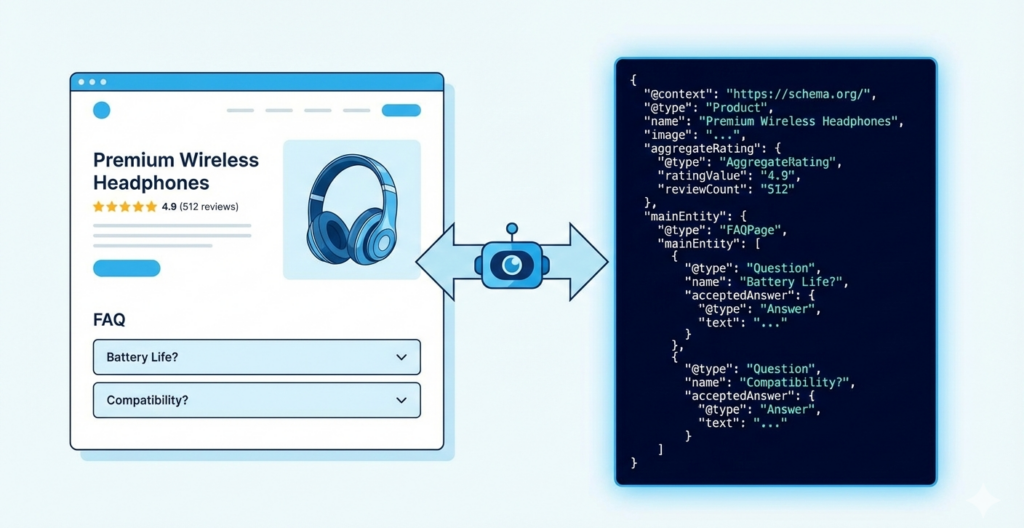
Schema markup is structured data. In simple terms, it is a standardized vocabulary from Schema.org that labels your content in a way machines can read with certainty.
Instead of forcing AI to guess what a page is about, schema markup tells it directly. This is a product review. This is the author. This is the brand being recommended. This is the conclusion.
That clarity matters more than ever.
Before AI Overviews, schema markup was mostly a rich-snippet tool. You used it to get star ratings, FAQ dropdowns, or breadcrumbs in search results. Helpful, but optional. Rankings still came from links, relevance, and content depth.
Post-AI, the role has changed.
AI systems now construct answers, not lists. When Google AI Overviews, conversational agents, or generative search features build a response, they actively look for machine-readable signals they can trust. Schema markup acts as a citation and trust layer. According to multiple 2025–2026 studies, pages with clear, comprehensive structured data are far more likely to be extracted, summarized, and referenced inside AI-generated answers.
Technically, schema can be implemented in three formats:
- JSON-LD – a script added to your page that separates structured data from visible content. This is Google’s preferred format.
- Microdata – markup embedded directly into HTML elements.
- RDFa – a more complex format often used in academic or enterprise contexts.
For affiliate sites, JSON-LD is the practical choice.
One important clarification. Schema markup does not directly rank pages. It does not replace SEO fundamentals. What it does is enable richer results, clearer entity recognition, and reliable AI interpretation. In an AI search era, that difference determines whether your content gets ignored or cited.
How Are AI Search Engines Using Schema Markup?
AI search engines do not just read your sentences; they perform entity recognition. They map your content to specific entities—like products, brands, and people—and the relationships between them. Schema markup is the most reliable way to trigger this process accurately.
When you use schema, you are essentially feeding Google’s Knowledge Graph, which contains over 500 billion facts. By tagging your content, your affiliate reviews become eligible for inclusion in this graph. The chain of visibility works like this:
- You implement schema.
- The AI identifies your content as a trusted entity.
- Your data is added to the AI knowledge graph.
- The system generates an AI Overview citation that leads to your site.
This is why LLMs with knowledge graphs built from schema show 300% higher accuracy compared to those reading plain text. We've seen that nesting schemas—linking a Product to a Brand and then to an Organization—makes AI trust and rank your content higher.
Microsoft's Bing has explicitly stated that schema helps its AI systems understand content. This also applies to voice search optimization, where AI assistants use structured data to provide verbal answers. Whether it is ChatGPT search or Perplexity AI, these systems are looking for structured “facts” they can verify.
Why Is Affiliate Content Uniquely Vulnerable to AI Search Disruption?

There is a frustrating paradox in affiliate marketing right now. The pages that drive your revenue—product reviews, “best of” roundups, and comparison tables—are exactly the pages AI systems are trained to summarize. When an AI provides a full comparison directly in the search results, it often eliminates the need for the user to click your link.
The truth is, without schema markup, AI systems cannot verify the trustworthiness or recency of your affiliate reviews. When the machine is unsure, it defaults to citing big brand pages or giant aggregator sites instead of your niche site.
Specific content types at high risk include:
- Review posts: AI summarizes the pros and cons, skipping your affiliate link.
- Buyer's guides: AI extracts the “top 3” recommendations.
- How-to posts: AI gives the steps but ignores your recommended tools.
- Deal and coupon pages: AI provides the code without the click.
So, why bother? Think of it this way: without schema, your affiliate site is a library with no catalog system. The AI's search algorithm is a librarian who is too busy to browse every shelf; they simply skip past your unlabeled books to find a shelf with clear labels. To survive the shift toward zero-click affiliate traffic, you must give the “librarian” a reason to pick your book and tell the reader exactly where it came from.
Which Schema Markup Types Should Affiliate Sites Be Prioritizing?
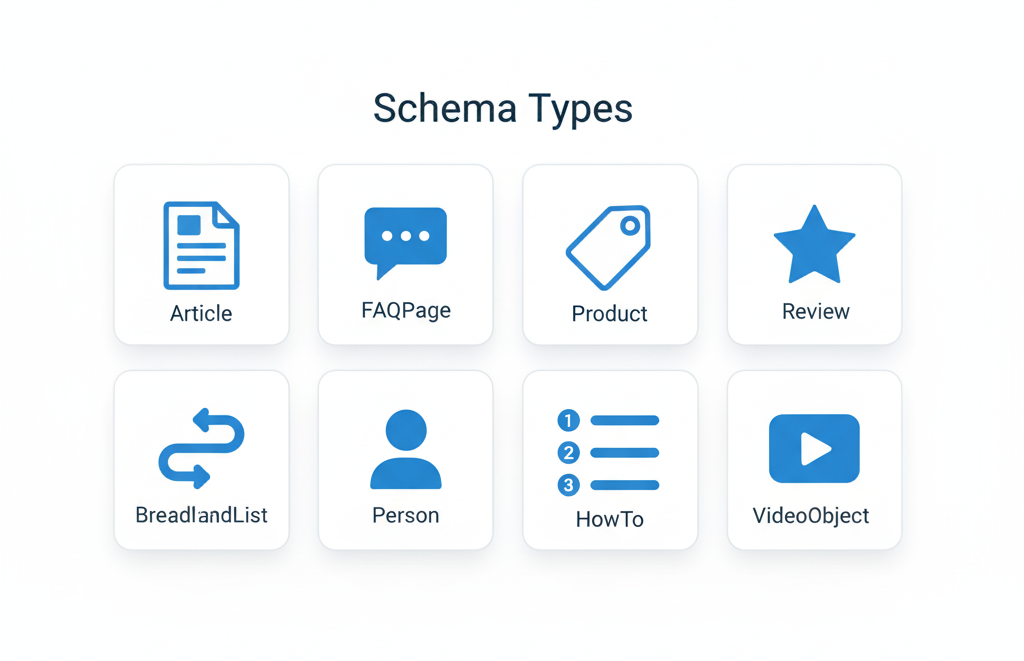
Not all schema types carry the same weight. In the “Generative Engine Optimization” (GEO) era, your priority should be defining core entities and answering user intent so clearly that an AI doesn’t have to “guess” what you’re recommending. For affiliate marketers, this means moving beyond basic blog post tags and into specific commerce-related schemas.
The following schema types are the heavy hitters for protecting and growing affiliate revenue:
- Product + Offer: This is the “bread and butter” of affiliate SEO. It tells the AI exactly what item is being discussed, its price point, and availability. By using the Offer property, you signal to AI search engines that your page is a bottom-of-funnel resource ready for a conversion. According to Digital Applied, sites using Product and Review schemas on buying guides see 4x more AI citations.
- Review & AggregateRating: These are critical for building trust. Review schema allows you to highlight the specific pros and cons (which Google AI Overviews love to scrape), while AggregateRating shows the machine that your recommendation is backed by a consensus of users. Pages using it see 20–30% higher click-through rates on e-commerce and affiliate content, according to WordStream.
- FAQPage: This is perhaps the highest-value real estate for AI citations. When you mark up your FAQs, you are providing “ready-to-use” answers for AI systems to pull into generative summaries. According to SAPT.ai, pages with FAQ schema see a 25% uplift in AI Overview citations.
- Article & BlogPosting: These provide the essential E-E-A-T (Experience, Expertise, Authoritativeness, Trustworthiness) signals. They tell the AI who wrote the piece and when it was last updated.
- Person & Organization: Crucial for authorship. In an era of AI-generated junk, Person schema proves that a real human with a track record wrote the review. Linking your author profile to your Organization via sameAs properties (linking to LinkedIn or Twitter) creates a verified trust loop.
- HowTo & VideoObject: If your affiliate site focuses on tutorials (e.g., “How to set up a home studio”), these schemas break down steps into a format that AI can easily parse for “how-to” queries. According to report by Empathy First Media, a fitness brand implementing HowTo schema on workout guide pages saw a 72% increase in clicks via featured snippets.
To help you prioritize, I’ve built the Affiliate Schema Selection Matrix. Use this to determine which code to deploy based on your content type:
The Affiliate Schema Selection Matrix
| Content Type | Recommended Schema Type(s) | AI Visibility Benefit |
| Single Product Review | Product, Review, Person | Triggers “Product Snippets” and detailed AI pros/cons lists. |
| “Best of” Roundup | ItemList, AggregateRating | Helps AI extract the “Top 3” recommendations for its summary. |
| Buyer's Guides | Article, FAQPage | Positions your site as the “Authority” source for broad queries. |
| Tutorial/Process | HowTo, VideoObject | Increases likelihood of appearing in “Step-by-step” AI answers. |
| Brand Comparison | Product (x2), Review | Enables the AI to construct side-by-side comparison tables. |
Use this matrix as your implementation starting point. Match your content type to the right schema combination, and you'll cover the vast majority of AI visibility opportunities available to affiliate sites right now.
How Do You Implement Schema Markup on an Affiliate Site Without Touching Code?
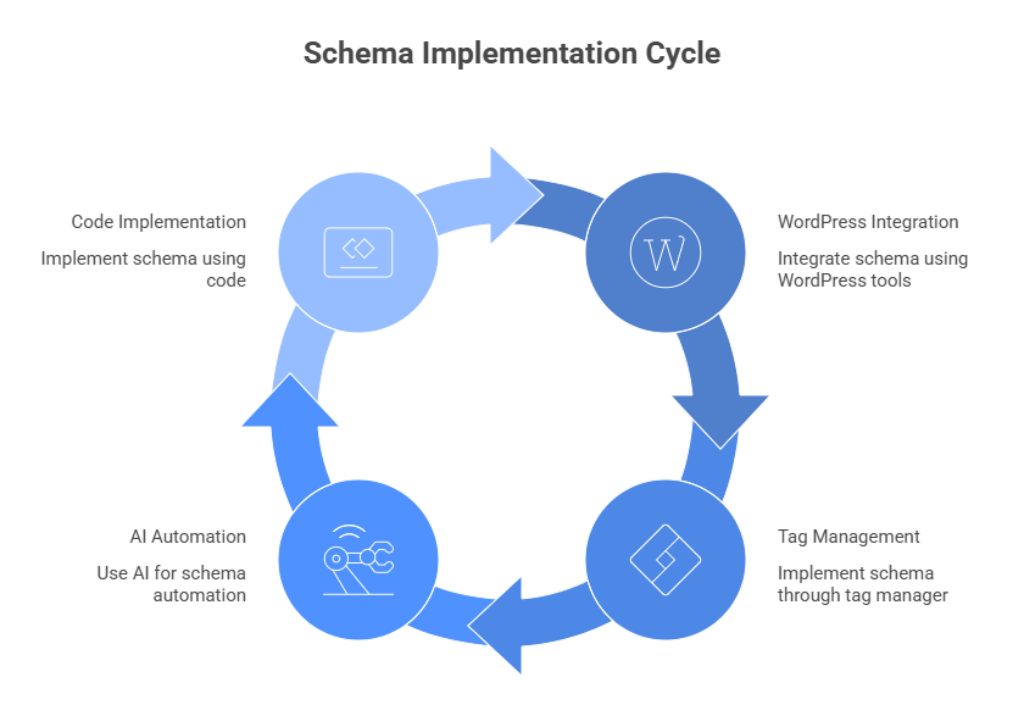
You don’t need to be a developer to win at the schema game. For most affiliate site owners, the technical barrier can be bypassed using automated tools that generate clean JSON-LD—the preferred script format for Google and Bing.
- WordPress Plugins (Recommended Starting Point): If your affiliate site runs on WordPress, RankMath is the tool to use. It includes built-in schema types for Article, Review, Product, FAQPage, and HowTo — all configurable from the post editor without touching a line of code. RankMath's schema module lets you add and nest schema types per page, which is exactly what affiliate content requires. It handles the JSON-LD generation automatically and keeps your markup clean and Google-compliant.
- Google Tag Manager: If you're not on WordPress, Google Tag Manager lets you inject JSON-LD schema scripts across your entire site without CMS access. You create a Custom HTML tag containing your JSON-LD code, set a trigger for the relevant page URLs, and publish. It's not as elegant as a native plugin, but it works on any platform — Squarespace, Webflow, custom-built sites — and gives you centralized control over your schema deployment.
- AI-Powered Schema Generators: Tools like Alli AI, Schema.dev, and Dentsu's Schema Markup Generator can auto-generate correct JSON-LD directly from your page's HTML content. You paste in your URL or page content, and the tool produces ready-to-deploy structured data. These are useful for quickly marking up a large batch of pages or verifying that your manually written schema is correctly structured.
- Manual JSON-LD: For developers or anyone who wants full control, JSON-LD schema is written as a <script type=”application/ld+json”> block and placed in the <head> or <body> of your page. This approach gives you complete flexibility to nest schema types — for example, a Product schema containing a nested Brand schema linked to an Organization entity with a real Wikidata ID — which is the level of depth that drives 4x AI citation rates according to Digital Applied.
Where to Start: Don't try to mark up your entire site at once. Pull your top 10 highest-traffic affiliate pages from Google Search Console, identify which schema types apply using the matrix above, and implement there first. Prioritize your product review posts and comparison pages — those are where schema has the most direct impact on AI citation and affiliate clicks. Then expand systematically from there.
How Do You Validate and Test Your Affiliate Site’s Schema Markup?
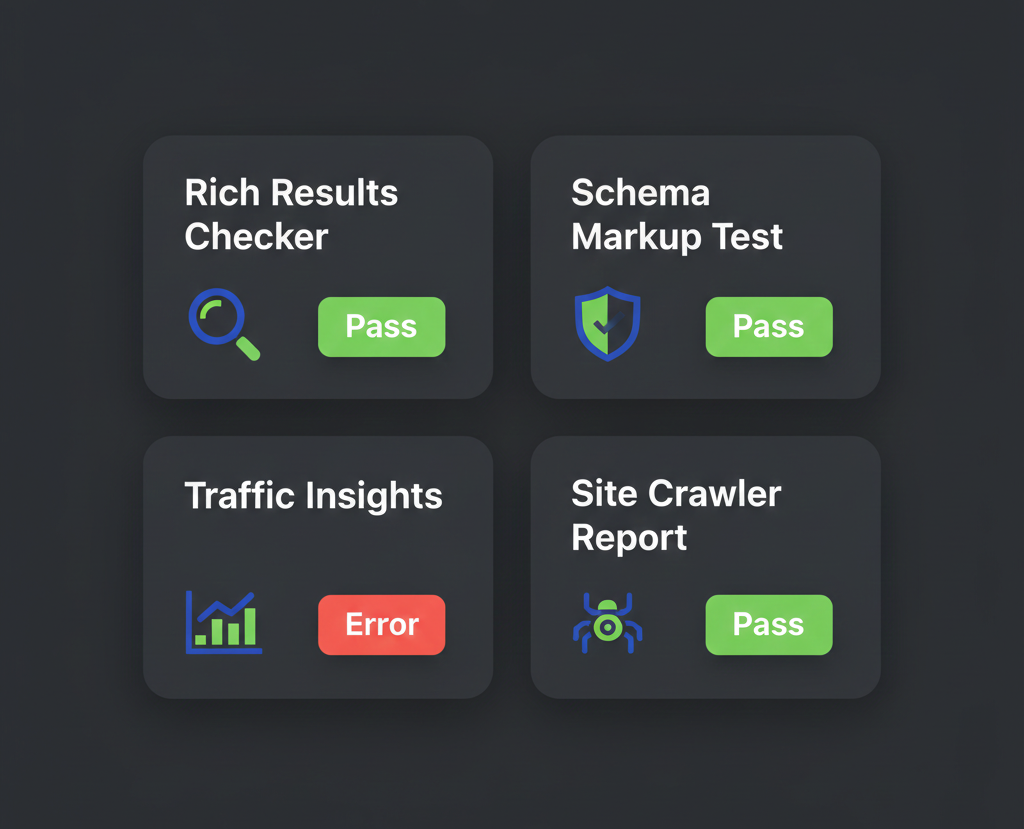
Adding code to your site is only half the battle; ensuring that AI agents can actually parse it is what secures the citation. In the 2026 search landscape, broken or contradictory schema isn’t just a technical glitch—it is a trust signal. If your JSON-LD says a product costs $49 but your page text says $79, AI systems may flag your content as unreliable and skip it entirely.
To maintain a clean bill of health, use this validation stack:
- Google Rich Results Test: This is your first stop. It simulates how Google sees your page and confirms if you qualify for specific rich snippets like star ratings or product carousels.
- Schema Markup Validator: While Google focuses on what it uses, this tool checks your code against the full Schema.org vocabulary. Use it to ensure your syntax is perfect and your entity nesting is logical.
- Google Search Console (Enhancements Tab): This provides a macro view. It tracks live performance and flags errors across your entire site, allowing you to spot “at scale” issues before they tank your traffic.
- Screaming Frog SEO Spider: For established affiliate sites, manual testing is impossible. Use the “Structured Data” tab in Screaming Frog to crawl your site and identify every page missing a critical Review or Product tag.
When you see an error, prioritize “Required field missing” over “Recommended field missing.” An error in a required field often invalidates the entire schema block, rendering your affiliate data invisible to the AI knowledge graph.
Common Schema Markup Mistakes to Avoid on Your Affiliate Sites
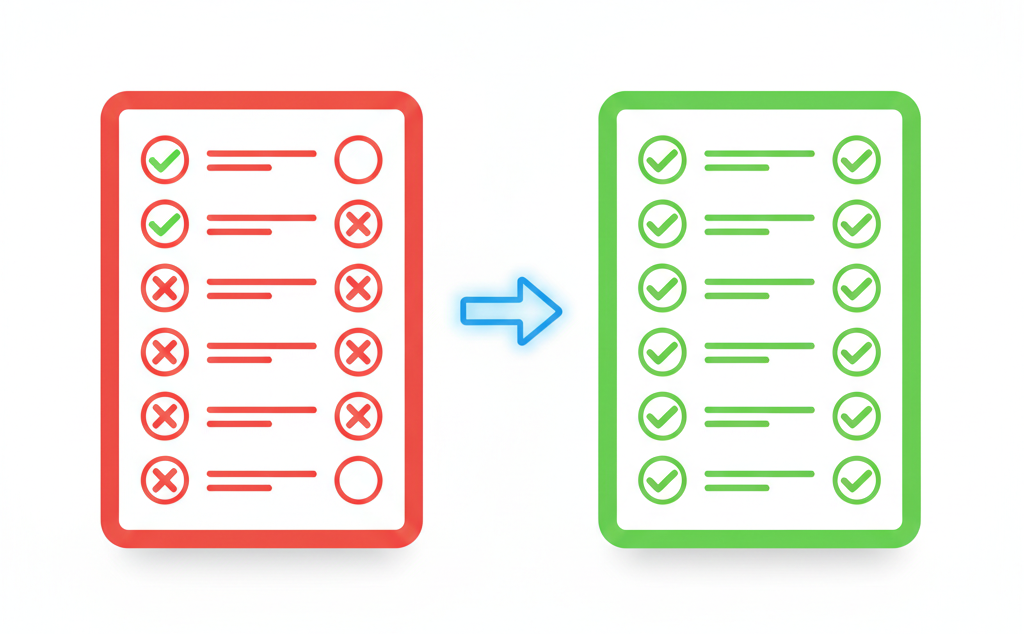
Even experienced affiliates fall into “optimization traps” that trigger manual actions or AI filtration. Avoid these common errors to keep your site in the AI citation loop:
- Schema Cloaking: Never markup information—like a discount code or a high rating—that isn't visible to the human reader. The Fix: Ensure every schema field has a corresponding visible element on the page.
- Generic “Thing” Schema: Using the broad Thing type tells the AI nothing about your intent. The Fix: Use specific types like Product, Review, or SoftwareApplication.
- Inconsistent Entity Naming: Calling a product “MacBook Pro M3” in your schema but “Apple Laptop” in your meta tags confuses entity mapping. The Fix: Use consistent naming conventions across all structured and unstructured data.
- “Set and Forget” Prices: Outdated pricing in your Offer schema triggers accuracy penalties from Google. The Fix: Use a plugin like RankMath to sync your schema with your actual affiliate table data.
- Anonymous Reviews: Skipping the Person or Author schema makes your review look like AI-generated fluff. The Fix: Always link your Review to a verified Person entity with a sameAs link to a social profile.
- Ignoring the FAQ Goldmine: Many affiliates write great FAQs but fail to tag them. The Fix: Add FAQPage schema to every review post to capture “Answer Engine” real estate.
- Missing AggregateRating on Roundups: AI needs a “consensus” signal for “Best of” lists. The Fix: Implement AggregateRating on every comparison page to summarize user sentiment.
Conclusion
As you have seen from the above, schema markup is not a technical afterthought you hand off to a developer someday. For affiliate sites in 2026 and beyond, it is the bridge between your content and the AI systems now sitting between searchers and your affiliate links. Those AI systems — Google's AI Overviews, ChatGPT search, Perplexity — are making citation decisions right now, on every query your pages used to rank for. Affiliates with properly structured data get cited. Those without it watch their traffic disappear into zero-click answers that never send a visitor their way.
The good news is that most affiliate sites haven't done this yet; the opportunity is still wide open.
Start right now. Open Google Search Console, identify your top three revenue-generating pages, and implement Product + Review + FAQPage schema on each one. Validate with the Rich Results Test. Fix any errors. Then expand from there, using the schema selection matrix in this guide to match every content type to the right structured data.
When you start right now, you are not just protecting current traffic — you're compounding your AI visibility advantage as search continues to shift. And you can be sure that this investment will pay out long after the next algorithm update.
Will love to hear your thoughts on this. Share with us in the comments below.
Frequently Asked Questions About Schema Markup for AI
What is a schema in Google AI Overview?
Schema in Google AI Overview is structured data code that helps Google understand and categorize your page content. When Google generates an AI Overview — the summary answer that appears at the top of search results — it pulls information from pages that clearly signal what their content means. Schema markup provides those signals. It labels your content with machine-readable tags from the Schema.org vocabulary, telling Google exactly what your page covers, who wrote it, and what it recommends. Pages with complete schema markup are 2–4x more likely to appear in Google AI Overviews than pages without it, according to WordStream.
What do schemas do in AI?
Schema markup gives AI systems a structured map of your content instead of forcing them to interpret raw text. AI search engines — including Google, Bing AI, and Perplexity — use schema to identify entities (products, people, brands, concepts) and the relationships between them. This process is called entity recognition. When an AI system can clearly identify what your page is about, who produced it, and what it recommends, it can cite your content with confidence in generated answers. Without schema, AI systems guess at your content's meaning. When they guess, they default to sources they can verify — and your affiliate page loses the citation. Schema removes that ambiguity entirely.
Is AI replacing SEO?
No. AI is changing how SEO works, not replacing it. The goal of SEO has always been the same: make your content visible and accessible to the systems mediating the relationship between searchers and your pages. Those systems used to be keyword-based ranking algorithms. Now they are AI-driven answer engines. The skills that matter have shifted — from keyword density and backlink volume to structured data, entity authority, and content that AI systems can extract and cite. Affiliates who treat this shift as a death sentence for SEO are wrong. Those who adapt their technical and content strategy to the AI search model will capture traffic that their competitors are abandoning.
How does schema markup work with Google?
Schema markup works by adding a structured data script — written in JSON-LD format — to your webpage's HTML. This script uses the standardized Schema.org vocabulary to label your content with specific property tags: the type of page, the author, the product being reviewed, the rating, the price, and more. Google's crawlers read this script when they index your page. They use it to determine whether your content qualifies for rich results — star ratings, FAQ dropdowns, product carousels — and whether it is eligible for citation in AI Overviews. Schema markup does not directly improve your search ranking. What it does is make your content interpretable, verifiable, and citation-ready — which, in the current search environment, drives measurable gains in visibility and click-through rate.