Chadrack
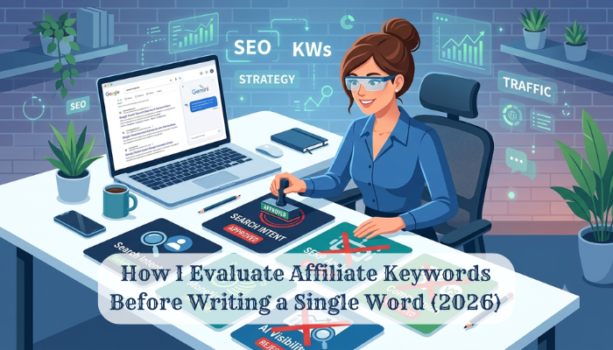
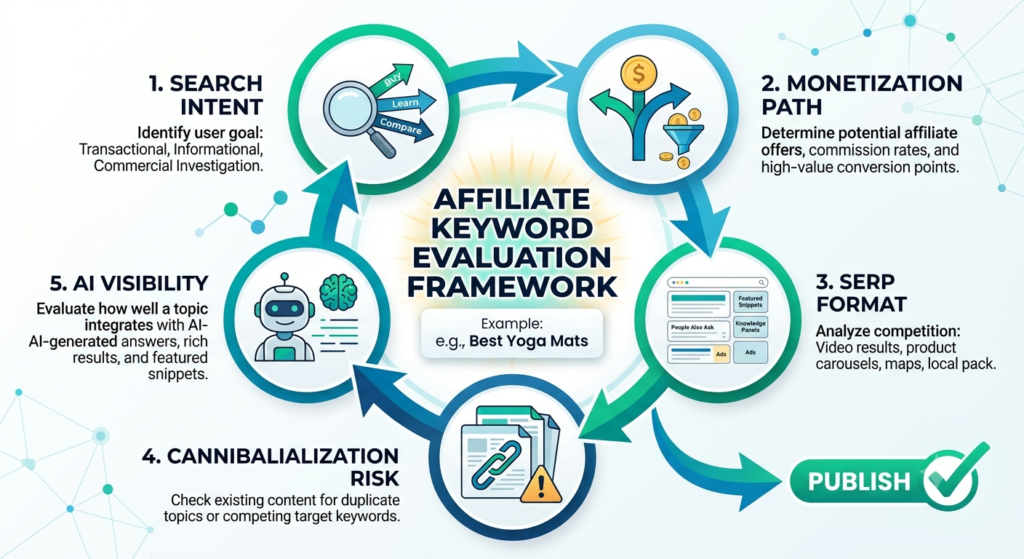
Before I write about any affiliate keyword, I run it through a five-point evaluation: search intent, monetization path, SERP format, cannibalization risk, and AI search visibility. A keyword only earns a place on my content calendar if it passes at least four of the five checks. This simple framework takes less than ten minutes and helps me avoid publishing content that attracts traffic but never generates affiliate commissions.
I no longer ask whether I can rank for a keyword. I first ask whether it deserves my time.
That single shift has had a bigger impact on my affiliate business than switching SEO tools or publishing more content.
For years, I approached affiliate keyword research the same way many bloggers do. I looked at search volume, keyword difficulty, and competition. If the numbers looked promising, I started writing. Sometimes the article ranked well. Yet many of those rankings produced little or no affiliate income because the keywords attracted readers who were researching, not buying.
I eventually realized that finding a keyword and validating a keyword are two completely different tasks.
Today, every keyword I discover must survive a simple five-point evaluation before I commit a single hour to creating content. I check search intent, monetization path, SERP format, keyword cannibalization, and AI search visibility. If a keyword fails these checks, I move on, regardless of its monthly search volume.
This framework has helped me stop chasing vanity metrics and focus on publishing affiliate content with a clear path to rankings, clicks, and commissions.
In this guide, I'll walk you through the exact five-point evaluation process I use before writing any affiliate article. By the end, you'll be able to assess any keyword in under ten minutes and quickly identify which opportunities deserve a place on your content calendar and which ones are likely to waste your time.
Key Takeaways
- Affiliate keyword research is about evaluating opportunities, not just discovering keywords.
- Every keyword should pass a five-point evaluation before you start writing: intent, monetization path, SERP format, cannibalization risk, and AI search visibility.
- Search volume and keyword difficulty never tell the full story. Manual SERP analysis and understanding how people search reveal whether a keyword is realistically winnable.
- In 2026, successful affiliate keyword research means creating content that can be cited by Google AI Overviews, ChatGPT, Perplexity, and other AI search engines, not just ranked in traditional search results.
- Spending ten minutes validating a keyword before writing can prevent dozens of wasted hours creating content that never earns commissions.
What Is Affiliate Keyword Research, and Why Evaluation Matters More Than Discovery?
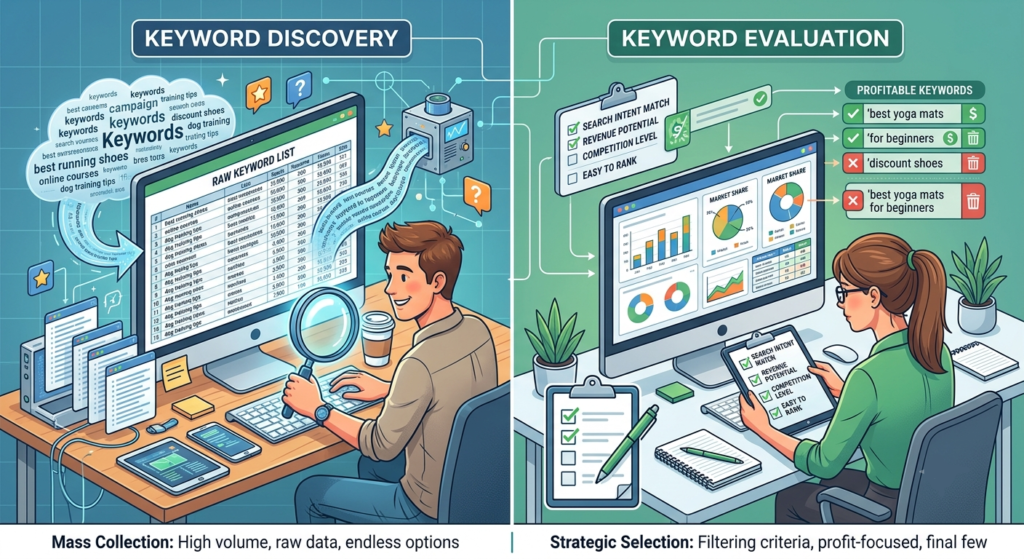
Affiliate keyword research is the process of identifying search terms with commercial or transactional intent that can be matched to a specific product, service, or comparison you can monetize. It differs from general SEO keyword research because the goal is not traffic. The goal is qualified traffic that converts into affiliate commissions. The keyword itself is only the starting point. The real advantage comes from deciding whether that keyword deserves your time before you write a single word.
That distinction is where most affiliate keyword research guides fall short. They treat affiliate marketing keyword research as a discovery problem: open a tool, plug in seed terms, export a list, done. Discovery is step one. It is not the whole job. A keyword list built from search volume and keyword difficulty alone is a hypothesis about what might work, not a plan for what will convert.
Your evaluation process determines whether that hypothesis becomes a profitable article or another page that ranks, attracts visitors, and never generates meaningful affiliate commissions.
This shift in thinking changed how I approach affiliate SEO. Instead of asking, “Can I rank for this keyword?” I ask a much better question:
“If I rank for this keyword, will it actually grow my business?”
That single question filters out a surprising number of ideas before I waste hours researching, outlining, writing, editing, and promoting content that was never likely to convert.
One reason this matters even more in 2026 is that search behavior has become increasingly fragmented. Searchers still use Google, but many now ask ChatGPT, Perplexity, Claude, and Google AI Overviews for recommendations before clicking through to websites. Modern affiliate marketing keyword research therefore needs to evaluate both traditional rankings and whether your content can become the source AI systems cite when answering questions.
Recommended: AI Affiliate Marketing Content Strategy That Ranks in AI Search Engines (2025 Tested)
What Search Intent Actually Tells You About a Keyword?
Search intent reveals why someone searched for a keyword, and understanding that motivation is often more valuable than knowing the keyword's search volume. If you misread intent, even a page that reaches Google's first page can struggle to generate clicks, conversions, and affiliate commissions.
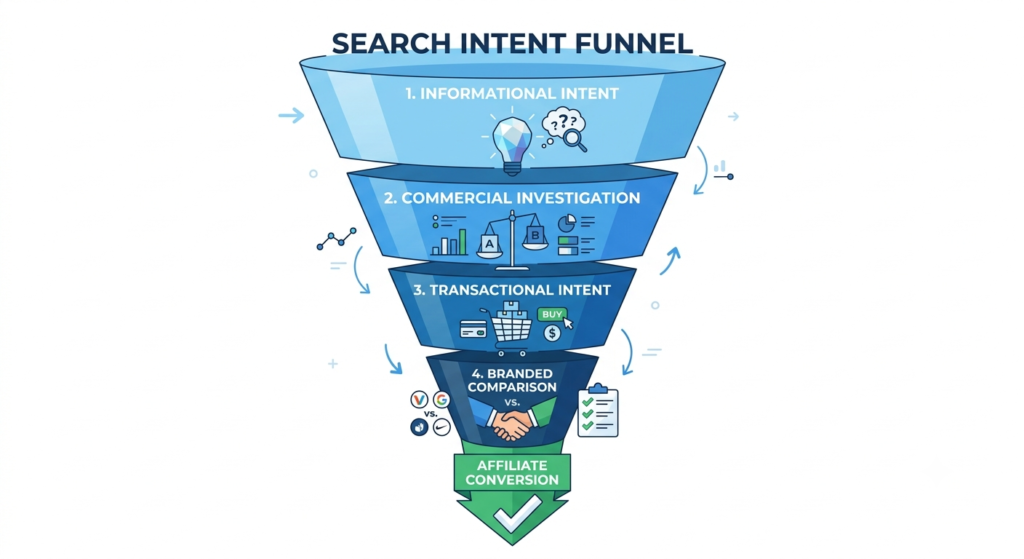
Every keyword falls into one of four buckets: informational, commercial investigation, transactional, or branded comparison.
Informational queries (“what is protein powder”) come from people still learning. Commercial investigation queries (“best protein powder for weight loss”) come from people comparing options before they buy. Transactional queries (“buy Optimum Nutrition Gold Standard”) come from people ready to click “add to cart.” Branded comparison queries (“Optimum Nutrition vs Dymatize”) come from people down to two finalists.
Words like best, review, and vs signal near-term purchase behavior. Words like what is and how does X work signal early-funnel research. This distinction matters because high-intent keywords convert at a completely different rate than early-funnel terms, even when both rank on page one.
Take a real before/after. “Best protein powder” tells you the searcher already knows protein powder exists and wants a shortlist to choose from, so the winning page is a comparison or a ranked list with affiliate links. “What is protein powder” tells you the searcher is still forming the question, so the winning page is an explainer, and forcing an affiliate pitch into it will feel like a detour, not an answer.
You can check intent in under two minutes without a paid tool. Search the exact keyword and look at the live SERP format. Ten listicles on page one means commercial investigation intent. A definition box and Wikipedia-style results mean informational intent. Product pages from Amazon or brand sites dominating the results mean transactional intent. The SERP tells you the intent Google has already decided on. Match it, or don't bother writing the page.
Does This Keyword Have a Real Monetization Path?
If you can't answer “how does this article make money” in one sentence, don't write it. That rule alone has saved me from publishing dozens of pages that might have ranked but would never have contributed meaningfully to my affiliate income.
Most affiliate keyword research guides treat monetization as an afterthought, something you figure out during the writing process once the outline exists. I check it before the outline exists. If I can't name the exact affiliate commissions path in one sentence, the keyword gets cut, no matter how attractive the search volume looks.
Before approving any keyword, I ask myself these questions:
- Is there a natural affiliate product or service that genuinely solves the reader's problem?
- Can I recommend the product based on experience, testing, or credible research?
- Would adding an affiliate recommendation improve the article rather than interrupt it?
- Can the reader take a meaningful buying action from this page?
- Does this keyword fit my broader content funnel and keyword mapping strategy?
If several of those answers are “no,” I move on to another keyword.
There are simply too many good opportunities to spend time forcing affiliate links into content where they do not belong.
Finally, before I approve any keyword, I ask myself two final questions. Would I personally link something here without it feeling forced? And is the affiliate link the answer to the reader's question, or a detour from it?
If the honest answer to either is no, the keyword fails this checkpoint, and no amount of traffic potential changes that.
That mindset has helped me create affiliate content that serves readers first while producing stronger conversion rates over time. It also makes every hour invested in writing substantially more likely to produce measurable returns.
What Does the Current SERP Format Tell You About Ranking Difficulty?
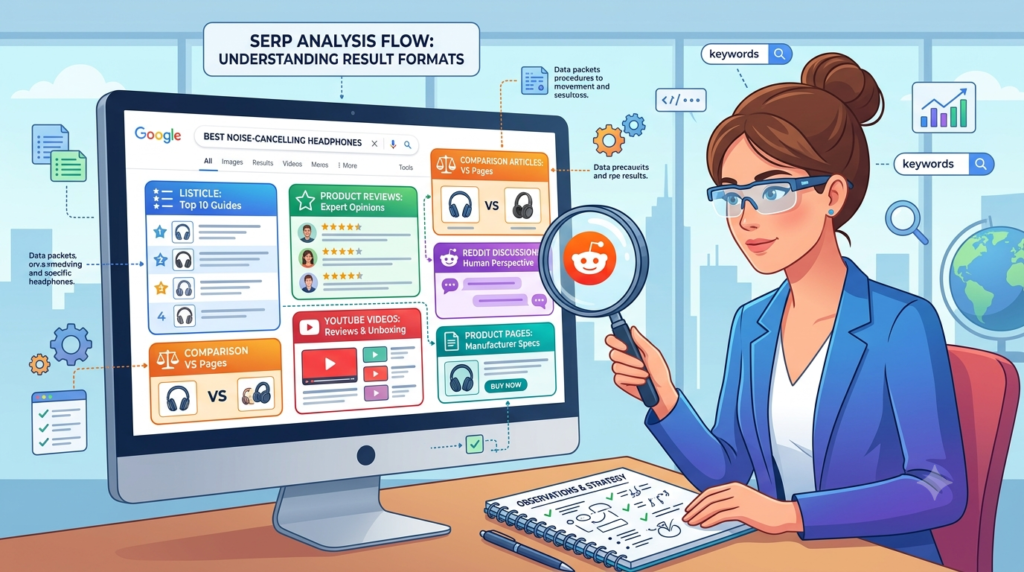
The current SERP format tells you more about ranking difficulty than any keyword tool's difficulty score, because it shows you exactly who you're competing against, not a modeled estimate. Run a manual SERP audit before you trust any tool's number.
Pull the top five to ten ranking URLs for the keyword and note the format of each one: listicle, single product review, comparison page, forum thread, or video. This takes about three minutes and tells you what Google has already decided the searcher wants.
Here's why the tool's difficulty score can mislead you. A keyword tool might rate a term as “medium difficulty,” but if the SERP is dominated by YouTube videos or big-brand product pages from Amazon, Walmart, or the manufacturer's own site, a blog post is not winning that page, regardless of what the score says. Difficulty scores measure backlink profiles and domain metrics. They don't measure format mismatch, and format mismatch is what actually kills most affiliate content.
Check the domain authority spread among the top ten results. If seven of ten results are low-authority sites running thin, generic content, the keyword is winnable with a genuinely better page. If seven of ten are established brands or high-authority publishers, that keyword needs a different angle or a pass entirely.
One practical habit protects future decisions: screenshot or log the SERP format at the time of research. SERPs shift. A keyword that showed a listicle-dominant SERP in January can show a video-dominant SERP by summer. Having a dated record means you can revisit a “pass” decision later with actual evidence, not memory.
Will This Keyword Cannibalize Existing Content on Your Site?
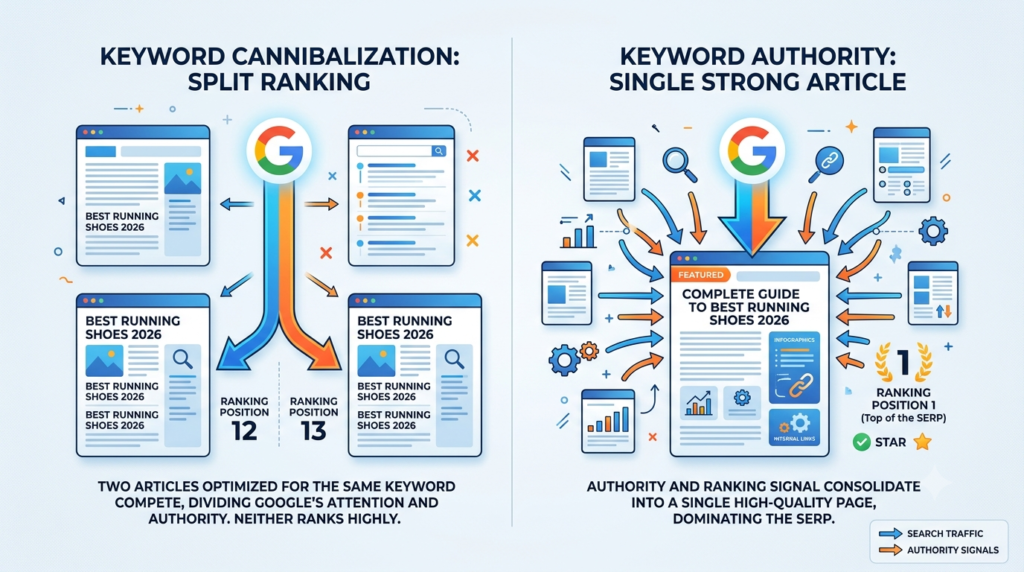
Keyword cannibalization means two pages on the same site compete for the same query, splitting ranking signals between them instead of concentrating authority on one page. It's a self-inflicted wound, and it's completely avoidable with one search before you write.
Before greenlighting any new article, search site:yourdomain.com plus the target term and its near-synonyms. If an existing page already ranks for that query or a close variant, you have two options: expand that page, or accept that your new article will compete with your own content instead of the competition's.
This is the checkpoint most affiliate keyword research guides skip entirely. I've read dozens of guides covering keyword mapping and search intent, and cannibalization rarely gets a mention. That's a real gap, because cannibalization is the single most common reason established affiliate sites stall out after year two or three. New writers publish for months without checking what's already live on their own domain, and their own older content becomes their biggest competitor.
The decision rule is simple: if an existing page already covers 70% or more of the same search intent, expand that page instead of publishing a new one. Add sections, update the data, deepen the comparison. Don't split your own ranking signals fighting yourself for the same spot.
Recommended: How to Use AI to Write Affiliate Product Reviews that Sell [2025 Guide]
How Do You Evaluate a Keyword for AI Search Visibility and Not Just Google Rankings?
Modern affiliate keyword research is no longer limited to Google's blue links. In 2026, you also need to evaluate whether a keyword creates opportunities to be cited by AI search engines such as Google AI Overviews, ChatGPT, Perplexity, and Claude. Visibility increasingly depends on becoming a trusted source, not simply earning the number one organic position.
This has become the fifth and final checkpoint in my evaluation framework.
Several years ago, my research process ended after reviewing search volume, competition, SERP analysis, and monetization potential.
Today, that isn't enough. After completing my traditional SERP review, I ask a simple question: does the query already trigger an AI Overview or a chat-style answer? If it does, the opportunity shifts. You're no longer competing purely to be the clicked blue link. You're competing to be the cited source inside that AI-generated answer, which still drives brand visibility and, in many cases, a click for anyone who wants more detail than the summary gives.
This is where content standards tie directly back to affiliate keyword research strategy. Declarative, entity-dense, directly-answerable content earns AI citations even when it doesn't win the top organic position. AI systems pull from pages that state facts plainly, name specific tools and entities, and answer the question in the first few sentences, not pages that bury the answer under three paragraphs of preamble.
Here's a two-minute test I run on every keyword now: search it as a direct question inside an AI assistant and note whether the response cites any source at all. An uncited AI answer is often a wide-open content opportunity. It means no site has claimed authority on that exact query yet, and a well-structured, entity-dense page can become the first cited source before competitors even notice the query exists in AI search.
What Does a Passing Keyword Score Actually Look Like? (Worked Example)
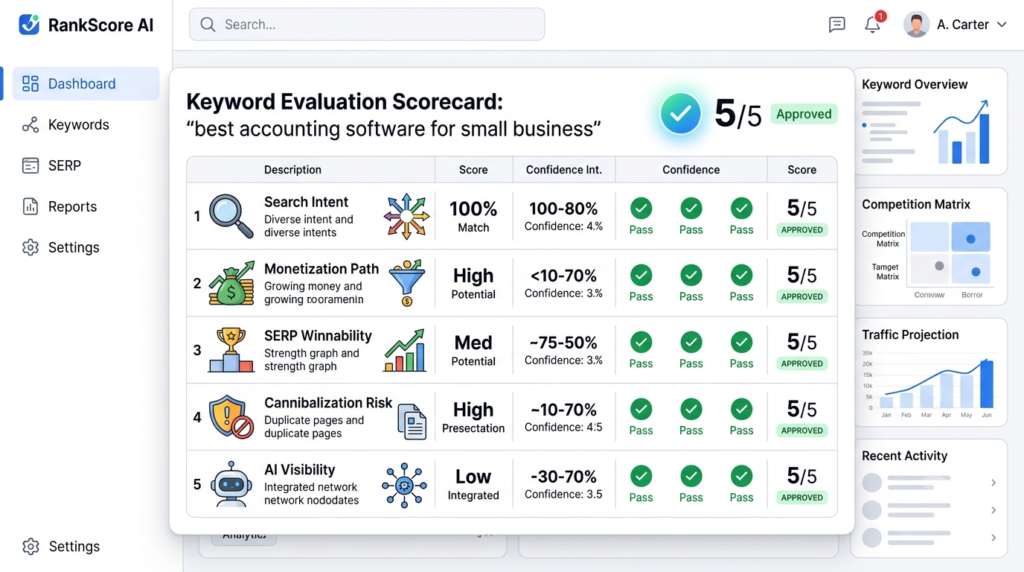
A keyword only earns a place on my content calendar if it passes at least four of my five evaluation checks. This scorecard keeps emotion out of the decision and ensures I invest my time in content with a realistic chance of generating rankings, AI visibility, and affiliate commissions.
Let's walk through a real example.
I'll use the keyword:
“Best email marketing software for affiliate marketers.”
This is the kind of commercial keyword I regularly evaluate because it has a clear audience, obvious buying intent, and multiple reputable affiliate programs.
Step 1: Search Intent
The phrase begins with “best,” which immediately signals commercial investigation.
People searching this keyword already know they need email marketing software. They're comparing platforms before making a purchase decision.
Result: PASS ✅
Step 2: Monetization Path
The monetization opportunity is straightforward.
The article can naturally compare products such as GetResponse, Kit, MailerLite, ActiveCampaign, and Brevo, while recommending the right solution for different types of affiliate marketers.
The affiliate recommendations become part of the answer rather than distractions from it.
Result: PASS ✅
Step 3: SERP Winnability
Next, I manually review Google's first page.
Suppose the search results include:
- Two niche marketing blogs
- One Hostinger guide
- One Semrush article
- One Reddit discussion
- Several independent affiliate websites
This tells me Google isn't rewarding only massive software companies. Smaller publishers are already competing successfully.
That makes the keyword realistic for a well-written, experience-based article.
Result: PASS ✅
Step 4: Cannibalization Risk
Before writing, I search:
site:webincomejournal.com “email marketing software”
I also search for related phrases such as:
- best email marketing tools
- email marketing for bloggers
- email marketing platforms
If I already have a comprehensive comparison article targeting nearly identical intent, I update that page instead of creating another one.
In this example, let's assume no existing article overlaps significantly.
Result: PASS ✅
Step 5: AI Search Visibility
Finally, I test the keyword in Google AI Overviews, ChatGPT, and Perplexity.
The AI responses summarize the topic and cite several sources, but they lack firsthand comparisons, practical buying advice, and a clear framework for choosing the right platform.
That tells me there's room to create a more complete, entity-rich resource capable of earning citations.
Result: PASS ✅
My Keyword Evaluation Scorecard
| Evaluation Check | Result | Notes |
| Intent Match | ✅ Pass | Strong commercial investigation intent with clear buying signals |
| Monetization Path | ✅ Pass | Multiple relevant affiliate products fit naturally within the article |
| SERP Winnable | ✅ Pass | Mix of established brands and smaller publishers already ranking |
| Cannibalization Risk | ✅ Pass | No existing page targets the same search intent |
| AI Visibility | ✅ Pass | Opportunity to create a more complete, citation-worthy resource |
Final Score: 5 out of 5 – Approved for the content calendar.
Not every keyword scores this well.
Some keywords fail because the search intent is informational with no obvious buying journey.
Others fail because the first page is dominated by official product documentation or major brands that would require enormous effort to outrank.
Sometimes the keyword overlaps heavily with an existing article, making an update a better investment than publishing something new.
That's perfectly acceptable.
The purpose of the scorecard isn't to approve every keyword.
It's to eliminate weak opportunities before they consume your writing time.
My rule is simple:
A keyword must pass at least four of the five evaluation checks before I begin outlining the article.
That rule has dramatically reduced the amount of content I publish while increasing the percentage of articles that contribute to traffic, affiliate commissions, and long-term topical authority.
What Common Mistakes Cost Affiliate Marketers the Most Time?
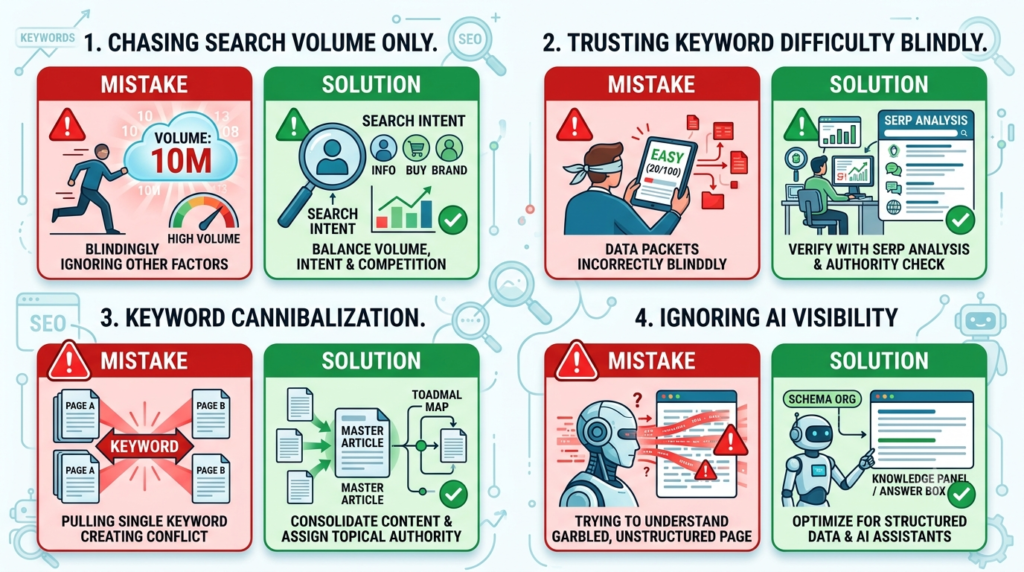
Most affiliate marketers don't lose time because they choose the wrong keyword tool. They lose time because they skip the evaluation process. Here are the four mistakes I see most often and the simple fix for each.
Mistake #1: Chasing search volume instead of monetization
A keyword with thousands of monthly searches is worthless if the reader has no reason to buy anything after landing on your page.
Fix: Ask yourself, “How does this article generate revenue?” If you can't answer that in one sentence, move on to another keyword.
Mistake #2: Trusting keyword difficulty scores without checking the SERP
A keyword tool cannot tell you whether Google prefers comparison articles, videos, product pages, or forum discussions.
Fix: Spend five minutes manually reviewing the top five to ten search results before making your decision.
Mistake #3: Publishing without checking for keyword cannibalization
Creating multiple pages that target the same search intent often weakens every article involved instead of strengthening your site's authority.
Fix: Search site:yourdomain.com along with the target keyword and its closest variations before approving a new article.
Mistake #4: Ignoring AI search visibility
Many bloggers still optimize exclusively for traditional rankings while overlooking how Google AI Overviews, ChatGPT, and Perplexity answer the same queries.
Fix: Test every target keyword inside AI search engines and identify opportunities to create content that deserves to be cited, not just clicked.
Conclusion
There you have it, my five-point framework for evaluating affiliate keywords before writing a single word. My 15+ years in this industry has taught me that successful affiliate marketers don't build profitable websites by publishing the most articles.
They build them by publishing the right articles. That's why I evaluate every keyword before opening a blank document. This five-point framework that I’ve shared with you above has fundamentally changed how I approach affiliate keyword research.
Instead of creating content and hoping it converts, I validate every opportunity before investing hours into research, writing, and promotion. The result is a content strategy built around quality rather than quantity. More importantly, it's built around conversion rather than traffic alone.
The next time you discover what looks like a promising keyword, don't rush into your writing tool. Run it through this five-point checklist first.
Spending ten minutes evaluating a keyword today can save you dozens of hours writing an article that was never going to earn rankings, citations, or affiliate commissions in the first place.
Frequently Asked Questions
What is a good AI visibility score?
A good AI visibility score indicates how often your website or brand appears in AI generated answers across platforms such as Google AI Overviews, ChatGPT, Perplexity, and Claude. While scoring methods differ between tools, a higher score generally means your content is cited more frequently and appears in more relevant AI responses. The best way to improve your score is to publish authoritative, well-structured, entity-rich content that directly answers users' questions.
How do you check AI visibility?
You can check AI visibility by using dedicated AI visibility platforms or by manually testing important keywords in Google AI Overviews, ChatGPT, Perplexity, and Claude. Record whether your website is cited, how often it appears, which competitors receive citations, and what type of content is referenced. Tracking these results over time helps you identify opportunities to improve your visibility and measure the impact of your content updates.
How is AI visibility calculated?
AI visibility is calculated by measuring how frequently a website, brand, or page is referenced in AI generated answers for a selected group of search queries. Most AI visibility tools evaluate factors such as citation frequency, share of voice, keyword coverage, competitor presence, and overall visibility across multiple AI search engines. Although each platform uses its own methodology, the goal is the same: estimate how visible your content is within AI generated search experiences.
How do you gain AI visibility?
You gain AI visibility by publishing accurate, well-organized content that answers questions clearly and demonstrates expertise. Focus on creating content with descriptive headings, concise definitions, strong topical coverage, relevant entities, original insights, and factual accuracy. Content that satisfies user intent and is easy for AI systems to understand is more likely to be cited by Google AI Overviews, ChatGPT, Perplexity, and other AI search engines.