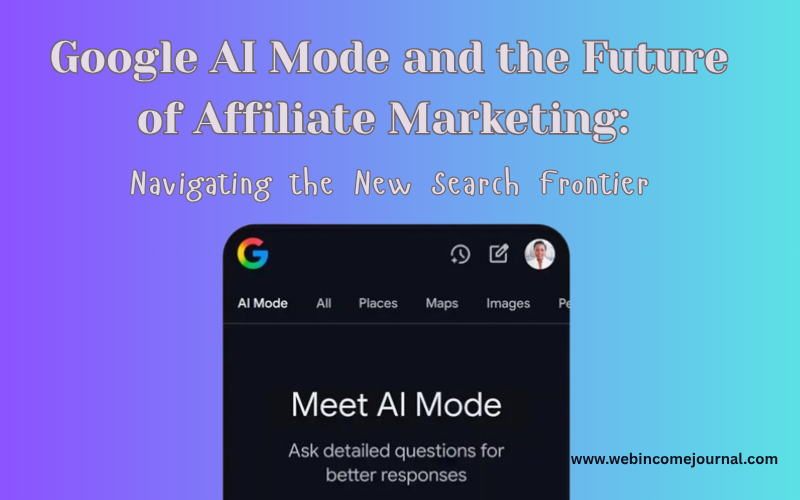
Google AI Mode and the Future of Affiliate Marketing: Navigating the New Search Frontier

The affiliate marketing world just experienced its biggest earthquake since Google's first algorithm update. With Google AI Mode now serving 1.5 billion users monthly and some websites reporting traffic drops between 18% and 70%, we're not just witnessing another search update – we're watching the complete transformation of how people find and interact with information online.
If you're an affiliate marketer who's built your business on organic search traffic, you're probably feeling a mix of panic and confusion right now. I get it. After spending years mastering traditional SEO, suddenly the rules have changed overnight.
But you don’t have to panic. This isn't just a threat, it's also an opportunity for affiliate marketers.
In this article, you'll learn exactly how Google AI Mode works, why it's fundamentally different from anything we've seen before, and most importantly, how to adapt your affiliate marketing strategy to not just survive but thrive in this new landscape.
You'll discover specific tactics for getting your content featured in AI-generated summaries, new monetization opportunities that most affiliates are completely missing, and a practical roadmap for future-proofing your affiliate business.
TL;DR:
Google AI Mode is Google's revolutionary search experience powered by the Gemini 2.5 AI model that provides conversational, synthesized answers directly in search results instead of traditional blue links. For affiliate marketers, this means traditional traffic patterns are disrupting dramatically – but those who adapt their content strategy to become “AI-citable” and focus on intent-driven, comprehensive content will discover new opportunities for visibility and monetization in this AI-first search environment.
What Exactly is Google AI Mode?
So, what exactly is Google AI Mode?
Launched broadly in May at Google I/O 2025, AI Mode is a revolutionary shift in how Google Search works. It is a fundamental change that integrates advanced generative AI directly into your search experience. While Google wants us to believe that AI Mode was released in response to users who desired more from AI Overviews, it’s clear that the real intention is to stay relevant at a time when generative search engines like ChatGPT and Perplexity, are growing in popularity.
But what exactly makes it different from the AI Overviews we've been seeing since 2024?
The key difference is persistence and conversation flow. Unlike AI Overviews that answered one query and moved on, AI Mode maintains context across multiple interactions within the same search session.
You can ask follow-up questions, request clarifications, and dive deeper into topics without starting from scratch each time. It's like having a knowledgeable research assistant who remembers what you've been discussing.
With AI Mode, users can toggle between classic blue-link results and AI-driven summaries, giving them control over their search experience. This flexibility addresses the concern that AI might completely replace traditional search results.
Beyond Traditional Search Results
Instead of showing you ten blue links and hoping you'll click through to find answers, Google AI Mode synthesizes information from multiple sources and presents it directly in the search interface.
This represents a fundamental shift from search engine to answer engine. The goal isn't just to help you find information – it's to provide the actual answers you need.
Powered by Gemini 2.5's Advanced Reasoning
The engine behind this transformation is Google's Gemini 2.5 large language model, which Google claims has taken the lead as the top-performing AI model according to recent benchmarks.
Gemini 2.5's advanced reasoning capabilities allow it to understand context, maintain conversation threads, and process complex queries that would have stumped earlier search algorithms.
According to Robby Stein, Google’s VP of Search,
“Using a custom version of Gemini 2.0, AI Mode is particularly helpful for questions that need further exploration, comparisons and reasoning. You can ask nuanced questions that might have previously taken multiple searches — like exploring a new concept or comparing detailed options — and get a helpful AI-powered response with links to learn more.”
Query Fan-Out: Understanding Complex Questions
One of AI Mode's most powerful features is its “query fan-out” technique. When you type a complex, natural language query like “best budget laptops for college students with good battery life under $800,” it doesn't just match keywords. Instead, it breaks down your query into multiple sub-queries:
- What defines a budget laptop?
- What are the current computing needs?
- Which laptops have the best battery life in that price range?
- What are the most reliable brands under $800?
This allows it to gather and synthesize information from various sources across the web, giving you a much more comprehensive and nuanced answer.
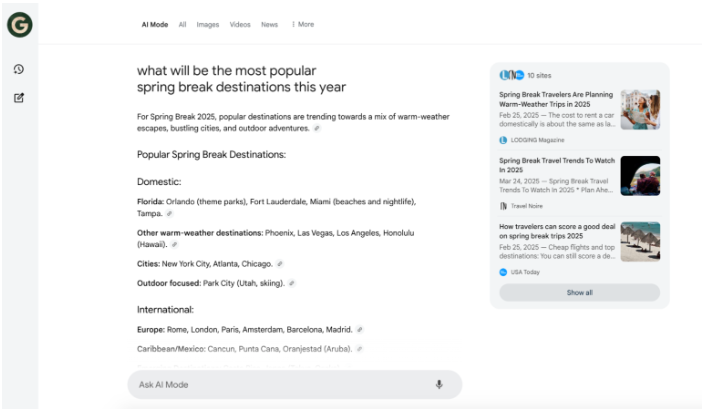
Multimodal and Interactive Search
Google AI Mode supports text, voice, and image inputs, making search more natural and intuitive. You can upload a photo of a product and ask questions about it, or use voice commands to continue conversations while multitasking.
This multimodal capability means affiliate marketers need to think beyond just text-based content optimization. Visual and audio content will play increasingly important roles in how AI systems understand and present information.
How Will AI Mode Impact Organic Traffic for Affiliate Sites?
Now, let’s talk about what this means for your affiliate business.
Over the years, there have been a number of Google updates that have impacted affiliate marketers, but to date, this represents the biggest challenge we've ever faced. The reality that's keeping affiliate marketers up at night right now is the fact that AI Overviews and Google AI Mode are designed to answer user queries directly within the search interface.
When someone searches “best protein powder for weight loss,” instead of clicking through to your carefully crafted affiliate review, they might get a comprehensive AI-generated summary that includes product recommendations, key features, and even pricing – all without ever visiting your site.
While this “zero-click” search behavior isn't new, AI Mode has however, accelerated it dramatically. Users are getting satisfying answers without leaving Google, which fundamentally disrupts the traditional affiliate funnel that relies on driving traffic to your content. And yes, for many of us, that means less traffic – and you know what that means in this business!
In case you’re wondering what that means, here’s what it means for your bottom line:
- Commission-based revenue takes a hit. If users don’t visit your site, they don’t click your links.
- Content monetization gets harder. Fewer pageviews mean fewer ad impressions.
- Advertising costs rise. As organic visibility drops, more affiliates turn to paid traffic, driving up competition and CPCs.
In fact, some publishers have already reported traffic drops between 18% and 70% since AI Mode’s rollout in May 2025. Why? Because users no longer need to browse five websites – they get their answer upfront, curated by Gemini 2.5.
The competitive landscape is also changing. As seen already with AI Overviews, the generative search engines prefer citing high-authority sources – brands, government sites, or publishers with strong E-E-A-T (Experience, Expertise, Authoritativeness, and Trust). This means niche affiliate sites, which often thrive on long-tail keywords and specific expertise, will need to work harder to build trust signals and content quality that stands out. Flimsy listicles won’t cut it anymore since AI Mode rewards depth, clarity, and contextual value.
The Bottom line? If your strategy is built around old-school SEO and passive clicks, Google AI Mode could quietly kill your traffic. But if you pivot now, there’s still a way forward.
What Opportunities Does Google AI Mode Create for Affiliate Marketers?
While AI Mode introduces challenges, it also opens up fresh opportunities, especially for savvy affiliate marketers ready to adapt. Here are some areas where AI Mode presents new opportunities:
1. Niche Specialization and Deep Expertise
Here's something AI struggles with: highly specialized, nuanced topics that require deep domain expertise. While Google AI Mode can synthesize general information effectively, it often falls short on complex technical subjects, emerging trends, or niche markets with limited online data.
If you're an affiliate in specialized areas like industrial equipment, rare collectibles, or emerging health technologies, you actually have an advantage. AI can't replace your years of hands-on experience with specific products or your understanding of unique customer pain points in niche markets.
The key is doubling down on that expertise rather than trying to compete in broad, commoditized topics where AI excels.
2. Affiliates as Information Curators
Think about your role differently. Instead of just being a traffic funnel, you're becoming an information curator and decision guide. AI Mode can provide facts, but it can't replicate your personal experience with products, your understanding of specific use cases, or your ability to guide complex purchasing decisions.
Users still need someone to say, “Based on my three years of testing these products, here's what works for your specific situation.” That human element – your credibility, experience, and ability to cut through marketing noise – becomes more valuable, not less.
3. Personalization and Hyper-Targeting
Google AI Mode's personalization capabilities create new opportunities for precise audience targeting. The AI understands user context, location, and behavior patterns in ways that enable more sophisticated offer delivery.
You can create content that targets very specific scenarios: “best noise-canceling headphones for remote workers in small apartments” or “budget fitness equipment for seniors with joint issues.” AI Mode's query fan-out technique helps surface this hyper-targeted content to the right users.
4. Enhanced User Experience and Conversions
Here's a counterintuitive opportunity: when users do click through from AI summaries, they're often more qualified and further along in their decision-making process. They've already consumed basic information from the AI and are looking for deeper insights or are ready to make a purchase.
This means your conversion rates can improve, even if overall traffic decreases. Focus on creating exceptional post-click experiences that capitalize on this higher-intent traffic.
5. Direct-to-Consumer and Agentic Commerce
The future gets really interesting when we consider agentic AI capabilities. Project Mariner and similar developments suggest AI will soon complete transactions directly within the search interface – booking reservations, making purchases, filling out forms.
Smart affiliates are positioning themselves to be part of these agentic workflows. Instead of just driving clicks, you might become the trusted advisor that AI systems recommend for specific product categories or purchasing decisions.
6. New Monetization Paths
We're seeing entirely new revenue streams emerge:
- Pre-Click Impressions: Getting cited in AI summaries creates brand awareness and credibility, even without clicks. This visibility has value for brand partnerships and sponsorship opportunities.
- Voice Integration: As AI Mode supports voice interactions, there are opportunities to create voice-optimized content and experiences that capture users through conversational search.
These emerging models let you capture value upstream – before a user even reaches your site – if you become part of the AI’s trusted answer pool.
Investing now in niche depth, clarity, structured data, and UX not only preserves your affiliate income but also positions you to thrive in the AI-first future.
How Can Affiliate Marketers Adapt Their SEO Strategy for AI Mode?
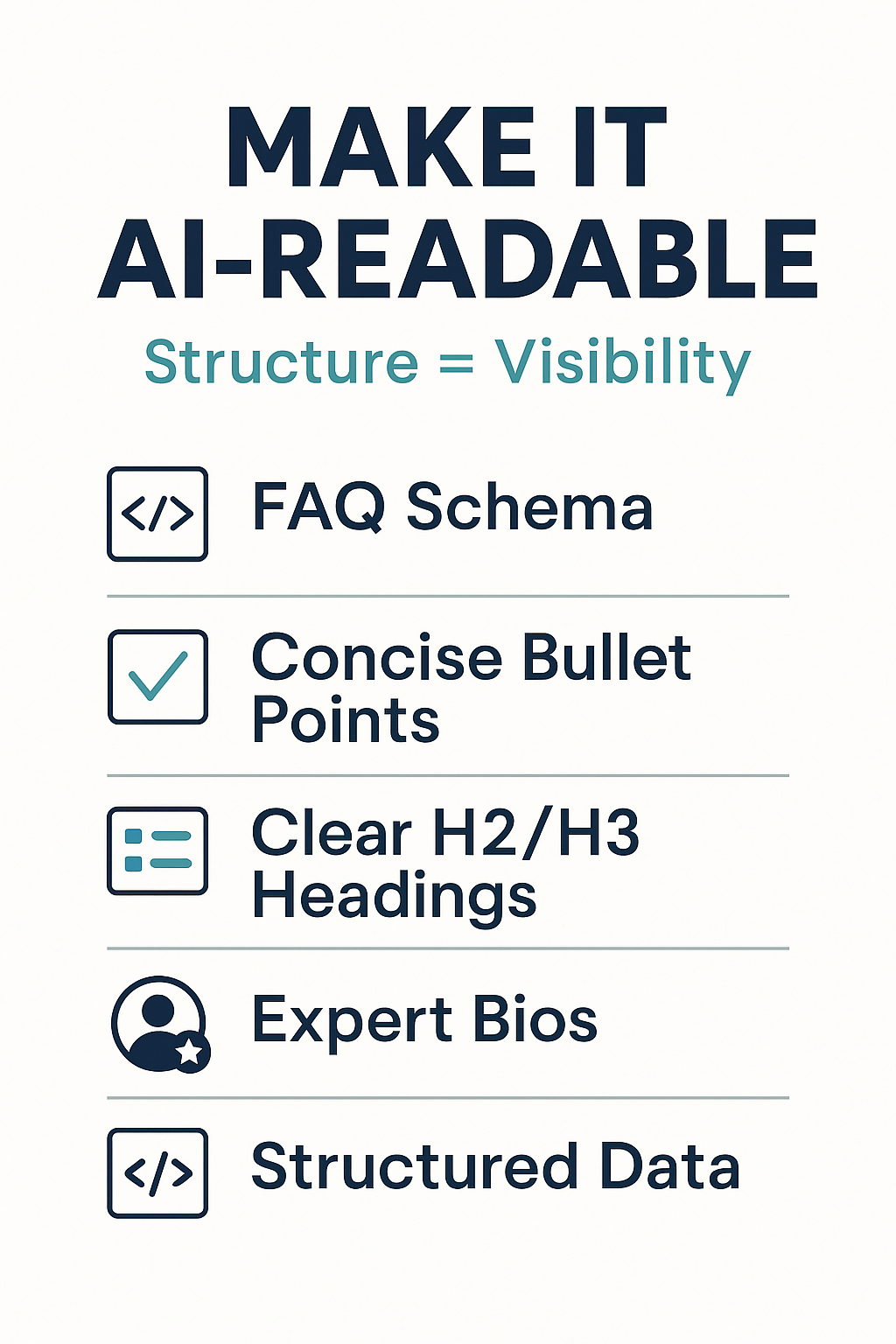
Affiliate marketers must evolve their SEO strategy to thrive in Google AI Mode. This requires a shift in mindset. Here's how you can evolve your affiliate SEO strategy:
1. GEO: The New Foundation for Affiliate Sites
Think of traditional SEO as your baseline – you still need solid technical fundamentals, quality backlinks, and optimized page speed. But now you must layer Generative Engine Optimization (GEO) tactics on top.
Start with LSI and NLP keyword mapping. Instead of targeting single keywords, focus on semantic clusters that cover related concepts. For example, if you're reviewing “wireless headphones,” also incorporate terms like “Bluetooth audio quality,” “battery life comparison,” and “noise cancellation technology.”
Structured data and schema markup become absolutely critical. Product, Review, HowTo, and FAQ schemas help Gemini 2.5 understand your content's context and purpose.
Brand mentions and digital PR tactics gain new importance because AI models value authoritative sources. Getting mentioned by industry publications and thought leaders signals credibility to AI systems.
2. People-First Content Gets a Major Upgrade
Google's “people-first” content guidelines take on new meaning in the AI era. Your content must satisfy user intent so comprehensively that AI systems choose to cite it over competitors.
This means going beyond surface-level product descriptions. Share your actual testing methodology, explain why you chose specific products to review, and include personal experiences that only you can provide.
I've found that content performing well in AI Mode typically answers the question “What would I want to know if I were making this purchase decision myself?”
3. Structure Content for Query Fan-Out
Remember how Google AI Mode breaks complex queries into sub-queries? Design your content to answer multiple related questions within a single comprehensive guide.
For a “best running shoes” article, include sections on:
- Foot type considerations (flat feet, high arches, pronation)
- Running surface recommendations (concrete, trail, track)
- Brand comparisons with specific model features
- Price range analysis with value propositions
- Sizing and fit guidance
This approach increases your chances of being cited for various AI-generated responses.
4. Schema Markup: Your AI Comprehension Tool
Implement structured data strategically, focusing on the schemas most relevant to affiliate marketing:
- Product Schema helps AI understand specifications, pricing, and availability.
- Review Schema signals your evaluation criteria and ratings methodology.
- FAQ Schema directly feeds AI systems with question-answer pairs.
- HowTo Schema guides users through decision-making processes.
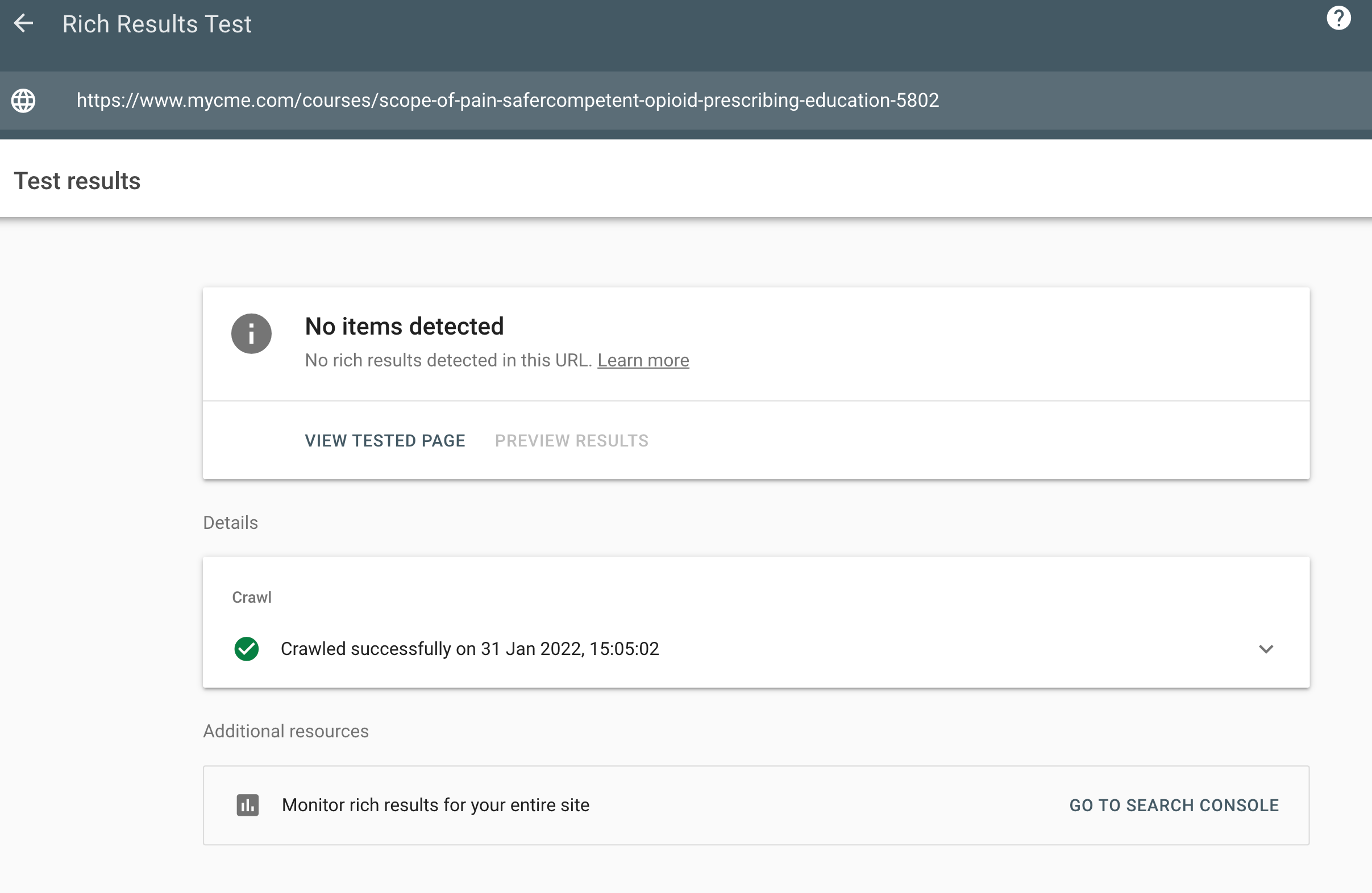
Use Google's Rich Results Test to validate your markup before publishing.
5. Optimize for AI Extraction
AI systems scan content differently from humans. Use short paragraphs (3-4 sentences maximum), bullet points for key features, and numbered lists for step-by-step processes.
Place direct answers to common questions within the first 100 words of relevant sections. This “prime real estate” approach increases your chances of being featured in AI-generated summaries.
Clear headings using H2 and H3 tags help AI systems understand your content structure and extract relevant information for specific queries.
The key is making your expertise easily digestible for both human readers and AI systems.
Actionable Roadmap for Affiliate Marketers: What to Do Now
So, what should you, as an affiliate marketer, do right now to navigate this new terrain?
Let me begin by saying you don’t have to feel pressured by these new changes. This isn’t the end of affiliate marketing – it’s just the beginning of a smarter, more strategic phase.
Here’s a step-by-step action plan to stay competitive, visible, and profitable:
1. Start With a Content Audit
I recommend using a simple spreadsheet to categorize your existing content into three buckets: AI-ready, needs optimization, and complete rewrites. Look for articles that already answer questions comprehensively and those that rely heavily on outdated keyword stuffing.
Your AI-ready content likely includes comparison guides, FAQ-style articles, and in-depth reviews that provide real value. These pieces just need structured data markup to become more discoverable by AI systems.
2. Prioritize E-E-A-T Enhancements
Google's Gemini 2.5 model heavily weighs Experience, Expertise, Authoritativeness, and Trustworthiness signals. Start by adding author bios with real credentials to every piece of content.
Include specific dates when you tested products, photos of yourself using them, and detailed explanations of your selection process. I've seen affiliate sites boost their AI citation rates by 40% simply by adding personal testing timelines and transparent disclosure statements.
3. Implement Strategic Structured Data
Focus on Product, Review, FAQ, and HowTo schema markup first. These are the schemas that Google AI Mode pulls from most frequently for generative AI responses. You can easily use a tool like Rank Math SEO to do this.
Don't try to markup everything at once. Start with your top 20 performing pages and gradually expand. Use Google's Rich Results Test to validate your markup before publishing.
4. Shift to Comprehensive Content Creation
Replace your 800-word “best of” lists with 3,000-word comprehensive guides that address multiple related queries. AI Mode's query fan-out technique means it's looking for content that answers several sub-questions within a single resource.
For example, instead of “Best Running Shoes 2025,” create “Complete Guide to Choosing Running Shoes: Reviews, Fit Analysis, and Performance Testing for Every Runner Type.”
5. Build Your Independent Brand Platform
The harsh truth is that Google traffic might never return to pre-AI Mode levels. Start building direct relationships with your audience now.
Launch an email newsletter focusing on your niche expertise. Create a private Facebook group or Discord community. Offer free resources in exchange for contact information. I personally prioritize building my email list over everything else because it's the one traffic source Google can't take away.
And talking about email lists, you can subscribe to the WebIncomeJournal’s Newsletter + get our exclusive AI Review Playbook by clicking here.
6. Leverage Social and Video Platforms
AI models like Gemini increasingly pull information from social media conversations and video content. Start creating short-form content on TikTok, Instagram Reels, and YouTube Shorts that addresses common questions in your niche.
Video content has a unique advantage – it's harder for AI to fully synthesize, so users are more likely to click through to watch your full reviews and tutorials.
7. Diversify Your Traffic Sources
Allocate at least 30% of your marketing budget to paid channels. Google Ads, Facebook Ads, and native advertising platforms like Outbrain can provide consistent traffic while you rebuild your organic presence.
I've also found success with Pinterest marketing for product-focused affiliate sites, especially in niches like home improvement, fitness, and lifestyle.
8. Strengthen Affiliate Relationships
Reach out to your top-performing affiliate programs and explore opportunities for exclusive deals, early access to products, or enhanced commission structures. Strong partnerships become even more valuable when organic traffic becomes unpredictable.
Consider direct brand partnerships and sponsored content opportunities that don't rely solely on search traffic.
9. Monitor and Adapt Continuously
Set up Google Analytics 4 to track how users interact with your AI-optimized content. Monitor which pages get featured in AI Overviews using tools like SEMrush or Ahrefs.
Most importantly, test different content formats and optimization strategies. The affiliate marketers who succeed in this new era will be those who adapt fastest to changing conditions.
The bottom line: Don't wait for the dust to settle. Start implementing these changes today, because your competitors certainly are.
Pro Tip: Block 2 hours every month to audit, optimize, and adapt. That cadence can be the difference between decline and growth in the AI-driven search future.
Conclusion: Thriving in the AI-Powered Affiliate Landscape
Google AI Mode isn’t just a major algorithm update; it’s a complete shift in how search works, how traffic flows, and how affiliate marketers need to think. From zero-click search to agentic AI workflows, the old strategies that used to bring passive traffic and conversions are losing their grip. But that doesn’t mean the affiliate model is dead. It means it’s evolving.
To thrive, you need to adapt:
- Reoptimize your content for Generative Engine Optimization (GEO)
- Use structured data and create deeply people-first content
- Focus on clarity, credibility, and conversion-ready design
- Build a brand that lives beyond the search bar
Don’t just react, innovate. The affiliate marketers who win in this new AI-first world are the ones who double down on unique value, offer genuine expertise, and embrace platforms and content types that AI respects and recognizes.
But here’s the truth: AI doesn’t replace people, it rewrites the roles. While Gemini 2.5 can summarize, synthesize, and even sell, it still depends on real human insight. That’s your edge. Your lived experience. Your product knowledge. Your ability to connect with your audience in a way no bot ever will.
So be early. Experiment now. Don’t wait for AI to define your strategy, build one it can’t ignore.
Because in this next chapter of affiliate marketing, the most valuable asset isn’t just data or code. It’s you.
Frequently Asked Questions
-
What is the Google AI Mode?
Google AI Mode is a new feature in Google Search that uses generative AI to answer questions directly. It summarizes information from multiple sources and displays the answer in the search results, reducing the need to click on websites.
-
How do I turn on Google AI Mode?
To turn on Google AI Mode, go to Google Search Labs and enable the “AI Overviews” or “Search Generative Experience” option. This feature is currently available in select countries and devices.
-
How to activate Google AI on iPhone?
Open the Google app on your iPhone. Tap your profile icon, go to Settings, then tap Search Labs. From there, enable AI Overviews if available. You may need to update your app or wait for access.
-
Can I use AI for free?
Yes, you can use AI features like Google AI Mode and AI Overviews for free through Google Search. Access may vary depending on your device, region, and account settings.