Affiliate Marketing Mistakes (2025): Why 99% of Beginners Fail and How to Avoid Their Fate


What if I told you that the biggest reason most affiliate marketers fail isn’t competition—it’s their mindset?
Every year, thousands of beginners jump into affiliate marketing with dreams of passive income, freedom, and quick success. But within months, most give up—frustrated, burned out, and convinced that “it doesn’t work anymore.” The truth? Affiliate marketing does work. What doesn’t work are the shortcuts, the copy-paste strategies, and the belief that money will magically appear without treating it like a real business.
Affiliate marketing isn’t a lottery ticket. It’s a system of strategy, trust, and patience. The people who succeed don’t rely on luck—they build processes that compound over time. And the reason 99% fail isn’t market saturation; it’s because they fall into the same predictable traps: chasing commissions, ignoring email lists, skipping SEO, spreading too thin, hiding disclosures, copying content, and quitting too early.
This guide breaks down those seven fatal affiliate marketing mistakes while showing you exactly how to fix them—using strategies built for 2025’s affiliate landscape, where authenticity and long-term value beat hype every single time.
Key Takeaways:
- 99% of affiliate marketers fail not from competition but from repeating the same avoidable mistakes.
- Success in 2025 requires treating affiliate marketing as a long-term business rooted in trust, not a get-rich-quick scheme.
- This article reveals the 7 fatal mistakes beginners make—and the blueprint to become part of the 1% who thrive.
DISCLOSURE: WebIncomeJournal is supported by readers like yourself. We may earn an affiliate commission when you purchase through our links, which enables us to offer our content for free. Learn more here.
What Is the Real Difference Between Failing and Succeeding in 2025?
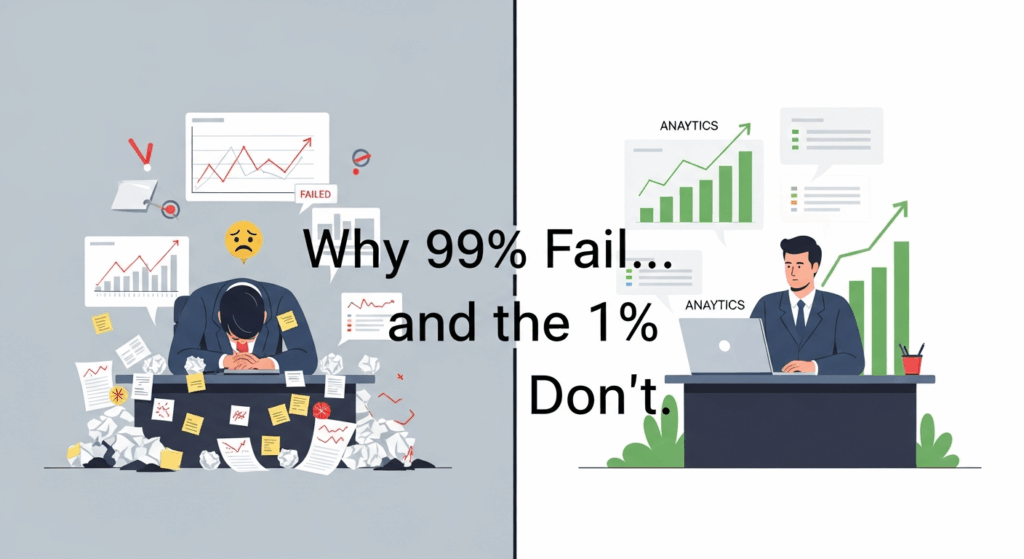
The difference between failure and success in affiliate marketing has never been more defined than it is today. In 2025, the gap isn’t about who works harder – it’s about who builds smarter. Those who fail still see affiliate marketing as a shortcut to income. Those who succeed treat it like building a real business asset.
With Google’s latest Helpful Content Update and the emphasis on E-E-A-T (Experience, Expertise, Authoritativeness, Trustworthiness), the game has changed. You can no longer trick algorithms or flood your site with product reviews written by AI tools and expect sustainable income. Google now rewards real expertise, transparent storytelling, and proof of personal experience. In short, the winners are the ones who sound human, not robotic.
The successful minority understands this. They focus on long-term success – creating a platform that educates, guides, and builds trust. They invest in content depth, authentic recommendations, and user-first SEO practices. Every blog post, email, or review they publish compounds in credibility and traffic over time.
Meanwhile, the failing 99% are still chasing high commissions, hopping from one trending offer to the next, and wondering why their clicks never convert. The truth? Affiliate marketing is no longer about selling – it’s about serving.
If you want to thrive in 2025, stop acting like a salesperson. Start positioning yourself as a trusted guide who solves real problems. The money follows trust – always has, always will.
The 7 Fatal Affiliate Marketing Mistakes That Kill Beginner Success
Here are the affiliate marketing errors that I have found to top the list of those affiliates who disappeared within their first six months—and how to avoid them in 2025.
MISTAKE #1: Prioritizing Commission Over Audience Value (The Trust Killer)
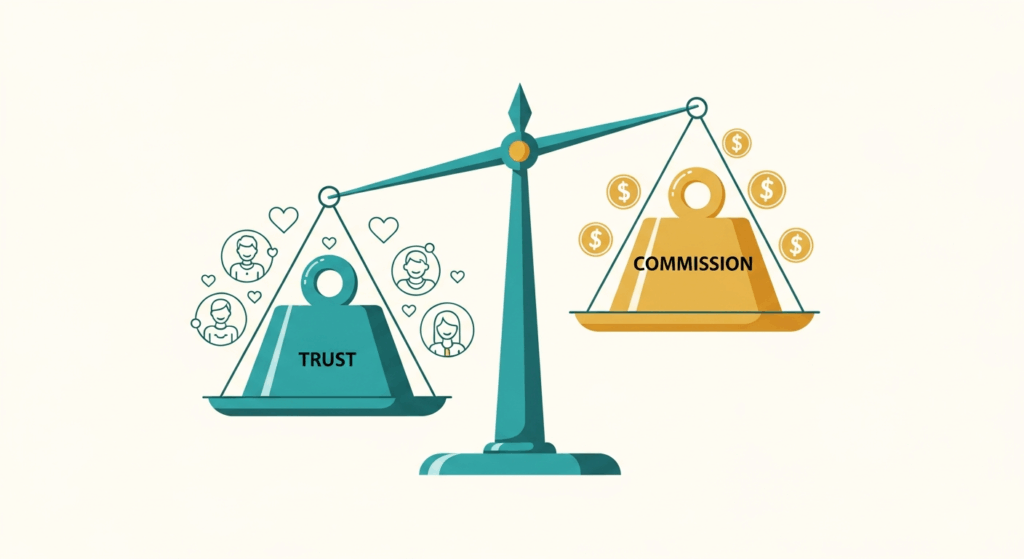
This is the most common and fastest way to destroy your reputation. When your focus shifts to commissions, you start promoting untested, irrelevant, or low-quality products simply because the payout looks attractive. You might make a few quick sales, but you’re also training your audience not to trust you. And once trust is gone, conversions disappear with it.
Your audience isn’t a wallet – they’re people looking for guidance from someone they believe in. Promoting anything you haven’t personally tested or don’t genuinely recommend turns your brand into noise. It’s also a direct hit to your site’s credibility under Google’s Helpful Content System, which penalizes content created for ranking or sales rather than usefulness.
The irony? The more you chase money, the further it runs. In affiliate marketing, your most profitable asset isn’t traffic – it’s trust.
The 2025 Fix: Shift from Salesperson to Subject Matter Expert
To win this year, and going forward, reframe your mindset: you’re not a promoter, you’re a trusted advisor.
Actionable Steps:
- Only promote what you’ve personally used or deeply researched. This is core to the Experience part of E-E-A-T. Share screenshots, results, or anecdotes that show firsthand insight.
- Write balanced, honest reviews. Include both pros and cons. Readers trust transparency far more than hype.
- Lead with solutions, not links. Focus on answering the user’s question or solving their pain point. Once they trust your guidance, the sale happens naturally.
- Study Google’s Helpful Content principles. Align your writing with value, depth, and clarity – not keyword stuffing.
- Want to see authentic affiliate programs worth promoting? Check out this curated list of AI affiliate marketing programs that match quality with real-world value.
Building trust is the only sustainable growth engine in affiliate marketing. When your content serves your audience first, profits follow as a byproduct – not the other way around.
MISTAKE #2: Ignoring the Power of Your Email List (The Asset Mistake)
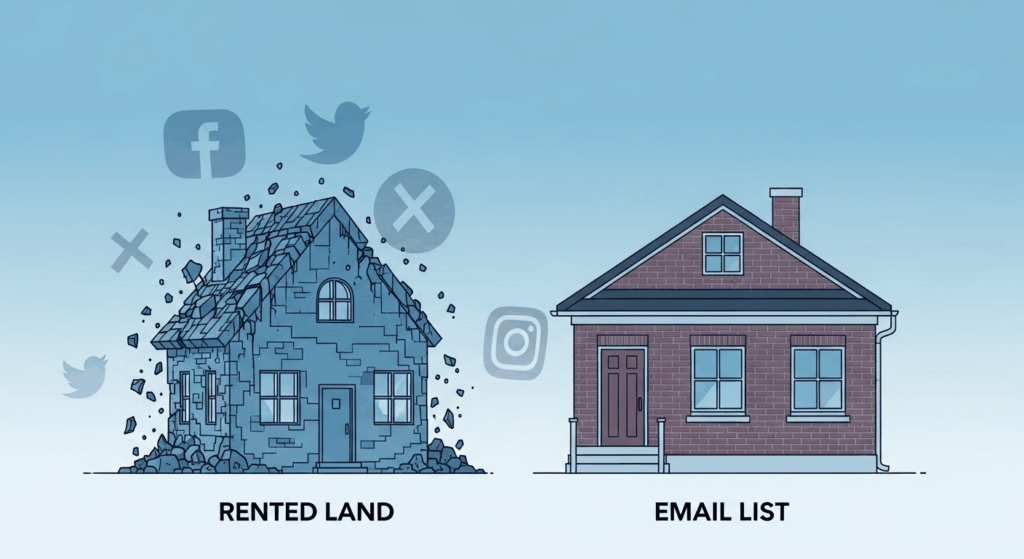
Relying solely on Google, YouTube, or TikTok for traffic is like building your business on rented land. You don’t own the algorithm, and when it shifts – as it inevitably does – your entire income stream can collapse overnight. Many affiliate marketers have woken up to find their site traffic down 80–90% because of an update they didn’t see coming.
Your email list is the only truly owned asset you control. It’s portable, resilient, and immune to algorithm shocks. More importantly, it converts far better than cold traffic. People who join your list have already said, “I trust you enough to stay in touch.” That relationship is gold – and most beginners ignore it.
Think of your email list as your affiliate marketing safety net. It lets you retarget past readers, nurture deeper relationships, and generate sales repeatedly from the same audience. Without it, you’re forced to rebuild your business every time a platform changes the rules.
Successful affiliates in 2025 don’t wait until they “have enough traffic” to start building their list – they start now. Your first ten subscribers are more valuable than ten thousand random clicks.
The 2025 Fix: Build an Owned Audience from Day One
To succeed long-term, you must build an audience you control – not one borrowed from a platform.
Actionable Steps:
- Create a high-value lead magnet immediately. Offer something actionable like a short checklist, niche mini-guide, or “first 5 steps” PDF that solves a specific problem your readers care about.
- Automate a 5-part welcome sequence. Before promoting a single product, send a short series of helpful emails that build trust. Focus on tips, quick wins, or personal insights that demonstrate value before you sell.
- Use a reliable email marketing tool. Platforms like GetResponse or FluentCRM make it simple to design lead capture forms, automation workflows, and analytics – everything you need to manage your list effectively.
- Treat your list like a private community. Engage, ask for feedback, and reward loyalty with exclusive tips or discounts.
Your list is your business’s heartbeat. Every subscriber is a long-term opportunity – one that no algorithm can take away.
MISTAKE #3: Neglecting Modern SEO for Instant Traffic (The Invisible Problem)

Many affiliate beginners believe they can skip SEO because social media seems faster. But ignoring Search Engine Optimization is like publishing a book without a cover or title – no one can find it. Without a strong SEO foundation, your content stays invisible to the exact people searching for what you offer.
Modern SEO is no longer about stuffing keywords or chasing backlinks. It’s about visibility through structure, relevance, and user experience. The creators who thrive in 2025 are those who understand how AI-driven search results (like Google’s AI Overviews) prioritize well-organized, trustworthy content written for humans.
If your site loads slowly, lacks structured headings, or misses on-page signals like schema markup, Google simply skips you. The result? You’re stuck relying on unpredictable social algorithms, while others enjoy consistent organic traffic that grows month after month.
Without SEO, you’re invisible. With it, you become a trusted destination for high-intent users ready to buy.
The 2025 Fix: Structure Content for AI Search Visibility and E-E-A-T
Modern SEO is a blend of technical precision and authentic expertise.
Actionable Steps:
- Target low-competition, long-tail keywords that align with user intent. Instead of “best fitness app,” aim for “best AI fitness app for busy moms.” Tools like Rank Math SEO and SEOPress make keyword optimization simple and structured.
- Optimize your site speed and mobile performance. Use Google’s Core Web Vitals as your benchmark – slow sites lose both rankings and trust.
- Structure your content for AI visibility. Use question-based H2 and H3 headings (“What is…?”, “How to…?”, “Why does…?”) to make your content easily understood by both users and search engines.
- Demonstrate E-E-A-T in every post. Add author bios, cite credible sources, and include firsthand experiences or data points to reinforce expertise.
- Regularly update your content. Fresh, helpful, and well-structured content is what AI-driven search prioritizes in 2025.
SEO is no longer optional – it’s your visibility engine. If you want your affiliate business to be found, trusted, and profitable, modern SEO must be your foundation, not an afterthought.
MISTAKE #4: Promoting Too Many Products (or in Too Many Niches) (The Focus Fail)

One of the fastest ways to stunt your affiliate growth is by trying to promote everything at once. Beginners often jump from dog training to crypto, from software tools to fitness gadgets, hoping something sticks. This “spray and pray” approach not only confuses your audience but also destroys your credibility.
When your website or content lacks a consistent theme, you lose topical authority – the signal Google uses to determine how trustworthy and relevant your content is within a specific niche. If you publish a post about “AI blogging tools” one week and “pet grooming hacks” the next, search engines and readers alike won’t know what you actually stand for.
The result? Your audience sees you as a generalist instead of an expert. Your authority spreads too thin to have any real impact, and your conversion rates plummet. Remember, people follow specialists, not dabblers. A focused niche allows you to go deep, not wide – and that’s where the long-term money is.
Affiliate marketing in 2025 rewards clarity. The smaller your focus, the easier it is to build content clusters, internal links, and consistent brand trust.
The 2025 Fix: The “Deep Focus” Strategy for Niche Authority
Winning in 2025 means going deep into one profitable niche and mastering it completely.
Actionable Steps:
- Choose a niche you’re genuinely passionate about. It’s easier to stay consistent and authentic when you care about the subject.
- Validate your niche’s profitability. Look for consistent search demand, strong affiliate programs, and products with long-term relevance.
- Focus on promoting 3–5 complementary products that solve variations of the same core problem for your audience. This builds authority, improves SEO relevance, and simplifies your content strategy.
- Develop topic clusters. Write multiple pieces of content that interlink around your niche’s main themes. This is how Google recognizes authority.
- Need ideas? Check out these top-performing AI affiliate marketing niches to identify evergreen opportunities that align with your strengths.
Deep focus isn’t about limiting your growth – it’s about compounding it. The more specific your niche, the easier it becomes to dominate it.
MISTAKE #5: Failing to Disclose Affiliate Relationships (The Compliance Pitfall)

Let’s be clear: hiding your affiliate relationships isn’t just unethical – it’s illegal in many regions. Under the FTC guidelines, you are required to disclose any affiliate links or partnerships that could influence your content. Ignoring this rule can result in penalties, account suspension, or permanent bans from affiliate networks like Amazon Associates.
But legality aside, the bigger loss is trust. Your audience is far more perceptive than you think. They know when you’re earning a commission, and pretending otherwise feels deceptive. Once that trust breaks, it’s nearly impossible to rebuild.
Transparency, on the other hand, builds authority. When you’re upfront about your affiliate relationships, readers appreciate your honesty. It turns your affiliate links from something to hide into a symbol of credibility – proof that you stand behind the products you recommend.
In 2025, where authenticity drives conversion, clear disclosure is part of your brand integrity.
The 2025 Fix: Complete, Clear, and Consistent Transparency
Don’t wait for regulators or networks to enforce compliance – make it your standard practice.
Actionable Steps:
- Add a clear disclosure at the top of every affiliate post just like the one on this post. A simple line like: “This post contains affiliate links. If you purchase through them, I may earn a small commission at no extra cost to you” is enough to do the trick.
- Disclose across all platforms – blog posts, YouTube descriptions, email newsletters, and social media captions. Consistency matters.
- Use compliant link cloaking to make your URLs neat (e.g., yourdomain.com/go/productname), but ensure your disclosure remains visible and easy to understand.
- Review program terms regularly. Each affiliate network has its own rules, and violating them can lead to lost commissions or bans.
- Model ethical marketing. Your openness will make readers more likely to click because they trust your recommendation.
Compliance isn’t a burden – it’s a long-term trust builder. In a world full of fake endorsements and hidden agendas, being transparent is your most underrated competitive advantage.
MISTAKE #6: Writing Product Descriptions Instead of Personal Case Studies (The Low-Effort Trap)

Here’s the harsh reality: 99% of affiliate marketers copy-paste product descriptions from the merchant’s website, maybe tweak a few words, and hit publish. That worked a decade ago – not anymore. Google’s 2025 Helpful Content and E-E-A-T updates are designed to detect and demote that kind of low-value content instantly.
The problem isn’t that you’re reviewing products. It’s that you’re doing it like everyone else. Search engines and readers are no longer fooled by repetitive content that offers no real-world insight. They want proof of experience – your story, your results, your unique perspective.
The top 1% of affiliates know this. Instead of writing “What it does,” they write “Here’s what happened when I used it.” They document their setup process, learning curve, results, and even mistakes. That’s what turns a generic review into a high-performing, trust-driven case study.
Google now prioritizes content that demonstrates personal experience – reviews written by real people using real tools. Your audience wants to know: Does it actually work? How does it compare to alternatives? Is it worth the money? Those are questions only firsthand experience can answer.
If your content sounds like a sales brochure, you’ll stay invisible. But if you can show proof of value, you’ll rise above the noise.
The 2025 Fix: Document Your Experience for Proof of Value
You don’t need to be a professional reviewer – you just need to be real.
Actionable Steps:
- Document your process. Take screenshots, photos, or short clips of you actually using the product. You can see this in all my reviews on this site. This gives visual authenticity that AI-generated text can’t replicate.
- Share measurable results. Include metrics (conversion rate increases, time saved, income boost, engagement lift). Specific numbers make your claims credible. See an example here.
- Write case study–style reviews. Replace “features” with “field results.” Frame your post as How I used [Product] to achieve [Outcome].
- Be transparent about limitations. Showing where the product falls short makes your content trustworthy.
- Learn to position your experience strategically. Read this guide on strategic affiliate marketing secrets to understand how to turn authentic stories into high-converting content.
Your personal experience is your edge. In 2025, showing proof will outrank even the most keyword-optimized post.
MISTAKE #7: Quitting Before the Compound Effect Kicks In (The Impatience Mindset)
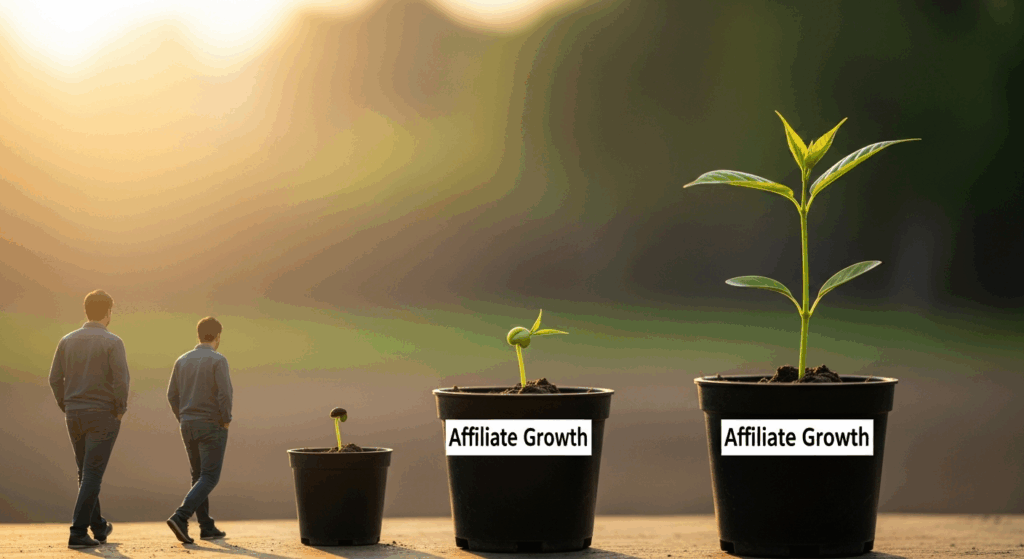
Most beginners underestimate how long affiliate marketing really takes. They treat it like a quick side hustle but expect full-time income in a few months. When that doesn’t happen, they quit – usually right before the compound effect begins to show results.
Affiliate marketing isn’t a lottery; it’s a system of compounding effort. Every blog post, backlink, email subscriber, and social mention adds to your long-term momentum. The results are invisible at first, but once authority, rankings, and trust begin to accumulate, growth accelerates exponentially.
The ones who fail give up after 3–6 months. The ones who succeed commit for 12–18 months before judging their progress. They understand that consistent, strategic effort compounds quietly in the background – and that’s when the magic happens.
If you’ve been at it for a few months and feel stuck, that’s actually a sign you’re right on schedule. The early stages are about laying foundations: content consistency, SEO trust, and brand visibility. The payoff comes later – but it only comes to those who persist.
The 2025 Fix: The 12-Month Content and Commitment Blueprint
Affiliate success follows the same pattern as investing – slow, steady, and cumulative.
Actionable Steps:
- Set SMART goals. Define targets that are Specific, Measurable, Achievable, Relevant, and Time-bound. For example: “Publish 50 SEO-optimized articles and reach 5,000 monthly visitors within 12 months.”
- Commit to one high-quality post per week. It’s better to publish 52 deep, evergreen articles in a year than 200 rushed ones.
- Track leading indicators. Instead of obsessing over commissions, monitor traffic growth, email opt-ins, and engagement metrics, they predict future earnings.
- Review and refine quarterly. Adjust based on data, not frustration. Success builds in small increments before showing large jumps.
- Stay consistent through the quiet phase. The first 6–9 months are the setup period. The final quarter is often where exponential growth begins.
Affiliate marketing isn’t about speed – it’s about staying in the game long enough for your results to compound. The moment you commit to that mindset, you’ve already joined the 1% who actually make it.
How to Go from the 99% to the Top 1% of Affiliate Marketers

The difference between the 99% who struggle and the 1% who thrive isn’t a secret formula – it’s mindset. The top performers treat affiliate marketing as a real business, not a side hustle or an experiment. They don’t chase the next trend or copy what others are doing; they focus on mastering fundamentals that compound over time.
Every success story in affiliate marketing shares the same DNA: clarity, ownership, and value. The 1% build deep authority in one niche, create an owned audience they can reach anytime, and become trusted problem-solvers rather than link droppers. They understand that affiliate marketing is a relationship-driven ecosystem – not just a numbers game.
If you want to join that 1%, the roadmap is simple but non-negotiable: focus, build, and serve.
Your 3-Step Success Checklist for Long-Term Affiliate Income
- Commit to a Niche: Go deep, not wide. Build expertise in one niche that aligns with your genuine interests. Your authority compounds when every piece of content reinforces your E-E-A-T (Experience, Expertise, Authoritativeness, Trustworthiness).
- Build Your Asset: Start capturing emails from day one. Social traffic fades, algorithms shift, but your list remains. An email subscriber is a long-term relationship – your most valuable asset for consistent revenue.
- Prioritize Value Over Sales: Your job is to solve problems, not push products. When your content genuinely helps, conversions happen naturally. Value builds trust; trust builds income.
The path to the top isn’t hidden – it’s paved with discipline, patience, and service.
Conclusion: The 2025 Action Plan
Success in affiliate marketing this year doesn’t require magic tactics. It requires mastery of the basics and relentless consistency. Build a brand people trust. Create content that informs, not manipulates. Serve your audience better than anyone else, and your growth will compound faster than any algorithm can keep up.
Start today by auditing your current efforts against the seven mistakes covered above. Identify where you’re losing trust, focus, or ownership – and fix those areas one by one. Affiliate marketing rewards patience, and 2025 is still full of opportunities for those who build intentionally.
Your next step is simple: implement one fix this week. Whether it’s starting your email list, narrowing your niche, or rewriting one post to show real experience – action compounds faster than ideas.
Frequently Asked Questions (FAQ)
1. What are the biggest pitfalls when starting with paid traffic?
Many beginners rush into paid ads without testing offers organically first. The main mistake is sending cold traffic to affiliate links instead of optimized landing pages or email opt-ins. Paid traffic should amplify proven systems, not replace organic learning.
2. How long does it realistically take to make money in affiliate marketing?
Expect a foundation phase of 6–12 months before consistent income. Affiliate success follows the compound effect – slow growth at first, then exponential once authority and trust take hold.
3. Should I focus on a low-ticket or high-ticket affiliate program?
It depends on your audience and niche maturity. Beginners often perform better with low to mid-ticket offers to build conversions and data. Once authority is established, adding high-ticket offers creates scalable income without sacrificing trust.