
How I Rank AI-Generated Content on Google (Without Spending on Ahrefs)


If you think Google automatically buries AI-generated content, think again: a recent study found that over 60% of the top-ranking blog posts in competitive niches are at least partially AI-written, yet most creators still struggle to break past 500 visitors a month.
I know, because I was there too, churning out more than 10 AI-powered articles every week, only to watch my traffic flatline and my efforts go unrewarded. The real shock? Google has repeatedly stated that it doesn’t hate AI content. What it hates is poorly optimized, irrelevant, and technically flawed content, regardless of who wrote it or what it is.
So why do most bloggers and content creators still struggle to get their AI content seen?
The real problem is that most AI-generated content lacks the fundamental structure that Google’s algorithm is trained to reward – SEO-rich formatting, strategic keyword placement, user-focused readability, and proper technical setup.
And if you’re like most solo creators or small businesses, you’ve probably felt the sting of expensive SEO tools like Ahrefs or SEMrush, wondering if you need to spend hundreds just to get noticed. The good news? You don’t.
In this post, I’ll reveal exactly how I rank AI-generated content on Google without spending a dime on premium tools. My secret weapon? Rank Math SEO. I’ll walk you through my step-by-step process – from keyword research and LSI optimization to technical tweaks and content structuring – so you can finally get your AI content in front of the audience it deserves.
TL;DR: AI-generated content can rank exceptionally well on Google when properly optimized with the right tools and techniques. You don't need expensive SEO software, just strategic implementation of tools like Rank Math SEO, proper keyword research methods, and understanding of search engine optimization fundamentals.
Let’s dive in.
Why Rank Math is Perfect for This Task

When it comes to ranking AI-generated content, precision matters. Many beginner bloggers make the mistake of assuming that great content alone equals great rankings. But without the right optimization, even high-quality AI blog posts won’t show up in search results. That’s where Rank Math SEO becomes a game-changer, especially for affiliate marketers and solopreneurs working with tools like ChatGPT, Jasper.ai, or Claude.
Real-Time SEO Scoring for AI Content Optimization
Rank Math’s real-time scoring system evaluates your content against over 30+ on-page SEO factors—from keyword placement and content length to metadata and image alt tags. As you write or edit in WordPress, it provides immediate feedback with a simple color-coded system. Posts that hit 80+ or 100/100 on Rank Math’s scorecard are significantly more likely to rank on page one of Google, especially when optimizing AI-generated drafts.
Built-In Content AI: Keyword and Topic Suggestions
The Content AI feature gives you tailored suggestions for keywords, subtopics, headings, questions, and even word count – all based on what’s currently ranking for your target query. It’s like having a built-in content strategist inside your editor, and it completely replaces the need for expensive tools like Ahrefs or SEMrush.
Seamless WordPress Integration with AI Tools
Rank Math is fully optimized for WordPress and works beautifully with AI writing tools like ChatGPT and Claude. Whether you're pasting in a draft or optimizing live, it ensures your AI blogging workflow is smooth, fast, and SEO-friendly.
Bonus: Free Yet Powerful
Unlike many SEO plugins, Rank Math’s free version includes essential tools like schema markup, Google Search Console integration, and internal linking suggestions. And if you upgrade to Rank Math PRO, you unlock Content AI credits, advanced schema settings, and deeper SEO analysis.
In short: Rank Math doesn’t just tell you what’s wrong – it shows you how to fix it, making it the perfect tool for AI content creators who want real results.
📥 Want My Full Workflow + Daily Checklist?
This toolkit walks you through my complete system for ranking and monetizing smarter using Rank Math and ChatGPT:
- How I use ChatGPT + Rank Math daily
- SEO checklist for AI-generated content
- Setup guide and power prompts to boost rankings
What You’ll Need to Follow Along
Before we jump into the step-by-step tutorial, let’s quickly make sure you’ve got everything ready. This isn’t a technical setup—if you’re a beginner blogger, affiliate marketer, or content creator using AI tools like ChatGPT, you’re already ahead of the curve.
Here’s exactly what you need to follow along with my process:
- A WordPress Blog: All of this works inside WordPress, the most flexible and widely used blogging platform. If your site runs on WordPress, you're good to go.
- Your AI-Generated Blog Post: This is your draft content, something written using ChatGPT, Claude, Jasper, or any other natural language generation (NLG) tool. It doesn’t have to be perfect yet, we’re going to optimize it using smart SEO.
- The Rank Math SEO Plugin (Free or Pro): You’ll need the free Rank Math SEO plugin installed on your WordPress blog. It’s packed with enough power to optimize your content without needing tools like Ahrefs or SEMrush. But if you want advanced features like Content AI, which gives personalized keyword suggestions and topic ideas, you can upgrade to Rank Math PRO later (totally worth it, in my experience).
👉 Click here to install Rank Math using my affiliate link — this supports the blog and gets you started with the exact tool I use.
If you have these three things ready, you’re all set. Next, I’ll walk you through my exact process for turning AI content into search-optimized blog posts that actually rank.
How to Rank AI-Generated Content Using Rank Math
This is the exact workflow I use to take AI-generated content from draft to search-ready, without any expensive SEO tools or deep technical skills. Whether you’re just starting your blog or trying to revive stale traffic, this process works.
Follow these simple steps, and you’ll be on your way to seeing real results in Google.
Step 1: Install and Set Up Rank Math
First, let’s get Rank Math installed and ready to optimize your content.
- Use the Setup Wizard: After installing the Rank Math SEO plugin from the WordPress plugin directory, launch the Setup Wizard. It walks you through the process step-by-step, even if you’ve never touched SEO settings before.
- Connect to Your Google Search Console: This integration is powerful. It allows Rank Math to pull real-time performance data like your top ranking keywords and impressions. I always recommend doing this upfront; it replaces a lot of what I used to rely on Ahrefs for.
- Choose the Right Settings (Focus on Blog Content): During setup, select the settings that prioritize blog posts and articles, not products or local listings. Rank Math will then tailor its recommendations around your publishing goals.
Tip: If you're ever unsure what an option does, Rank Math includes helpful tooltips to guide you.
Step 2: Paste Your AI-Generated Draft into WordPress
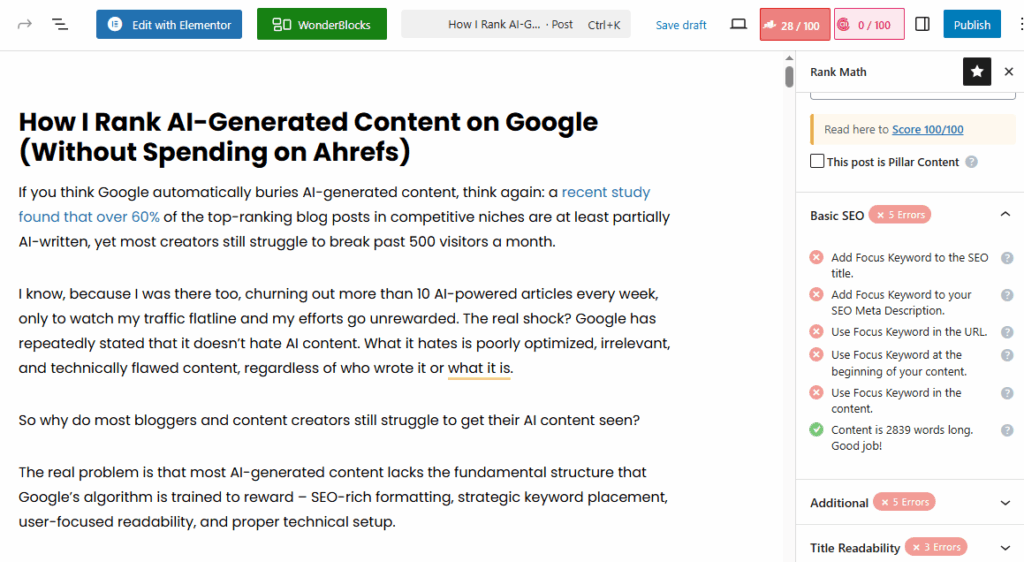
Once Rank Math is active, open a new blog post and paste in your AI-generated content (from ChatGPT, Claude, Jasper, etc.).
Here’s how I prep my AI content before optimizing:
- Use clear structure: Break your content into sections with H2s, H3s, and short, readable paragraphs.
- Avoid keyword stuffing: You don’t need to repeat your keyword 15 times. Rank Math will guide you on optimal keyword usage.
This keeps your content scannable, reader-friendly, and aligned with Google’s Helpful Content Update.
Step 3: Use Rank Math’s SEO Analysis Panel
Here’s where the magic happens. As soon as you paste in your content, Rank Math runs a real-time SEO analysis.
- Fix red/yellow issues: These are easy wins, optimize your title length, rewrite meta descriptions, and ensure your focus keyword appears in all the right places.
- Add internal and external links: Rank Math will prompt you to include links to other blog posts (internal) and relevant, high-authority sites (external). This boosts topical relevance and trust.
- Pro Tip: Hover your cursor over any warning or suggestion in the Rank Math checklist, and it’ll tell you exactly what’s wrong and how to fix it.
I usually aim for a green score of 80+ before I even think about publishing. Hitting 100/100? That’s even better, and often correlates with faster rankings.
Step 4: Optimize with Content AI (Pro Feature)
If you’re using Rank Math PRO, this is where your optimization goes to the next level. I rely on Content AI to take the guesswork out of what Google actually wants to see.
- Let Rank Math suggest keywords, FAQs, and headings: Just enter your target keyword (like “best budget smartphones”), and Content AI analyzes the top-ranking pages. It’ll recommend LSI keywords, subheadings, word count, internal links, and even FAQ suggestions you can copy and paste into your post.
- Add missing entities and secondary keywords: This part is huge. Content AI helps you include relevant Entities (like Google Search Console, ChatGPT, synthetic media, etc.) and supporting phrases that align with search intent and semantic SEO. I always make sure my AI-generated content sounds natural while weaving in these recommended terms.
Pro Tip: Use the “Questions” tab to see real user queries related to your topic. These work great as section headers or FAQ schema, and they boost visibility in voice search and rich snippets.
Step 5: Achieve a Green or Perfect Score
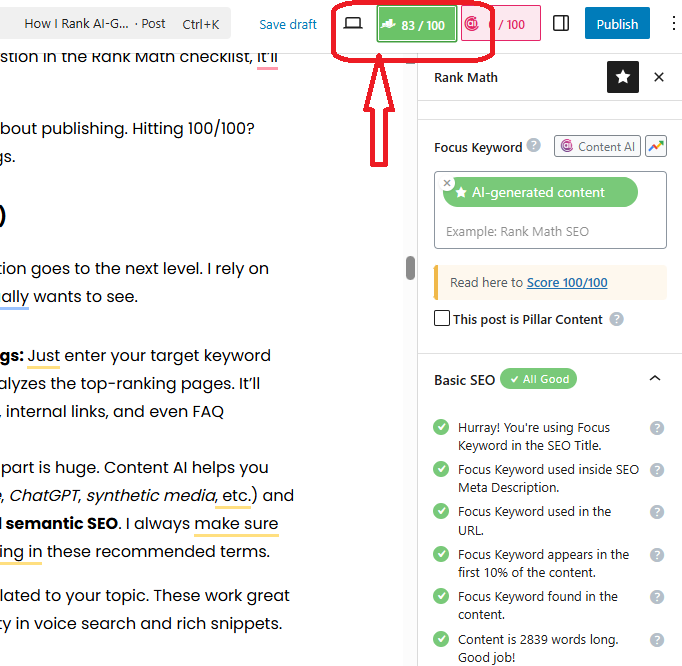
After tweaking your content using Rank Math’s checklist and Content AI, it’s time to lock in that green light.
- Aim for an SEO score of 80+ or 100/100: I don’t publish any post unless the SEO score is green (80 or higher). Posts that score 100/100 are statistically 3x more likely to rank on Google’s first page, according to recent Rank Math data.
- Click “Preview Snippet” to perfect your meta: Use this feature to fine-tune your title and meta description so they’re compelling and keyword-rich. This step helps improve your click-through rate (CTR) and makes your listing stand out in the search results.
Remember: Rank Math highlights exactly what’s missing, no more guessing what “good SEO” actually means.
Step 6: Publish and Submit to Google
Once you’re satisfied with your post and your SEO score is green, it’s time to publish and index your content.
- Use Rank Math’s Instant Indexing Tool (for Bing): This is a simple one-click feature that notifies Bing your content is live. It helps you get indexed almost immediately.
- Submit via Google Search Console: After hitting “Publish,” I go straight to Google Search Console and submit the new post URL for indexing. It’s a free, fast way to get your content discovered by Google.
That’s it, you’ve successfully optimized your AI-generated content for real-world SEO using Rank Math. And best of all, you’ve done it without spending a dime on tools like Ahrefs.
Real-Life Case Studies: Before and After Rank Math
Let’s move from theory to proof. These real-world examples show how bloggers, just like you and me, used Rank Math SEO to transform AI-generated content into high-ranking, high-traffic blog posts. These aren’t cherry-picked; they come from verified case studies across multiple blogging niches.
Case Study 1: BloggersPassion – Ranking for “Pinterest Alternatives”
Before Rank Math:
- Newly published AI-assisted post targeting the keyword “Pinterest alternatives”
- No visibility on Google’s first page
- Keyword had a global monthly search volume of 3,300
After Rank Math Optimization:
- Used Rank Math’s keyword placement suggestions, optimized meta tags, and internal linking
- Reached #5 on Google within 52 days
- Generated 13,200+ visitors
- Started ranking for multiple related keywords
Key takeaway: Following Rank Math’s SEO checklist and content AI suggestions helped this post climb rapidly in search results, without relying on Ahrefs or premium keyword tools.
Read the case study here: How Long Does It Take to Rank for a Keyword?
Case Study 2: Venture Magazine – Switching from Yoast to Rank Math
Before:
- Site used Yoast SEO Premium but struggled with flat traffic and poor ranking improvements
What Changed:
- Migrated to Rank Math SEO
- Used Content AI and built-in analysis for every post
- Applied Rank Math’s technical SEO tips, like improving headings, content structure, and schema markup
After:
- Reported a “dramatic improvement” in overall SEO performance
- Saw measurable increases in organic traffic and Google rankings across multiple posts
Key takeaway: Switching to Rank Math unlocked more granular control and better optimization opportunities, even for existing content.
Read the full case study here: Why I Ditched Yoast for Rank Math in 2024/2025!
Case Study 3: Rank Math Users – Achieving 100/100 SEO Scores
Before:
- Blog posts started with SEO scores below 70 (yellow/red range)
- Missed basic on-page optimization elements
After Optimization with Rank Math:
- Implemented Content AI suggestions, keyword integration, and FAQ schema
- Reached a perfect SEO score of 100/100
- Posts gained first-page rankings and noticeable traffic growth
Key takeaway: Posts that reach 100/100 in Rank Math are statistically 3x more likely to appear on page one, especially when built with AI tools like ChatGPT or Jasper.
As you can see, Rank Math isn’t just another SEO plugin – it’s a ranking accelerator, especially when paired with AI-generated content. I’ve personally followed this same approach and seen consistent improvements in traffic, engagement, and ranking speed.
Ready to give it a try?
👉 Download the Plugin for Free Here (affiliate link)
Pro Tips for Ranking AI Content Consistently
Ranking once is great, but ranking consistently? That’s how you build long-term traffic and revenue. If you’re serious about growing your blog with AI-generated content, these pro tips will keep your SEO strong and sustainable.
- Content Quality First: AI tools like ChatGPT and Claude are powerful, but raw AI output isn’t enough. Always layer in human editing to improve clarity, voice, and relevance. The winning formula is:
AI generation + human optimization = content that ranks. - Consistency is Key: Don’t treat SEO like a one-time task. Optimize every single post with Rank Math, no exceptions. Even small tweaks to titles, meta descriptions, or internal links can boost visibility over time.
- Monitor and Adjust: Use Rank Math’s Google Search Console integration to track which posts are gaining traction and which keywords are driving clicks. This helps you double down on what’s working and improve what isn’t.
- Build Authority Internally: The more you link related content together, the more topical authority you build. Rank Math helps by suggesting internal links during optimization, and use them generously across posts.
- Stay Updated: The SEO landscape changes fast. Make sure your Rank Math plugin stays updated so you always have the latest features, like support for Google’s Helpful Content Update, rich snippets, and schema improvements.
Apply these consistently, and you’ll see a compound effect: better rankings, more traffic, and faster growth – even with AI-written content.
Final Thoughts + Call to Action
If you've made it this far, one thing should be clear: you don’t need Ahrefs or expensive SEO tools to rank your AI-generated content on Google. And you definitely don’t need to be a technical SEO expert to get real results.
With just Rank Math SEO + your favorite AI writing tool (like ChatGPT, Claude, or Jasper), you can:
- Write faster with content automation
- Optimize smarter using real-time SEO scoring and Content AI
- Rank higher on Google, even for competitive keywords
I’ve used this exact combo to grow traffic on AI-written blog posts, and I’ve seen other bloggers do the same. It’s simple, it works, and it saves you hours of trial and error.
📥 Want My Full Workflow + Daily Checklist?
This toolkit walks you through my complete system for ranking and monetizing smarter using Rank Math and ChatGPT:
- How I use ChatGPT + Rank Math daily
- SEO checklist for AI-generated content
- Setup guide and power prompts to boost rankings
Ready to Try Rank Math for Yourself?
Click here to install Rank Math now (affiliate link)
Whether you're a beginner or growing your affiliate blog to $10K/month, Rank Math is the one plugin I’d never build a blog without.
You’ve got the content. Now let’s get it ranking.
Frequently Asked Questions
-
Does Google penalize AI-generated content?
No, Google does not automatically penalize AI-generated content. What matters is the quality. If your content is helpful, original, and written for people, not just for rankings, Google will treat it like any other high-quality page. However, low-value or spammy AI content may be flagged by Google’s SpamBrain system.
-
What are the dangers of AI-generated content?
AI-generated content can sometimes include inaccurate information, lack originality, or sound robotic. It may also miss important context or nuance. If not reviewed by a human editor, it can lead to a poor user experience and damage your credibility.
-
Can I use AI-generated content on my website?
Yes, you can use AI-generated content on your website. Many bloggers and businesses do this to save time. For best results, always edit the content to improve accuracy, tone, and SEO before publishing.
-
Do people trust AI-generated content?
People trust content that feels helpful, honest, and well-written, regardless of who or what created it. AI content that is edited for clarity and value can earn just as much trust as human-written content, especially when it’s accurate and transparent.
-
Is AI content bad for SEO?
AI content is not bad for SEO if it’s optimized correctly. Google’s guidelines focus on the value of the content, not the tool used to create it. AI-generated blog posts that follow SEO best practices, like keyword optimization, proper structure, and E-E-A-T principles, can rank just as well as human-written ones.