
Are your SEO strategies stuck in the Google 2015 playbook?
Well, you're already centuries behind your competition because in 2025, AI-driven search engines have flipped the script. Instead of just matching keywords and spitting out a list of links, these search engines use advanced AI – think large language models (LLMs) and machine learning – to analyze your intent, understand the context, and deliver direct, conversational answers.
As someone who has been in this SEO copywriting game for over ten years and has witnessed hundreds of algorithm updates, I can say categorically that this is beyond an algorithm update. This is a seismic shift. And, it's already impacting how users discover brands, content, and offers online.
As you do know, Google announced its AI-powered search, Google SGE, back in 2023. Later, this was released as AI Overviews in 2024, and in May of this year, it announced AI Mode, which is to be an expansion of AI Overviews. This is a clear indication that like the other AI search engines – ChatGPT, Perplexity, Bing Copilot, and emerging platforms like You.com and Brave Search – Google is fully set to jettison the traditional blue links for AI-generated answers.
So, what does this mean for you as a content publisher?
It means one thing: in 2025 and beyond if your content isn’t AI-ready, you’ll be invisible!
But that doesn’t mean you’ll need to throw out everything you know about search engine optimization. Yes, you've heard many “gurus” say SEO is dead, but I believe that you only need to adapt your approach and use the right tools to bridge the gap between traditional SEO and AI search optimization (AI SEO).
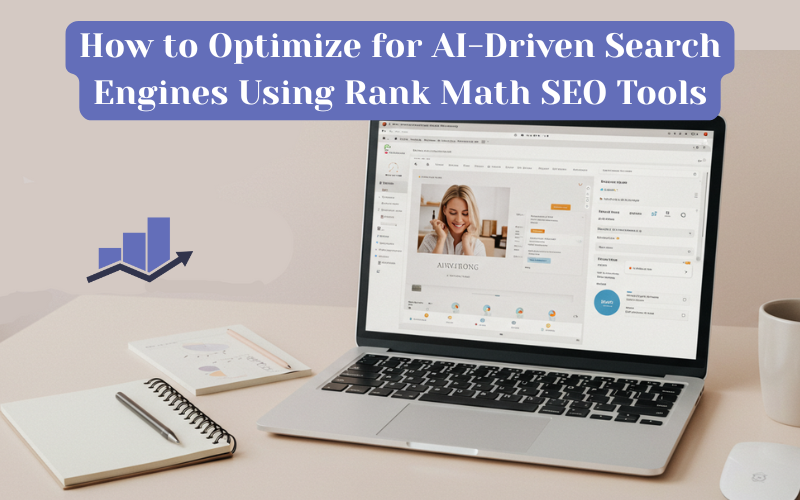
In this guide, you'll learn exactly how you can adapt your SEO strategy using Rank Math SEO tools so you don't get left behind.
TL;DR: AI-driven search engines like Google SGE and ChatGPT Search now dominate how users find information, generating direct answers for most queries instead of traditional link lists. This comprehensive guide shows you exactly how to use Rank Math's AI-powered features to optimize your WordPress content for semantic search, structured data, and conversational AI responses, helping you maintain visibility in this new search landscape.
Let’s jump in.
DISCLOSURE: WebIncomeJournal is supported by readers like yourself. We may earn an affiliate commission when you purchase through our links, which enables us to offer our content for free. Learn more here.
AI-Driven Search Engines and Their Impact on SEO
Let’s begin by first understanding what these search engines are and how they operate, and their impact on SEO generally.
What Are AI-Driven Search Engines?
AI-driven search engines are search platforms that use artificial intelligence, especially natural language processing and machine learning, to understand user intent and deliver highly relevant, conversational results. Unlike traditional search engines that rely on keyword matching, AI-driven engines interpret context and semantic meaning to generate direct answers, summarize information from multiple sources, and personalize the search experience.
Major players include:
- ChatGPT Search (OpenAI)
- Google AI Overview (formerly SGE)
- Perplexity AI
- Bing AI (Microsoft Copilot)
Adoption is skyrocketing: Google’s SGE now answers nearly 87% of queries directly, and ChatGPT hit 300 million weekly active users by late 2024.
How AI Search Engines Process and Rank Content
AI search engines rely heavily on Natural Language Processing and semantic search to understand content meaning beyond individual keywords. They analyze the relationships between concepts, entities, and topics to determine relevance and authority. They prioritize:
- Context and intent recognition over exact keywords
- Authority and credibility signals, like backlinks and domain trust
- Structured data and schema markup to quickly grasp your content’s subject
In practice, this means content must be written for information retrieval and search query understanding, with clear signposts that AI can follow.
Key Ranking Factors for AI Search Optimization
As I have mentioned above, AI-powered search engines rank content differently than traditional search engines. Here are some of the things they consider:
- Content relevance and topical authority: Your content must demonstrate comprehensive expertise on a subject, not just surface-level coverage. Building content clusters around related topics signals to AI that you're a legitimate authority.
- Structured content hierarchy: Use clear H1–H6 headings, bullet points, and numbered lists for clarity. This helps AI systems parse and understand your information quickly.
- Entity recognition and relationships: Explicitly name “Google,” “OpenAI,” or “Perplexity AI” where relevant. These engines identify people, places, organizations, and concepts mentioned in your content, then evaluate how these entities relate to each other and to the search query.
- User experience signals and engagement metrics: Factors like page load speed, mobile responsiveness, time on page, and user satisfaction signals help determine whether your content deserves prominent placement in AI-generated responses.
By embracing semantic search, AI in SEO, and advanced search technology principles, you align your site with how AI-powered platforms evaluate and present content, so you stay visible as the search landscape evolves.
Essential AI Search Optimization (AI SEO) Strategies
Content Structure and Formatting for AI Visibility
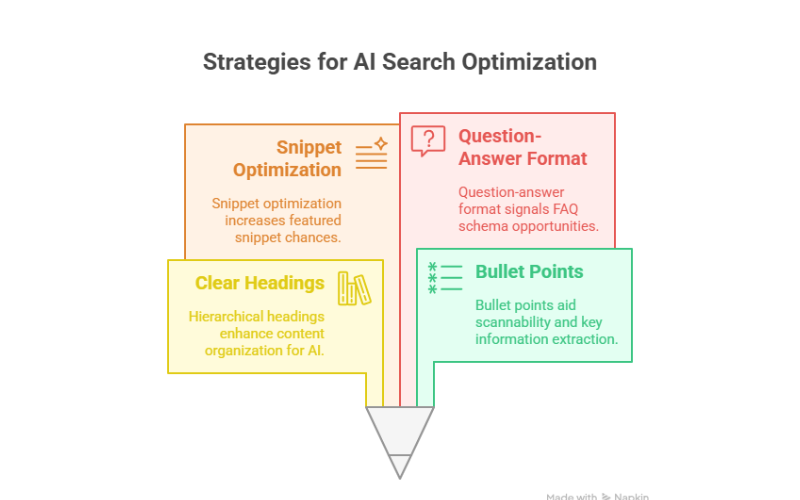
AI-driven search engines favor well-organized content. To boost scannability and snippet potential use:
- Clear hierarchical headings (H1–H6): Your heading structure should follow a clear hierarchy, H1 for your main topic, H2 for major sections, and H3-H6 for subsections. This logical flow helps AI systems understand your content's organization and extract relevant information for search responses.
- Bullet points and numbered lists: These aren't just reader-friendly, they're AI-friendly. These formats make your content scannable and help AI engines quickly identify key information to include in conversational answers.
- Featured snippet optimization: Structure your content to answer specific questions within the first 40-60 words of a section. Start with the direct answer, then provide supporting details. This approach increases your chances of being featured in both traditional snippets and AI-generated responses.
- Question‑and‑answer format: Pose common queries (e.g., “What is semantic search?”) and answer immediately. This signals FAQ schema opportunities.
Semantic SEO and Entity Optimization
AI search engines rely on entity recognition; they see concepts as nodes in a knowledge graph, not just words. To align your content:
- Understand entity‑based search: Treat “Google Gemini,” “ChatGPT Search,” and “Perplexity AI” as distinct entities. Link them contextually.
- Build topic clusters: Build pillar pages covering broad topics, then create supporting content that explores specific aspects. For example, if you create a pillar page on AI-driven search engines, you should support it with in‑depth cluster posts (e.g., “How NLP Works in AI SEO”). Link these pieces together to demonstrate expertise and depth of knowledge.
- Use related keywords and LSI terms: Don't just sprinkle synonyms throughout your content; build genuine connections between related ideas. For example, for a post covering AI-powered search engines, you should naturally include phrases like “semantic search,” “user intent analysis,” and “contextual search.” This demonstrates your understanding of the subject matter.
- Establish topical authority: Go beyond surface-level with your content. AI search engines favor content that explores topics comprehensively, addresses related questions, and provides unique insights that users can't find elsewhere.
Technical SEO Requirements for AI Search
Behind the scenes, technical health matters greatly when it comes to AI search engines. AI crawlers need efficient signals:
- Schema markup implementation: This structured data helps AI systems understand your content's context, purpose, and relationships. Use Rank Math to add Article, FAQ, and HowTo schemas. This helps AI overviews surface rich results.
- Core Web Vitals optimization: AI systems consider user experience signals when determining content quality. Ensure your pages load quickly, remain stable during loading, and respond promptly to user interactions.
- Mobile‑first indexing: Ensure responsive design and touch‑friendly elements so AI sees your content as accessible.
- Site architecture for AI crawling: Organize silos logically, use breadcrumb schema, and maintain a clean XML sitemap. AI systems need to understand how your content relates to other pages on your site to build comprehensive topic coverage.
Foundational AI SEO: Setting Up Rank Math for Success
Activating Essential Rank Math Modules for AI Optimization
Getting Rank Math ready for AI-driven search engines starts with enabling the right modules. The two most critical modules for AI search optimization are Schema (Structured Data) and Content AI. After you’ve installed and activated the Rank Math plugin in your WordPress dashboard:
- Go to Rank Math » Dashboard.
- Toggle on the Schema (Structured Data) module.
- Enable the Content AI module.
Once activated, you’ll see new menu items under Rank Math » Schema and Rank Math » Content AI.
- Schema module lets you choose from over 20 schema types (Article, FAQ, HowTo, etc.).
- Content AI gives real-time suggestions on related keywords, headings, and content depth.
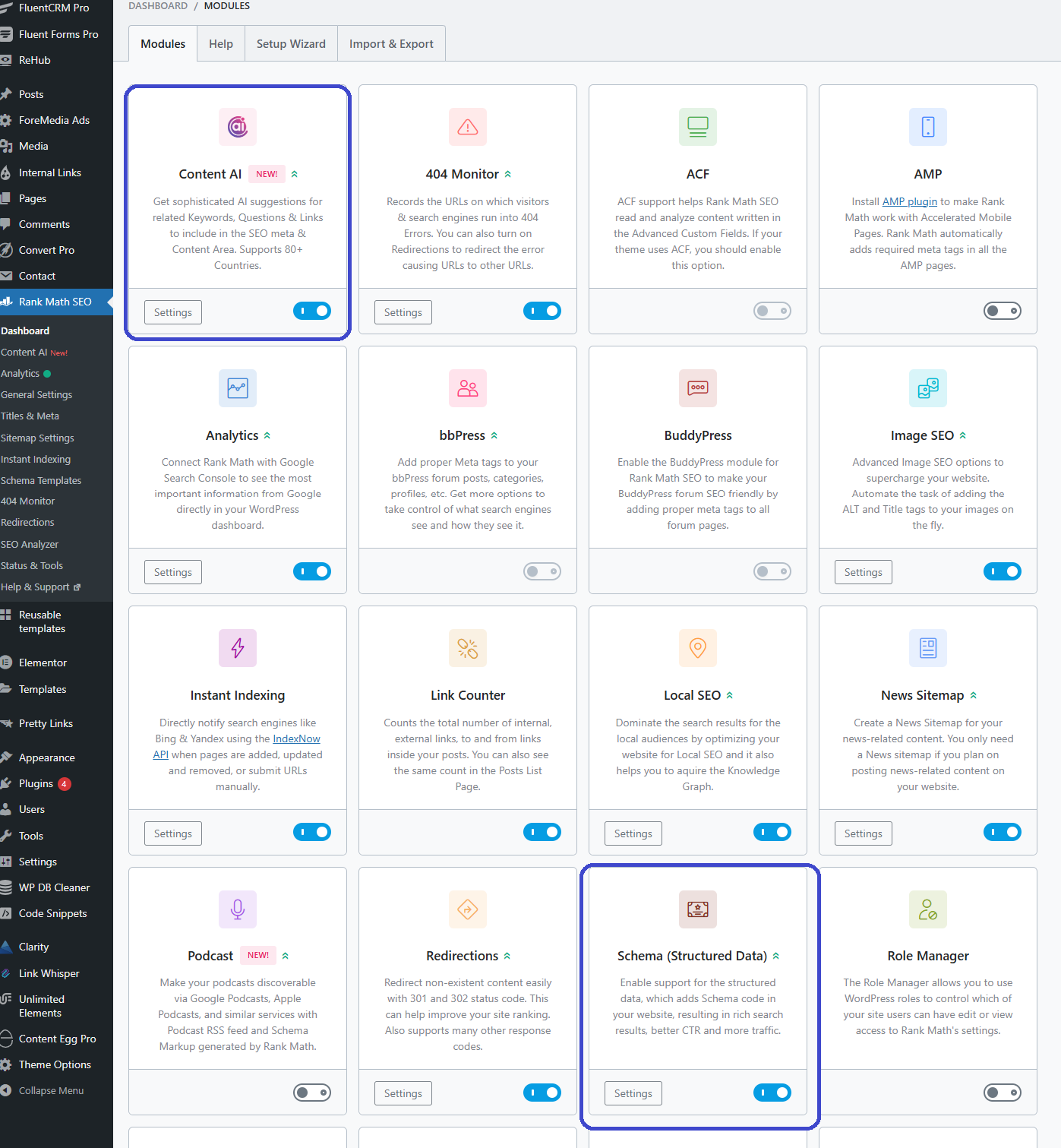
Enabling these modules ensures your content follows semantic search best practices and signals structure clearly to AI-driven search engines.
I also recommend enabling the Local SEO module, even if you're not a local business. This module helps establish your brand as a recognized entity, which is crucial for AI search engines that prioritize authoritative sources.
Configuring Your Site’s Core Information for AI Understanding
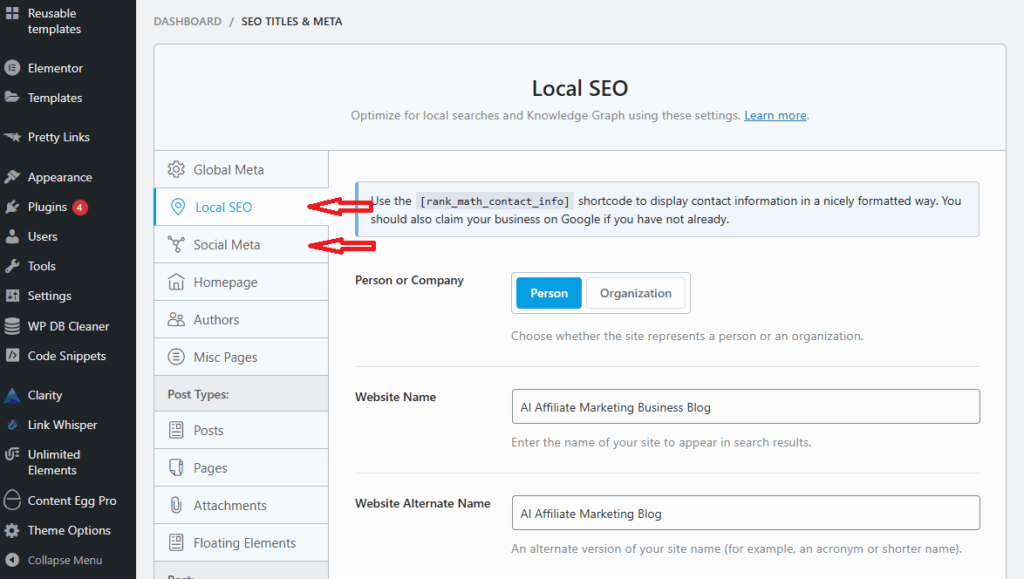
Your site's entity information is the foundation of AI search optimization. Go to Rank Math » Title & Meta » Local SEO to establish your brand's digital identity. Fill out your organization name, logo, contact information, and social media profiles completely.
The Local SEO section requires attention even for non-local businesses. Add your business address, phone number, and operating hours if applicable. This information helps AI search engines understand your business context and credibility signals.
Social Meta configuration connects your content to your brand's social presence across platforms. Link your Facebook, Twitter, LinkedIn, and other social profiles to create a cohesive entity signal. AI search engines use these connections to verify your authority and authenticity.
Don't skip the Knowledge Graph settings. Add information about your company's founding date, key personnel, and industry focus. This data helps AI systems understand your expertise and topical authority, making your content more likely to appear in AI-generated responses.
The Person schema setup is equally important for individual content creators. Configure your author profiles with professional credentials, expertise areas, and social media links. AI search engines increasingly factor author expertise into content rankings.
These settings feed structured metadata into your site’s <head>, helping AI-powered platforms like Google AI Overview and Bing AI recognize your site as a trusted entity.
By activating the right modules and configuring core entity details, you lay the groundwork for AI SEO success, letting Rank Math automate schema markup and guide your content toward AI-driven search visibility.
A clear site-wide entity helps AI search engines link your brand to content. Start with:
- Local SEO
- Navigate to Rank Math » Title & Meta » Local SEO.
- Enter your business name, address, and phone number (NAP) exactly as they appear on Google Business Profile.
- Add business hours and category to reinforce your entity signals.
- Social Meta
- Go to Rank Math » Title & Meta » Social Meta.
- Input your Facebook and Twitter handles.
- Upload a default Open Graph image and enter your organization’s logo URL.
These settings feed structured metadata into your site’s <head>, helping AI-powered platforms like Google AI Overview and Bing AI recognize your site as a trusted entity.
By activating the right modules and configuring core entity details, you lay the groundwork for AI SEO success, letting Rank Math automate schema markup and guide your content toward AI-driven search visibility.
Creating and Optimizing Content for AI Overviews
Leveraging Rank Math’s Content AI to Write for Topics, Not Just Keywords
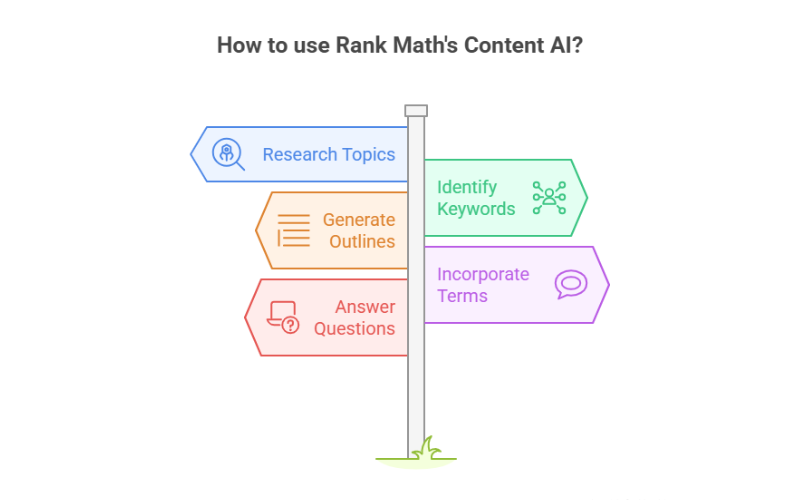
When you open a post in the WordPress editor, Rank Math’s Content AI pane appears on the right. Use it to:
- Research topics by entering your primary keyword (e.g., AI-driven search engines).
- Identify related keywords like “semantic search,” “machine learning search algorithms,” and “user intent analysis.”
- Generate SEO‑friendly outlines that include H2s and H3s tailored to AI search queries.
- Incorporate LSI and NLP terms suggested by the tool to cover context and intent.
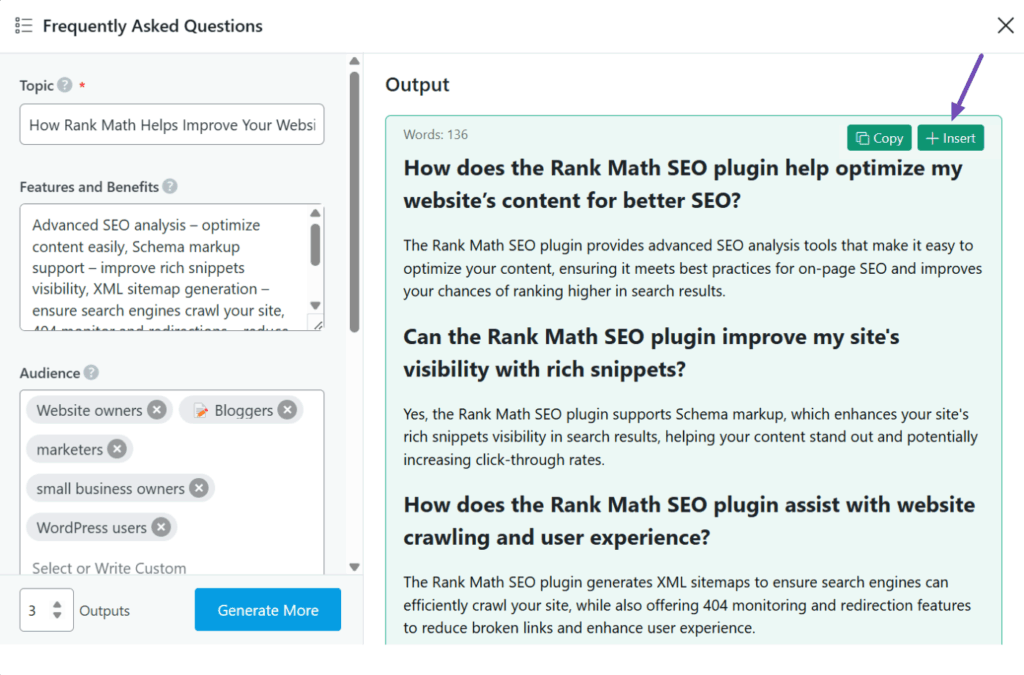
- Answer common questions directly by clicking the “Add FAQ” button, which injects question-and-answer blocks you can customize.
These real‑time suggestions help you craft content that AI-powered platforms, like ChatGPT Search and Google AI Overview, recognize as topically relevant and comprehensive.
Crafting Content That Answers Questions Directly
AI overviews reward concise, answer‑first writing. To structure for “answerability”:
- Use clear headings that mirror common queries (e.g., “What Is a Knowledge Graph?”).
- Write short paragraphs no longer than four sentences.
- Start sentences with the answer, then expand.
Example:
Question: “How does schema markup improve AI search visibility?”
Answer‑first sentence: “Schema markup gives AI engines clear context about your content.”
Follow with two to three lines explaining how Rank Math automates schema for Article, FAQ, and HowTo types.
This format signals AI crawlers where to extract direct answers for rich snippets and overview panels.
The Power of Factual Accuracy and Citing Your Sources
AI search engines prioritize verifiable information. To build credibility:
- Link to authoritative sites like OpenAI’s research on GPT models or Google’s official SGE documentation.
- Use inline citations sparingly, with descriptive anchor text (e.g., “According to Google’s AI Overview guide…”).
- Update statistics regularly—AI overviews flag outdated facts.
By weaving trustworthy sources into your content, you boost your E‑E‑A‑T signals (Experience, Expertise, Authoritativeness, Trustworthiness) and improve your chances of being featured in AI-driven answer boxes.
Schema Markup: The Language of AI Search Engines
Schema markup serves as the bridge between your content and AI search engines' understanding capabilities. It tells AI exactly what your content is about, whether it’s an article, FAQ, product, recipe, or tutorial. While traditional search engines could function with basic HTML, AI-driven search engines rely heavily on structured data to quickly parse and categorize your content for inclusion in conversational responses.
AI search engines like Google AI Overview and Perplexity AI don’t just scan your site for keywords; they scan for context. Schema provides that context in a standardized format that machines can read quickly and accurately. This is especially critical for rich results like featured snippets, answer boxes, and AI-generated summaries.
Without schema, your content may be skipped entirely, even if it’s high-quality.
A Step-by-Step Guide to Implementing Key Schemas with Rank Math
Rank Math makes schema integration simple with built-in support for 20+ schema types. Here’s how to add the essentials:
1. Article Schema
- Go to your post in the WordPress editor.
- Scroll to the Rank Math SEO box below your content.
- Click the Schema tab » Schema Generator » choose Article.
- Customize the name, author, and publishing details.
- Click Save for this Post.
2. FAQ Schema
- In the WordPress editor, add an “FAQ by Rank Math” block.
- Input your question and short answer.
- Repeat for additional FAQs. Rank Math automatically marks them up behind the scenes.
3. HowTo Schema
- Select “HowTo” from the Schema Generator.
- Fill in the step-by-step process and estimated time.
- You can also add images for each step to increase engagement.
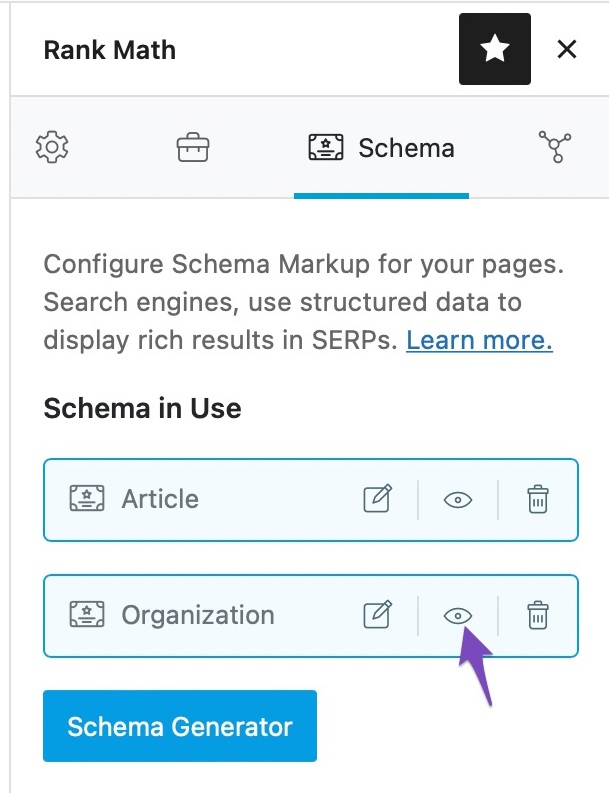
These schemas make it easy for AI-powered engines to display your content in dynamic, visually rich formats that improve click-through and visibility.
Advanced Schema: Showcasing Expertise with “Person” and “Organization” Schema
To boost E-E-A-T signals (Experience, Expertise, Authoritativeness, and Trustworthiness), connect your content to real entities:
Person Schema (Author):
- In your WordPress dashboard, go to Users » Your Profile.
- Fill in fields like your job title, bio, and social profiles.
- Then navigate to Rank Math » Titles & Meta » Author and enable the appropriate options.
- Rank Math automatically includes this data in post metadata when enabled.
Organization Schema:
- Navigate to Rank Math » Titles & Meta » Local SEO.
- Choose “Organization” as the type.
- Enter your company name, logo, phone number, and address.
This schema helps AI associate your content with a credible author and a real-world brand, two key factors in getting featured in AI-driven search results.
Building Your Brand as a Recognized Entity
What is a Knowledge Graph and Why Does it Matter for AI?
Google’s Knowledge Graph is like a giant web of interconnected facts about people, places, organizations, and things. It helps AI understand how concepts relate to each other, so when someone searches for your brand, Google (or ChatGPT, or Bing AI) knows who you are, what you do, and why you matter.
When AI-driven search engines generate answers, they often pull from these knowledge graphs to ensure accuracy and context. If your brand isn’t clearly defined and connected, you may be skipped entirely, no matter how good your content is.
In AI SEO, your goal is to become an entity that lives in that graph. That means making sure your name, logo, social profiles, and website are consistently connected and recognized across the web.
Using Rank Math to Solidify Your Brand's Online Presence
Rank Math makes this easier than ever by helping you configure structured data that defines your brand entity clearly. Here’s how:
- Go to Rank Math » Title & Meta » Local SEO
- Set your business type (e.g., Organization or Person)
- Add your company name, phone number, logo, and address
- Include business hours and service area if applicable
- Head to Rank Math » Title & Meta » Social Meta
- Fill in your Facebook, Twitter, LinkedIn, and Instagram URLs
- Add a default Open Graph image and your brand’s logo
These settings embed structured metadata across your site, linking your content to your business identity in the Knowledge Graph, and making it easier for AI search engines to connect the dots.
Beyond the Basics: Advanced Rank Math Tips for AI Search
Optimizing for “People Also Ask” Using Rank Math’s Research Tools
Here's something most people miss: AI-driven search engines love answering follow-up questions. When ChatGPT or Perplexity generates a response, they often include related questions users might ask next. That's your golden opportunity.
Rank Math’s Research feature helps you uncover these “People Also Ask” (PAA) questions right inside your WordPress dashboard.
- Open the Rank Math SEO sidebar in the post editor.
- Click Research » Related Questions to load PAA queries tied to your primary keyword (e.g., “How do AI-driven search engines work?”).
- Review the list and select high‑value questions.
- Add each question as an H3 heading in your article, then answer it immediately in a concise paragraph.
By matching PAA queries, you signal to AI search engines, like Google AI Overview and ChatGPT Search, that your content directly addresses user intent. This boosts your chance of being pulled into dynamic answer panels.
The Role of Internal Linking in Establishing Topical Authority
AI search engines value topical authority, and a strong internal link structure tells them you’re an expert hub. Rank Math’s Link Suggestions streamlines this:
- In the editor, click Link Suggestions under the Rank Math sidebar.
- Browse through recommended internal pages related to your topic cluster (e.g., posts on “semantic search” or “machine learning search algorithms”).
- Insert links using descriptive anchor text, and avoid generic phrases like “click here.”
Aim for at least 3–5 internal links per long-form post. This not only improves crawlability for AI bots but also distributes your entity signals across your site. When AI-driven platforms evaluate your content, they see a well‑connected network of pages, reinforcing your brand as a trusted authority on AI in SEO.
Best Practices for AI-Driven SEO
1. Focusing on User Intent
Traditional SEO was obsessed with keywords. AI-driven search engines, however, are obsessed with intent, what the user actually wants to know. Your job? Match that intent with answers, not just content.
Start by identifying real search queries. Use tools like Rank Math’s Content AI or “Related Questions” suggestions to uncover what your audience is asking.
Then:
- Lead with answers, don’t bury them under introductions.
- Target specific search intents: Is the user looking to buy, learn, or compare?
For example, instead of just writing about “AI search engines,” address specific questions like:
- “How do AI-driven search engines rank content?”
- “What SEO tools help with AI search?”
This increases your chance of showing up in AI summaries and conversational answers.
2. Enhancing Content Readability
If your content is hard to read, AI will skip it, and so will humans. Follow these readability rules:
- Use simple, direct language. Think Grade 8 reading level.
- Break long paragraphs into digestible blocks (3–4 lines max).
- Use headers, bullet points, and numbered lists to make scanning easy.
AI search engines like Perplexity and You.com favor content that’s structured and skimmable. The easier it is to read, the easier it is to extract and summarize.
3. Keeping Content Up-to-Date
AI-powered platforms evaluate freshness as a trust signal. If your stats are two years old or your tools are outdated, you’ll lose visibility. To stay current:
- Review and update your top posts quarterly.
- Re-check facts, citations, and examples regularly.
- Monitor changes in AI algorithms, like updates from Google Gemini or OpenAI's model improvements.
Rank Math’s SEO Analyzer can also flag outdated practices and help you keep your optimization current. In the AI era, staying relevant is just as important as being right.
Common Mistakes and How to Avoid Them
Traditional SEO Practices That Don't Work for AI Search
Let’s be real, what worked five years ago can kill your visibility today. AI-driven search engines don’t play by the old rules. Yet many still cling to outdated tactics. Here’s what to stop doing:
- Over-relying on exact-match keywords: AI engines focus on meaning, not repetition. “AI-driven search engines” and “search powered by machine learning” are the same idea to an LLM.
- Neglecting semantic relationships: If your content doesn’t explore related terms like “semantic search” or “natural language processing,” it feels thin to AI.
- Ignoring user intent signals: Writing a 2,000-word post when the user just wants a definition? That’s a bounce waiting to happen.
- Poor structure: AI prefers clearly marked headings, bullet points, and logical flow. Long, unformatted blocks? You’re invisible.
Rank Math Implementation Pitfalls
Rank Math is powerful, but only if used correctly. Missteps here can undermine your AI SEO strategy. Watch out for:
- Incorrect focus keyword setup: Don’t just set it and forget it. Make sure the keyword appears naturally in the right places, title, intro, and H2s.
- Ignoring AI suggestions: The Content AI module tells you what to improve. Skipping it means missing out on visibility.
- Poor schema implementation: Setting the wrong schema type or leaving fields blank confuses AI crawlers.
- Shallow content: Rank Math rewards coverage. If you publish surface-level articles, expect surface-level results, if any.
Avoid these traps, and you’ll be way ahead of 90% of creators still optimizing like it’s 2013.
Conclusion: Your Roadmap to Thriving in the Age of AI Search
AI-driven search engines aren’t a future trend; they’re the new standard. If your SEO strategy isn’t evolving, your visibility will vanish. The good news? With the right tools and tactics, you can stay ahead.
Here’s what to remember:
- Create high-quality, expert-driven content that answers real questions clearly and directly.
- Use Rank Math’s Schema and Content AI tools to structure your content for AI understanding and relevance.
- Establish your brand as a recognized entity using consistent schema, local SEO, and social metadata.
- Stay agile, AI search is always changing, and your strategy should too.
Whether you're a solo blogger or running a digital agency, the path forward is the same: optimize not just for search engines, but for intelligent search engines. And Rank Math gives you the exact features to do just that.
Start implementing these strategies today. And if you’re serious about dominating AI-powered platforms like Google AI Overview and ChatGPT Search, consider upgrading to Rank Math PRO. You’ll unlock advanced schema automation, Content AI credits, and features that give your site a real competitive edge.
The AI search era is here. It’s time your SEO caught up.
Frequently Asked Questions
-
Are there any AI search engines?
Yes, there are AI search engines. Some examples include You.com, Perplexity.ai, and Andi Search. These platforms use artificial intelligence to understand queries and provide more personalized or conversational results.
-
Can AI be used as a search engine?
Yes, AI can function as a search engine. It analyzes user queries, understands context, and delivers relevant answers using machine learning, natural language processing, and large datasets.
-
Are Google searches AI-driven?
Yes, Google searches are AI-driven. Google uses artificial intelligence models like RankBrain, BERT, and MUM to understand search intent and improve the quality of results.
-
Can AI replace Google search?
AI can complement but not fully replace Google search today. While AI tools can answer questions directly, Google still offers broader access to indexed web pages and structured results.
-
What is Google’s AI called?
Google’s main AI systems include RankBrain, BERT, and MUM. For generative AI, Google uses Gemini (formerly Bard) to power its Search Generative Experience (SGE) and other tools.