The Real Affiliate Blogging Stack in 2026 (Tools, Systems, Priorities)

If you search for “affiliate blogging tools” right now, you'll find lists. Lots of them. Forty tools. Fifty-two tools. One site I came across recently had sixty-one — yes, sixty-one — tools crammed into a single post, presented as if you're supposed to subscribe to all of them before you publish your first article.
But here's the reality: the affiliate bloggers generating consistent, passive income are not juggling dozens of apps. They run lean, integrated systems of 8 to 12 carefully chosen tools that actually talk to each other. In a world where Google AI Overviews and ChatGPT search are changing how readers find information, your tech stack needs to do more than just manage links—it needs to build authority.
I have been building and auditing affiliate sites for over 11 years, and over this time, I have seen how “tech bloat” kills profit margins. That’s why in this guide, we’ll cut through the noise. We will cover the five core layers of a real affiliate stack, the tools you need to survive the shift to AI-driven search, and how to prioritize your spending, whether you are just starting or ready to scale.
No wish lists. No filler. Just the system.
Key Takeaways:
- An affiliate blogging stack has five functional layers: Foundation, Traffic & SEO, Content Creation, Link Management, and Analytics. Every tool you own should serve one of these layers — or get cut.
- More tools ≠ more income. Bloggers running lean, integrated stacks of 8–12 tools consistently outperform those with bloated setups.
- 2026 adds two new demands: AI search visibility (GEO/AEO) and cookieless tracking — and most existing stacks aren't built for either.
- Stage matters. The right stack at $500/month revenue looks very different from the right stack at $10,000/month. This guide covers both.
- The best move before buying anything new: audit what you already have.
DISCLOSURE: WebIncomeJournal is supported by readers like yourself. We may earn an affiliate commission when you purchase through our links, which enables us to offer our content for free. Learn more here.
What Does a “Real” Affiliate Blogging Stack Actually Include in 2026?
Before we dive into the real affiliate blogging stack, let's first understand the meaning of an affiliate blogging stack.
An affiliate blogging stack is the complete set of tools, platforms, and systems you use to run your affiliate blog as a business — from publishing content to tracking revenue. It's not a wishlist of everything that sounds useful. It's a working system where every tool has a specific job.
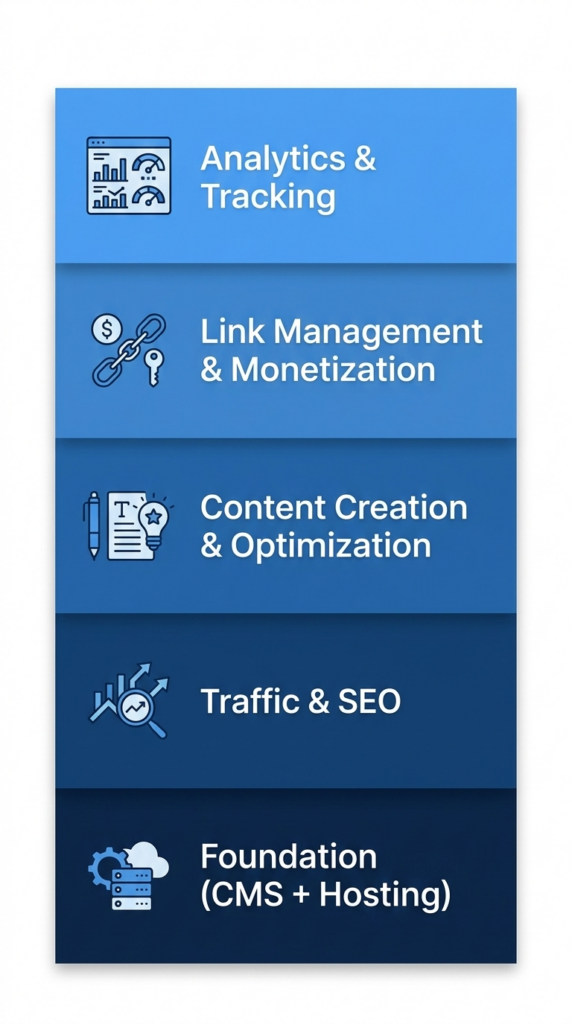
Think of it in five functional layers:
- Foundation — Your CMS and hosting. This is the ground everything else stands on.
- Traffic & SEO — Keyword research, backlink analysis, and rank tracking. This is how you get found.
- Content Creation & Optimization — The tools that help you produce and refine content that ranks and converts.
- Link Management & Monetization — How you handle, cloak, and track your affiliate links.
- Analytics & Tracking — The data layer that tells you what's working and what's bleeding money.
Every tool in your arsenal must earn its keep by serving at least one of these layers. If it doesn't help you rank, convert, or track, it is tech debt.
But beyond these layers, the 2026 landscape has added two “invisible” layers that most bloggers ignore. These layers sit across all five layers.
The first is AI search visibility — also called GEO (Generative Engine Optimization) or AEO (Answer Engine Optimization). Google's AI Overviews, ChatGPT search, and Perplexity are changing how readers discover affiliate content. Getting cited in an AI answer is quickly becoming as valuable as a Page 1 ranking — and your entire stack needs to support that goal, from how you structure content to which SEO plugins you use.
The second is cookieless, privacy-first tracking. As third-party cookies disappear, affiliates who rely solely on network dashboards are flying blind. Your tool stack needs to account for this now, before it becomes a crisis.
Keep both in mind as we go through each layer. They're not add-ons — they're 2026 requirements.
What Is the Best Platform and Hosting Setup for an Affiliate Blog in 2026?
Your Foundation layer isn't glamorous. But get it wrong and everything built on top of it suffers — your rankings, your load times, your conversions, and increasingly, your chances of being cited in AI-generated answers. This is because Google and AI search engines now use these performance metrics as a baseline filter; if your site doesn't load instantly, it is unlikely to be featured in an AI Overview or a top-three organic spot.
For this layer, your priority is your CMS: WordPress.org (self-hosted). It remains the clear default for affiliate bloggers, and for good reason. Its plugin ecosystem is unmatched — tools like RankMath SEO, ThirstyAffiliates, and WP Review Pro are all built for WordPress. You get full SEO control, total flexibility over your site structure, and the ability to own your platform entirely. No platform lock-in, no revenue share.
The alternatives are worth knowing, but they're situational. Webflow makes sense if you're in a design-heavy niche and want visual control without a developer. Ghost is a strong option if your affiliate strategy is built around a newsletter first, with content as the secondary engine. For most affiliate bloggers, though, WordPress is still the right call.
For the best hosting for affiliate marketing, I recommend three specific paths based on your stage:
- LiquidWeb: Excellent for budget-conscious starters who still need reliable uptime and decent speeds. You may also want to consider Bluehost at this level.
- ScalaHosting: The “sweet spot” for scaling blogs that need high-performance cloud VPS features without the enterprise price tag.
- InMotion Hosting: A powerhouse for established sites with heavy traffic that require top-tier server response times to maintain high conversion rates.
The truth is, 81% of brands now run affiliate programs, and competition for those clicks is fierce. Starting with a solid CMS for bloggers and professional hosting ensures you aren't fighting your own infrastructure while trying to outrank the competition.
Which SEO and Keyword Research Tools Do Serious Affiliate Bloggers Actually Use?
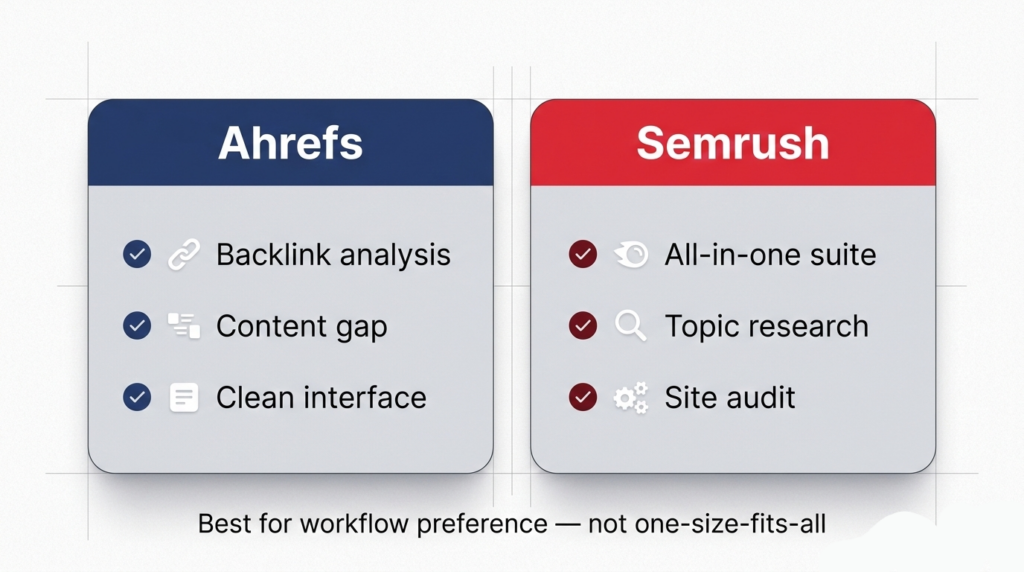
This is the highest-ROI layer of your stack. In 2026, the debate between Ahrefs vs Semrush for affiliate marketing has shifted from “who has more data” to “who has the better AI-integrated workflow.” Both are powerhouses, and your choice ultimately depends on your daily habits.
Ahrefs remains the surgical tool of choice for link builders. Its “Site Explorer” and “Link Intersect” features are the gold standard for uncovering exactly how your competitors are winning. For affiliate bloggers, the Ahrefs Content Gap tool is essential for identifying the specific topics your site is missing to achieve topical authority. Its “Parent Topic” functionality is particularly useful for building the content clusters that AI search engines love to cite.
Semrush, on the other hand, has evolved into a comprehensive “marketing command center.” It offers a more aggressive AI suite, including the Semrush AI Visibility tool, which tracks how often your brand is mentioned in AI Overviews and ChatGPT. If you want a tool that handles SEO, PPC research, and social media tracking in one tab, Semrush is the winner.
However, for budget-constrained bloggers, you don't need a $130/month subscription to start. A “starter stack” consisting of Google Search Console (for real-world performance data) and Google Keyword Planner (for raw search volume) is incredibly potent. You can supplement this with:
- Mangools: A beginner-friendly, affordable suite that excels at SERP analysis.
- Keywords Everywhere: A browser extension that provides “on-the-fly” data while you browse your niche.
- Keyword Surfer: A free tool for quick, keyword-level insights directly in the Google search bar.
The critical affiliate blog SEO strategy for 2026 is moving beyond simple keyword volume. Serious bloggers now prioritize topical authority tools. Success isn't about ranking for one “best product” keyword; it's about owning the entire conversation around a category so that AI engines view your site as the definitive source.
What AI and Content Creation Tools Are Affiliate Bloggers Using to Scale Their Output?
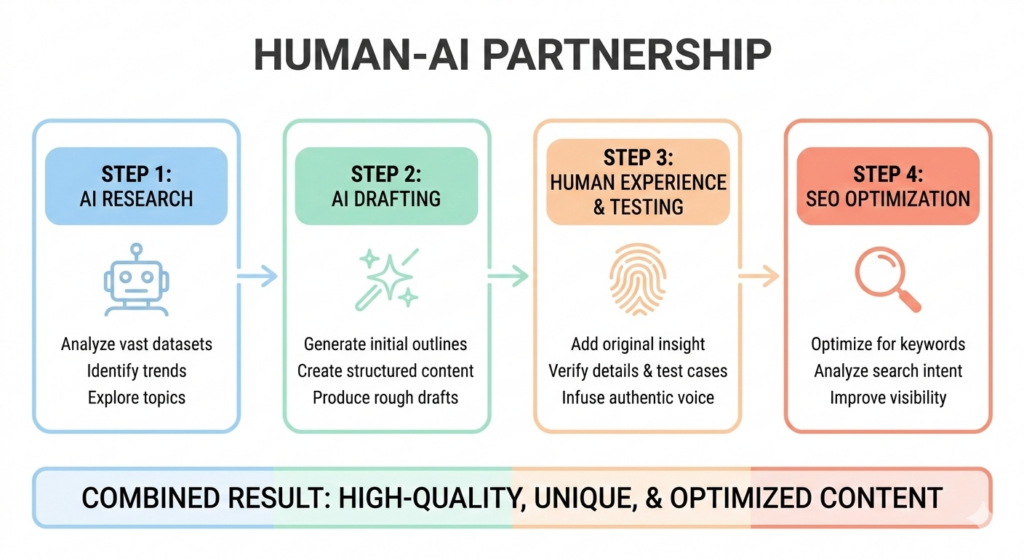
The AI content revolution has arrived, and it has fundamentally changed the affiliate marketing workflow. In 2026, the barrier to entry for “good” content is zero. To survive, your content must be “exceptional.” What this means is that you should use AI to accelerate your work, not replace your brain.
The most effective content creation tools for bloggers are now split by their role in the production line. Here's how a practical affiliate marketing content workflow actually looks in 2026:
- Research & Scaffolding: Claude and ChatGPT are unmatched for brainstorming unique angles, creating complex outlines, and synthesizing large sets of data into “snackable” sections for AI Overviews.
- Optimized Drafting: Koala Writer and SEOWriting.ai are some of the industry favorites for generating affiliate-optimized copy at scale. These tools integrate real-time SERP data and automatic Amazon product linking, saving hours of manual formatting.
- Real-Time Optimization: Tools like Rank Math SEO are non-negotiable for “grading” your content against the current winners. They ensure your keyword density and topical coverage match the benchmarks AI search engines use to rank content.
Beyond these tools, there’s one more area you must take seriously in 2026. To rank and—more importantly—to be cited as a source in an AI Overview, you must inject original experience signals. This is the core of E-E-A-T for affiliate content in 2026.
Your toolchain strategy must include a “Humanization” step. This means adding first-person opinions (for example, “In my three weeks of testing…”), original high-resolution photos, and specific “edge case” scenarios that a generic LLM cannot invent. If your article looks like a generic AI rewrite, it will be ignored. If it looks like a field report from an expert, it becomes a citation magnet.
An example worth noting here is Jessica R., a stay-at-home mom who built her eco-parenting affiliate blog to $6,200/month in 18 months. According to AffiliatePathways, she achieved this feat through publishing consistent niche content with genuine first-hand experience baked in. The tools accelerated her output. The experience made it worth reading.
How Do You Manage, Cloak, and Track Affiliate Links Effectively?
Link management is the layer where affiliate bloggers quietly leak the most money — and it's usually the last place they look when revenue stalls.
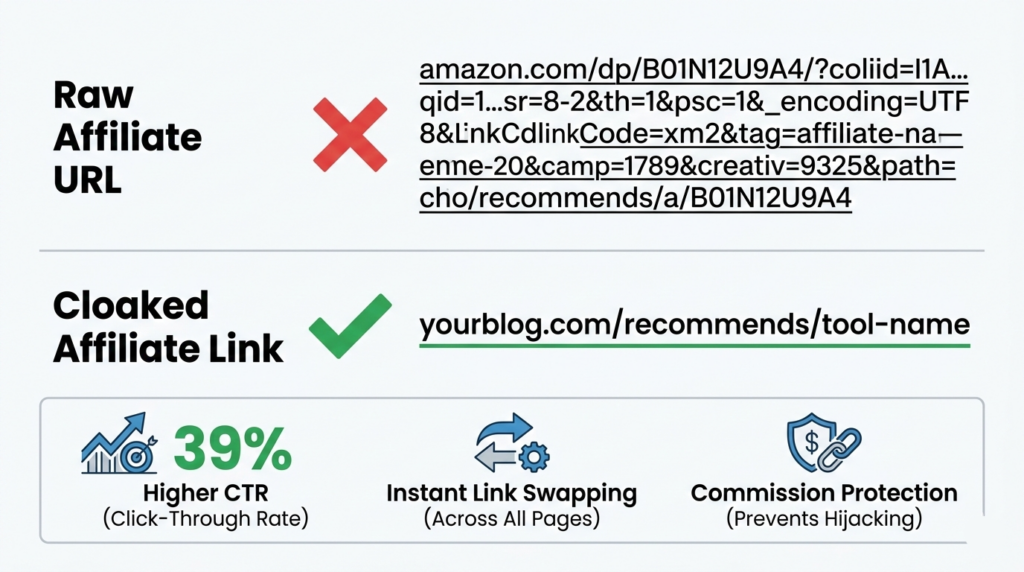
Here's what's actually happening when you skip proper link management: you're posting raw, ugly affiliate URLs that erode trust, you have no idea which links are broken, and when a program changes its URL structure, you're manually hunting through dozens of posts to fix it. That's not a system. That's a liability.
For most affiliate link management, the choice comes down to two dominant WordPress plugins: Pretty Links and ThirstyAffiliates.
- Pretty Links is the gold standard for beginners. It is lightweight and excels at “cloaking”—turning a long, suspicious URL into a clean, branded link like yourdomain.com/go/product. According to data from Rebrandly, branded links see a 39% higher click-through rate because they build trust with the reader.
- ThirstyAffiliates is the power-user choice. It offers advanced features like auto-linking (automatically hyperlinking specific keywords across your site), geo-targeting (sending UK visitors to Amazon.co.uk and US visitors to Amazon.com), and broken link alerts.
However, the real “pro” move in 2026 is moving beyond simple WordPress plugins for your data. Relying solely on individual affiliate network dashboards is insufficient for scaling. This is where Affilimate has become a competitive edge. It acts as a centralized affiliate link tracker and analytics dashboard, pulling data from dozens of different networks (Amazon, ShareASale, Impact, etc.) into one unified view. This allows you to see exactly which specific blog post—and even which specific link within that post—is driving your revenue. This allows you to double down on what works.
What Email Marketing Tools Should Affiliate Bloggers Prioritize in 2026?
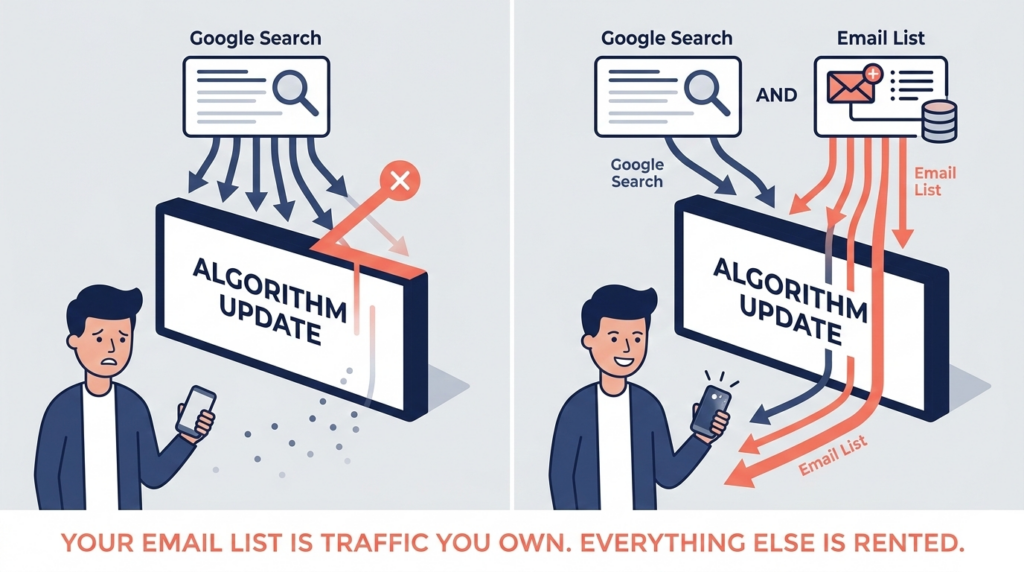
In an era where Google AI Overviews and ChatGPT are intercepting organic clicks, your email list is no longer just a marketing channel—it is your traffic insurance policy. As organic click-through rates fluctuate due to AI search disruption, an owned audience is the only thing standing between you and a total collapse in revenue during an algorithm update.
When choosing email marketing tools for affiliate bloggers, the landscape in 2026 is defined by three major players:
- Kit (formerly ConvertKit): Still the undisputed champion for content creators. Its strength lies in its “visual automation” builder and advanced tagging. You can tag a reader who clicks a link for “Budget Laptops” and automatically send them a specialized sequence of deals, drastically increasing your email list affiliate income.
- Beehiiv: The rising star for those pursuing a newsletter-first affiliate strategy. If your business model is built around a weekly curated blast rather than just “SEO blogging,” Beehiiv’s built-in referral programs and ad network make it a powerhouse.
- Mailchimp remains a valid option for simplicity. It's familiar, widely integrated, and the free tier is generous enough to get started. The trade-off is that its automation logic is less flexible than Kit at the same price point.
- FluentCRM: For the technical power user, this self-hosted WordPress plugin offers deep behavioral automation without the recurring monthly “subscriber tax” charged by SaaS platforms.
According to Bloghunter's 2026 affiliate statistics, 78% of consumers trust blog recommendations over ads. Email lets you deliver those recommendations directly, repeatedly, to people who have already chosen to hear from you. That's a fundamentally different relationship than a one-time organic visit — and it's one that no algorithm update can take away.
So, the strategic priority for 2026: start building your list from day one. Not when you hit 10,000 monthly visitors. Day one.
How Are Smart Affiliate Bloggers Adapting Their Tools for AI Search Visibility in 2026?
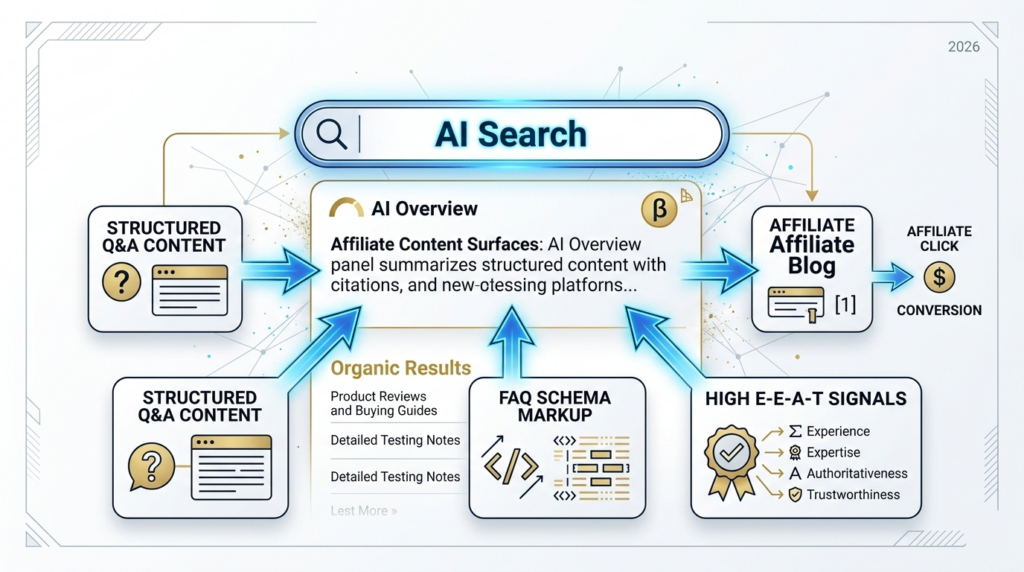
While doing research for this post, I noticed that none of the list posts I came across talked about this — at least, not at the tool level. This was really surprising to me because in 2026, the goalpost has shifted. Today, being cited as a source in a Google AI Overview or a Perplexity answer is the new “Page 1 ranking.” So, to stay visible, you need to move beyond traditional SEO and adopt Generative Engine Optimization (GEO). This is not about gaming the system; it’s about making your data so structured and authoritative that an LLM cannot afford to ignore it.
The question is, how do we adapt to this at the tool level?
It starts with affiliate blog schema markup. Using advanced features in Rank Math SEO or SEOPress, bloggers are now deploying specific FAQ, HowTo, and Product schemas that serve as a direct “data feed” for AI agents. When you provide clear, structured metadata, you reduce the “hallucination risk” for the AI, making it more likely to cite your site for specific product specs or pricing.
Furthermore, GEO affiliate marketing requires a move toward “chunkable” content. Tools like SEOWriting.ai and ContentBot have introduced features that automatically format key takeaways into the “answer-first” blocks that AI Overviews prefer.
However, the most important tool in your GEO arsenal today isn't an app—it’s your E-E-A-T signals. AI search engines are increasingly sensitive to “fingerprinting” real expertise. This means using your stack to highlight original product testing, first-person opinions, and verified author bios. If an AI engine can't find a “human in the loop” within your content, it will likely pass you over for a more authoritative, cited source.
What Analytics and Tracking Tools Do You Actually Need to Optimize Affiliate Revenue?
If you aren't tracking your revenue back to the specific article and traffic source, you aren't running a business, you’re running a hobby. In 2026, affiliate revenue analytics have become significantly more complex due to the “death of the cookie.”
Your essential analytics layer should consist of:
- GA4 (Google Analytics 4): While controversial for its complexity, it remains the baseline for understanding user journey paths and identifying where readers drop off before clicking your affiliate links.
- Google Search Console: Your primary tool for monitoring indexing health and seeing which queries are actually triggering AI Overviews for your site.
- Affilimate: As mentioned earlier, this is the “glue” that connects your traffic to your actual dollars. It allows you to see your Earnings Per 1,000 Visitors (EPM)—the only metric that truly matters for long-term sustainability. A post generating 500 clicks a month at $0.40 EPM is underperforming compared to a post generating 200 clicks at $3.20 EPM.
The biggest shift in conversion tracking for affiliate blogs is the move toward cookieless tracking. As browsers like Safari and Chrome continue to restrict third-party cookies, relying on traditional “last-click” attribution is a losing game. Serious affiliates are now implementing server-to-server (S2S) tracking using tools like Voluum or RedTrack. These platforms bypass the browser entirely, communicating directly with the affiliate network to ensure you get credited for every sale, even in a privacy-first world.
What Productivity and Workflow Tools Keep an Affiliate Blogging Business Running?
This is the operational layer of your tool stack, and it is what separates a blogger who dabbles from one who runs an actual business.
You can have the best SEO tool and the best link manager on the market. If your content pipeline is chaotic, your affiliate program details are simple dead. Also, if you're briefing writers via long email threads, your stack has a serious gap.
Notion is the anchor tool for this layer, and it's become significantly more capable in 2026 with the addition of Notion AI. At its core, use it for three things: a content calendar that tracks every post from idea to published, an affiliate program database that logs commission rates, cookie windows, payment thresholds, and program terms in one place, and SOPs (standard operating procedures) for every repeatable task in your workflow — briefing writers, publishing checklists, quarterly stack audits. When you can hand a VA a Notion SOP and have them execute a task without a single back-and-forth message, that's leverage.
Notion AI is making it increasingly practical to consolidate research, drafting, and planning in a single workspace — reducing the number of tabs, tools, and context switches in your daily workflow. That's worth paying attention to as it matures.
Trello or Asana work well if Notion feels like overkill. For a solo blogger managing a straightforward editorial calendar, a Trello board with columns for each content stage (Idea → Brief → Draft → Edit → Scheduled → Published) is simple, visual, and effective. Don't over-engineer this layer.
Canva solves a real problem for affiliate bloggers working without a design team. Comparison graphics, featured images, Pinterest pins, email headers — Canva handles all of it with enough template quality that your visuals look intentional rather than improvised. The free tier covers most needs; Canva Pro adds brand kits and background removal that become useful as your content volume grows.
Loom earns its place the moment you hire your first writer or VA. Async video walkthroughs eliminate the back-and-forth that kills productivity when you're coordinating with remote collaborators. Record a ten-minute brief once; send it to every writer who covers that topic. The time savings compound quickly.
The principle across all of these: your workflow tools should reduce friction, not create it. If a tool requires more maintenance than it saves, it's not earning its place.
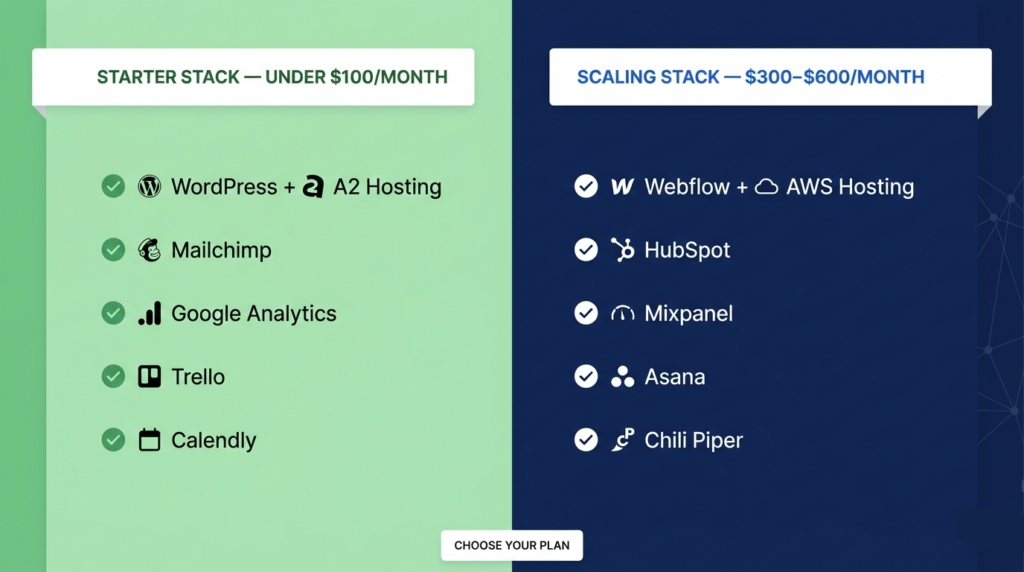
What Does the Starter Affiliate Blogging Stack Look Like vs. the Scaling Stack?
This is the section to bookmark.
Everything we've covered so far answers what tools exist. This section answers the question that actually matters for most readers: what should I be using right now, given where I am?
The decision logic is straightforward: don't upgrade a layer until the current tool is the actual bottleneck in your revenue growth. Buying Ahrefs when you're publishing two posts a month isn't a stack upgrade — it's an expensive subscription you'll underuse. The goal is the right tool at the right stage, not the best tool at every stage simultaneously.
Here's how the two stacks compare:
| Layer | Starter Stack (Under $100/month) | Scaling Stack ($300–600/month) |
| Foundation | WordPress + ScalaHosting | WordPress + InMotion or LiquidWeb |
| Traffic & SEO | Google Search Console + Google Keyword Planner (free) or Mangools | Ahrefs or Semrush |
| Content Creation | ChatGPT (free tier) | Rank Math Pro + Koala or SEOWriting.ai |
| Link Management | Pretty Links (free tier) | ThirstyAffiliates |
| Email Marketing | Kit free plan (up to 10,000 subscribers) | Kit Creator Pro or FluentCRM |
| Analytics | GA4 + Google Search Console | GA4 + Affilimate |
| Productivity | Canva free + Trello | Notion + Canva Pro + Loom |
| Schema & SEO Plugin | Rank Math free | Rank Math Pro or SEOPress Pro |
The Starter Stack in practice:
You can launch a fully functional, properly optimized affiliate blog for well under $100/month. ScalaHosting's managed cloud plans start at a price point that doesn't require you to compromise on performance. The free GSC + Google Keyword Planner combo gives you real keyword data. ChatGPT accelerates your content process. Pretty Links keeps your affiliate URLs clean. Kit's free plan handles email up to a meaningful subscriber count. GA4 and Search Console handle your analytics entirely for free.
This stack has no legitimate gaps for a blogger in their first twelve months. The tools don't become bottlenecks until you're publishing consistently and generating enough traffic and revenue to justify more sophisticated tooling.
The Scaling Stack in practice:
When you're generating consistent revenue and traffic, the upgrade logic is layer-by-layer. Your SEO tool upgrades when you need competitor intelligence and content gap analysis to find your next growth levers. Your link manager upgrades when you're managing enough programs that auto-linking and geo-targeting save meaningful time. Affilimate enters the picture when you need content-level revenue attribution across multiple networks — typically when you're earning from three or more programs simultaneously. FluentCRM becomes relevant when your email sequences are complex enough that Kit's interface creates friction.
The scaling stack isn't about prestige. It's about having tools that match the complexity of the business you're actually running.
One final note: audit before you upgrade. Most bloggers who feel like they need a better tool actually need to use their current tool better. Before adding a line item to your stack, spend thirty minutes asking whether the existing tool has features you're not using. More often than not, the answer is yes.
Which Tools Are Affiliate Bloggers Wasting Money On (And What to Cut)?
Let's talk about the tools you probably shouldn't be paying for.
In an industry where every “guru” has an affiliate link to sell you, tech bloat is a silent profit killer. To maintain a lean affiliate stack, you must be ruthless. If a tool isn't directly responsible for bringing in a reader or converting a click, it is probably dead weight.
The most common area of waste is social media scheduling tools. Unless your niche relies heavily on Pinterest or Instagram for traffic, paying $50 a month to “cross-post” your SEO articles to a dead Twitter feed is a low-ROI activity. For SEO-focused blogs, your time and money are better spent on content depth than on social automation.
Another massive money pit is the expensive funnel builder. Platforms like ClickFunnels are powerful, but they are often total overkill for affiliate bloggers. A well-structured WordPress site with high-quality CTAs, a fast-loading theme, and a simple lead magnet often converts just as well—without the $297 monthly price tag.
Furthermore, stop paying for multiple overlapping SEO tools. You do not need Ahrefs and Semrush and Moz. These platforms provide 90% of the same data. Pick the one that fits your workflow and cancel the rest. Similarly, avoid hoarding generic AI writing subscriptions. In 2026, a combination of ChatGPT for research and a single specialized tool like SEOWriting.ai covers almost every content need.
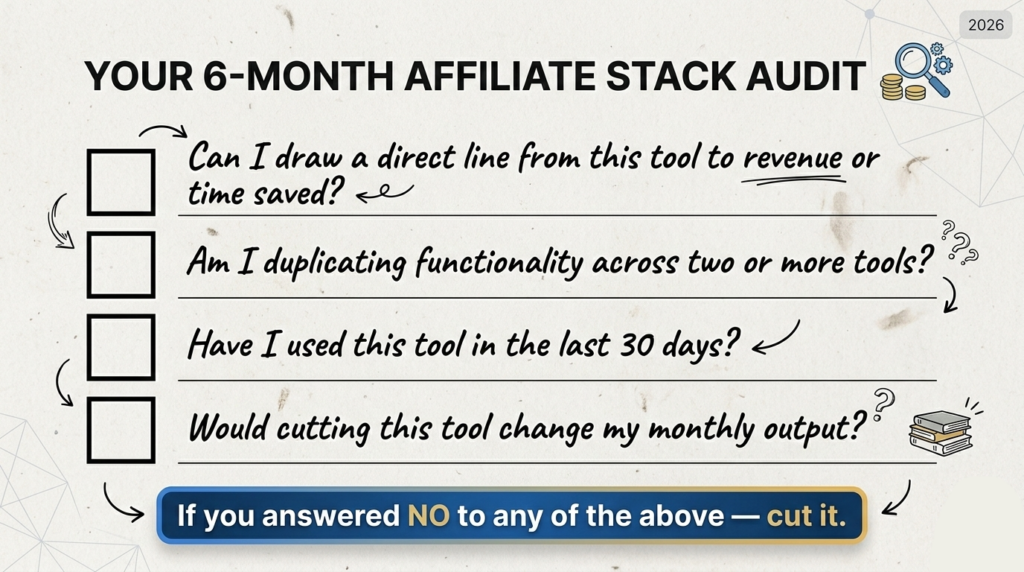
Conduct an affiliate marketing tool audit every six months. Look at your bank statement and ask: “Did this tool help me earn more than it cost me this month?” If the answer isn't a definitive “Yes,” cut it. Focus on ROI affiliate tools that move the needle, not “nice-to-have” gadgets that just sit in your browser extensions.
What Are the Most Important Priorities for Building Your Affiliate Stack in 2026?

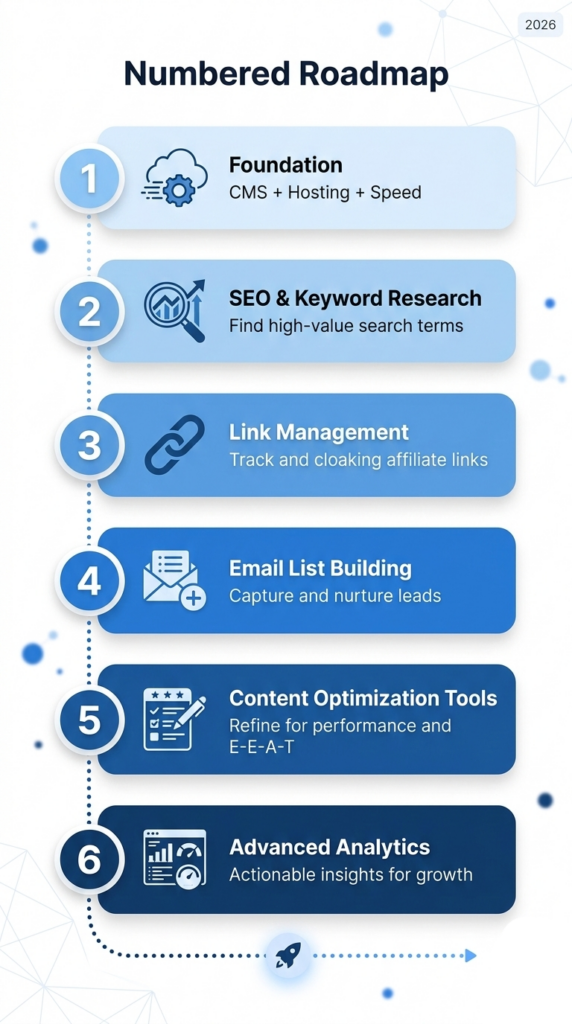
Success in affiliate marketing is as much about when you buy as it is about what you buy. Most beginners fail because they follow the reverse order: they buy the “pro” keyword tools and expensive AI writers before they even have a website that loads properly.
To build a sustainable affiliate blog roadmap, follow this high-performance sequence:
- Get the Foundation Right: Do not pass go until your CMS (WordPress) and hosting are optimized. Site speed and Core Web Vitals are the prerequisites for everything else.
- Build SEO Capability: Once the site is live, invest in one solid keyword research tool. You cannot write “experience-led” content if you don't know what questions people are actually asking.
- Nail Link Management Early: This is a critical affiliate marketing strategy for 2026. It is incredibly painful to retrofit 500 links with cloaking and tracking once you are already successful. Install a tool like PrettyLinks on day one.
- Start Email List Building: Even if you only have ten visitors a day, start capturing those emails. This is your hedge against the volatility of AI search. One of the biggest mistakes I still regret today is not doing this when I started.
- Add Content Optimization Tools: Once you are publishing consistently (at least 2-3 times a week), layer in tools like Rank Math SEO or SEOPress to ensure your content is competitive in the SERPs.
- Layer in Advanced Analytics: Only when you are generating significant traffic and multiple revenue streams should you invest in complex attribution tools like Affilimate or S2S tracking.
This hierarchy ensures you are always investing from your profits rather than your savings. By focusing on these affiliate blogging priorities, you ensure that your stack grows in lockstep with your revenue, creating a system that works for you rather than a list of subscriptions that you work for.
Conclusion: Build a Stack That Works for You, Not Against You
There you have it, my recommended affiliate blogging stack for 2026. As you’ve seen, the goal was never about using the most tools; rather, it was about building the tightest, most integrated system that serves your specific affiliate blogging model.
In this guide, we covered the five layers necessary for a profitable affiliate blog — Foundation, Traffic & SEO, Content Creation, Link Management, and Analytics — plus the productivity layer that keeps the whole operation running. You learned what a starter stack looks like under $100/month and what a scaling stack looks like when revenue justifies the investment. You also learned what most guides ignore entirely in 2026: structuring your stack and your content for AI search visibility, because today, being cited in an AI Overview is the new Page 1.
I hope you find this guide useful as you build your affiliate blogging stack starting today. You may also want to check out my deep dive into Affiliate Content Strategy for 2026 to learn how to put these tools to work.
Now, I’d love to hear from you. What does your current stack look like? Are there any tools you’ve cut recently that improved your margins? Let me know in the comments below.