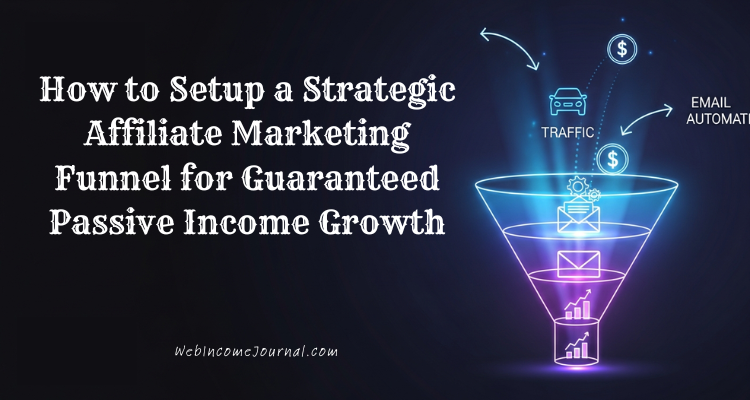
How to Setup a Strategic Affiliate Marketing Funnel for Guaranteed Passive Income Growth

I still remember the frustration of posting affiliate links everywhere and watching my commissions trickle in like a leaky faucet. You know that feeling, right? You're doing everything the “gurus” tell you—dropping links in blog posts, sharing on social media, sending occasional emails—but your income remains unpredictable. Some months you'd make $200, other months $47. There was no system, no predictability, just hope.
The truth is, the old way of affiliate marketing—randomly throwing links at your audience—died years ago. Today's consumers are smarter, more skeptical, and bombarded with promotions from every direction. They need a reason to trust you before they'll ever click your link, let alone buy through it.
In this guide, you'll learn my proven 4-step framework for constructing an affiliate funnel that works while you sleep. This isn't theory. This is the exact blueprint I use to generate consistent passive income, and by the end, you'll have everything you need to build your own automated asset.
TL;DR: A strategic affiliate marketing funnel is a systematic customer journey that transforms cold traffic into loyal buyers through a proven four-stage process: attracting visitors, capturing their interest with valuable lead magnets, nurturing trust through automated email sequences, and converting them into high-value purchases. This approach creates predictable, passive income that scales without requiring you to work harder.
What is a Strategic Affiliate Marketing Funnel and Why is it Essential for Passive Income?
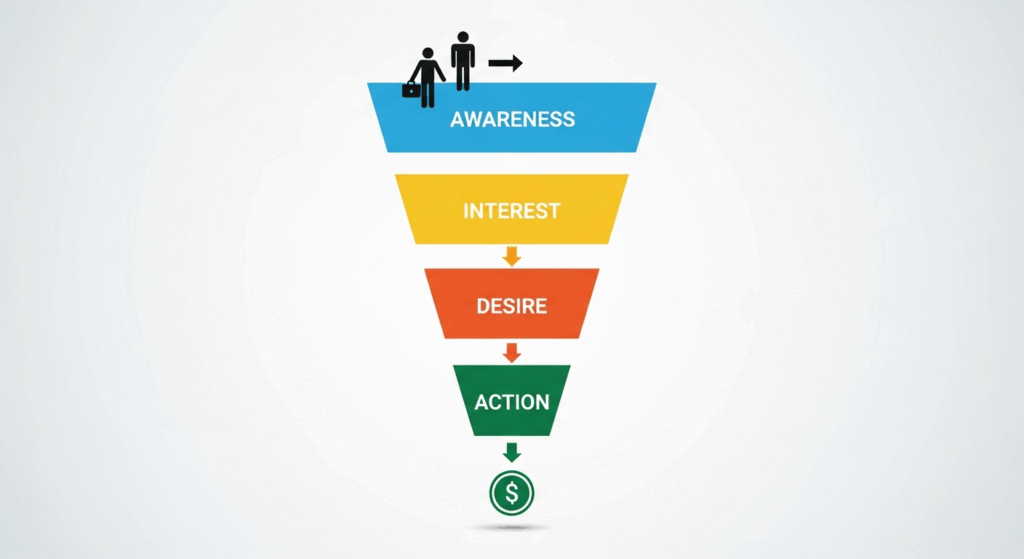
A strategic affiliate marketing funnel is more than just the traditional AIDA framework you learned in Marketing 101. It's a complete system designed to guide strangers through a predictable path to becoming paying customers.
Here's how the four core stages work in 2025:
- Awareness (Attract): You drive targeted traffic to your content through SEO, paid ads, or social media. These are cold visitors who don't know you yet.
- Interest (Capture): Instead of immediately pushing them toward an affiliate link, you offer something valuable—a lead magnet like a checklist, template, or mini-course—in exchange for their email address.
- Desire (Nurture): Through automated email sequences, you build trust, share stories, address objections, and position your affiliate product as the solution they've been searching for.
- Action (Convert): With trust established, you guide them to the affiliate offer through a strategic bridge page that pre-sells the product and manages expectations.
The critical difference between a funnel and a simple landing page? A funnel captures the lead before the sale. When someone visits a landing page and doesn't buy, they're gone forever. With a funnel, you capture their email address and get unlimited chances to convert them.
The Strategic Advantage: Scalability and Predictable Growth
The real power of an affiliate sales funnel lies in automation. Once built, your funnel works 24/7, nurturing leads and generating sales while you sleep, travel, or work on other projects. This is how you achieve true passive income—not by working harder, but by building systems that sell for you.
But here's what most affiliate marketers miss: the focus should be on Lifetime Value (LTV), not just that first commission. According to recent data, email marketing delivers an average ROI of 4200%-4500% in 2025 campaigns. Your email list transforms one-time buyers into repeat customers, allowing you to promote multiple relevant products over time. That $47 commission becomes $500+ over the customer's lifetime.
Selecting Your Niche and Product for Long-Term Profit
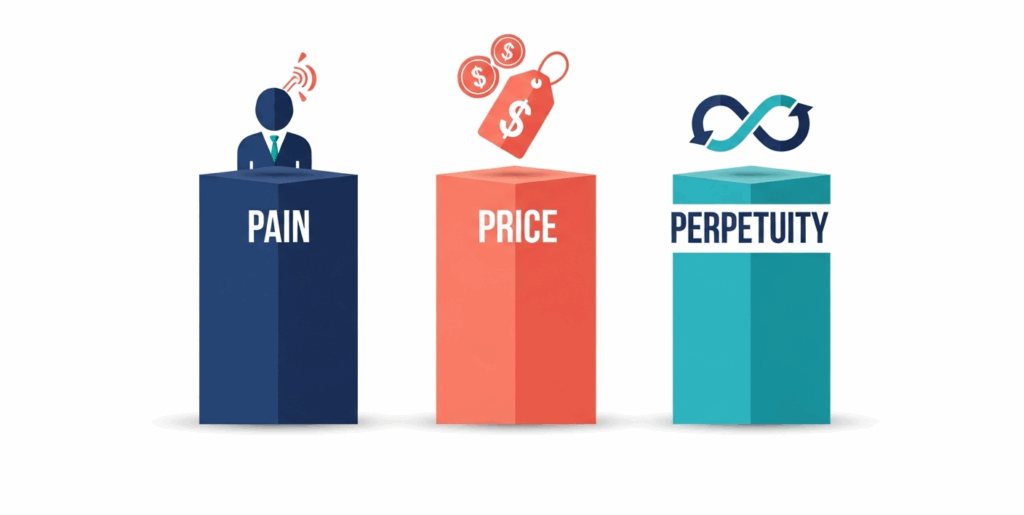
Before building anything, you need the right product. I use the “3 P's” framework:
- Pain: Does this product solve a genuine, urgent problem? The stronger the pain point, the easier the sale.
- Price: Higher-ticket offers ($100+) mean fewer sales needed to hit your income goals. A $500 commission beats ten $50 commissions.
- Perpetuity: Recurring commission programs are the foundation of guaranteed passive income. Would you rather earn $100 once or $30 every month for years?
Focus on affiliate programs offering recurring commissions, SaaS products, membership sites, or subscription services. These create predictable monthly revenue that compounds as you add more customers to your funnel.
The 4-Step Framework to A Strategic Affiliate Marketing Strategy
Part 1: The Foundation
Before you build your first Landing Page or write your first email, you need a solid foundation. This starts with product validation and selecting the right funnel architecture.
Product Validation: Identifying High-Converting Offers
Not all affiliate products are created equal. Before investing time building a funnel, you need to validate your chosen offer.
Start by checking product credibility. Look for affiliate programs with strong reputations, positive user reviews, and transparent commission structures. I personally dig into refund rates—anything above 10% is a red flag. High refunds signal either a poor product or misleading marketing, both of which will damage your reputation.
Use Google Trends to verify market demand. Is interest growing, stable, or declining? You want products riding upward trends, not dying industries. Check affiliate networks like ClickBank or ShareASale for gravity scores and earnings per click (EPC) data. Products with consistent EPC above $1.00 typically convert well.
Here's my Authenticity Rule, and it's non-negotiable: Only promote what you genuinely use or believe in.
I've seen too many affiliates chase high commissions for products they've never touched. Your audience can smell inauthenticity from a mile away. When you promote something you actually use, your recommendations carry weight. You can speak to real benefits, address actual concerns, and build the trust that converts cold traffic into buyers.
But beyond data, apply the Authenticity Rule – only promote what you’ve tested or genuinely believe in. Audiences sense insincerity fast, and your trust equity is your most valuable currency. When people believe you use what you recommend, conversions follow naturally.
Which Affiliate Funnel Model Guarantees the Highest Conversions?
You have two primary affiliate funnel models to choose from, depending on your traffic source and audience temperature.
Model 1: The Lead Magnet Funnel (Best for list-building)
This is my go-to for cold traffic and long-term revenue growth:
Free E-book/Checklist → Squeeze Page → Bridge Page → Affiliate Offer
You attract visitors with valuable content, offer them a lead magnet on a squeeze page, capture their email, then nurture them through automated sequences before introducing the affiliate product via a bridge page. This model excels at building a large email list you can monetize repeatedly. Funnels optimized with multi-channel traffic sources generate 2x the affiliate revenue compared to single-channel efforts.
Model 2: The Bridge Page Funnel (Best for direct, warm traffic)
For audiences already familiar with you, like your social media followers or YouTube subscribers:
Traffic Source → Bridge Page → Affiliate Offer
You skip the lead magnet and send warm traffic directly to a bridge page that pre-qualifies and pre-sells before sending them to the offer. This streamlined approach works because trust already exists.
Why a dedicated Bridge Page is non-negotiable:
Here's where most affiliates fail—they send traffic directly to the affiliate offer. Big mistake.
A bridge page sits between your audience and the merchant's sales page. It serves three critical functions: it pre-sells the product by explaining why you recommend it, it manages expectations by clearly outlining what the product does (and doesn't do), and it includes your FTC disclosure, keeping you legally compliant.
Brands using bridge funnels to pre-qualify leads before sending them to affiliate offers achieved 30% higher conversion rates than direct affiliate links. That bridge page is your secret weapon.
Part 2: Building the Funnel
With your high-value product and funnel model chosen, it’s time to get your hands dirty building the assets that will generate sales. This isn't about using a generic template; it’s about crafting precise tools for affiliate conversion rate optimization.
Step 1: Crafting Your High-Value Lead Magnet (Interest Stage)

Your lead magnet is the handshake that begins the relationship. It’s not about giving away random freebies – it’s about solving a micro-problem that connects directly to the bigger issue your affiliate product solves. For instance, if your product is an SEO tool, your lead magnet could be a “7-Day Blog Optimization Checklist.” It gives an immediate win, builds trust, and positions your product as the next logical step.
To increase conversions, focus on opt-in rate optimization – the science of designing irresistible offers that convert. The best-performing lead magnets usually check these boxes:
- Solve a specific, measurable problem.
- Promise a quick transformation (“Get your first 100 visitors in 7 days”).
- Have a strong visual hook – a mockup or 3D cover that signals value.
You’re not just exchanging information for an email; you’re exchanging trust for permission to build a relationship.
Step 2: Designing the Squeeze Page (The Lead Capture Point)

Your squeeze page has a single purpose: capture the lead. Every word, color, and design element should move visitors toward that goal. Follow the single-focus rule – one page, one offer, one action.
The essential elements of a high-performing squeeze page are:
- Compelling headline: Promise a clear benefit (e.g., “Get the 3-Step System to Build Your First $1,000 Affiliate Funnel”).
- Visual proof: Add an image or mockup of your lead magnet to make it tangible.
- High-contrast CTA button: Use action-driven text like “Get Instant Access” or “Send Me the Guide.”
For deeper design optimization, explore Unbounce’s guide to high-converting landing pages and HubSpot’s conversion rate benchmarks to fine-tune your page elements.
Step 3: Structuring the Strategic Bridge Page (Desire Stage)

Once a visitor opts in, the bridge page becomes the emotional bridge between your authority and the product’s value. Its job is to create micro-commitment – to help prospects see that the product you’re recommending is not a pitch, but a solution they’re already looking for.
Here’s the ideal content flow:
- Validate the problem: Speak to the reader’s pain point or frustration.
- Present the affiliate product as the ultimate solution: Demonstrate why it works, not just what it does. Use results, screenshots, or short videos for authenticity.
- Ethical disclosure: Add a short note like “This page contains affiliate links, which means I may earn a commission at no extra cost to you.”
- Clear CTA: End with a confident, direct action such as “Start Your Free Trial” or “Get Lifetime Access.”
For transparency and compliance, always include your FTC Affiliate Disclosure near your call-to-action. It builds credibility and strengthens trust – the single most important conversion factor in affiliate marketing.
When these three steps align – value-driven lead magnet, laser-focused squeeze page, and trust-based bridge page – you create a funnel that converts consistently and ethically, forming the foundation of a long-term passive income system.
Part 3: Automation & Nurturing
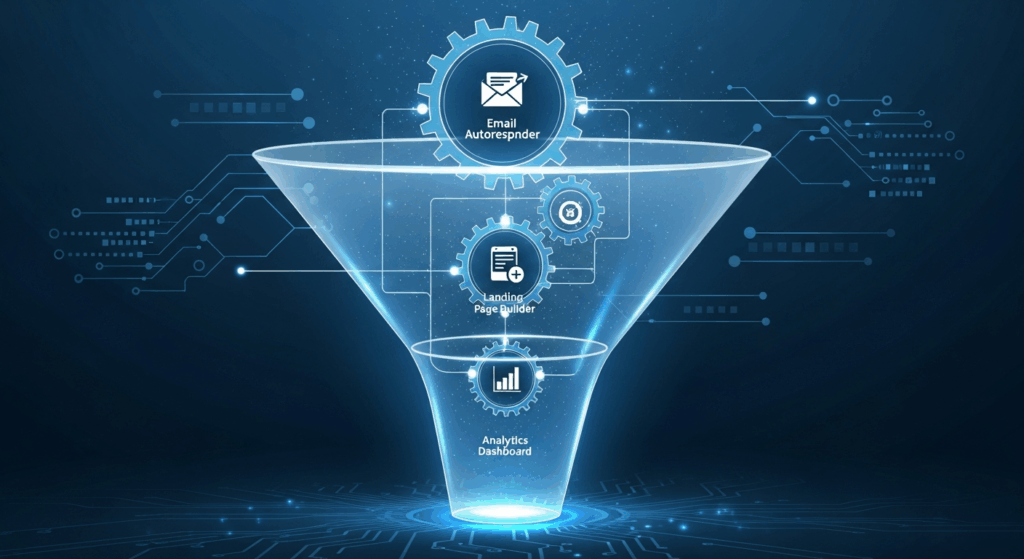
This is where the word “passive” truly comes to life. Your manual work is done. Now you need to install the engine that runs 24/7. Achieving true passive income is impossible without robust Affiliate Marketing Automation.
Assembling Your Core Automation Tool Stack
You can't build a passive income machine with manual processes. The right tools transform your funnel from a side hustle into an automated asset that generates revenue around the clock.
Here's the essential tool stack I use:
- Email Autoresponder/CRM: This is your command center. I recommend GetResponse or Kit.com (formerly ConvertKit) for their robust automation capabilities and affiliate-friendly policies. These platforms let you create sophisticated email sequences that trigger based on user behavior—opens, clicks, purchases—without you lifting a finger. GetResponse's visual automation builder makes complex sequences simple, even for beginners.
- Landing Page Builder: Speed matters. You need to test variations quickly without waiting on developers. ClickFunnels and OptimizePress are my go-to choices because they offer pre-built templates optimized for conversions. Within an hour, you can have a professional squeeze page live and collecting emails. The built-in A/B testing features let you experiment with headlines, images, and CTAs to continuously improve your opt-in rates. If your site is running on WordPress like me, OptimizePress is your best choice.
- Tracking/Analytics: You can't optimize what you don't measure. Google Analytics 4 tracks traffic sources and user behavior through your funnel, showing exactly where people drop off. Pair this with your affiliate network's tracking dashboard (most platforms like ShareASale and ClickBank provide detailed analytics) to monitor click-through rates and conversion data. I check these metrics weekly to identify bottlenecks and opportunities for improvement.
The investment in these tools—typically $100-200/month combined—pays for itself quickly when your funnel starts converting consistently.
Writing a High-Converting 7-Day Email Nurture Sequence
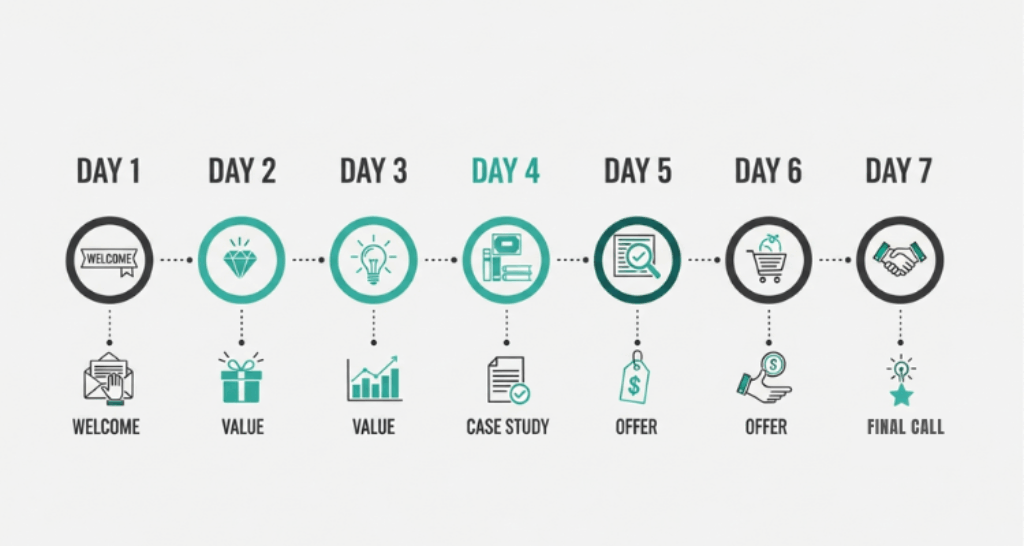
Once someone opts in, your email sequence does the heavy lifting. This is where trust transforms into sales. Here's my proven 7-day framework:
- Email 1 (Welcome & Value): Immediately deliver your lead magnet and thank the subscriber. Set expectations – tell them what’s coming next and why it’s valuable.
- Emails 2–4 (Value & Trust): Share case studies, quick wins, or actionable tutorials that demonstrate your expertise. This is where you handle common objections and establish credibility through social proof and results.
- Emails 5–7 (Pitch & Urgency): Transition smoothly into your offer. Emphasize transformation, not features. Introduce scarcity or time-sensitive bonuses only if they’re genuine. End with a clear, benefit-driven call to action.
Strategic Tip: Segment your list based on engagement. According to FluentCRM, segmented emails get over 100% more click-throughs and marketers see up to 760% revenue boost from segmentation. Most autoresponders let you tag subscribers who click certain links or ignore emails. Use that data to adjust your messaging – send warm leads deeper content and re-engage cold ones with alternative angles.
With automation, every email becomes a digital salesperson that works tirelessly behind the scenes. Done right, your funnel doesn’t just sell products – it builds trust, authority, and recurring income, creating a truly passive revenue engine.
Part 4: Traffic & Optimization
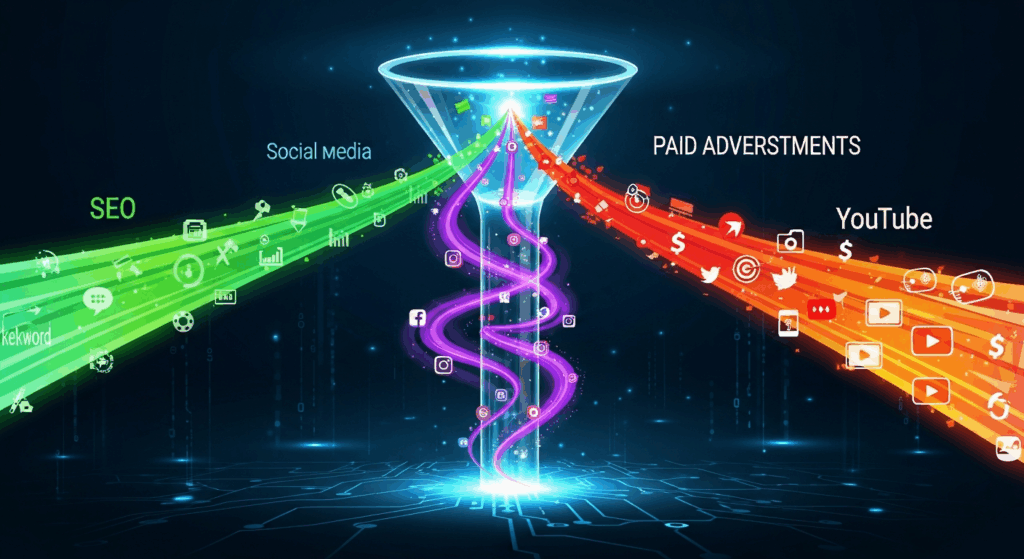
You've built the asset. Now, how do you fuel the engine and ensure your Strategic Affiliate Marketing Funnel is hitting peak performance? The final stage is all about driving quality traffic and relentlessly optimizing every component.
Driving Targeted Traffic to the Top of the Funnel (Awareness Stage)
A perfect funnel means nothing without traffic. You need a steady stream of targeted visitors entering at the awareness stage, and you have two primary strategies to make that happen.
Organic Strategy (Passive, Long-Term):
Content marketing and SEO targeting “problem-aware” keywords is my foundation for sustainable traffic. Instead of chasing high-competition terms like “best email marketing,” I target specific pain points: “how to stop email subscribers from unsubscribing” or “why my marketing emails go to spam.”
These problem-aware keywords attract people actively searching for solutions—exactly who you want entering your funnel. Create comprehensive blog posts (1,500+ words) that genuinely solve problems, then naturally introduce your lead magnet as the next step. Build keyword clusters around your niche, interlinking related content to establish topical authority. This approach takes 3-6 months to gain traction, but once ranking, it delivers free, qualified traffic indefinitely.
Voice search optimization has also become crucial in 2025, contributing to a 15% increase in organic traffic for mobile users entering affiliate funnels.
Paid Strategy (Fast, Scalable):
When you need results now, paid ads deliver. Facebook Ads and Google Ads let you target specific demographics with laser precision. The key is matching your ad messaging directly to your lead magnet.
If your lead magnet is “5 Email Templates for Course Creators,” your Facebook ad should target people interested in online courses, digital products, and email marketing—not generic “business owners.” The tighter your targeting, the higher your opt-in rate and the lower your cost per lead.
Start with a $10-20 daily budget, test multiple ad variations, and scale what works. I've seen affiliates profitably acquire leads for $2-5 each using highly aligned lead magnets. Multi-channel traffic sources (combining SEO, paid ads, and social media) generate 2x the affiliate revenue compared to relying on a single channel.
Continuous Optimization: A/B Testing for Higher Conversions
Your initial funnel is just version 1.0. Real profit comes from relentless optimization. Track these critical drop-off points:
- Squeeze page CTR: How many visitors actually opt in? If you're below 25%, your headline or offer needs work.
- Email open rates: Are people reading your emails? Under 20% open rates signal weak subject lines or list quality issues.
- Bridge page conversions: What percentage of email clicks turn into affiliate clicks? Low numbers here mean your bridge page isn't pre-selling effectively.
Here's what to A/B test systematically:
Test headlines first—they have the biggest impact. Try benefit-driven vs. curiosity-driven approaches. Change one lead magnet offer against another (template vs. checklist). Experiment with CTA button colors (high-contrast colors typically win). Test email subject lines ruthlessly—your best-performing subject lines can double open rates.
According to 2025 data, 60% of affiliates report that funnel analytics and A/B testing were crucial in improving conversions. Set these benchmark metrics:
- 30% opt-in rate on your squeeze page (anything above 40% is excellent)
- 25-35% email open rates
- 15-20% click-through rate from email to bridge page
- 5-10% conversion rate from bridge page to affiliate purchase
If you're consistently hitting these numbers, you have a profitable funnel worth scaling.
Monitoring Key Metrics for Sustainable Passive Income
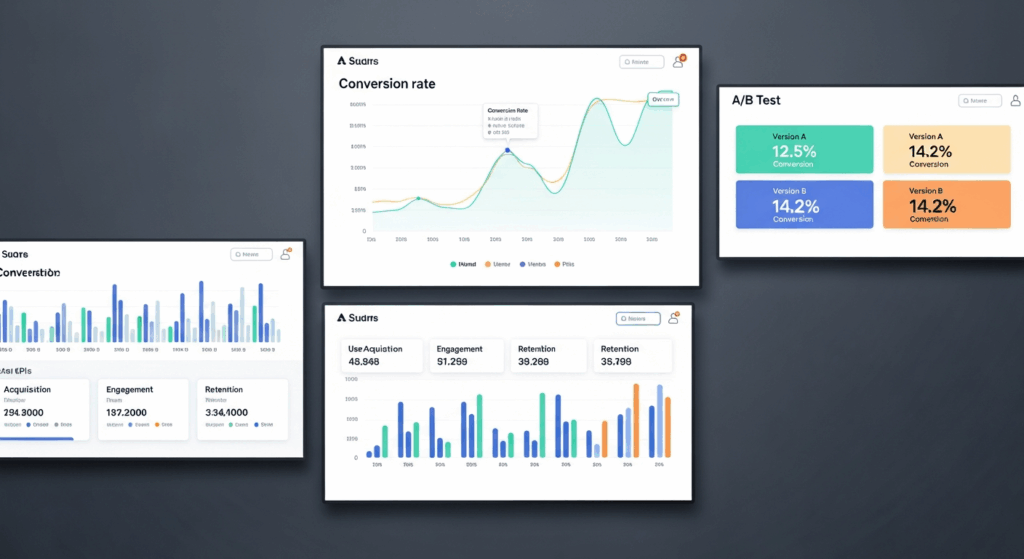
Vanity metrics like traffic and email list size don't pay bills. Focus on profitability metrics:
- CPA (Cost Per Acquisition): If you're spending $50 in ads to acquire a customer who generates a $30 commission, you're losing money. Your earnings per customer must exceed your acquisition cost, ideally by 3x or more for sustainable growth.
- EPC (Earnings Per Click): This tells you how much each click to your affiliate offer is worth. Top-performing affiliate products show EPC above $1.00. If your EPC is $0.15, either your traffic is poorly targeted or your product doesn't convert well.
Review your commission reports weekly. For recurring commission programs, monitor monthly retention rates—are customers staying subscribed or churning after one month? A SaaS affiliate earning $30/month per customer needs to track how many customers remain active after 6, 12, and 24 months. That's where real passive income compounds.
I check Google Analytics and my affiliate dashboard every Monday morning. This 15-minute review tells me exactly what's working, what's broken, and where to focus my optimization efforts for the week ahead.
Common Pitfalls & How to Avoid Them
Building a Strategic Affiliate Marketing Funnel isn't complicated, but it's easy to trip over common mistakes that kill your profitability and sabotage your passive income growth.
- Treating Affiliate Traffic Like Regular Traffic (Ignoring Trust Transfer): This is the biggest mistake. Your traffic doesn't know the merchant. They know you. Skipping the Bridge Page and sending traffic directly to a sales page ignores the necessary trust transfer from your brand to the product. Avoid it: Use the bridge page to validate the problem and introduce yourself as the trusted solution-provider.
- Overcomplicating Too Early: You don’t need six funnels, ten products, and a $1,000 CRM on day one. Start with one high-value, recurring commission product and one simple Lead Magnet Funnel. Avoid it: Build and optimize the simplest version first, then scale.
- Not Aligning Incentives: Promoting low-commission, one-time sale products means you’re doing the work for pennies. Your incentive (profit) doesn't align with the effort. Avoid it: Prioritize high-ticket offers and recurring commission programs, ensuring a high Earnings Per Click (EPC).
- Poor Tracking & Mis-Attribution: If you can't see which email or traffic source led to the sale, you’re flying blind. You can’t optimize what you can't measure. Avoid it: Use robust Affiliate Link Tracking Tools and dedicated sub-IDs in your links.
- Inconsistent Affiliate Support & Communication: You are representing a brand. Ignoring customer questions or being unresponsive damages your credibility. Avoid it: Be ready to answer pre-sale questions and quickly point buyers to the vendor’s support team if issues arise.
- Violating Affiliate Disclosure / Compliance Rules: Your business is built on trust. Ignoring FTC rules or the terms of service of the affiliate platform is a liability. Avoid it: Clearly and conspicuously place your FTC Affiliate Disclosure on every page where an affiliate link appears, especially your Bridge Page.
Conclusion: Your Blueprint for Passive Income Mastery
A strategic affiliate marketing funnel isn’t just a tactic – it’s an asset that works while you don’t. When built with precision, it attracts the right audience, nurtures trust and converts attention into predictable income.
Remember the core structure:
- Choose a high-value, recurring commission product that truly helps people.
- Create a compelling lead magnet that solves an immediate problem.
- Build a bridge page that transfers trust through authenticity.
- Set up automation that nurtures leads and sells on autopilot.
This is how modern affiliate marketers achieve scalability and freedom – by engineering a system that runs 24/7 with measurable, ethical precision.
Start today. Choose your first recurring program, design your lead magnet, and map out your 7-day nurture sequence. You’re not just building a funnel; you’re building a digital asset that pays dividends for years to come.
👉 Explore our guides on Best Recurring Affiliate Programs or How to Automate Your Way to Real Profits in 2025 to begin your journey.