Chadrack
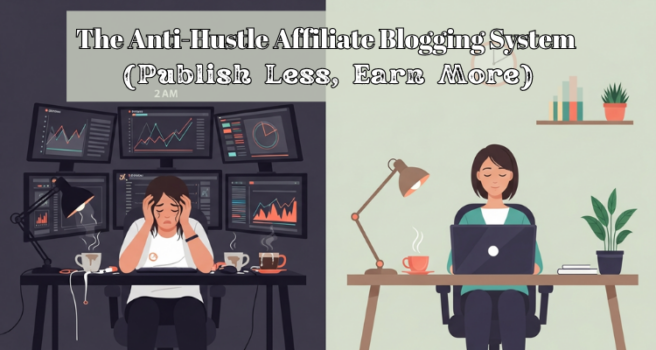
It's 2 AM, and you're staring at your analytics dashboard again. You've published five posts this week—just like the gurus told you to—but your affiliate income barely moved. Your eyes burn, your coffee's gone cold, and you're starting to wonder if this whole “content is king” thing is just a cruel joke.
But, here’s the uncomfortable truth: more content does not automatically mean more money. In fact, for most affiliate blogs, publishing more often leads to more stress, more shallow posts, and the same disappointing results. This is the affiliate blogging paradox. You can work harder, publish more, and still stay stuck.
Hustle culture made this worse. Somewhere along the way, content marketing turned into a numbers game. Post daily. Post faster. Post more. But Google changed. Readers changed. And burnout became normal.
Well, there is another way.
In this guide, you’ll learn the anti-hustle affiliate blogging system—a strategic approach where you publish less, but each post works harder for you. Instead of churning out mediocre posts like a content factory, you'll create fewer, deeply valuable pieces that rank higher, convert better, and generate passive income for years.
So, if you are tired of grinding and ready for a calmer, more profitable approach, this is for you.
DISCLOSURE: WebIncomeJournal is supported by readers like yourself. We may earn an affiliate commission when you purchase through our links, which helps us offer our content for free. Learn more here.
What Is the Anti-Hustle Affiliate Blogging System? (And Why It Works)
The anti-hustle affiliate blogging system is a strategic way to build an affiliate blog that focuses on fewer posts, deeper research, and higher conversion intent. Instead of publishing three to five posts per week, you publish less often and invest more time into each piece. The goal is simple. Each article should be strong enough to rank, earn trust, and sell on its own.
This is not a lazy system. It is a high-effort, high-leverage system. You trade volume for impact. You stop chasing page counts and start building assets.
This approach works because affiliate blogs do not win by being noisy. They win by being useful. According to NewMedia, 65% of affiliate publishers rely on content sites and blogs as their main revenue source [NewMedia, 2024]. The winners in that group are not the ones publishing the most. They are the ones publishing the most helpful.
The Core Principles of Anti-Hustle Affiliate Blogging
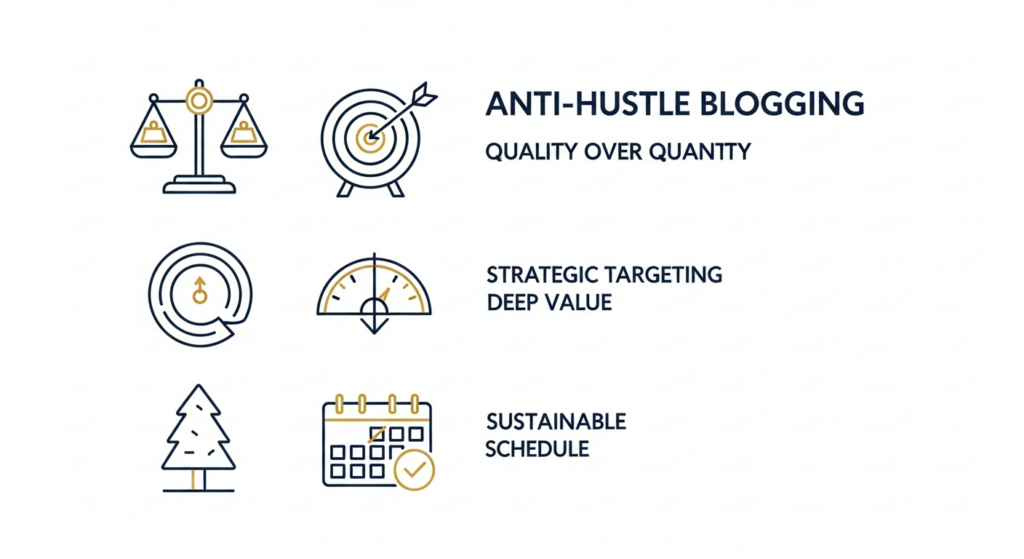
At the center of this affiliate blogging system are five rules:
- Quality over quantity. One strong guide can outperform ten weak posts. Long-form, in-depth content earns more links, more time on page, and more trust.
- Strategic keyword targeting beats spray-and-pray. You target keywords with buyer intent instead of writing about everything in your niche.
- Deep reader value beats shallow content. Every post must solve a real problem completely.
- Sustainable publishing schedules. You publish at a pace you can maintain for years, not weeks.
- Evergreen, compound-interest content. You build pages that keep earning long after you hit publish.
How Traditional Affiliate Blogging Advice Got It Wrong
The “post daily” advice came from an older internet. It no longer fits how search and readers work.
Quantity-first strategies burn people out because they reward speed over thinking. They also fail in search. Google now favors depth, expertise, and usefulness. According to statistics by NewMedia (quoted above), blogs that combine SEO and real value drive the majority of affiliate revenue in the industry.
On the engagement side, data from Wix shows that the average blog conversion rate is about 5%, but search visitors with strong intent convert up to 14.6%, compared to 1.7% for low-intent traffic [Wix, 2023]. Thin content attracts the wrong traffic. Deep content attracts buyers.
Why Does Publishing Less Actually Help You Earn More?
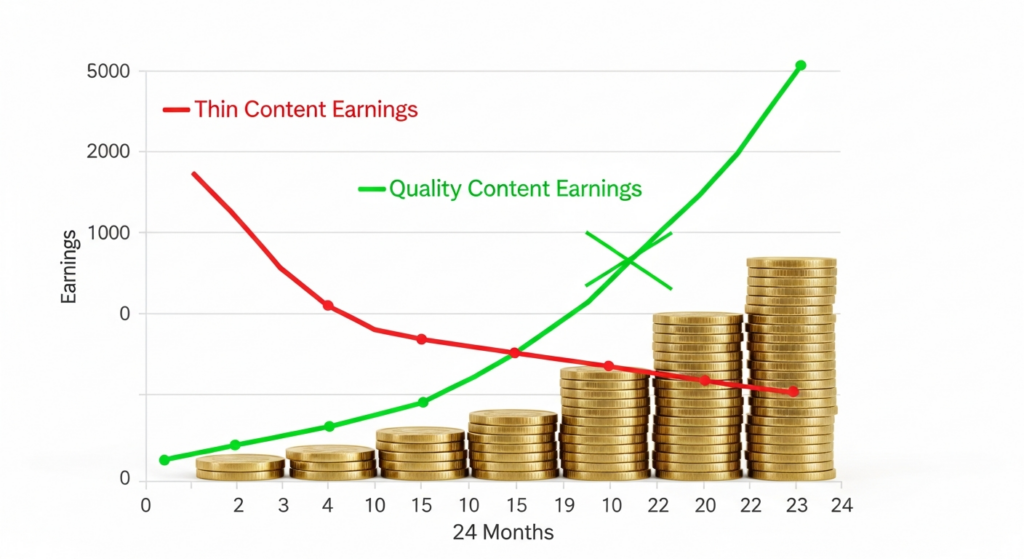
Publishing less doesn't mean working less; it means working smarter. Strategic, well-researched affiliate content outperforms high-volume mediocrity in every metric that matters: search rankings, conversion rates, and long-term passive income. You're not being lazy; you're being strategic.
When you focus on fewer pieces, you can afford to do the work most people skip. Real research. Real comparisons. Real explanations. That is what search engines and readers reward.
The Compound Effect of High-Quality Content
- Evergreen content continues earning for years: Your comprehensive guide to choosing DSLR cameras doesn't expire next month. With occasional updates, it can generate affiliate commissions for five years or more. That's the power of compound-interest content—you do the work once, but it pays you repeatedly.
- Better search rankings = consistent passive traffic: High-quality posts naturally attract backlinks from other websites, social shares, and prolonged engagement—all signals that boost your search rankings. Once you hit page one for a commercial keyword, you've got a traffic machine that runs 24/7 without additional promotion.
- Higher engagement = better conversion rates: When readers spend 10 minutes on your ultimate guide instead of 30 seconds on a thin listicle, they develop trust. They see you as an authority, not just another affiliate pushing products. That trust directly translates to clicks and conversions.
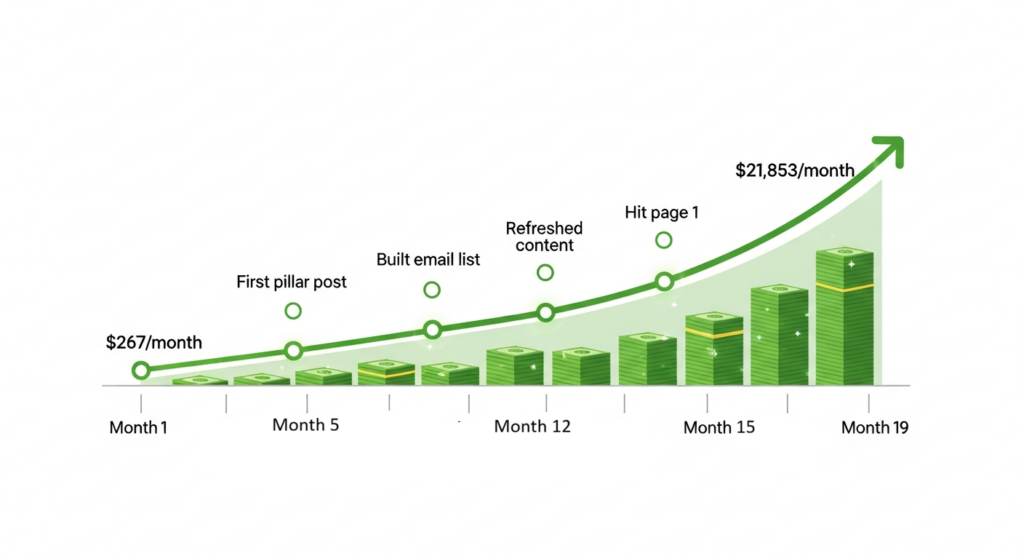
You can see this pattern in slow-growth blogs like Wait But Why, which publishes rarely but dominates its topics because each article is unusually deep and original. In affiliate marketing, the same pattern shows up again and again. One documented case study from Reddit shows a site growing from $267 per month to $21,853 per month in 19 months by focusing on fewer, higher-quality Amazon-focused pages.
How Do You Build Your Anti-Hustle Affiliate Blogging System?
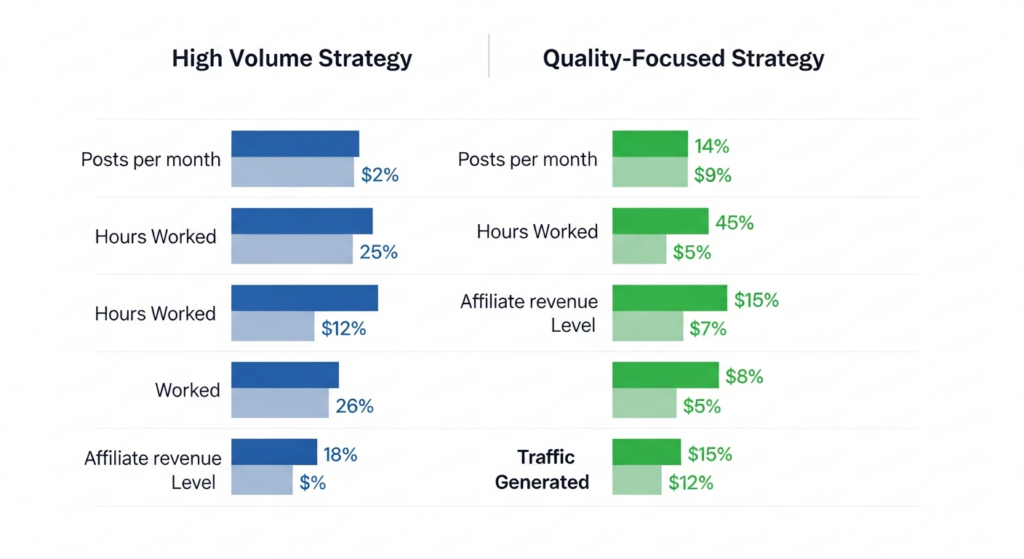
The anti-hustle affiliate blogging system works because it is simple, focused, and repeatable. You are not building a content factory. You are building a small set of high-value assets that earn for a long time.
Here is how to set up your anti-hustle affiliate blogging system.
Step 1: Choose Your Niche Strategically (Not Broadly)
- Narrow niches vs. broad topics: Here's where most new affiliate bloggers go wrong—they choose “fitness” or “personal finance” thinking broader means more opportunity. Wrong. Broad niches mean competing against established authority sites with massive budgets. Instead, go narrow: “home gym equipment for apartment dwellers” or “budgeting apps for freelancers.” Narrow niches let you dominate a specific space and build real topical authority.
- Assessing affiliate program quality in your niche: Not all niches offer equally profitable affiliate programs. Before committing, research the commission structures available. Software and digital products often offer 20-50% recurring commissions. Physical products through Amazon Associates might only pay 1-3%. High-ticket affiliate programs in niches like web hosting or business tools can mean $50-200 per conversion. Run the math: would you rather make 100 sales at $3 each or 10 sales at $100 each?
- Competition analysis for realistic expectations: Use tools like Ahrefs or SEMrush to check the domain authority of sites ranking for your target keywords. If page one is dominated by sites with DA 60+, you'll struggle as a new blog. Look for niches where DA 20-40 sites rank well—that's your opportunity zone.
- Finding the sweet spot: passion + profitability + expertise: The magic happens where three circles overlap. You need genuine interest (or you'll burn out), profitable affiliate programs (or you won't earn), and some level of expertise or willingness to develop it (or you won't build authority). I've been building niche affiliate sites since 2018, and every successful one hit all three criteria.
Step 2: Research Keywords Like Your Income Depends on It (Because It Does)
- Long-tail keyword targeting for less competition: Forget “running shoes,”that's a battlefield you'll lose. Target “best running shoes for plantar fasciitis under $100” instead. These long-tail keywords have lower search volume but way higher buyer intent and far less competition. That's where new affiliate blogs actually rank and earn.
- Commercial intent keywords vs. informational: Not all keywords make money. What is affiliate marketing” is informational, readers are learning, not buying. “Best email marketing platform for small business” screams commercial intent—someone's ready to make a purchase decision. Focus 80% of your content on commercial and transactional keywords where affiliate links make sense.
- Using tools: Ahrefs, SEMrush, free alternatives: Premium tools like Ahrefs and SEMrush give you keyword difficulty scores, search volume, and competitive analysis. They're worth the investment if you're serious. Can't afford them yet? Start with free alternatives like Google Keyword Planner, Ubersuggest, or AnswerThePublic. They're not as comprehensive, but they'll get you started.
- Creating a strategic keyword bank (not a content calendar): Stop planning 52 weeks of content topics. Instead, build a bank of 50-100 high-value keywords you could eventually target. Organize them by difficulty and intent. When you're ready to create content, pick the most strategic keyword from your bank—one you can realistically rank for that aligns with quality affiliate programs.
Step 3: Plan Your Pillar Content Strategy
- What is pillar content and why it matters: Pillar content is your comprehensive, authoritative guides on core topics in your niche. Think 3,000-5,000-word ultimate resources that cover a subject exhaustively. These posts become the foundation of your site—they attract backlinks, rank for multiple keywords, and establish you as an authority. Every successful niche affiliate blog has 10-20 pillar posts driving most of their traffic and income.
- Identifying your 10-20 core topics: What are the essential subjects someone needs to master in your niche? For a blog about home coffee brewing, pillars might include “Ultimate Guide to Espresso Machines,” “Complete French Press Tutorial,” “Coffee Bean Selection Guide,” and so on. These topics should be broad enough to merit comprehensive treatment but specific enough to your niche positioning.
- Building topical clusters: Each pillar post becomes the hub of a content cluster. Your espresso machine guide links to supporting posts about “How to Clean Espresso Machines,” “Best Budget Espresso Machines Under $500,” and “Espresso vs. Drip Coffee Comparison.” This internal linking structure shows Google you have deep expertise and helps all your content rank better.
- Creating content that answers multiple related queries: Your pillar posts shouldn't just target one keyword—they should comprehensively answer dozens of related questions. Use tools like “People Also Ask” in Google search results or AnswerThePublic to find every question people ask about your topic. Then answer all of them in one authoritative resource.
Step 4: Create Exceptional, Conversion-Focused Content
- Research depth requirements (5-10 hours per post vs. 1 hour): This is where the anti-hustle system demands more per piece but less overall. Plan to spend 5-10 hours on each pillar post: researching competitors, testing products yourself, gathering data, outlining strategically, writing thoroughly, and optimizing for SEO. Yes, that's significantly more than rushing out a 1-hour post. But one 10-hour post that earns $500/month beats ten 1-hour posts earning $20 each.
- Structuring content for both readers and SEO: Use clear H2 and H3 subheadings that include your keywords naturally. Break up text with bullet points, numbered lists, and short paragraphs for scannability. Include a table of contents for longer posts. Answer the primary question in your introduction, then provide comprehensive details in the body. This structure keeps readers engaged (lower bounce rate) while making it easy for search engines to understand your content.
- Strategic affiliate link placement: Don't blast affiliate links everywhere, it screams desperation and tanks trust. Place links naturally within product reviews, comparison tables, and specific recommendations. I typically include 3-5 affiliate links in a 2,000-word review post, always with proper disclosure. Links work best in context: “After testing 12 standing desks, the Uplift V2 offers the best balance of stability and price” (linked) converts far better than “Check out standing desks here” (linked).
- Adding unique value: original data, case studies, personal experience: This is what separates exceptional content from mediocre regurgitation. Share your actual experience using products. Include original photos or videos. Document your own experiments and results. One blogger hit $150,000 per year with affiliate marketing by focusing on genuine, user-friendly content backed by personal testing—not just rewriting manufacturer specs.
Step 5: Optimize for Maximum Passive Income
- On-page SEO best practices: Use your target keyword in your title tag, URL, first 100 words, and naturally throughout the content. Include semantic variations and related terms. Optimize your meta description to drive clicks from search results. Add descriptive alt text to images. Use schema markup for product reviews and comparison posts—this helps you appear in rich search results. Tools like Rank Math SEO or Yoast make this straightforward even for beginners.
- Strategic internal linking: Every new post should link to 3-5 relevant existing posts on your site. Every pillar post should receive links from multiple supporting articles. This creates a web of topical authority that Google rewards. Use descriptive anchor text: “our guide to WordPress hosting for bloggers” rather than “click here.” Internal links distribute ranking power and keep visitors on your site longer.
- Email capture integration: Affiliates using email newsletters earn 35% more revenue per subscriber than blog-only setups, according to research on affiliate marketing. Add email opt-ins to every post—offer a downloadable checklist, template, or bonus guide related to your content. Tools like ConvertKit, GetResponse, or FluentCRM make this easy. Your email list becomes a direct channel for promoting affiliate content without relying solely on search traffic.
- Updating and improving existing content: Your published posts aren't finished—they're assets to maintain and improve. Every 6-12 months, review your top-performing content. Update statistics, add new product options, refresh outdated screenshots, and improve sections that could be clearer. Google loves fresh, updated content, often rewarding updates with ranking boosts. Sometimes refreshing an existing post delivers better ROI than creating a new one.
What Should Your Anti-Hustle Publishing Schedule Look Like?

There is no magic number. But most quality-first affiliate blogs publish 1 to 4 high-value posts per month. That might sound low if you're used to “post daily” advice, but remember: one exceptional 3,500-word guide that ranks and converts beats seven rushed 800-word posts that disappear into the void.
The key word here is sustainable. A schedule you can maintain for three years will always outperform an aggressive pace you abandon after three months. I've watched countless bloggers quit because they pushed too hard, too fast. Don't be that person.
Finding Your Sustainable Rhythm
- Weekly vs. bi-weekly vs. monthly publishing: If you can dedicate 10-15 hours per week to your blog, weekly publishing of comprehensive posts is achievable. Got 5-7 hours weekly? Bi-weekly makes more sense. Only have weekends? Monthly deep-dives work fine—just ensure you're genuinely consistent. The blogger who published one exceptional post monthly for two years will outperform the blogger who published daily for three months then quit.
- How to batch content creation: Batching saves mental energy and increases efficiency. Dedicate one day to keyword research and outlining for multiple posts. Spend another day writing drafts. Set aside time for editing and optimization separately. When you batch similar tasks, you avoid the cognitive switching costs of jumping between research, writing, and editing. Some bloggers batch-create a month's worth of content in one intense weekend, then focus on promotion and optimization during the month.
- Balancing consistency with quality: Consistency matters for SEO and audience trust, but quality matters more. If you normally publish bi-weekly but need three weeks for an exceptionally comprehensive guide, take it. Readers and search engines will reward that depth. However, disappearing for three months tanks your momentum. Find the balance: consistent enough to build authority, flexible enough to maintain quality.
- Signs you're publishing too much (or too little): Publishing too much looks like declining content quality, dreading your writing sessions, rushing research, or skipping SEO optimization because you're racing to hit your quota. Publishing too little looks like losing momentum, forgetting your content strategy, letting competitors dominate your target keywords, or publishing so irregularly that you're essentially restarting each time. You're in the sweet spot when each post meets your quality standards and you're actually excited to create content.
How Do You Choose the Right Affiliate Programs for This System?
Quality-focused blogging demands equally quality affiliate partnerships. You're investing serious hours into each piece of content, so the programs you promote need to deliver strong commissions, convert well, and genuinely serve your audience. Promoting mediocre products with poor commission structures wastes the value you've built through exceptional content.
- Commission structure analysis (one-time vs. recurring): One-time commissions pay you once per sale—fine for physical products, but recurring commissions create compounding income. Software affiliate programs like ConvertKit or web hosting providers often offer 20-50% recurring monthly commissions. Promote a $50/month tool at 30% recurring, and each customer generates $15 monthly for as long as they subscribe. That's passive income that actually compounds. According to affiliate marketing insights, 46% of B2B companies adopted affiliate programs in 2026, up from 32% in 2020—many offering lucrative recurring structures.
- Cookie duration importance: Cookie duration determines how long you get credit for a sale after someone clicks your link. Amazon Associates offers just 24 hours—if someone clicks today but buys tomorrow, you earn nothing. Other programs offer 30, 60, or even 90-day cookies. Longer durations mean higher conversion rates on your traffic, especially for high-consideration purchases.
- Product quality and audience alignment: Never promote garbage just because commissions are high. Your reputation is your biggest asset in the anti-hustle system. Promote products you've actually used, believe in, and would recommend to friends. If you're targeting budget-conscious freelancers, don't push premium enterprise tools they can't afford.
- Top affiliate networks for bloggers: ShareASale and CJ Affiliate offer thousands of programs across diverse niches with solid tracking and reliable payments. Amazon Associates works well for physical products despite low commissions (1-3%). ClickBank specializes in digital products with higher commissions. Impact and Awin serve mid-to-large brands. Platform-specific programs like the Amazon affiliate program or niche-specific networks often convert better than broad marketplaces.
- Warning signs of bad affiliate programs: Red flags include unclear commission terms, delayed or unreliable payments, poor product quality, low conversion rates despite traffic, short cookie durations with high-consideration products, lack of affiliate support or marketing materials, and programs that prohibit honest reviews or require you to only say positive things. If a program feels sketchy, it probably is—move on.
What Are Common Mistakes to Avoid in Anti-Hustle Affiliate Blogging?
This system fails when people misunderstand it.
The biggest mistake is confusing “less” with “lazy.” You must work more per post, not less.
Other common traps:
- Skipping SEO basics and hoping good writing is enough. It is not.
- Promoting products you do not believe in. This kills trust and long-term income.
- Not disclosing affiliate links. This is both a legal and trust problem.
- Never updating old content. Old winners decay if you ignore them.
- Ignoring analytics. You need data to know what to improve.
- Publishing in bursts, then disappearing. Inconsistency breaks momentum and trust.
A final warning: this system will not work if you are looking for shortcuts. It works for people who want fewer posts, better posts, and a calmer way to build real assets.
Can You Really Make Money Publishing Less Content?
Yes. And there is real data behind it.
Real Income Examples and Case Studies
Multiple case studies show this pattern: fewer pages, higher impact.
One public example shows an affiliate site growing from $267 per month to $21,853 per month in 19 months by focusing on a small set of high-quality Amazon-focused pages [Reddit case study, 2023].
Other documented bloggers report $3,000 to $10,000+ per month while publishing only one or two major pieces of content per month. The difference is not speed. It is depth.
Expect a slower start. This is not a 30-day trick. Most quality-first sites take 6 to 12 months to gain real traction. After that, growth compounds.
Passive income also needs honesty. Content does not run itself. It needs updates. But the work shifts from creation to improvement.
The Financial Math of Quality vs. Quantity
High-volume blogging looks cheaper. It is not.
If you outsource, you pay for many weak posts. If you write yourself, you burn time.
In a quality system, you may spend 8 hours on one post. But if that post earns $500 per month, that is a very different return.
Measure revenue per hour worked, not posts per week.
Over time, fewer strong assets beat many weak ones. That is the real math.
How Do You Transition from Hustle to Anti-Hustle?
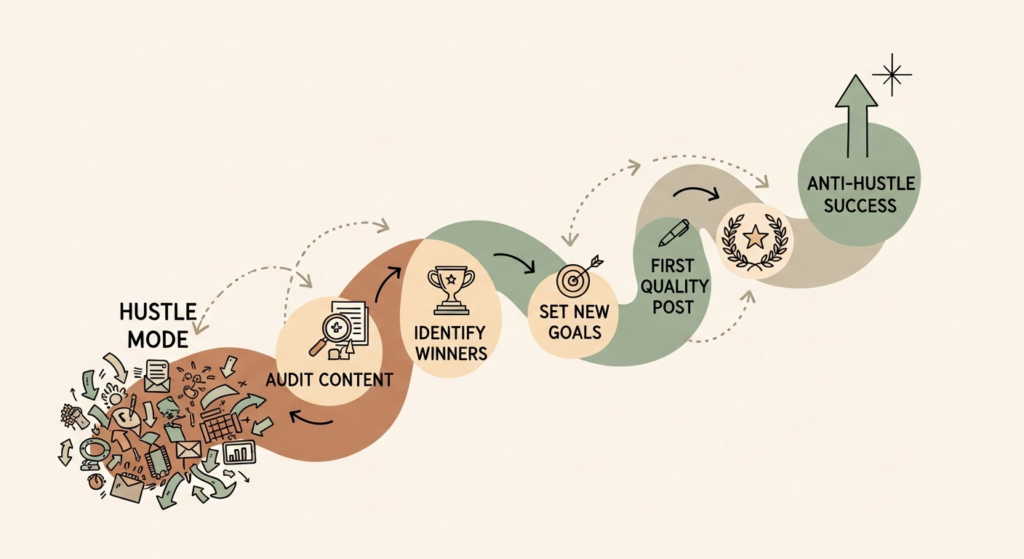
Switching from hustle mode to an anti-hustle affiliate blogging system is not just a strategy change. It is a thinking change.
Start with a content audit. Open Google Search Console and Analytics. Sort your posts by traffic and by clicks. You will almost always see the same pattern. A small number of pages do most of the work.
Mark three groups:
- Winners: pages that already get traffic or sales
- Maybes: pages that rank on page two or three
- Dead weight: thin posts that do nothing
Expand the winners. Improve the maybes. Merge or remove the dead weight.
Next, set new publishing goals. Replace “I must post every week” with “I will publish one great piece every two or four weeks.” This feels slow at first. It is not.
Manage your expectations. Traffic may dip while you clean things up. That is normal. You are trading noise for signal.
If you already have an audience, tell them what you are doing. Say you are focusing on fewer, better resources. Most people will respect that.
This transition usually takes three to six months. After that, your work feels calmer. And more effective.
Conclusion: Slower, Smarter, and Finally Profitable
The anti-hustle affiliate blogging system challenges everything conventional wisdom teaches about content marketing. Instead of grinding out daily posts until you burn out, you publish strategically—less frequently but with significantly more depth, research, and value. This isn't laziness; it's intelligent resource allocation that respects both your time and your readers' attention.
Remember the core philosophy: sustainable success comes from strategic quality, not frantic output. One comprehensive guide ranking #1 for a commercial keyword generates more affiliate income than ten rushed posts scattered across page three of search results. The data backs this up—65% of affiliate publishers rely on blogs as their primary revenue source, but winners focus on depth, not frequency.
Ready to implement the anti-hustle approach? Download our free content planning template to map out your pillar content strategy and keyword bank.