The Real Difference Between Traffic and Income in Affiliate Blogging


You’ve heard it said that traffic is the lifeblood of affiliate marketing, right? What if I told you that more traffic does not automatically mean more money from your blog?
While this sounds counterintuitive, it is nevertheless the truth. I've seen this play out dozens of times—bloggers obsessing over pageviews while their bank accounts stay flat. I’ve watched one site pull in 100,000 visitors a month and barely clear $500, while another with 10,000 visitors quietly makes over $3,000 from affiliate offers.
Same internet. Same year. Same tools. Very different outcome.
In my research in the last few months, I’ve discovered that one of the fears of affiliate bloggers, in the face of recent Google updates and AI Overviews impact on organic traffic, is that with traffic getting harder to grow, their affiliate income is already doomed!
While this might be true in some way, it might interest you to know that the real problem is not traffic.
The real problem is how that traffic turns into money.
In this guide, I'll show you why affiliate traffic vs income isn't a 1:1 relationship, why traffic volume is often a vanity metric, and how to shift your thinking from “How do I get more visitors?” to “How do I make each visitor worth more?”
Once you see how this really works, you’ll stop chasing numbers that look good and start building something that actually pays.
TL;DR:
- Traffic does not equal income. Most affiliate sites convert only 0.5% to 1% of visitors, which means 99 out of 100 people leave without buying anything (OpenSend, 2024).
- Income is driven by three levers: quality of traffic, conversion rate, and earnings per click (EPC). Pageviews alone do not matter.
- 10,000 targeted visitors can beat 100,000 random ones if the intent, offer, and page match.
- Pros track revenue per visitor or per page, not sessions or impressions (FatStacksBlog, 2023).
- The business is not “get traffic.” The business is “turn the right traffic into cash at a high enough EPC that you can scale without going broke.”
DISCLOSURE: WebIncomeJournal is supported by readers like yourself. We may earn an affiliate commission when you purchase through our links, which enables us to offer our content for free. Learn more here.
What Does “Traffic” Really Mean in Affiliate Blogging?
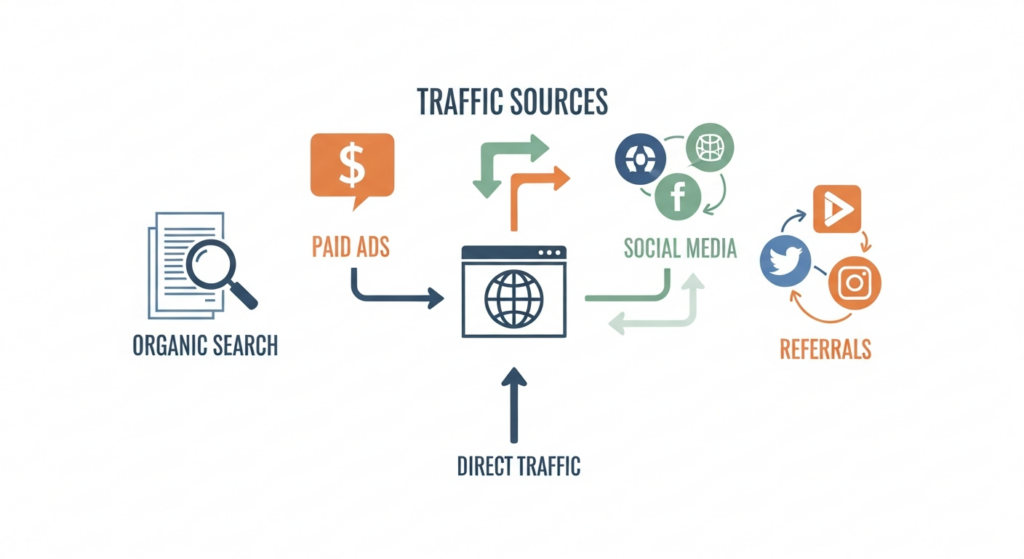
When bloggers talk about “traffic,” they usually mean people landing on their site. But in practice, traffic gets sliced into a few different numbers, and each one tells a slightly different story.
- Pageviews: how many pages were loaded.
- Sessions: how many visits happened.
- Unique visitors: how many actual people showed up.
Here’s the first trap. None of these numbers tell you why someone came or what they planned to do.
And that’s everything in affiliate marketing – the source matters way more than the volume.
Not all traffic behaves the same:
- Organic vs. paid: Organic search traffic usually comes with intent and compounds over time. Paid traffic is fast and scalable, but stops the moment you stop paying.
- Direct, referral, social: Direct and referral often come from people who already trust you. Social traffic can be huge and still bounce in seconds.
- Mobile vs. desktop: Mobile users browse more. Desktop users often buy more. Same page. Very different behavior.
This is why traffic volume alone is a vanity metric.
You can have a viral post, a spike from social media, or a Discover hit and still make almost nothing. The average affiliate link converts at only 0.5% to 1%, and anything above 1% to 5% is considered good (OpenSend, 2024). That means 95 to 99 out of 100 visitors never buy.
So, 100,000 visitors with weak intent can earn less than 10,000 visitors who came looking to buy.
Organic traffic does have one real advantage. It compounds. Once a page ranks, it can send qualified clicks for years. But even then, if the intent is wrong or the page is weak, you’re just compounding the wrong kind of visitors.
The truth is simple.
Traffic is just raw material.
What you do with it is what pays.
What Does “Income” Actually Represent in Affiliate Marketing?
Income is the outcome of how well your traffic performs, not how much you get.
In affiliate blogging, income usually comes from four sources:
- Affiliate commissions – one-time payouts or recurring subscriptions
- Display ads – paid per 1,000 views using RPM models
- Sponsored content – flat fees from brands
- Digital products – courses, tools, or downloads you own
Most bloggers only look at total earnings. That is a mistake.
What matters is how income is calculated and tracked. You need to know revenue by page, by traffic source, and by click. A site earning $2,000 means nothing if it costs $1,700 in ads and tools to run.
This is where gross vs net income matters. Gross income looks good. Net income pays bills.
Income also varies widely by niche. According to compiled affiliate reports and surveys:
- Finance sites average about $9,296 per month
- Pet niches average closer to $920 per month
Same traffic effort. Very different payout ceilings.
Another trap is income spikes. A viral post, a seasonal promo, or a short-term offer can inflate earnings for one month. That feels good, but it is fragile.
Sustainable affiliate income comes from repeatable systems. Pages that convert every week. Offers with stable EPC. Traffic you can predict.
Traffic gets attention.
Income gets freedom.
And confusing the two is why many affiliate sites never move past “almost working.”
Why Doesn't More Traffic Always Mean More Income?

This is where most affiliate bloggers hit a wall. They do everything right to grow traffic—publish consistently, optimize for SEO, promote on social—and watch their visitor count climb while their income barely budges. The disconnect is real and frustrating.
I’ve seen this repeatedly over years. For example, a site with 500,000 visitors a month struggles to break the $2,000 mark whilea smaller site quietly out-earns them because the pages, offers, and intent line up.
Here are the five real reasons the disconnect happens:
- Wrong traffic source for your monetization model: Social traffic might love your content but never click “buy.” SEO or email traffic often does.
- Mismatch between content intent and commercial intent: A “what is” guide brings curiosity. A “best X for Y” page brings buyers. According to FigPii's 2024 conversion research, informational searches convert around 0.5% while transactional searches hit 2-5%.
- Poor conversion optimization: Slow pages, weak CTAs, no trust signals. Even good traffic leaks money.
- Low-value traffic: Wrong countries. Wrong audience. Wrong device mix. Same page. Half the earnings.
- Ineffective monetization strategy: Low-paying programs, weak offers, or relying only on ads when affiliate links would pay more.
How Algorithm Changes Expose the Myth
Here's something most affiliates don't talk about, algorithm updates often hurt traffic without hurting income, or vice versa.
When Google's Helpful Content Update hit in 2023-2024, many sites lost 40-70% of their organic traffic. But affiliates who'd been attracting the right traffic—buyer-intent, high-converting visitors—saw their income stay stable or even grow. Why? The algorithm pruned away the informational, low-converting traffic and kept the money pages ranking.
Meanwhile, sites that had built traffic on fluffy, AI-generated content saw both traffic and income collapse because they'd been attracting the wrong visitors all along.
The bounce rate and engagement metrics told the real story. Sites with 70% bounce rates and 30-second average session durations lost rankings. Sites with engaged visitors (40% bounce, 3+ minutes on page) often maintained or improved positions, and their income reflected it.
The truth? You don’t have a traffic problem. You have a conversion and intent problem.
What is Traffic Quality and Why Does It Matter More Than Quantity?
Traffic quality is the single most important concept in affiliate marketing that nobody talks about enough. You can have all the traffic in the world, but if it's the wrong people, you're running a charity, not a business.
High-quality traffic comes from people who are ready, willing, and able to buy what you're promoting. These visitors have three characteristics:
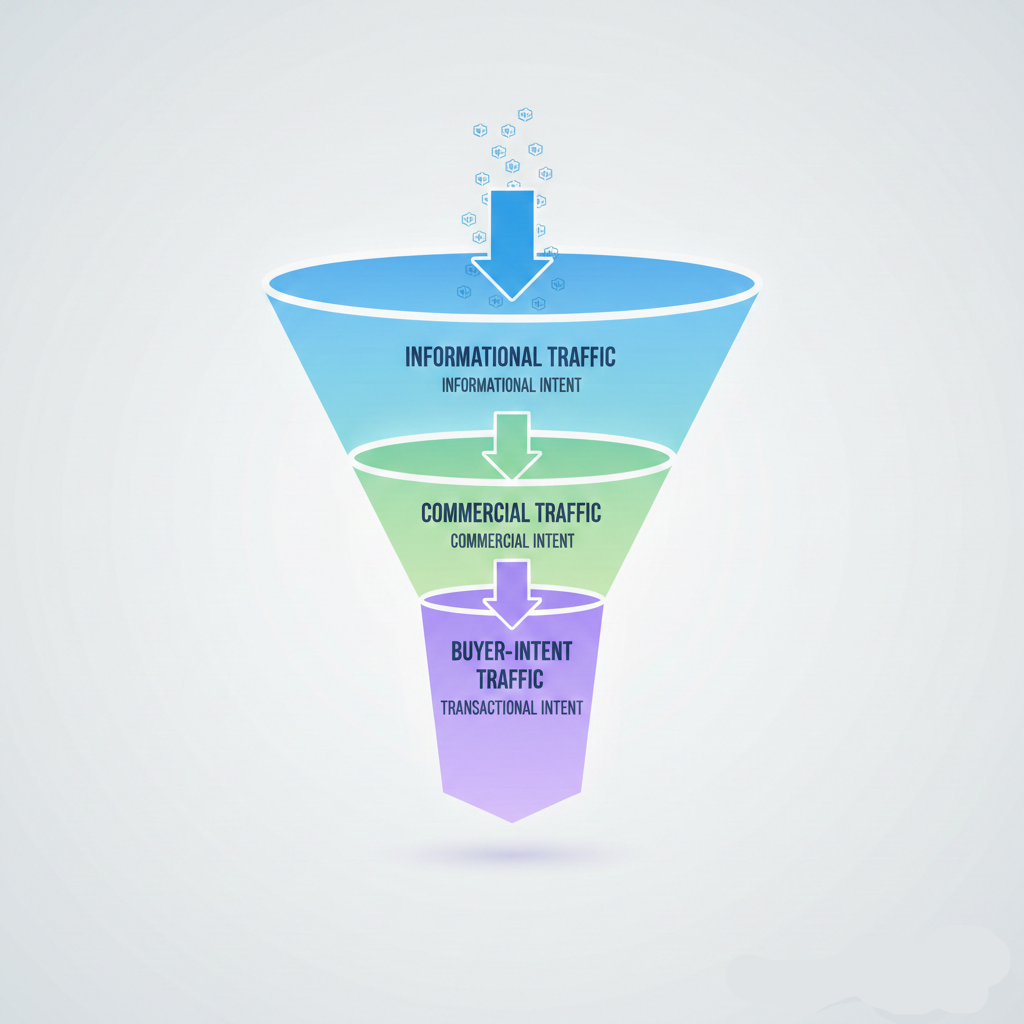
- Buyer intent: “Best laptop for video editing” beats “what is a laptop.” Informational keywords bring readers. Buyer-intent keywords bring wallets. According to OpenSend's conversion data, visitors from buyer-intent keywords convert at 2-5%, while informational keyword traffic hovers around 0.5-1%. That's a 2-10x difference.
- Engagement: These spend more time on site, visit more pages per session. Engaged visitors are telling you they’re getting closer to a decision.
- Right audience: This means your visitors match your offer's ideal customer. If you're promoting premium productivity software aimed at entrepreneurs, traffic from students looking for free alternatives won't convert—even if they're interested in the topic.
Quality Metrics You Should Actually Track
This is why you must track quality metrics, and not just vanity pageviews. Here's what matters:
- Conversion rate by traffic source: Tells you which channels bring buyers versus browsers. Check your analytics: does Pinterest convert at 0.3% while Google organic converts at 1.8%? That's your signal to double down on SEO and stop wasting time on social.
- Average Order Value (AOV): Shows how much people spend when they do buy. Two affiliate programs might both convert at 1%, but if one has a $50 AOV and the other has $200, you're earning 4x more from the same conversion rate.
- Click-through rate on affiliate links: This reveals content effectiveness. If 1,000 people read your review but only 20 click your affiliate link, your content isn't persuasive or your placement needs work.
The Case Study That Proves Quality Over Quantity
Remember that pet blogger from the intro? Here's the full story.
Before the algorithm update, she was getting 50,000 monthly visitors. Sounds impressive. But 35,000 of those visitors came from broad informational content like “why do cats purr” and “funny cat names.” These posts ranked well and drove traffic but converted terribly—around 0.2%.
The remaining 15,000 visitors came from buyer-intent content: “best automatic litter box,” “wet cat food comparison,” and “cat water fountain reviews.” These converted at 2.5%.
When Google's update hit, it pruned the fluffy informational content but kept the buyer-intent pages ranking. Traffic dropped to 15,000, but now ALL of it was high-converting. Her conversion rate went from a blended 0.6% to 2.5%, and her income jumped 40% despite losing 70% of her traffic.
This is what traffic quality looks like in action.
How Do Conversion Rates Bridge the Gap Between Traffic and Income?
Conversion rate is the multiplier that turns traffic into money. You can have all the visitors in the world, but if they don't convert, you're broke. Get this one metric right, and everything else falls into place.
What Is a Conversion in Affiliate Marketing?
In affiliate terms, a conversion happens when someone clicks your affiliate link and completes the desired action—usually a purchase, but sometimes a signup, download, or lead submission depending on your offer type.
Not every click converts. In fact, most don't. After someone clicks your affiliate link, they land on the merchant's site, and that's where the real battle happens. You've done your job (getting the click), but now the merchant's sales page, checkout process, and offer quality determine whether the sale happens.
This creates a two-stage conversion funnel: your click-through rate (how many visitors click your affiliate link) and the merchant's conversion rate (how many clicks become sales). You control the first. The merchant controls the second.
Typical Affiliate Conversion Rate Benchmarks
According to OpenSend's 2024 affiliate statistics, typical affiliate conversion rates break down like this:
- 0.5-1%: Average for most affiliate sites
- 1-5%: Good performance, well-optimized content
- 5-10%: Excellent, usually very targeted traffic or niche products
In broader ecommerce, FigPii's conversion research shows average conversion around 2-5%, with top-performing sites pushing above 10%. This tells you there's massive room for improvement above the typical affiliate baseline.
Context matters. A 3% conversion rate promoting $200 software subscriptions is phenomenal. The same 3% promoting $10 impulse-buy products might not be worth your time once you factor in traffic acquisition costs.
The Conversion Rate Formula
The math is simple:
Conversion Rate = (Number of Conversions ÷ Number of Visitors) × 100
If 10,000 people visit your review page and 150 buy, that's a 1.5% conversion rate.
But here's the more useful calculation:
Revenue = Traffic × Conversion Rate × Average Commission
This formula shows why conversion rate is the leverage point. Double your conversion rate from 1% to 2%, and you double your income—same traffic, same commissions, twice the money.
Conversion rates are shaped by a few core factors:
- Landing page optimization: Does the page answer the buyer’s real question fast?
- Trust and credibility: Real photos, experience, proof, and honest pros and cons.
- Offer relevance and timing: Right product. Right problem. Right moment.
- Page speed and mobile experience: Slow pages kill sales. Mobile now drives most visits.
- Clear calls to action: If you hide the click, you kill the sale.
What's the Difference Between Paid and Organic Traffic for Income Generation?
Paid versus organic traffic isn't just about how visitors find you—it's about completely different business models, profit margins, and strategic approaches to affiliate income. Understanding these differences determines whether you build a sustainable asset or a cash-burning machine.
Organic traffic is a long-term asset. You publish, you rank, and you collect clicks for months or years. This is why 78.3% of marketers rely on SEO as a core channel (HubSpot, 2024). On average, organic affiliate traffic converts around 0.94% with roughly $0.93 EPC in many niches (PostAffiliatePro, 2024).
Vulnerability to algorithm changes is the dark side organic traffic. Google updates can tank your traffic overnight. That pet blogger who lost 70% of her traffic? That's the risk. However, if you're building quality content focused on user satisfaction and EEAT, algorithm updates often hurt your competitors more than you.
Paid traffic, on the other hand, means you buy clicks through Google Ads, Facebook Ads, native advertising (Taboola, Outbrain), or other platforms. You're renting attention, and the meter's always running.
The big advantage is targeting. You can aim ads at exact keywords, interests, or problems. The big risk is math. If your ROAS (return on ad spend) drops below about 1.3:1, you’re working for the ad platform, not yourself.
This is why most serious affiliates use a hybrid approach. SEO builds the asset. Paid traffic stress-tests offers and scales what already works.
As a rough rule, you should only push paid traffic when you can afford to lose the money. That usually means a $3,000 to $5,000 monthly test budget for serious learning.
Across the industry, affiliate marketing averages about $12 in revenue for every $1 spent (industry reports, 2024). But that’s an average. Plenty of campaigns lose money.
Use organic to build.
Use paid to accelerate.
How Does Content Intent Affect Your Affiliate Income?
Content intent is the secret that separates affiliates earning six figures from those stuck at $1,000/month with similar traffic. You can have perfect SEO, beautiful design, and great products—but if your content doesn't match what people are actually trying to do, you won't make money.
Understanding the Three Types of Search Intent
- Informational intent means someone wants to learn something. They're asking “how,” “why,” or “what is.” Examples: “how do noise-canceling headphones work,” “what is affiliate marketing,” “why do cats knead.” These searches drive massive traffic but they don't convert well because the person isn't ready to buy—they're still in education mode.
- Commercial intent signals someone is researching before buying. They're comparing options, reading reviews, and evaluating features. Examples: “best laptop for video editing,” “iPhone 15 vs Samsung S24,” “top productivity apps.” This is the sweet spot for affiliate content.
- Transactional intent means someone is ready to buy right now. They're searching for deals, specific products, or purchase terms. Examples: “buy Sony WH-1000XM5,” “Grammarly discount code,” “Shopify free trial.” These convert at 5-10% but generate less traffic because fewer people search these terms.
Buyer-Intent Keywords That Actually Convert
The most profitable keywords follow specific patterns. These formats consistently outperform:
- “Best [product/category]” keywords attract people comparing options. “Best standing desks” or “best email marketing software” brings visitors who know they want to buy—they just haven't chosen which product yet.
- “[Product] review” keywords target people evaluating a specific option. “Ahrefs review” or “Sony A7 IV review” brings visitors deep in their research who want detailed, trustworthy information before purchasing.
- “[Product A] vs [Product B]” comparison keywords are conversion gold. “Grammarly vs ProWritingAid” or “Shopify vs WooCommerce” attracts people actively choosing between two options.
- “[Product] discount/coupon” keywords bring the highest-intent traffic. Someone searching “Bluehost coupon code” is literally ready to buy—they're just looking for the best deal first.
How Can You Optimize for Income Without Sacrificing Traffic?
Optimizing for income does not mean killing traffic. It means making your existing traffic work harder.
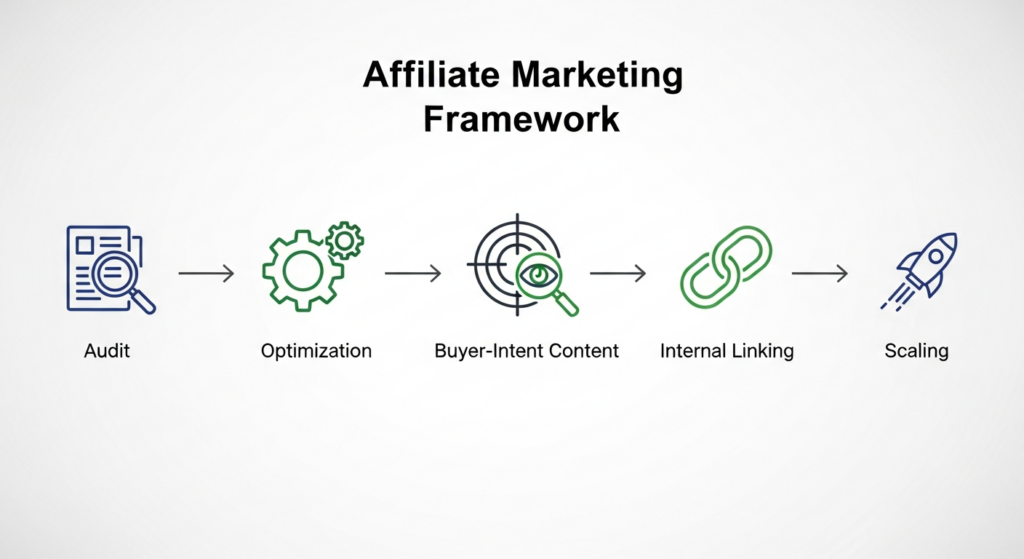
Here is a framework that actually holds up in practice.
- Audit traffic sources and conversion rates: Break traffic down by source. Organic, paid, email, social. Then map conversion rate and EPC to each. This shows where money is already happening.
- Identify top-performing content: Sort pages by EPC and RPM, not pageviews. Your best assets are often not your biggest pages.
- Fix high-traffic, low-conversion pages: These are hidden opportunities. Improve headlines, clarify intent, reposition links, and remove distractions. Small changes here can unlock large gains.
- Create more buyer-intent content: Double down on reviews, comparisons, and “best” posts that already convert. Let data guide what you publish next.
- Improve internal linking to money pages: Guide readers from informational content into pages designed to convert. This increases income without chasing new visitors.
Landing Page Changes That Move Revenue
Focus on fundamentals.
- Above-the-fold clarity matters. Visitors should understand the value in seconds.
- Use clear value propositions. Explain who the product is for and who it is not for.
- Comparison tables work because they reduce decision fatigue.
- Trust badges, disclosures, and real-world experience reduce hesitation.
- Personalized calls to action outperform generic ones. Speak to the reader’s situation, not the product features.
A/B Testing and Mobile Reality
A/B testing does not need to be complex. Test one change at a time. Headlines. CTA placement. Link wording.
Mobile optimization is not optional. About 58% of traffic is mobile, and poor mobile layouts quietly kill conversions.
Extend Value Beyond the First Visit
Email lists raise lifetime value. Email converts higher than most traffic sources because trust is already established.
Diversifying income also reduces risk. Combine affiliates, ads, digital products, and sponsorships where it makes sense.
Tools And Timeline Expectations
Use analytics, affiliate dashboards, link managers, and speed tools to guide decisions.
Most optimizations show early movement in 30 to 60 days. Bigger shifts take a few months.
Income optimization is not a hack.
It is discipline applied consistently.
The Role of Trust: Why Traffic Doesn't Buy from Strangers
People do not buy from pages.
They buy from sources they trust.
This is the real meaning behind Google’s EEAT: Experience, Expertise, Authoritativeness, and Trustworthiness. You can rank without it. You rarely convert without it.
Here’s what happens in real life. A visitor might land on your site to learn. But when it’s time to click “buy,” they ask a quiet question:
“Do I believe this person?”
If the answer is no, they go back to Google.
Trust shows up in practical ways:
- First-hand experience: Real photos. Real screenshots. Real stories.
- Specific opinions: Not “this is great,” but “this part is good, this part is weak.”
- Clear affiliate disclosures: Hiding them kills brand authority. Being open builds it.
- Social proof: Comments, mentions, real usage.
A site with no face, no experience, and no original images feels like a pamphlet. A site with lived experience feels like advice from someone who has already made the mistake for you.
This is why two pages can rank and only one sells.
Traffic gets you a chance.
Trust gets you the click.
What Common Mistakes Kill Affiliate Income Despite Good Traffic?
I’ve audited a lot of affiliate sites. The same problems show up again and again.
Here are the seven that hurt the most:
- Too many ads, not enough content: Pages become cluttered and unreadable. Fix this by prioritizing clarity over monetization density.
- Promoting irrelevant products: If the offer does not match the problem, clicks stall. Only recommend products you would actually choose in that situation.
- Ignoring user experience: Slow pages, poor mobile layouts, and confusing structure push buyers away. Fix the experience first.
- Poor disclosure practices: Hidden or misleading disclosures destroy trust. Be clear and visible.
- Relying on a single traffic source: Algorithm changes happen. Diversify before you are forced to.
- Not tracking the right metrics: Sessions do not pay bills. Track EPC, RPM, and conversion rate.
- Expecting instant results: Affiliate income compounds slowly. Impatience kills consistency.
One mistake deserves special attention. Using AI-generated content without human input. I have seen sites lose over 90% of traffic after publishing unedited, generic content at scale.
Other silent killers include duplicate content penalties, broken affiliate links, and choosing low-commission programs that cap earnings no matter how much traffic grows.
Every one of these mistakes has a fix.
The common thread is trust. Lose it, and traffic becomes noise.
Conclusion: Shifting Your Mindset from Traffic Chaser to Income Optimizer
There you have it, the truth about affiliate traffic and income. As you’ve seen, traffic and income aren't the same thing. Never have been, never will be. But more importantly, now you understand why, and what to do about it.
The real equation isn't Traffic = Income. It's:
Quality Traffic × Conversion Rate × Monetization Strategy = Income
Change any one of these variables, and your earnings shift dramatically. Optimize all three simultaneously, and you build a genuinely profitable affiliate business instead of a high-traffic, low-income content library.
If you want to act on this, start here:
- Audit your current pages and traffic sources.
- Find your highest-converting content and study it.
- Create and prioritize buyer-intent pages.
- Diversify how you earn.
- Track revenue per visitor, not just visitors.
Stop asking, “How do I get more traffic?”
Start asking, “How do I make each visitor worth more?”
Want help with that shift? Then use our free affiliate income calculator and tracker and start measuring the metrics actually matter in your business.
Frequently Asked Questions
How much traffic is needed for affiliate income?
You don't need massive traffic to earn meaningful affiliate income. A site with 5,000 monthly visitors targeting buyer-intent keywords and converting at 2.5% can generate $3,000-5,000 monthly with the right offers and commission structure. Quality matters more than quantity—10,000 targeted visitors often out-earn 100,000 random pageviews. According to ClickBank's research, affiliates can start seeing profits with as few as 10,000 monthly visitors if traffic quality and conversion optimization are strong.
Do affiliate blogs need massive traffic to make money?
No. One affiliate case study showed a site plateauing at 20,000-30,000 monthly sessions but earning consistent income by focusing on high-EPC content rather than traffic volume. Another example: a curated products site generates over $20,000 monthly from Amazon alone with 2.8 million visits, while another affiliate earns similar income from just 50,000 highly targeted visitors. The difference is niche selection, traffic quality, and conversion optimization—not just traffic volume.
What is a good conversion rate for affiliate traffic?
Average affiliate conversion rates range from 0.5% to 1% for typical sites, according to OpenSend's 2024 statistics. Good performance sits at 1-5%, while excellent, highly optimized campaigns can hit 5-10%. Context matters—commercial intent traffic (buyers researching products) converts at 2-5%, while informational traffic (people learning) converts around 0.5-1%. Your target depends on your niche, traffic sources, and content quality, but consistently hitting 2%+ puts you ahead of most affiliates.
Can a blog with 500 visitors/day make money?
Absolutely. 500 daily visitors equals 15,000 monthly—enough to generate meaningful income with the right strategy. At a 2% conversion rate on buyer-intent traffic and $50 average commission, that's 300 conversions generating $15,000 monthly. Even at more conservative 1.5% conversion and $30 commission, you'd earn $6,750 monthly. The key is attracting the right visitors (buyer intent), promoting appropriate offers (decent commissions), and optimizing conversions. Traffic volume alone doesn't determine income—traffic quality and monetization strategy do.
Is affiliate marketing passive income?
Not really. While affiliate commissions can continue flowing from old content (making it more passive than a 9-5 job), successful affiliate marketing requires ongoing work: creating new content, updating existing articles, monitoring program changes, optimizing conversions, building backlinks, and maintaining technical site health. According to CustomGPT's timeline analysis, most affiliates need 6-12 months of active content creation before seeing significant income, and 12-24 months to build truly sustainable revenue. Think “leveraged income” rather than “passive”—your effort compounds over time, but it's never completely hands-off.