Chadrack
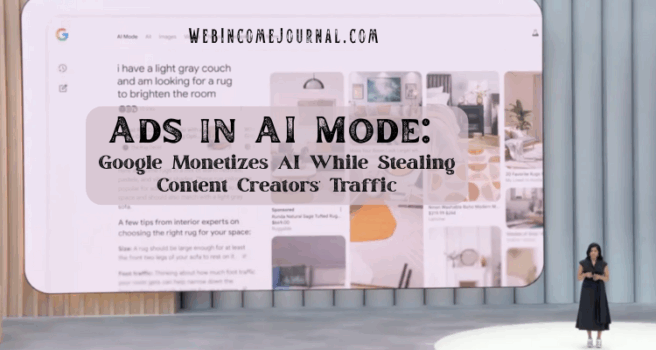
What happens when the platform that promised to democratize information suddenly becomes the biggest threat to the creators who built it?
Just a few weeks ago, in my article: Google's AI Search Revolution and the Looming Crisis for the Open Web, I warned that Google was “sawing off the branch it's sitting on” with its aggressive push into AI-powered search. In that article, I argued that this push would be detrimental to both the creators and Google. This is because Google's business model is fundamentally built on search advertising revenue that comes from people clicking on ads and visiting websites after searching.
Recent studies already suggest that Google understood this very well, even from the beginning. To ensure that its over $200 billion per annum income is not affected by this AI search revolution, Google is working frantically to monetize the very AI responses that are stealing the creators’ audience, while creators watch their revenue streams dry up.
The message is clear: Google has always prioritized its advertising revenue over your survival as a content creator.
This article reaffirms once again that Google is being short-sighted with this new push and requests that Google come up with urgent solutions like revenue sharing and fair attribution.
Key Takeaways:
- Google is embedding ads inside AI-generated answers (called AI Mode and AI Overviews), leading to a sharp decline in clicks to original websites.
- Content creators are fueling these AI answers, but Google is keeping the traffic – and the money.
- Google is prioritizing short-term ad revenue over the long-term health of the content ecosystem that feeds their AI systems.
- Fair revenue sharing between Google and content creators whose work powers AI responses is now urgently needed to prevent the collapse of the open web.
The Numbers Are Alarming and Demand Urgent Attention
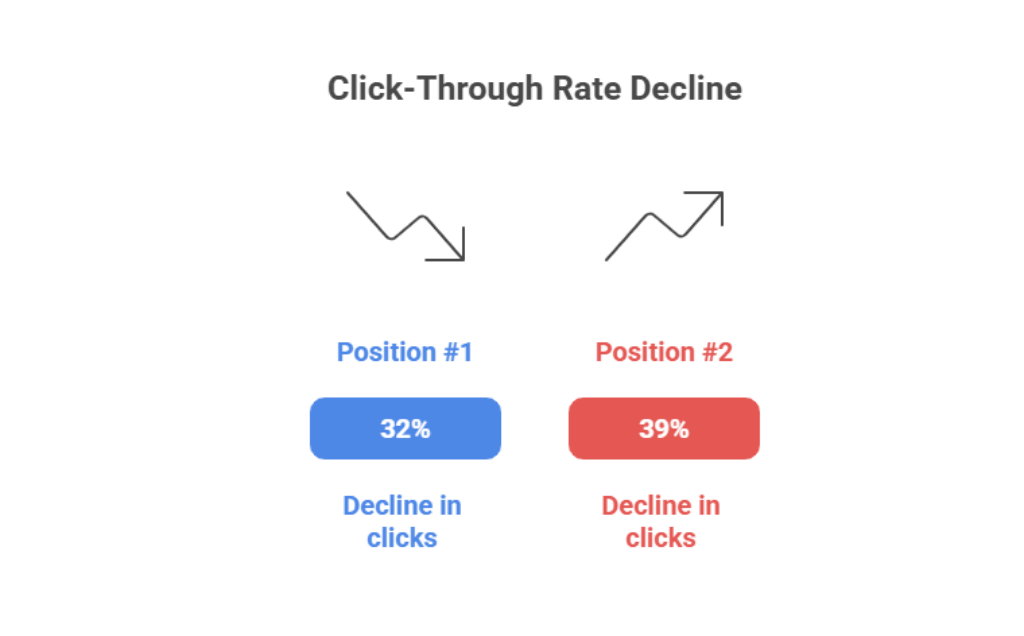
The fear that SEOs and content creators had from the beginning is no longer a theory. New data from studies indicate that it’s worse than many feared. What the numbers confirm is alarming: creators are being cut out of the search economy they helped build.
According to the latest GrowthSRC study:
- Position #1 CTR has dropped from 28% to just 19% – that’s a 32% decline in clicks, even if you’re still ranking at the top.
- Position #2 is faring even worse, with a 39% drop in click-through rates.
- This confirms what we’re seeing across industries: the traditional “10 blue links” model is collapsing under the weight of AI-generated answers.
Here are some real-world case studies from the frontline. Charleston Crafted, a well-established blog in the home improvement niche:
- Lost 70% of their website traffic in a single month.
- This resulted in a 65% drop in ad revenue, a catastrophic loss for a small content-driven business.
They’re not alone. MailOnline, one of the world’s largest publishers, now reports:
- Less than 5% CTR on desktop
- Just 7% CTR on mobile …when AI Overviews are triggered.
That means 93–95% of their potential readers never click through – despite their content likely being used to generate the AI answer.
We saw this coming, which is why I wrote my previous take on this issue. As I mentioned in that article, this is the first time I’m speaking out against Google. I’ve always supported its algorithm updates, considering them as some unnecessary evil needed to ensure sanity in the industry. But this is different.
What is happening is a clear indication that Google, not wanting to lose its multi-billion-dollar ad revenue ($66.89 billion in Q1 2025) in the rush to stay competitive in the AI search revolution, is ready to sacrifice the very creators fueling its AI system.
The initial industry estimates of a 25% cut in website visits and $2 billion in annual ad revenue losses for creators now look conservative. But while publishers bleed, Google is pushing ads into its AI-generated answers, thereby not only “stealing” publishers’ audience but also their ad revenue, so it could maintain its huge billions in ad revenue.
The result? A widening gap between Google’s bottom line and the financial survival of the very creators fueling its AI system. This is not fair.
Google’s ‘Revenue-First’ Response Is Hypocrisy
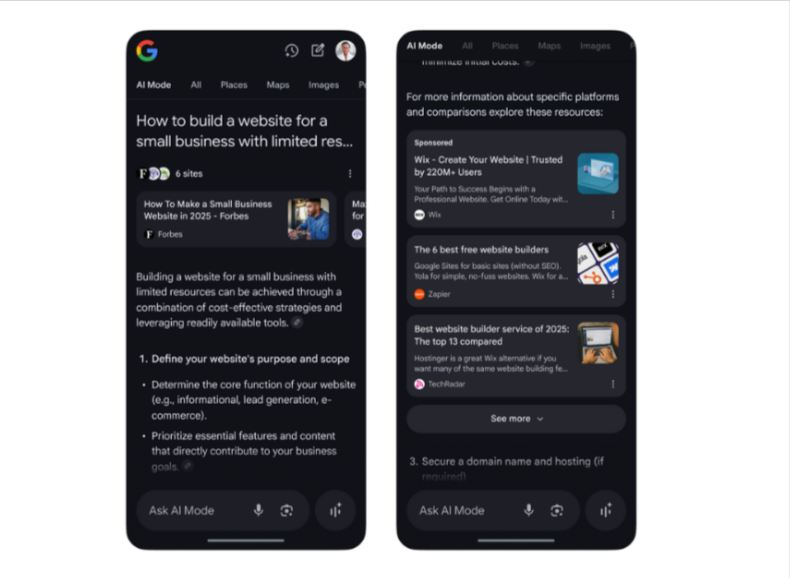
The timing tells you everything about Google's priorities. As I’ve mentioned, implementing ads in AI Mode is a clear indication that Google was well aware of the “sawing off the branch it was sitting on” analogy all along. However, its move to double down on monetization without first pausing to address the ecosystem damage they were causing shows their insensitivity to the plight of content creators who are watching their traffic collapse.
From what we have seen so far, it’s clear that Google planned for this. New ad placements have been announced, solidifying their revenue-first approach. Beyond testing ads in AI responses, they're also systematically embedding them across every AI-powered search experience:
- AI Overviews get monetized on both desktop and mobile. Your carefully crafted content gets summarized by Google's AI, which then displays ads right alongside the summary that replaced your traffic.
- AI Mode now features embedded ads within conversational responses. When users have back-and-forth conversations with Google's AI, advertisements appear naturally woven into the dialogue – almost like recommendations from the AI itself.
- Performance Max and Shopping campaigns automatically appear in AI responses. If you're already running these Google ad types, your ads might show up in AI Mode without you even changing settings. It's broad reach with less control.
So, this is not just about evolving search; it's hypocrisy at the heart of Google's strategy. This is exactly what I referred to as a digital “Tragedy of the Commons” in my earlier article. It’s not a secret that Google built its empire on the open web – a commons powered by independent creators, bloggers, and publishers – but now, in the race to dominate AI search, it’s exploiting that very ecosystem without offering anything back. And the damage is piling up fast.
Here’s the hypocrisy:
- First, Google scrapes your content to train Gemini and generate AI Overviews – without permission, and without pay.
- Then, it replaces your site in the search results with a summarized AI answer – cutting off your traffic.
- Now, it embeds ads inside those AI responses – profiting from the very information it took from you.
At no stage in this process do creators get a slice of the revenue. No licensing fees. No traffic guarantees. No visibility boost.
Google gets the clicks. Google keeps the users. Google cashes in.
This is a classic case of double extraction: creators are squeezed from both ends, while the platform scales profit off their unpaid labor. Google is literally killing the golden goose while demanding it keep laying eggs.
This isn't just unfair – it's economically unsustainable. Google's short-term profit maximization is destroying the long-term viability of the content ecosystem that makes their search engine valuable.
The question isn't whether this model is profitable for Google today. The question is whether there will be any quality content left to power their AI tomorrow.
As SEO veteran Barry Adams put it:
“It gives you less reason to create content… because there is no more traffic, Google is keeping it.”
And, The Washington Post notes, “web publishers rely on traffic from Google to stay afloat”, so cutting off referrals risks starving the content creators.
That’s the death spiral in motion.
By prioritizing monetization over sustainability, Google risks breaking the web-wide trust that made its search engine so effective. Without change, this isn’t just a crisis for content creators – it’s a slow implosion for the web itself.
A Call for Fair Play – Concrete Solutions Google Should Consider
Now that Google is actively monetizing AI Mode and AI Overviews, it’s time for content creators to demand something simple: fairness.
If Google is going to embed ads inside AI-generated responses, and those responses are built using our work, then the people powering the system – us – deserve a share of the value we’re helping to create.
I’ve said it before in my earlier article, but it’s worth repeating. For us, here’s what fair play looks like in this new AI-driven search landscape:
1. Revenue Sharing for AI-Cited Content
If your content is quoted, summarized, or used as a data source in AI Overviews, and Google earns ad revenue from that interaction, you should receive a cut of that revenue – just like YouTube creators do when ads run on their videos.
The infrastructure already exists. Google knows how to track content use and share earnings. They just need to apply the same model to search.
2. Traffic Guarantees for Cited Sources
AI Overviews should guarantee a minimum click-through rate (CTR) for any source cited. If Google’s AI answers steal the attention, there needs to be a policy ensuring traffic isn’t reduced to zero. Otherwise, there’s no incentive to keep creating.
3. Stronger Attribution with Clear “Read More” Buttons
Burying a hyperlink in gray text isn’t attribution – it’s obfuscation. Google should include bold, clear “Read More” buttons with every AI Overview to drive users back to the original source. This restores visibility and respects the creator’s role.
And let’s not forget: Google already does this with YouTube. The Partner Program proves they can profit and support creators. It’s not about what’s possible. It’s about priorities.
Fairness isn’t a feature. It’s a responsibility.
The Fairness Argument – Why Google Should Act Now
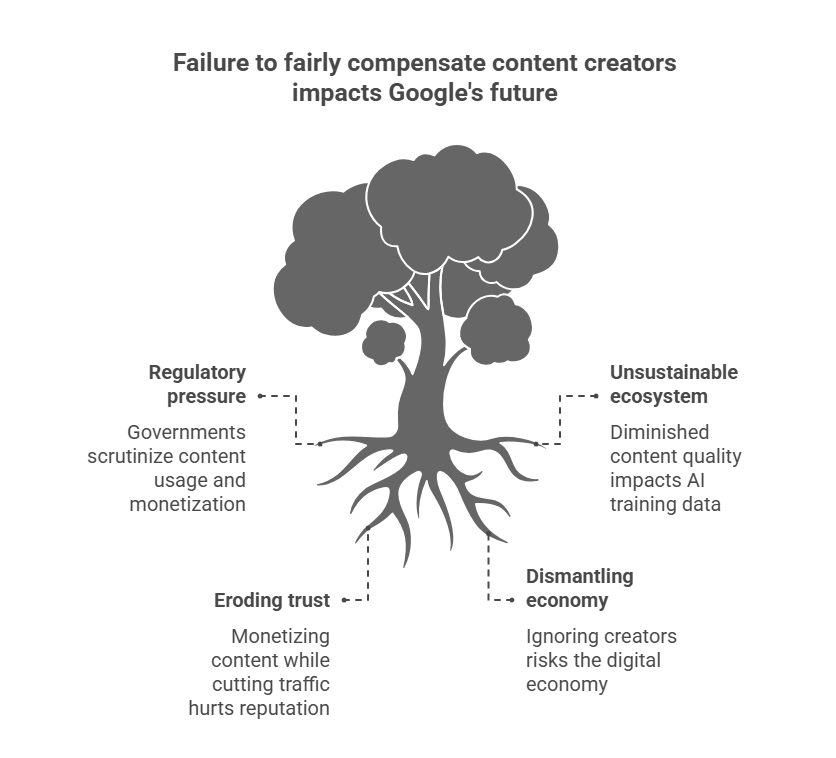
The call for Google to act isn't just an emotional plea from struggling creators; it's rooted in clear legal, ethical, and business imperatives. There are compelling reasons why Google should address the issues surrounding ads in AI Mode and AI Overviews right now, before the situation escalates further.
From a legal and ethical standpoint, regulatory pressure is already building. I've previously mentioned the EU complaint, and this is just the beginning. Governments and regulatory bodies globally are increasingly scrutinizing how tech giants utilize content and monetize AI. The perception of Google as a “content parasite” taking without giving back is not just bad for public relations; it could lead to significant legal challenges and fines down the line. The current model, where Google profits from ads in AI Overviews while creators get nothing for the content that powers those overviews, is a recipe for regulatory intervention.
There's also a strong business case for Google to foster a sustainable creator ecosystem. A healthy, thriving open web with diverse and high-quality content directly translates to better AI training data. If creators reduce content quality or quantity due to a lack of compensation, Google's Gemini AI models will have less valuable, up-to-date information to learn from. This directly impacts the quality of Google's AI search results and, ultimately, its competitive advantage against rivals like Microsoft Copilot and Perplexity. A sustainable creator ecosystem doesn't just benefit us; it ensures Google's AI remains cutting-edge and relevant.
Furthermore, Google's public relations are at stake. The company built its legacy on the informal motto “Don't be evil.” Yet, the current perception among content creators is that Google is doing exactly the opposite by monetizing their work while cutting off their traffic. This erosion of trust can have long-term consequences for user perception and brand loyalty. The creator community, regulators, and users are increasingly demanding fair play.
Finally, the creator economy matters. Millions of livelihoods depend on the open web ecosystem, from independent bloggers and affiliate marketers to news organizations and small businesses. Their ability to generate revenue from their content fuels innovation, provides diverse perspectives, and enriches the internet for everyone. Ignoring their plight isn't just unethical; it risks dismantling a vital part of the digital economy that Google itself benefits from.
Fairness isn’t optional. It’s the only way forward.
Conclusion: The Moment of Truth
This moment marks a defining crossroads for Google. Will they choose to build a sustainable ecosystem, one that fairly compensates the creators who fuel their AI, or will they continue down the path of short-term profit extraction through ads in AI Mode and AI Overviews, ultimately cannibalizing the very content they rely on?
For independent content creators, affiliate marketers, and online publishers, this isn't just about adapting to a new algorithm; it's about the viability of our businesses and livelihoods. The “zero-click” search phenomenon and the integration of sponsored content directly into AI answers mean that simply ranking #1 isn't enough anymore. Our work is being summarized, monetized by Google, and we're left with dwindling traffic and revenue.
Therefore, the call to action is urgent: the creator community, regulators, and users must demand fair play. We need Google to recognize the symbiotic relationship it has with content creators and implement solutions like revenue sharing for AI-cited content and traffic guarantees. The precedent exists, as seen with the YouTube Partner Program.
We believe Google can win the AI race and revolutionize search while simultaneously preserving the open web. It doesn't have to be a zero-sum game. But this can only happen if they choose fairness over greed, prioritizing a collaborative, sustainable ecosystem where creators are compensated for their invaluable contributions. The future of the open web, and indeed, Google's long-term success, depends on it.
Because without creators, there is no AI worth monetizing.